

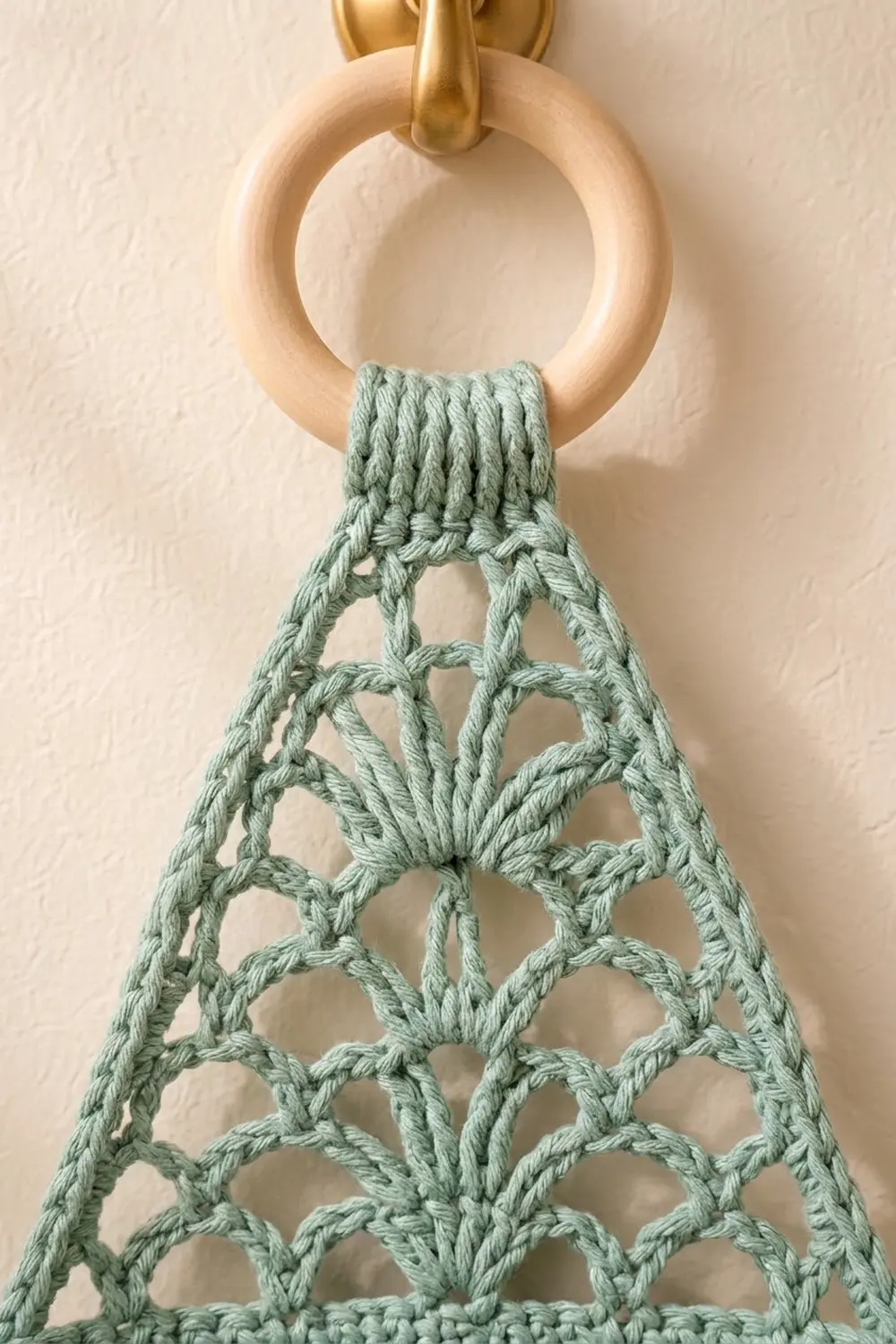
This hanging toilet paper holder combines a long lace backing panel with three rounded pockets, each holding one standard roll. The panel narrows at the top into a solid strap that wraps around a wooden ring, so the holder hangs neatly from a towel hook or wall knob.
The design uses one soft sage green cotton. The backing panel is an open chain-arch mesh framed by a solid single crochet border. Each pocket has a solid round base, a ridged turning edge, a band of leaf-shaped fans, and a firm rim.
The pattern uses US crochet terms. The finished holder measures 7.25 in (18.4 cm) wide and 24 in (61.0 cm) long, measured from the bottom of the ring. Each pocket is 5.5 in (14.0 cm) across and 4 in (10.2 cm) tall.
You make the panel from the top down (strap first, then the mesh) and add the border. Next, you crochet three pockets in the round and sew them to the front of the panel.
Finished Size and Construction
- Finished size: 7.25 in (18.4 cm) x 24 in (61.0 cm) hanging length
- Skill level: Intermediate
- Terminology: US crochet terms
- Yarn weight: Worsted (#4) cotton
- Hook: 5.0 mm (H-8)
- Number of pieces: 4 (1 backing panel + 3 pockets)
- Layout: 3 pockets stacked down the center of the panel, 1 in (2.5 cm) apart
- Pocket size: 5.5 in (14.0 cm) diameter x 4 in (10.2 cm) tall
- Panel size before border: 6.25 in (15.9 cm) x 24.5 in (62.2 cm), including the strap
- Border depth: 0.5 in (1.3 cm), 2 rounds of sc
Materials
Choose a smooth worsted weight cotton or cotton blend. Cotton holds the pocket shape and handles bathroom humidity well. Avoid splitty yarns, because the fans need clear stitch tops.
- Sage green: about 270 g / 415 m
Each pocket uses about 55 g / 85 m, and the bordered panel uses about 60 g / 92 m. The total includes a margin of about 15% for swatching and tension differences.
Tools:
- 5.0 mm (H-8) crochet hook
- Wooden ring, 2.75 in (7.0 cm) diameter
- Tapestry needle
- 6 locking stitch markers
- Rustproof pins and a blocking mat
- Measuring tape and spray bottle
Abbreviations (US Terms)
- ch – chain
- sl st – slip stitch
- sc – single crochet
- dc – double crochet
- sk – skip
- st(s) – stitch(es)
- BLO – back loop only
- RS / WS – right side / wrong side
Special stitches:
- Arch: a ch-5 loop with a sc at each end.
- Shell: 5 dc in the same st.
- Fan: 9 dc in the same ch-5 arch.
Gauge and Checkpoints
Solid gauge: 14 sc x 16 rows = 4 in (10.2 cm).
Mesh gauge: 6 arches = 6.25 in (15.9 cm) wide, and 8 mesh rows = 4 in (10.2 cm) tall.
Make one pocket first. It works as your swatch and shows you whether the roll fits.
Checkpoints:
- Pocket base after Rnd 10: 5.5 in (14.0 cm) across
- Finished pocket: 4 in (10.2 cm) tall
- Strap after Row 12: 2 in (5.1 cm) wide x 3 in (7.6 cm) long
- Panel after Mesh Row 9: 6.25 in (15.9 cm) wide
- Panel before border: 24.5 in (62.2 cm) long
If your base is larger than 5.5 in (14.0 cm), go down a hook size. If it is smaller than 5.25 in (13.3 cm), go up a hook size so the roll still fits. If your mesh arches come out too wide, tighten your chains instead of changing hooks, because the strap and border depend on your sc gauge.
Pocket (Make 3)
Work in joined rounds with the RS facing. The beginning ch 1 does not count as a stitch.
Base
Rnd 1: Magic ring, ch 1, 6 sc in ring, sl st to first sc. (6 sts)
Rnd 2: Ch 1, 2 sc in each st around, sl st to first sc. (12 sts)
Rnd 3: Ch 1, sc in next st, 2 sc in next st around, sl st to first sc. (18 sts)
Rnd 4: Ch 1, sc in next 2 sts, 2 sc in next st around, sl st to first sc. (24 sts)
Rnds 5–10: Keep increasing 6 sts evenly in each round, with 1 more sc between increases each time. Rnd 5 has 30 sts, Rnd 6 has 36, Rnd 7 has 42, Rnd 8 has 48, Rnd 9 has 54, and Rnd 10 has 60 sts. Stagger the increases so the circle stays round.
Checkpoint: the base lies flat and measures 5.5 in (14.0 cm) across.
Solid Lower Wall
Rnd 11 (turning ridge): Ch 1, sc BLO in each st around, sl st to first sc. (60 sts) The unworked front loops form a ridge, and the wall starts to rise.
Rnds 12–15: Ch 1, sc in each st around, sl st to first sc. (60 sts)
The lower wall is now about 1.25 in (3.2 cm) tall.
Fan Lace Band
Rnd 16 (shells): Ch 1, sc in first st, sk 2 sts, shell in next st, sk 2 sts, sc in next st 9 times, sk 2 sts, shell in next st, sk 2 sts, sl st to first sc. (10 shells + 10 sc = 60 sts)
Each repeat uses 6 sts, and 10 x 6 = 60, so the round closes evenly.
Rnd 17 (arches): Sl st in next 3 dc to reach the center dc of the first shell. Ch 1, sc in same st, ch 5, sc in center dc of next shell 9 times, ch 2, dc in first sc. The ch 2 and dc form the tenth arch. (10 arches)
Rnd 18 (fans): Ch 1, sc in the arch just formed, fan in next arch, sc in next arch 4 times, fan in next arch, sl st to first sc. (5 fans of 9 dc + 5 sc = 50 sts)
The fans fill every other arch and flare upward into leaf shapes. The sc between them pull the open arches into the fan outlines.
Rnd 19 (conversion): Ch 1, 2 sc in next sc, sc in next 4 dc, 2 sc in next dc, sc in next 4 dc 5 times, sl st to first sc. (50 sts worked 1 per st + 10 extra = 60 sts)
Rim
Rnds 20–22: Ch 1, sc in each st around, sl st to first sc. (60 sts)
Fasten off and leave a 30 in (76.2 cm) tail for sewing.
Checkpoint: the pocket is 4 in (10.2 cm) tall and 5.5 in (14.0 cm) across. A roll should slide in with light resistance and stand about 0.75 in (1.9 cm) above the rim.
Backing Panel
Work in turned rows from the top down.
Strap
Ch 8.
Row 1: Sc in 2nd ch from hook and in each ch across. (7 sts)
Rows 2–12: Ch 1, turn, sc in each st across. (7 sts)
Checkpoint: 2 in (5.1 cm) x 3 in (7.6 cm).
Arch Mesh
The mesh alternates two row types. A rows (odd-numbered) begin and end with a sc at the edge. B rows (even-numbered) begin and end with a half-arch, which offsets the arches.
Row 1 (A): Ch 1, turn, sc in first st, ch 5, sk 2 sts, sc in next st twice. (2 arches)
Row 2 (B): Ch 5 (counts as dc + ch 2), turn, sc in first arch, ch 5, sc in next arch across, ch 2, dc in last sc. A B row worked over n arches has n – 1 full arches plus 2 half-arches.
Row 3 (A): Ch 1, turn, sc in first dc, ch 5, sc in next full arch across, ch 5, sc in 3rd ch of turning ch-5. (2 arches)
Row 4: Repeat Row 2.
Row 5 (A-increase): Ch 1, turn, (sc, ch 5, sc) in first dc, ch 5, sc in next full arch across, ch 5, (sc, ch 5, sc) in 3rd ch of turning ch-5. (4 arches)
Rows 6–8: Work Row 2, Row 3, then Row 2 again. (4 arches)
Row 9: Repeat Row 5. (6 arches) Checkpoint: 6.25 in (15.9 cm) wide.
Rows 10–40: Alternate Row 2 (even rows) and Row 3 (odd rows), ending with Row 2. (6 arches)
Row 41 (A-decrease): Ch 1, turn, sc in first full arch (skipping the dc and the half-arch), ch 5, sc in next full arch across. Leave the last half-arch unworked. (4 arches)
Row 42: Repeat Row 2. (4 arches)
Row 43: Repeat Row 41. (2 arches)
Do not fasten off. The mesh measures 21.5 in (54.6 cm), so the panel is 24.5 in (62.2 cm) including the strap. The decrease rows round the bottom into a U shape.
Make All Pieces
- Sage green: 1 backing panel + 3 pockets
Layout on the front of the panel:
[ strap + ring          ]
[ taper, Rows 1–9       ]
[ gap, Rows 10–11       ]
[ POCKET 1, Rows 12–19  ]
[ gap, Rows 20–21       ]
[ POCKET 2, Rows 22–29  ]
[ gap, Rows 30–31       ]
[ POCKET 3, Rows 32–39  ]
[ bottom, Rows 40–43    ]
Each pocket covers 8 mesh rows, or 4 in (10.2 cm), with 2 rows (1 in / 2.5 cm) between pockets.
Border
Add the border before joining so the pockets sit on a stable panel.
Border gauge: 3 sc per 2 mesh rows, or 1 in (2.5 cm), along the sides. That is slightly firmer than the 3.5 sc per inch of the solid gauge, which keeps the edge from rippling.
Rnd 1: Ch 1, turn.
- Bottom edge: 5 sc in each of the 2 arches of Row 43. (10 sc)
- First side: Along the mesh, work 1 sc in each A-row end and 2 sc around each B-row end post (22 x 1 + 21 x 2 = 64 sc). Then work 1 sc in each of the 12 strap row ends. (76 sc)
- Top edge: On the foundation chain, work 3 sc in first ch, sc in next 5 chs, 3 sc in last ch. (11 sc)
- Second side: 12 strap sc + 64 mesh sc. (76 sc)
- Sl st to first sc.
Total: 10 + 76 + 11 + 76 = 173 sts. The 3-sc corner groups are counted only in the 11-st top edge, never in the side counts.
Rnd 2: Ch 1, sc in each st around. Work 3 sc in the center sc of each top corner group, and 2 sc in the first and last sc of the bottom edge. Sl st to first sc. (173 sts worked 1 per st + 6 extra = 179 sts)
Fasten off and weave in the ends.
Why the math works: each sc round adds 0.25 in (0.6 cm) to every edge. The 2 rounds therefore widen the panel from 6.25 in (15.9 cm) to 7.25 in (18.4 cm) and lengthen it from 24.5 in (62.2 cm) to 25.5 in (64.8 cm). The 6 extra stitches sit only on the outer curves, where the edge needs more length.
Joining
On each pocket, place markers 4 sts on each side of the round join. This marks an 8-st strip, about 2.3 in (5.8 cm) wide, for the back of the pocket. The strip lies flat against the panel, centered over the middle 2 arches (arches 3 and 4).
Pin Pocket 1 with its rim at Row 12 and its base edge at Row 19. With the long tail, whipstitch down the left edge of the strip. Catch each pocket round (Rnds 11–22, 12 rounds) to the panel. The 12 rounds spread over 8 panel rows, so work about 3 rounds for every 2 rows.
Sew the right edge of the strip the same way. Then stitch the 8 rim sts one-to-one into the Row 12 arch sc, and tack the Rnd 11 ridge to Row 19.
Keep your tension even, so the seam closes without puckering the mesh. If the arches bunch up, loosen the seam and re-pin.
Repeat for Pocket 2 (Rows 22–29) and Pocket 3 (Rows 32–39).
Checkpoint: the gaps measure 1 in (2.5 cm), and the panel lies flat at 7.25 in (18.4 cm) wide.
Pass the strap through the ring from front to back. Fold 1.5 in (3.8 cm) to the WS and whipstitch it down. The hanging length is now 24 in (61.0 cm).
Final Blocking
- Take the holder off the ring hook and remove any rolls.
- Mist the holder until it is damp but not soaked.
- Pin the panel to 7.25 in (18.4 cm) wide, opening each arch evenly.
- Fill each pocket with a rolled towel to shape it.
- Ease the fans open so each one spreads like a leaf.
- Let it dry fully, about 24 hours, before unpinning.
Final Quality-Control Checklist
- Each pocket has 60 sts in Rnds 11–15 and 19–22.
- Each pocket has 5 fans, with 3 visible from the front.
- The panel has 6 arches across the straight section.
- Border Rnd 2 totals 179 sts.
- The pockets are centered and level, with 1 in (2.5 cm) gaps.
- The strap is sewn securely.
- All ends are woven in at least 2 in (5.1 cm).
Troubleshooting
Base ruffles: you have too many increases. Recount against the multiples of 6.
Base cups early: your tension is too tight. Go up a hook size for Rnds 1–10.
Fans lean sideways: Rnd 17 missed the center dc. Frog back and recount.
Roll won’t fit: the base is under 5.25 in (13.3 cm). Remake it with a larger hook.
Panel edges wave: the border has too many sc. Recheck the 1-and-2 pattern on the row ends.
Panel narrows: a B row is missing a half-arch. Each B row starts with ch 5 and ends with ch 2, dc.
Pocket sags: add a second seam line 1 st outside the strip.
Care
Hand wash in cool water, press out the water in a towel, and dry flat with the pockets reshaped. Do not tumble dry.

Final Notes
Each measurement builds on the one before. A 60-st base gives a 5.5 in (14.0 cm) pocket, and 12 wall rounds bring it to 4 in (10.2 cm) tall. Six arches make a 6.25 in (15.9 cm) panel, and the 2-round border brings it to 7.25 in (18.4 cm). Three 8-row pocket zones with 2-row gaps fill the straight mesh. The folded strap finishes the holder at 24 in (61.0 cm). If every checkpoint matches, the finished holder will too.
Happy crocheting!