

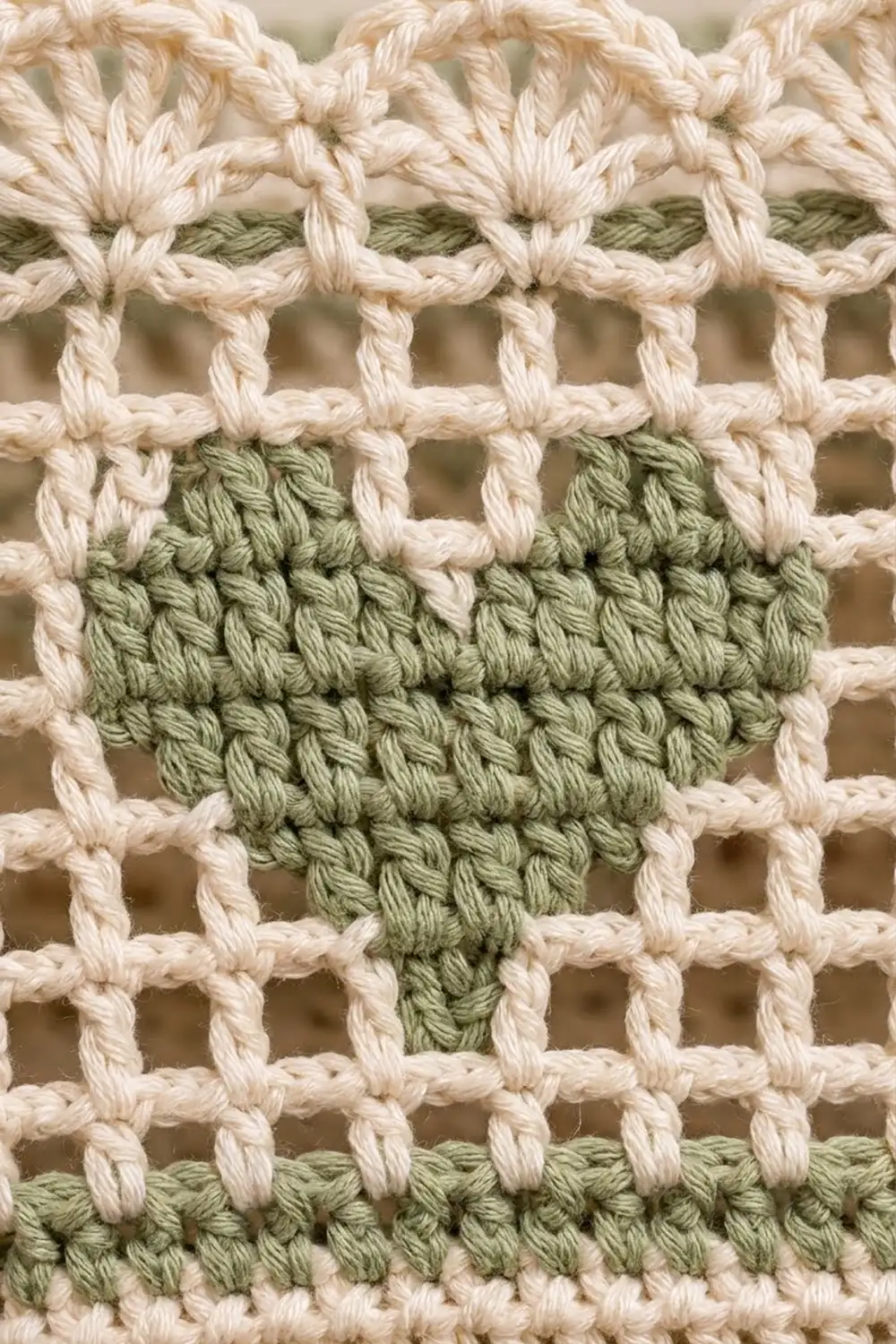
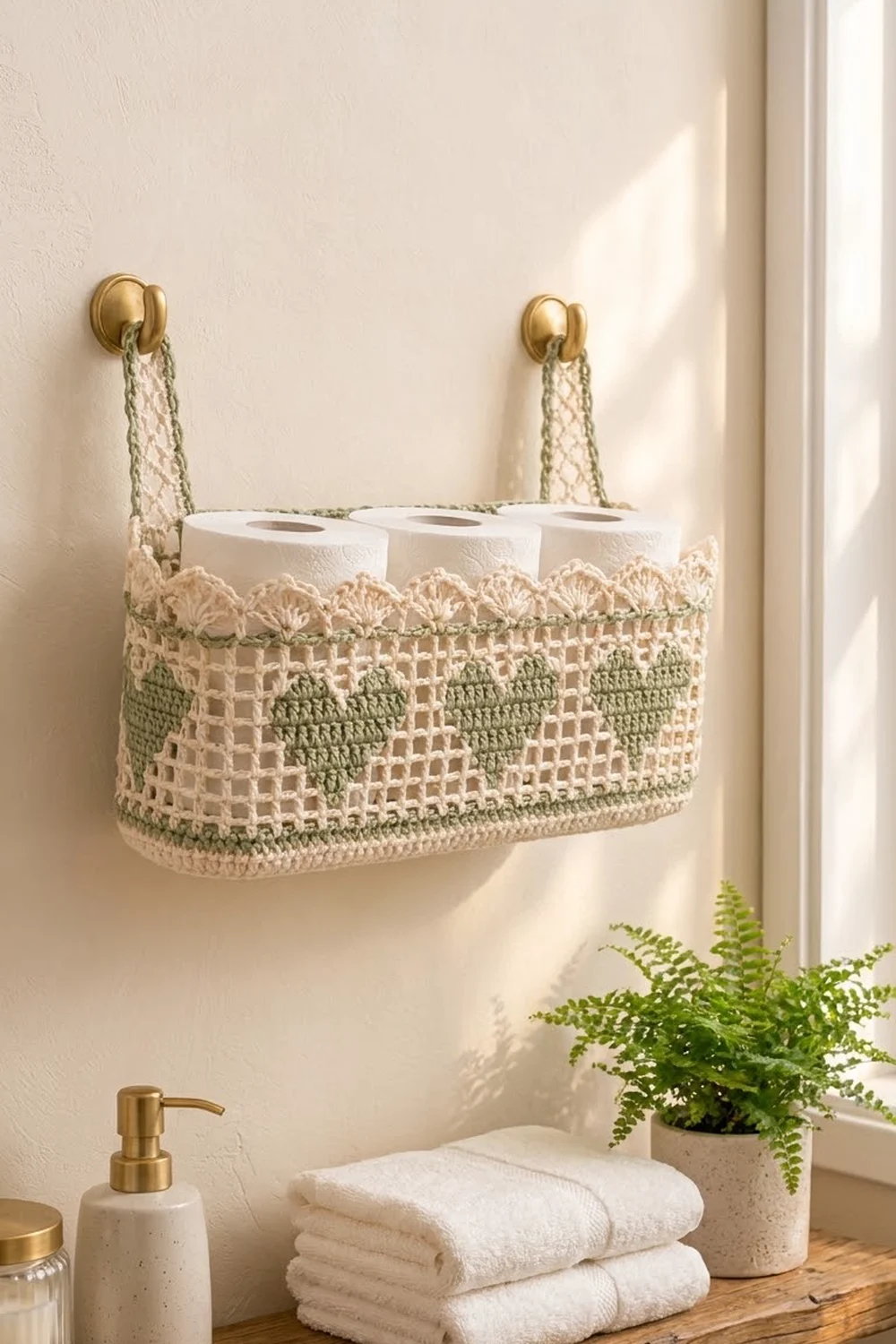
This hanging basket holds three standard toilet paper rolls and is easy to look at. It has a firm cream oval base, open filet mesh walls and three solid sage hearts across the front. A soft scalloped shell edge finishes the rim.
The palette is two colors: warm cream for the base, mesh, shells and straps, and muted sage green for the hearts, the accent stripes and the strap edging. It looks like farmhouse filet work but stays practical. The single crochet base keeps its shape, and the mesh lets air reach the rolls.
The pattern uses US crochet terms. The finished basket measures about 14 in (35.6 cm) long, 4.5 in (11.4 cm) deep and 4.6 in (11.7 cm) tall. Each strap adds about 6 in (15.2 cm), plus a hanging loop.
Construction: work the oval base in joined single crochet rounds. Turn up the walls with a back-loop round, then add single crochet bands and 8 turned rounds of filet mesh with the hearts worked in. Finish with a sage round, cream shells in the front loops, and two straps worked in the free back loops.
Finished Size and Construction
- Finished size: 14 in (35.6 cm) long × 4.5 in (11.4 cm) deep × 4.6 in (11.7 cm) tall
- Skill level: Intermediate
- Terminology: US
- Yarn weight: Worsted (#4) cotton
- Hook: 4.0 mm (G-6)
- Number of pieces: 1 (the straps are worked onto the basket)
- Layout: Oval basket with a 3-heart filet panel on the front and 2 straps on the back
- Base size: 14 in × 4.5 in (35.6 cm × 11.4 cm), 132 stitches around
- Height before the shell border: about 4.1 in (10.4 cm)
- Border depth: about 0.5 in (1.3 cm)
Materials
Use a smooth, firm, 100% cotton or cotton-blend worsted yarn of about 170 m per 100 g. Cotton holds its shape and copes with bathroom humidity. Avoid fuzzy or very stretchy yarns, because they blur the mesh.
- Cream: 100 g, about 170 m (185.9 yd)
- Sage green: 50 g, about 85 m (93.0 yd)
Tools:
– 4.0 mm (G-6) crochet hook
– 6 locking stitch markers
– Tapestry needle
– Scissors
– Measuring tape
– Spray bottle and a small box or rolled towel for blocking
– Two wall hooks for hanging
These quantities include a margin of roughly 30–40% for swatching and weaving in ends.
Abbreviations (US Terms)
- ch – chain
- sl st – slip stitch
- sc – single crochet
- dc – double crochet
- BLO / FLO – back loop only / front loop only
- st(s) – stitch(es)
- sp – space
- sk – skip
- rep – repeat
- RS / WS – right side / wrong side
Special stitches and terms:
- Open square: dc, ch 1. The next dc closes the square.
- Block (filled square): dc, then dc in the ch-1 space below. The next dc closes the block.
- Shell: 5 dc in the same stitch.
- Standing dc: start with a slip knot already on the hook, then work a dc as normal.
Gauge and Checkpoints
- Single crochet: 16 sts and 18 rows = 4 in (10.2 cm)
- Filet mesh: 8 squares (16 sts) and 10 rows = 4 in (10.2 cm)
Make a small mesh swatch before you start. Then treat the base as your test piece: the whole pattern depends on 132 stitches measuring 33 in (83.8 cm) around.
Checkpoints:
– After base Round 1, the straight edge measures about 9.5 in (24.1 cm).
– After base Round 5, the oval measures about 11.75 in × 2.25 in (29.8 cm × 5.7 cm).
– After base Round 10, the oval measures 14 in × 4.5 in (35.6 cm × 11.4 cm).
– After Mesh Round 8, the wall measures about 3.9 in (9.9 cm) from the base fold.
– After the shell border, the basket stands about 4.6 in (11.7 cm) tall.
If your piece is too big, go down half a hook size. If it’s too small, go up half a size. Change hooks rather than stitch counts: the heart panel and shell repeats depend on exactly 132 stitches.
Base
With cream, ch 39.
Round 1: 3 sc in 2nd ch from hook. Sc in each of next 36 ch, then 3 sc in last ch. Working along the opposite side of the chain, sc in each of next 36 ch. Join with sl st to first sc. (78 sts)
The round has two 3-stitch end groups and two 36-stitch sides. The round starts at the first stitch of an end group.
Rounds 2–10: Ch 1. Around the first end group, work (sc in next n−2 sts, 2 sc in next st) 3 times, where n is the round number. Sc in next 36 sts. Work the second end group the same way. Sc in next 36 sts. Join.
On Round 2, n−2 is 0, so you work 2 sc in each of the 3 end stitches. Each end group grows by 3 stitches per round, so each round’s total is 72 + 6n:
- Round 2: 84 sts
- Round 3: 90 sts
- Round 4: 96 sts
- Round 5: 102 sts
- Round 6: 108 sts
- Round 7: 114 sts
- Round 8: 120 sts
- Round 9: 126 sts
- Round 10: 132 sts (work this round in sage)
Change to sage on the final sl st of Round 9. On Round 10 each end group has 30 stitches and each side still has 36: 30 + 36 + 30 + 36 = 132.
If the curved ends start to point, shift where you place the increases within each end group from round to round.
Walls
Wall Round 1: Join cream with the final sl st of Round 10. Ch 1, sc in BLO of each st around. Join. (132 sts) This round makes a crisp fold line, so the walls stand up.
Wall Round 2: Ch 1, sc in each st around. Join, changing to sage. (132 sts)
Wall Round 3: With sage, ch 1, sc in each st around. Join, changing to cream. (132 sts)
Checkpoint: the wall is about 0.7 in (1.8 cm) tall.
Filet Mesh
The mesh rounds are joined and then turned. That way each sage heart bobbin waits where the next round needs it.
Mesh Round 1 (RS): Sl st in next st. Ch 4 (counts as dc and ch 1), sk next st. Dc in next st, ch 1, sk next st; rep from * around. Join with sl st to 3rd ch of beginning ch-4. Turn. (66 dc + 66 ch-1 sps = 132 sts; 66 squares)*
On this round, count the ch-1 spaces from the beginning. Place a marker in space 12 and in space 36. These two spaces and everything between them form the heart panel: 25 squares centered on the front straight side. Move the markers up each round.
Mesh Rounds 2–8: Ch 4, dc in next dc, ch 1; rep from * around. Join to 3rd ch of beginning ch-4 and turn. Work open squares everywhere except the heart panel, which you work as listed below. Every round stays at 132 sts*, because a block only replaces a ch-1 with a dc.
The heart panel is: Heart, 2 open squares, Heart, 2 open squares, Heart. Each heart is 7 squares wide. Work each heart line as follows:
| Round | Each heart (7 squares) |
|---|---|
| 2 | 3 open, 1 block, 3 open |
| 3 | 2 open, 3 blocks, 2 open |
| 4 | 1 open, 5 blocks, 1 open |
| 5 | 7 blocks |
| 6 | 7 blocks |
| 7 | 1 open, 2 blocks, 1 open, 2 blocks, 1 open |
| 8 | 7 open (plain mesh) |
Each heart uses 27 blocks. Each line is symmetrical, so the instructions read the same on RS and WS rounds.
Color handling:
- Use one small sage bobbin of about 4 m (4.4 yd) for each heart.
- Work the dc just before a run of blocks in sage, work the blocks in sage, and work the closing dc in sage too. A run of k blocks therefore uses 2k + 1 sage dc. This gives the heart a sage outline on both sides.
- Carry cream inside the sage stitches across the run, then pick cream up again.
- On Round 7, keep sage for the single ch-1 between the two lobes.
- When the next run starts one square to the side, carry sage inside the cream dc just below it to reach that spot.
- After Round 7, fasten off the sage bobbins.
Checkpoint: each heart measures 3.5 in (8.9 cm) wide and 2.4 in (6.1 cm) tall.
Top Border and Straps
Border gauge: each shell repeat uses 6 stitches and is 1.5 in (3.8 cm) wide.
Sage Round (RS): After joining Mesh Round 8, change to sage and turn so the RS faces you. Ch 1, sc in same st as join. Sc in next ch-1 sp, sc in next dc; rep from * around, ending with sc in last ch-1 sp. Join. Fasten off. (66 + 66 = 132 sc)*
Number these stitches 1–132 from the join.
- Front straight section: sts 30–65 (36 sts)
- Back straight section: sts 96–131 (36 sts)
- Curved ends: sts 66–95 and sts 132 plus 1–29 (30 sts each)
Checkpoint: the basket is about 4.1 in (10.4 cm) tall.
Shell Round: Join cream in the FLO of st 30. Sc in FLO of next st, sk 2 sts, shell in FLO of next st, sk 2 sts; rep from * around (the first sc goes in st 30). Join to first sc. Fasten off. (22 shells and 22 sc)*
Per side:
– Front: 36 sts ÷ 6 = 6 shells
– Each end: 30 sts ÷ 6 = 5 shells
– Back: 36 sts ÷ 6 = 6 shells
Total: 6 + 5 + 6 + 5 = 22 shells.
Why the math works: 132 divides evenly by 6, and so does every section length (36 and 30). The shell round starts on the first stitch of the front, so every section begins and ends on a sc and the scallops line up at each corner.
Straps (make 2)
Straps are worked into the free back loops of the sage round, behind the shells. Strap A uses sts 90–94. Strap B uses sts 1–5. Their centers are 43 sts, or 10.75 in (27.3 cm), apart, and both sit symmetrically about the center of the back.
Row 1: With cream, work a standing dc in BLO of the first strap st. Ch 1, sk 1, dc in BLO of next st, ch 1, sk 1, dc in BLO of next st. (3 dc + 2 ch-1 sps = 5 sts; 2 squares)
Rows 2–15: Ch 4 (counts as dc and ch 1), turn. Dc in next dc, ch 1, dc in last st. On Row 2 the last st is the standing dc; after that it is the 3rd ch of the turning ch. (5 sts)
Checkpoint: the strap measures 6 in (15.2 cm).
Loop: At the end of Row 15, ch 10. Sl st in the 3rd ch of the beginning ch-4 of Row 15. Fasten off.
Edging: Join sage at the lower right corner of the strap. Work 2 sc in each dc row-end up the side (30 sc), 14 sc in the ch-10 loop, then 2 sc in each row-end down the other side (30 sc). Fasten off. (74 sc)
Final Blocking
- Weave in all ends along same-color stitches. Hide the sage tails inside the heart blocks.
- Spray the basket until it is evenly damp, not dripping.
- Fit a 14 in × 4.5 in (35.6 cm × 11.4 cm) box inside, or pack it firmly with a rolled towel.
- Square the mesh with your fingers so the columns stand straight.
- Pinch each shell into an even fan.
- Lay the straps flat and straight, and shape the loops into rounds.
- Let it dry completely, at least 24 hours. Use light spray starch if you want stiffer walls.
Final Quality-Control Checklist
- The base measures 14 in × 4.5 in (35.6 cm × 11.4 cm) and lies flat.
- The wall has 132 stitches on every round.
- All three hearts are centered on the front, with 2 open squares between them.
- Each heart has a clean point and two even lobes.
- There are 22 even shells, with 6 across the front.
- The straps are the same length, 6 in (15.2 cm), and the loops match.
- No cream strand shows through the hearts.
Troubleshooting
- The base cups: you need more increases or a larger hook on the base. Check the 72 + 6n counts.
- The base ruffles: the tension is too loose. Go down a hook size.
- Hearts drift off-center: recount the markers in spaces 12 and 36 on Mesh Round 1.
- The mesh slants: turn after every mesh round, without exception.
- Shells crowd at the corners: the sage round count is off. It must be exactly 132.
- Straps stretch: use firmer tension or add starch.
Care
Hand wash in cool water and reshape while damp. Lay flat over a box form to dry.
Final Notes
The measurement chain runs like this:
- A 38-stitch side, 9.5 in (24.1 cm), grows to a 132-stitch oval of 14 in × 4.5 in (35.6 cm × 11.4 cm).
- That oval supports 66 mesh squares and a 25-square heart panel.
- The 132-stitch sage round supports exactly 22 shells.
- The two straps, 6 in (15.2 cm) each, hang from the back.
If every checkpoint matches, the basket comes out true to size.
Happy crocheting!