

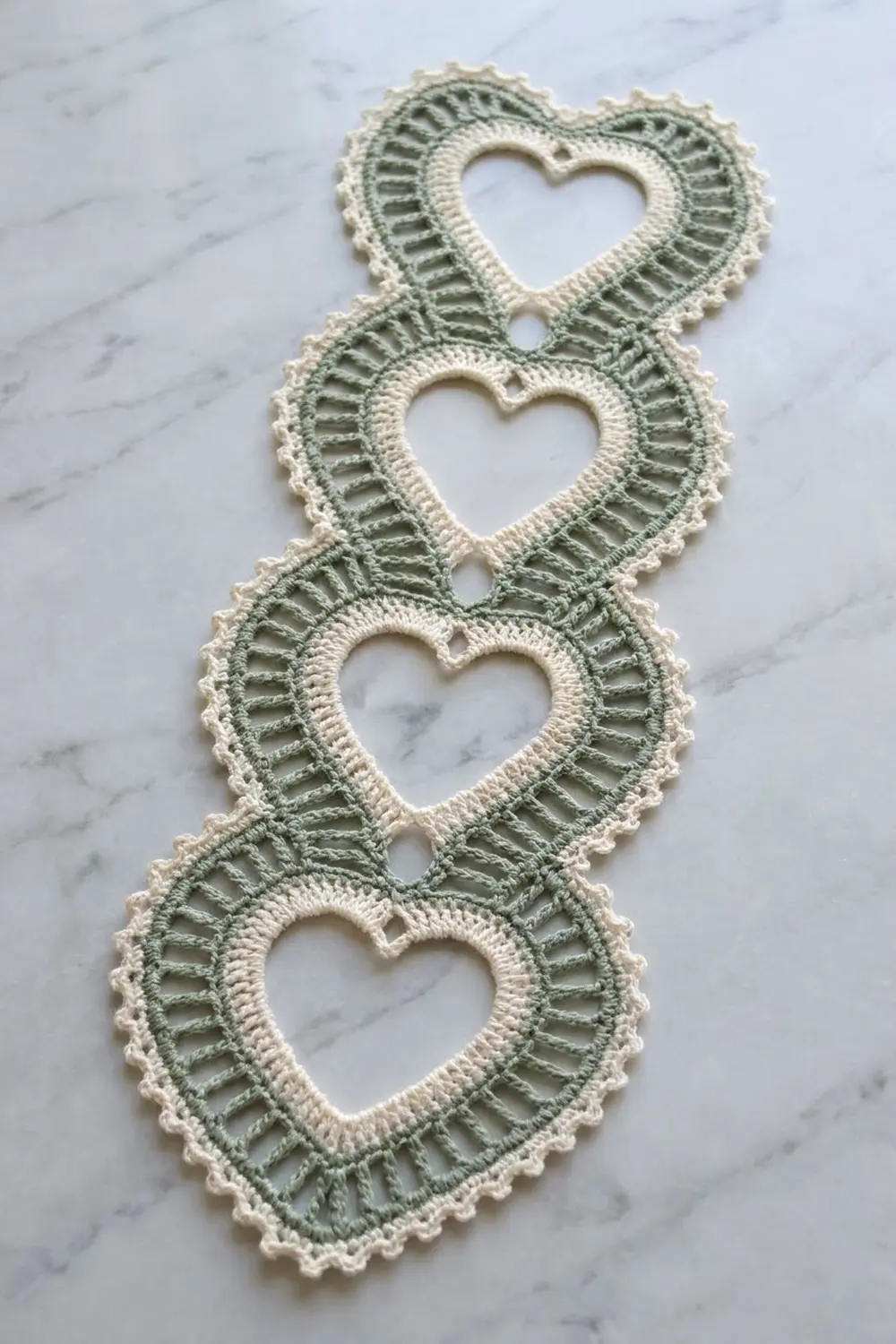
This lace strip pairs a column of four open cream hearts with sage-green ladder bands. The ladder sweeps around each heart in soft S-curves, pinches in at a narrow waist between hearts, then flares out again around the next pair of lobes. A cream rail and a round of small picots finish the scalloped outline.
The palette is just two colors, sage green and cream. In a smooth cotton the strip looks like vintage Bruges lace, with clean stitches, open spaces and a lot of light coming through. It works as a table accent, a shelf edging or a bookmark-style keepsake, or you can stitch it onto a plain curtain or pillow as an insertion.
All instructions use US crochet terms. The finished strip measures 4.75 in wide x 12 in long (12.1 cm x 30.5 cm) after blocking.
The strip is one single piece made in three stages. First you work a cream “spine” of four linked heart outlines in one continuous strand. Next, one sage round of treble-crochet rungs goes all the way around the spine to make the ladder band. Last come two cream border rounds: a rail round, then a picot round. You never have to join separate pieces.
Finished Size and Construction
- Finished size: 4.75 in x 12 in (12.1 cm x 30.5 cm)
- Skill level: Intermediate
- Terminology: US crochet terms
- Yarn weight: Sport weight (2), mercerized or smooth cotton
- Hook: 3.0 mm
- Number of pieces: 1 (a single strip)
- Layout: 4 hearts stacked vertically and linked tip-to-dip by short stems
- Single heart outline: 2.25 in wide x 2 in tall (5.7 cm x 5.1 cm)
- Size before border: 3.75 in x 11 in (9.5 cm x 27.9 cm)
- Border depth: 0.5 in (1.3 cm) on every edge
Materials
Pick a smooth, firmly plied sport-weight cotton. Mercerized cotton shows the rungs and picots best. Soft, splitty cotton blurs the ladder and makes the hearts look fuzzy.
- Cream (Color A): 20 g, about 60 m (65.6 yd), for the heart spine, rail and picots
- Sage green (Color B): 10 g, about 30 m (32.8 yd), for the ladder band
These amounts include a safety margin of roughly 25%, so you can make a gauge swatch or undo a round.
Tools:
- 3.0 mm crochet hook
- Tapestry needle
- Scissors
- Rust-proof pins
- Blocking mat or folded towel
- Spray bottle
- Ruler or tape measure
Abbreviations (US Terms)
- ch – chain
- sl st – slip stitch
- sc – single crochet
- tr – treble crochet
- sk – skip
- st(s) – stitch(es)
- sp – space
- tr2tog – treble 2 together
Special stitches:
- tr2tog: [Yarn over twice, insert hook in next st, pull up a loop, (yarn over, pull through 2 loops) twice] 2 times, then yarn over and pull through all 3 loops on hook. Counts as 1 rung.
- Picot: Ch 3, sl st in 3rd ch from hook.
Gauge and Checkpoints
Base gauge: 22 sc and 24 rows = 4 in (10.2 cm) in sc. One tr stands about 0.75 in (1.9 cm) tall.
Gauge matters here because heart size, ladder width and border fit all depend on it. Before you commit to the strip, make one heart (the first 40 ch ring with its sc) as a test.
Checkpoints:
- One heart outline: 2.25 in wide x 2 in tall (5.7 cm x 5.1 cm), gently pinned into shape.
- Finished spine: 2.25 in x 9.5 in (5.7 cm x 24.1 cm). That is 4 hearts at 2 in (5.1 cm) each plus 3 stems at 0.5 in (1.3 cm) each.
- After the ladder round: 3.75 in x 11 in (9.5 cm x 27.9 cm). The band adds 0.75 in (1.9 cm) on every side.
- After the border: 4.75 in x 12 in (12.1 cm x 30.5 cm).
If your test heart is too big, go down to a 2.75 mm hook. If it is too small, go up to a 3.25 mm hook. Keep all the stitch counts the same. Change only the hook, because every later count depends on the 172-stitch spine.
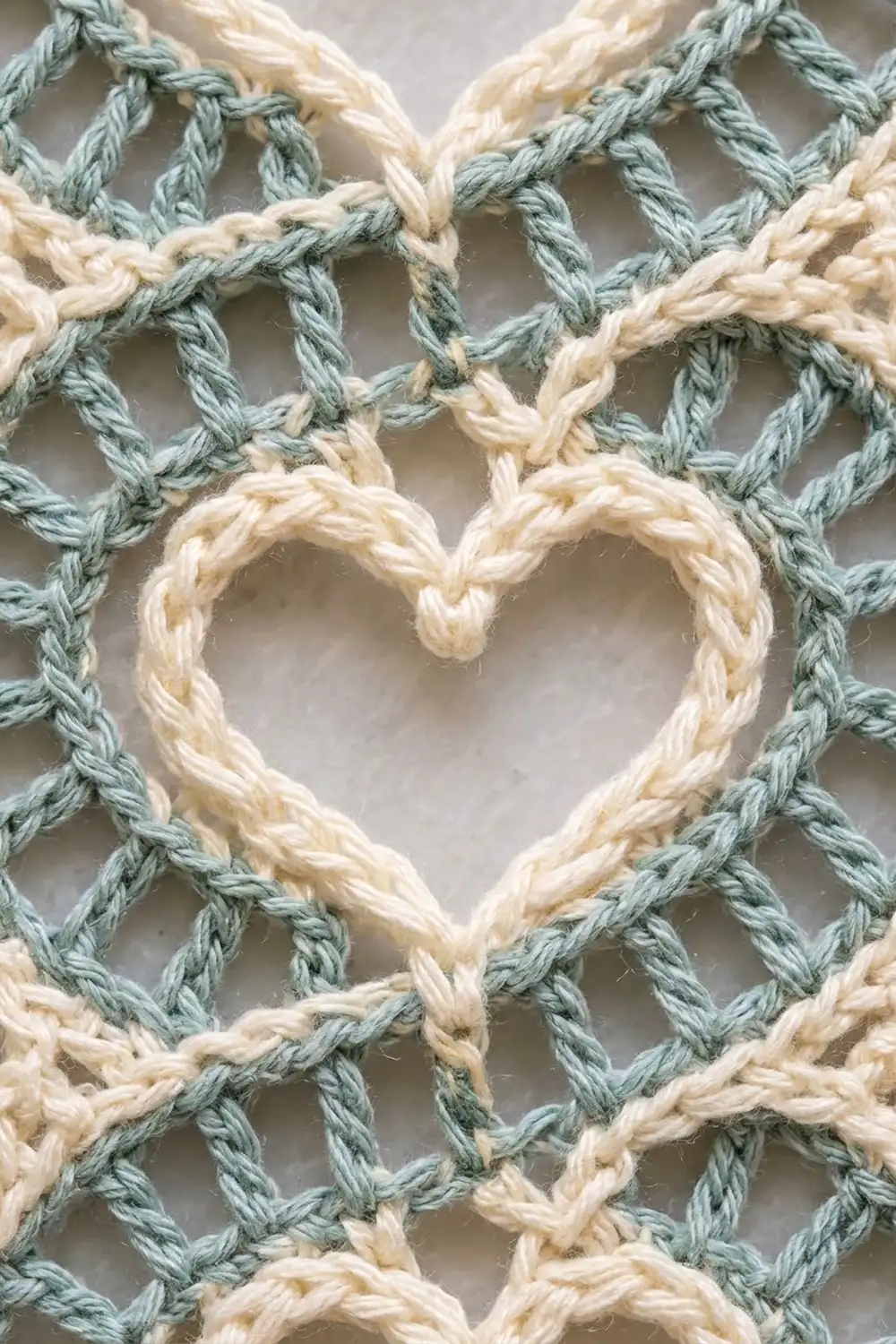
Part 1: Heart Spine (Color A, Cream)
The spine is a single strand. On the way down you make each heart ring and cover its left half. On the way back up you cover the right halves and the stems.
Each heart ring has 40 ch. The join sl st sits at the dip (top center) of the heart. The first 20 ch you cover form the left half, and the remaining 20 ch form the right half. The tip of the heart is the point between ch 20 and ch 21.
Downward pass:
Heart 1: Leave a 6 in (15.2 cm) tail. Ch 40 and sl st in the 40th ch from hook to form a ring. This join is the dip of Heart 1. Ch 1 (does not count as a st), then work 1 sc in each of the next 20 ch of the ring. (20 sc: left half)
Stem 1: Ch 4.
Heart 2: Ch 40 and sl st in the 40th ch from hook to form a ring. This join is the dip of Heart 2, sitting at the bottom of the stem. Ch 1, then sc in each of the next 20 ch of the ring. (20 sc: left half)
Stem 2 and Heart 3: Repeat Stem 1 and Heart 2.
Stem 3 and Heart 4: Repeat Stem 1 and Heart 2.
Turn at the bottom: Without any stem, keep going around Heart 4 and work 1 sc in each of the remaining 20 ch. Sl st in the Heart 4 dip join. Heart 4 is now complete. (40 sc)
Upward pass:
- Sc in each of the 4 ch of Stem 3. (4 sc)
- Sc in each of the remaining 20 ch of Heart 3, then sl st in the Heart 3 dip join. (Heart 3: 40 sc)
- Sc in each of the 4 ch of Stem 2, then sc in each of the remaining 20 ch of Heart 2. Sl st in the Heart 2 dip join.
- Sc in each of the 4 ch of Stem 1, then sc in each of the remaining 20 ch of Heart 1. Sl st in the Heart 1 dip join.
Fasten off and weave in both tails.
Spine stitch count: 4 hearts x 40 sc = 160 sc, plus 3 stems x 4 sc = 12 sc, for 172 sc total.
Shape each heart with your fingers. Push the dip down and pull the tip into a point. Pin the spine flat and check it against Checkpoint 2.
Part 2: Ladder Round (Color B, Sage)
Number each half-heart from 1 to 20 in the direction you are working. On the left side, st 1 sits next to the dip and st 20 sits at the tip. On the right side, st 1 sits next to the tip and st 20 sits at the dip.
The stems have two sides. Each stem’s left side is made of 4 free chain loops, and its right side is the 4 sc from the upward pass. Never work into the dip sl sts.
On the lobes, each rung is followed by a ch 2, which lets the outer edge flare around the curve. Along the lower sides, a ch 1 keeps the band straight. At the stems, tr2tog pulls the band in to form the waist.
Join: With the right side facing, join Color B with a sl st in st 1 of the Heart 1 left half.
Left side, going down:
- Heart 1 left half: Ch 4 (counts as tr), ch 2, sk 1. Then [tr in next st, ch 2, sk 1] 5 times, followed by [tr in next st, ch 1, sk 1] 4 times. (10 rungs, 6 ch-2 sps, 4 ch-1 sps)
- Stem 1, left side: [Tr2tog over next 2 free loops, ch 1] 2 times. (2 rungs, 2 ch-1 sps)
- Hearts 2 and 3, left halves, with Stem 2 between them: Work each left half as [tr in next st, ch 2, sk 1] 6 times, then [tr in next st, ch 1, sk 1] 4 times. Work Stem 2 like Stem 1.
- Stem 3, left side: Work like Stem 1.
- Heart 4 left half: [Tr in next st, ch 2, sk 1] 6 times, then [tr in next st, ch 1, sk 1] 3 times. Tr in st 19, ch 1.
- Bottom tip: (Tr, ch 3, tr) in st 20, ch 1. (2 rungs, 1 ch-3 sp, 1 ch-1 sp)
Right side, going up:
- Heart 4 right half: [Sk 1, tr in next st, ch 1] 4 times, then [sk 1, tr in next st, ch 2] 6 times. (10 rungs, 4 ch-1 sps, 6 ch-2 sps)
- Stem 3, right side: [Tr2tog over next 2 sc, ch 1] 2 times.
- Hearts 3, 2 and 1, right halves: Work each one like the Heart 4 right half. Between them, work Stems 2 and 1 like Stem 3.
- Finish: The last ch 2 after st 20 of Heart 1 becomes the top center space. Sl st in the 4th ch of the beginning ch-4. Fasten off.
Round count:
- Rungs: 40 tr on the left halves, 6 tr2tog on the left stems, 2 tr at the tip, 40 tr on the right halves and 6 tr2tog on the right stems, for 94 rungs.
- Spaces: 48 ch-2 sps, 45 ch-1 sps and 1 ch-3 sp, for 94 spaces. In a closed round the number of spaces always equals the number of rungs.
Pin the strip flat and check it against Checkpoint 3: 3.75 in x 11 in (9.5 cm x 27.9 cm).
Border (Color A, Cream)
Border gauge: Along any straight stretch, the rail round should match the base gauge of 22 sc = 4 in (10.2 cm).
The rule for this round is 1 sc for every rung and 1 sc for every chain in the spaces. That makes the rail exactly as long as the outer edge of the ladder, so the border does not ruffle or cup.
Round 1: Rail
Join Color A with a sl st in the top of the first rung, which is st 1 of the Heart 1 left half. Ch 1, then work around:
- sc in every tr and tr2tog
- 2 sc in every ch-2 sp
- 1 sc in every ch-1 sp
- 5 sc in the ch-3 sp at the tip
Sl st in the first sc.
Count per section:
- Left side: 46 rungs + (24 ch-2 sps x 2) + 22 ch-1 sps = 116 sc
- Bottom tip: 2 rungs + 5 + 1 = 8 sc
- Right side, including the top center: 46 rungs + (24 ch-2 sps x 2) + 22 ch-1 sps = 116 sc
- Total: 116 + 8 + 116 = 240 sc
Round 2: Picot Edge
Ch 1. [Sc in each of next 4 sts, picot] 60 times. Sl st in the first sc. Fasten off.
Count per section:
- Left side: 116 sc and 29 picots
- Bottom tip: 8 sc and 2 picots
- Right side: 116 sc and 29 picots
- Total: 240 sc and 60 picots
Why the math works: Each section is a multiple of 4 (116, 8 and 116), so the picot repeat fits exactly. Every picot sits in the same position on the left and right sides, and the bottom point gets its own pair of picots. The two border rounds add 0.5 in (1.3 cm) on every edge. That takes the strip from 3.75 in x 11 in to 4.75 in x 12 in (9.5 cm x 27.9 cm to 12.1 cm x 30.5 cm).
Final Blocking
- Weave in all the remaining tails, tucking each one into stitches of its own color.
- Soak the strip in cool water for 10 minutes, then press out the water gently in a towel. Do not wring it.
- Lay the strip on the blocking mat right side up and pin the two long edges straight. The centerline should measure 12 in (30.5 cm) and the widest points 4.75 in (12.1 cm).
- Pin each heart: one pin in the dip and one at the tip, then round out both lobes.
- Pin each rung so it lies straight and the ladder spaces are even.
- Pin each picot into a small round point.
- Leave it to dry completely, about 24 hours, before you remove the pins.
Final Quality-Control Checklist
- [ ] There are 4 hearts, and each one has a clear dip and a sharp tip
- [ ] The spine count is 172 sc and each heart has 40 sc
- [ ] There are 94 rungs in total with no skipped or doubled spaces
- [ ] The rail round has 240 sc: 116 + 8 + 116
- [ ] There are 60 picots, evenly spaced, with 29 on each side and 2 at the tip
- [ ] The strip measures 4.75 in x 12 in (12.1 cm x 30.5 cm)
- [ ] The left and right edges mirror each other
- [ ] All tails are woven in and none show through the lace
Troubleshooting
The hearts look like circles. Block them again and pin the dip and the tip firmly. If it still happens, work the 3 sc closest to the dip on each half as sl sts on your next strip.
The ladder band cups. Your tension is tight on the ch-2 spaces. Make the chains a little looser, or go up a hook size for this round only.
The ladder band ruffles. Your chains are too loose. Make them snugger, or change each ch 2 to a ch 1 on the 2 rungs closest to each tip.
The rail count is wrong. Count each side of the ladder round separately. The left and right sides should each have 46 rungs. A missing tr2tog at a stem is the most common cause.
The picots don’t come out even. Recount the rail. The picot repeat only works on exactly 240 sc.
The waist between hearts is too open. Pull the tr2tog stitches tight, and pin the waist inward when you block.
Care
Hand wash in cool water with a mild detergent and lay flat to dry. Block it again with pins if the hearts lose their shape.
Final Notes
Everything in this pattern follows one measurement chain. A test heart of 2.25 in x 2 in (5.7 cm x 5.1 cm) gives a spine of 2.25 in x 9.5 in (5.7 cm x 24.1 cm). The 94-rung ladder round makes that 3.75 in x 11 in (9.5 cm x 27.9 cm). Finally, the 240-stitch rail and the 60-picot edge bring the strip to 4.75 in x 12 in (12.1 cm x 30.5 cm). If each checkpoint matches, the strip will lie flat and mirror cleanly from side to side.
Happy crocheting!