

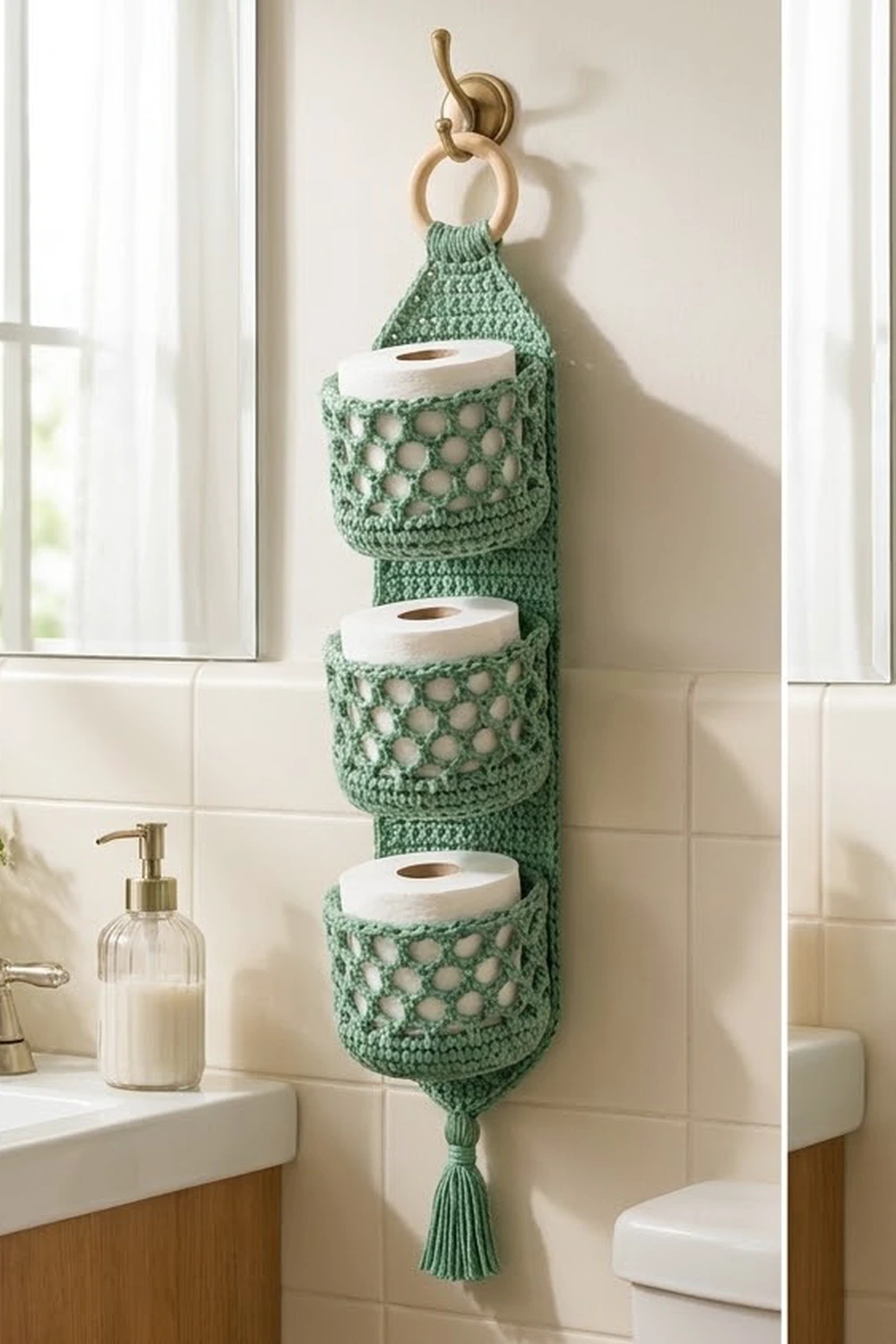
This hanging holder stores three spare toilet rolls on the wall in one neat column. Three open honeycomb baskets are sewn flat-backed to a long, sturdy panel. A wooden ring at the top lets you hang it, and a tassel finishes the point at the bottom.
The sample is worked in one soft sage green, which looks good next to white rolls, wood and marble. Each basket has a solid base, a firm bottom band, an airy chain-loop mesh and a solid rim that keeps the opening round.
The pattern uses US crochet terms. With its border, the panel is 4.75 in (12.1 cm) wide. It hangs 22.375 in (56.8 cm) from the fold at the ring to the bottom point, or 26.375 in (67.0 cm) including the tassel. Each basket is about 5.75 in (14.6 cm) across, 4.5 in (11.4 cm) deep and 4.25 in (10.8 cm) tall.
Construction in short: you crochet three baskets in the round, from the oval base up to the rim. Then you work the panel in rows from the bottom point up to the top tab. Finally, you sew on the baskets, add a border around the panel, and attach the ring and tassel.
Finished Size and Construction
- Finished size: 4.75 in (12.1 cm) wide × 22.375 in (56.8 cm) hanging length; 26.375 in (67.0 cm) with the tassel
- Skill level: Easy–Intermediate
- Terminology: US
- Yarn weight: Worsted (#4) cotton
- Hook: 5 mm (H-8)
- Number of pieces: 4 crocheted pieces (3 baskets and 1 panel), plus 1 tassel and 1 wooden ring
- Layout: 3 baskets stacked in 1 vertical column
- Piece size: each basket is 5.75 × 4.5 × 4.25 in (14.6 × 11.4 × 10.8 cm)
- Panel size before border: 4 × 23.5 in (10.2 × 59.7 cm)
- Border depth: 0.375 in (1.0 cm) on each edge
Materials
Choose a smooth, firm worsted-weight cotton at about 170 m per 100 g. Cotton holds the basket shape and won’t stretch out under the weight of a roll. Avoid very soft or splitty yarn, because the mesh will sag.
- Sage Green: 300 g / about 510 m
- each basket: about 50 g / 85 m (150 g / 255 m for all three)
- panel and border: about 90 g / 153 m
- tassel: about 5 g / 9 m
The quantities include a margin of about 20% for swatching and any rows you need to rip out.
Tools: 5 mm (H-8) hook, 70 mm (2.75 in / 7.0 cm) wooden ring, tapestry needle, 6 locking stitch markers, a stiff card 4.5 in (11.4 cm) wide, scissors, tape measure and rust-proof pins.
Abbreviations (US Terms)
- ch – chain
- sc – single crochet
- sl st – slip stitch
- st(s) – stitch(es)
- sk – skip
- BLO – back loop only
- inc – 2 sc in the same st
- sc2tog – pull up a loop in each of the next 2 sts, then yarn over and draw through all 3 loops on the hook
- reverse sc – also called crab stitch: sc worked from left to right (for right-handers) into the next st to the right
Special stitch: ch-5 mesh loop. This is a chain-5 anchored with an sc into the center of a loop from the round below. Stacking these loops round after round makes the honeycomb.
Gauge and Checkpoints
Gauge: 16 sc and 16 rows = 4 in (10.2 cm), worked in rows.
Test one basket base (Rounds 1–9) first and measure it before you go on.
- Base Round 9: 5.75 × 4.5 in (14.6 × 11.4 cm), 64 sts
- Basket Round 12: solid band 0.75 in (1.9 cm) tall
- Basket Round 17: wall 3.25 in (8.3 cm) tall
- Basket Round 20: wall 4 in (10.2 cm) tall; basket 4.25 in (10.8 cm) tall in total
- Panel Row 12: 4 in (10.2 cm) wide × 3 in (7.6 cm) tall
- Panel Row 72: 18 in (45.7 cm) tall
- Panel Row 94: 23.5 in (59.7 cm) tall
If your piece is too big, go down 0.5 mm in hook size. If it is too small, go up 0.5 mm. Never change the stitch counts, because the joining and the border depend on them.
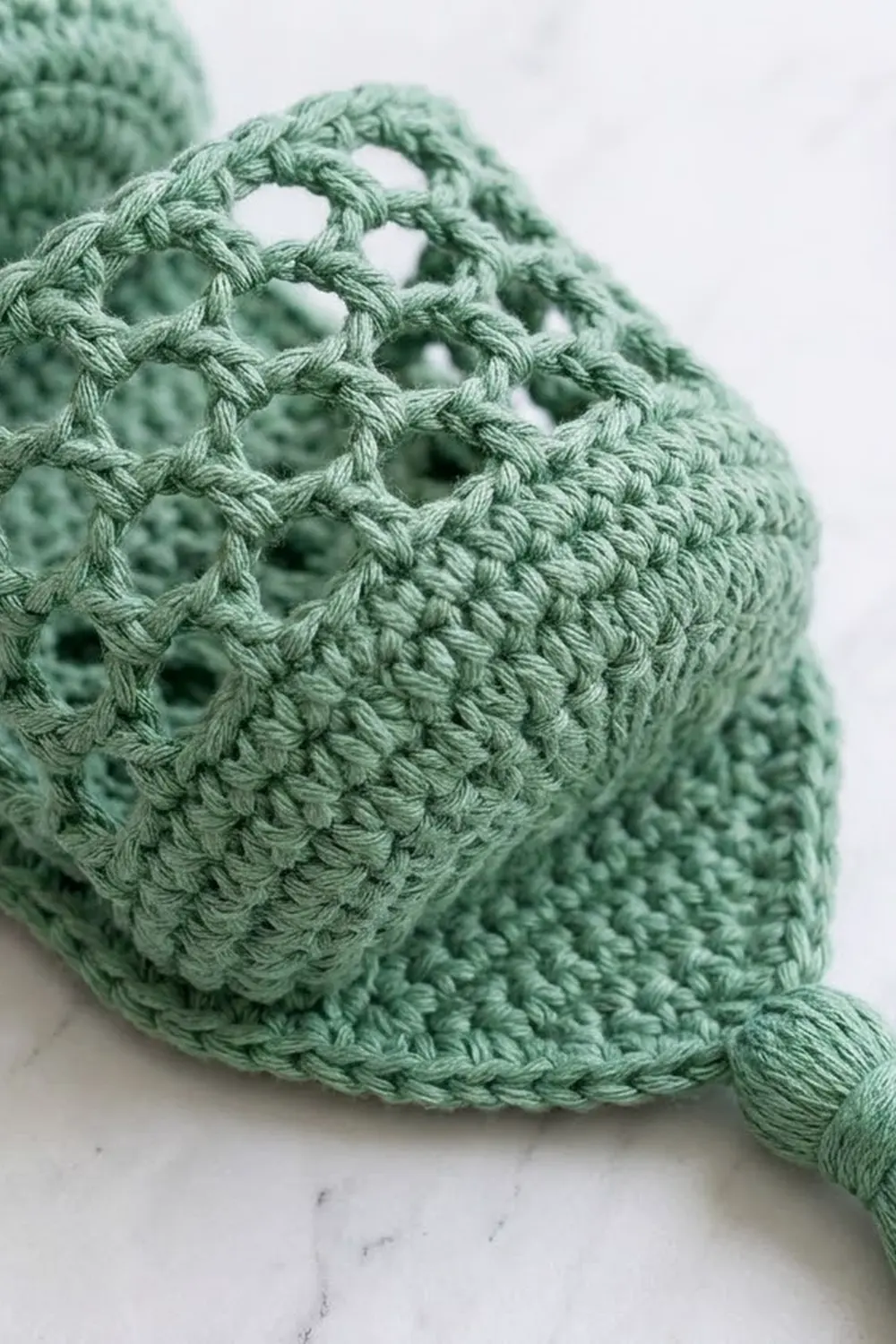
Basket (Make 3)
Each round starts with ch 1, which does not count as a stitch, and ends with a sl st into the first st.
Oval Base
Round 1: Ch 8. Work 3 sc in the 2nd ch from the hook, sc in the next 5 ch, and 3 sc in the last ch. Working along the opposite side of the foundation, sc in the next 5 ch. Join. (16 sts: two ends of 3 sts and two straight sides of 5 sts)
Round 2: [Inc in each of the next 3 sts, sc 5] twice. (22 sts)
Round 3: [(Sc 1, inc) 3 times, sc 5] twice. (28 sts)
Round 4: [(Sc 2, inc) 3 times, sc 5] twice. (34 sts)
Round 5: [(Sc 3, inc) 3 times, sc 5] twice. (40 sts)
Round 6: [(Sc 4, inc) 3 times, sc 5] twice. (46 sts)
Round 7: [(Sc 5, inc) 3 times, sc 5] twice. (52 sts)
Round 8: [(Sc 6, inc) 3 times, sc 5] twice. (58 sts)
Round 9: [(Sc 7, inc) 3 times, sc 5] twice. (64 sts: two ends of 27 sts and two straight sides of 5 sts)
Wall
Round 10 (turning round): Sc in BLO of each st around. (64 sts = 64 worked 1 per st + 0 added) The unused front loops form a ridge around the base.
Rounds 11–12: Sc around. (64 sts)
Round 13 (mesh set-up): Sc in the first st, ch 5, sk 3 sts, sc in the next st. Repeat from * around, ending with ch 5, sk 3, and join to the first sc. (16 ch-5 loops)
Round 14: Sl st in each of the next 3 ch to reach the center of the loop. Ch 1, sc in the same loop, ch 5, sc in the next ch-5 loop. Repeat from * around, ending with ch 5, and join. (16 ch-5 loops)
Rounds 15–17: Repeat Round 14. (16 ch-5 loops each round)
Round 18 (conversion round): Work 4 sc in each ch-5 loop. (64 sts = 16 loops × 4 sc + 0 extra)
Rounds 19–20: Sc around. (64 sts)
Before you fasten off, count the sts of Round 20 from the join and mark st 22 and st 37. These 16 sts (sts 22–37) are centered on one straight side and form the back of the basket. Mark the same sts in the front-loop ridge of Round 9. Fasten off, leaving a 24 in (61.0 cm) tail for sewing.
Backing Panel (Make 1)
Each row starts with ch 1 and turn. The ch 1 does not count as a stitch.
Row 1: Ch 7. Sc in the 2nd ch from the hook and in each ch across. (6 sts)
Row 2: Sc across. (6 sts)
Row 3: Inc, sc 4, inc. (8 sts)
Rows 4, 6, 8 and 10: Sc across. (same count as the row before)
Rows 5, 7, 9 and 11: Inc, sc to the last st, inc. (10, 12, 14 and 16 sts)
Row 12: Sc across. (16 sts) The bottom point is now 3 in (7.6 cm) tall.
Rows 13–72: Sc across. (16 sts) These 60 rows make 15 in (38.1 cm) of straight panel.
Row 73: Sc2tog, sc 12, sc2tog. (14 sts)
Rows 74, 76, 78 and 80: Sc across. (same count as the row before)
Rows 75, 77, 79 and 81: Sc2tog, sc to the last 2 sts, sc2tog. (12, 10, 8 and 6 sts)
Rows 82–94: Sc across. (6 sts) Rows 83–94 form the 3 in (7.6 cm) ring tab.
Fasten off. The panel measures 4 × 23.5 in (10.2 × 59.7 cm).
Make All Pieces
- Baskets: 3 in Sage Green (about 150 g)
- Panel: 1 in Sage Green (about 90 g, including the border)
- Tassel: 1 in Sage Green (about 5 g)
Layout (front view, with rows counted from the bottom point):
            ( wooden ring )
          [ tab  Rows 83–94 ]
         / taper Rows 73–82 \
        |  Row 72 (free)     |
        |  BASKET 3          |  rim Row 71, base Row 55
        |  gap  Rows 51–54   |
        |  BASKET 2          |  rim Row 50, base Row 34
        |  gap  Rows 30–33   |
        |  BASKET 1          |  rim Row 29, base Row 13
         \ point Rows 1–12  /
                tassel
Joining
Lay the panel right side up with Row 1 at the bottom, and pin all three baskets in place before you sew.
Stitch-to-stitch logic: The panel is 16 sts wide, and each basket’s back section is exactly 16 sts (sts 22–37). Every basket st is sewn to exactly 1 panel st, so nothing is gathered or stretched. The other 48 basket sts curve out at the front, 12 in (30.5 cm) around.
- Base line: Whipstitch the 16 marked ridge loops of Round 9 to the 16 sts of the base row (Row 13, 34 or 55), 1 to 1.
- Rim line: Flatten the back of the wall against the panel. Whipstitch the 16 marked sts of Round 20 to the rim row (Row 29, 50 or 71), 1 to 1.
- Sides: Make 3–4 tacking stitches up each side of the flattened back.
Tension: Pull each stitch just snug. If the seam is too tight, the panel puckers; if it is too loose, the baskets tip forward.
Size checkpoint: Each rim should sit 4 in (10.2 cm), or 16 rows, above its base line. Each gap between baskets should be 1 in (2.5 cm), or 4 rows.
Border
The border goes around the panel only.
Border gauge: 4 sc per 1 in (2.5 cm) along every edge.
Round 1: With the right side facing, join the yarn in the first st of Row 94.
– Top edge: 3 sc in the first st, sc 4, 3 sc in the last st. (10 sts, including both corner groups)
– Long side: 1 sc in each row end from Row 93 down to Row 2. (92 sts)
– Bottom edge: working into the foundation ch, 3 sc in the first ch, sc 4, 3 sc in the last ch. (10 sts, including both corner groups)
– Long side: 1 sc in each row end from Row 2 up to Row 93. (92 sts)
– Join. (204 sts = 10 + 92 + 10 + 92)
Round 2: Ch 1, reverse sc in each st around. Join. (204 sts) Fasten off.
Why the math works: At this gauge there are 4 sts and 4 rows per inch, so 1 sc per row end matches the panel’s height exactly. Each corner group is counted only on its short edge, so no corner is counted twice. The border adds 0.375 in (1.0 cm) on every edge, which makes the panel 4.75 × 24.25 in (12.1 × 61.6 cm).
Ring and Tassel
Ring: Pass the tab through the ring from front to back. Fold Rows 89–94 (with their border) down behind Rows 83–88, then whipstitch the top edge to Row 83. The panel now hangs 22.375 in (56.8 cm) from the fold.
Tassel: Wrap the yarn 30 times around the 4.5 in (11.4 cm) card. Tie a 12 in (30.5 cm) strand through the top of the wraps, then cut the bottom loops. Wrap a second strand 6 times around the bundle 0.5 in (1.3 cm) below the top and knot it. Trim the strands to 4 in (10.2 cm), then use the top tie to sew the tassel to the bottom point.
Final Blocking
- Mist the whole holder until it is damp.
- Pin the panel flat at 4.75 in (12.1 cm) wide, straightening the tapered edges.
- Fill each basket with a roll so the mesh opens into even hexagons.
- Comb the tassel strands straight with your fingers.
- Leave it to dry for at least 12 hours before you unpin it.
Final Quality-Control Checklist
- Each basket has 64 sts in Rounds 9–12 and 18–20, and 16 loops in each mesh round
- All three baskets match in height to within 0.25 in (0.6 cm)
- The panel is 16 sts wide from Row 12 through Row 72
- Each rim is level and sewn 1 to 1 across the panel
- The border totals 204 sts, with 92 sts on each long side
- The ring is held firmly in the fold
- The tassel hangs straight and is centered on the point
- All ends are woven in at least 2 in (5.1 cm)
Troubleshooting
- The base cups: Go up a hook size. The base ruffles: Check that each end gets only 3 increases per round.
- The mesh twists: Sl st exactly to the center (3rd) chain of the loop before you start each round.
- A roll fits tightly: Block the basket over a roll to open up the mesh.
- The panel narrows: Count 16 sts on every row, since the last st is easy to miss.
- The baskets droop: Add tacking stitches along the sides and tighten the rim seam.
- The border ripples on the tapers: Work slightly tighter along the diagonal row ends.
Care
Hand wash in cool water with mild soap, press out the water in a towel, and reshape the holder to dry flat. Don’t tumble dry.
Final Notes
Every measurement follows from the gauge of 16 sc = 4 in (10.2 cm). That gives a 64-st base of 5.75 × 4.5 in (14.6 × 11.4 cm) and a basket 4.25 in (10.8 cm) tall. The panel is 16 sts wide, matching each basket’s 16-st back, and measures 4 × 23.5 in (10.2 × 59.7 cm). The 204-st border takes it to 4.75 × 24.25 in (12.1 × 61.6 cm). After the fold, the holder hangs 22.375 in (56.8 cm), or 26.375 in (67.0 cm) with the tassel. If every checkpoint matches, all the pieces fit together without adjusting.
Happy crocheting!