

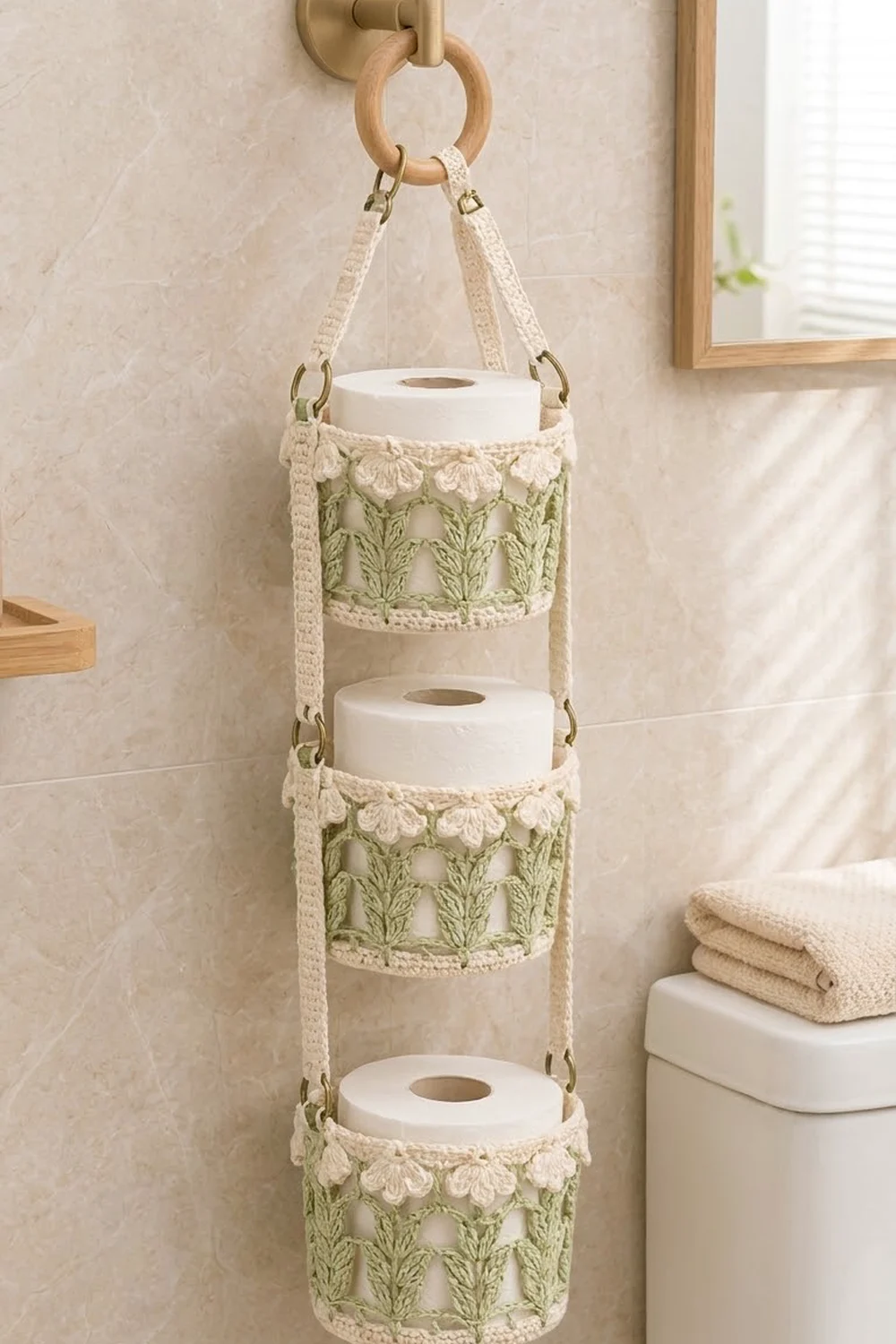
The Sage Meadow holder has three lace baskets hung one above another, each holding one spare toilet roll. Each basket has a solid cream base, a sage-green wall of leafy stems and pointed arches, and a cream band finished with small hanging flowers.
The palette is soft: sage green for the leaves and cream for everything structural. Cotton keeps the baskets crisp and easy to wash, which matters in a bathroom.
This pattern uses US crochet terms. Each basket measures 5 in (12.7 cm) across and 4 in (10.2 cm) tall. With the straps and the ring attached, the holder hangs about 33 in (83.8 cm) long.
Each basket is worked in joined rounds from the center of the base upward, so the walls have no seams. You then make three long straps. Each strap is sewn to all three baskets at evenly spaced points, and its top loop clips onto a wooden ring with a lobster clasp.
Finished Size and Construction
- Basket size: 5 in (12.7 cm) diameter × 4 in (10.2 cm) tall
- Overall hanging length: about 33 in (83.8 cm)
- Skill level: Intermediate
- Terminology: US
- Yarn weight: DK / light worsted cotton (#3)
- Hook: 3.5 mm (E-4)
- Number of crocheted pieces: 6 (3 baskets, 3 straps)
- Layout: 3 baskets stacked vertically, 4 in (10.2 cm) apart, held by 3 straps spaced evenly around them
- Basket size before border: 5 in (12.7 cm) × 2.75 in (7.0 cm) tall
- Border depth: 1.25 in (3.2 cm)
- Strap size: 1 in (2.5 cm) × 28 in (71.1 cm), plus end loops
Materials
Use a smooth mercerized or combed cotton in DK weight. Cotton holds the basket shape and stands up to bathroom humidity. Avoid acrylic, because the lace walls will sag.
- Cream: 120 g / 270 m
- Sage green: 40 g / 90 m
Tools and hardware:
- 3.5 mm (E-4) crochet hook
- Tapestry needle
- 6 stitch markers
- Wooden ring, 3 in (7.6 cm) diameter
- 3 lobster clasps with swivel eyes, about 1.25 in (3.2 cm) long
- Tape measure, rust-proof pins and scissors
- A jar or can about 5 in (12.7 cm) across, for blocking
These quantities include a margin of about 20% for your gauge swatch and small differences in tension.
Abbreviations (US Terms)
- ch – chain
- sl st – slip stitch
- sc – single crochet
- dc – double crochet
- tr – treble crochet
- BLO – back loop only
- sp(s) – space(s)
- st(s) – stitch(es)
- rep – repeat
Special stitches:
- 3dc-cl (3-double-crochet cluster): *Yarn over, insert hook in the stitch, pull up a loop, yarn over and pull through 2 loops. Repeat from * 2 more times in the same stitch, then yarn over and pull through all 4 loops on the hook.
- Leaf group: (3dc-cl, ch 1, dc, ch 1, 3dc-cl) in the same stitch. In Rounds 18–19 this becomes the Tall leaf group, which uses tr in place of dc.
- 2dc-cl (2-double-crochet cluster): Same as the 3dc-cl, but work only 2 partial dc and pull through all 3 loops.
- Flower fan: (2dc-cl, ch 2) 4 times, then 2dc-cl, all in the same stitch. This makes 5 petals.
Gauge and Checkpoints
Gauge: 18 sc and 20 rounds = 4 in (10.2 cm) in sc.
Make one full basket before you start the others, and measure at each of these points:
- After Rnd 6 (36 sts): base diameter 2.5 in (6.4 cm)
- After Rnd 12 (72 sts): base diameter 5 in (12.7 cm), circumference 16 in (40.6 cm)
- After Rnd 15: wall height 0.6 in (1.5 cm)
- After Rnd 20: wall height 2.75 in (7.0 cm)
- After Rnd 24: wall height 4 in (10.2 cm) to the flower tips
If the base is bigger than 5 in (12.7 cm), go down half a hook size. If it is smaller, go up half a size. If the base cups upward, your tension is too tight on the increases. If it ruffles, it is too loose. Fix the base before you go on, because every count after it depends on 72 stitches.
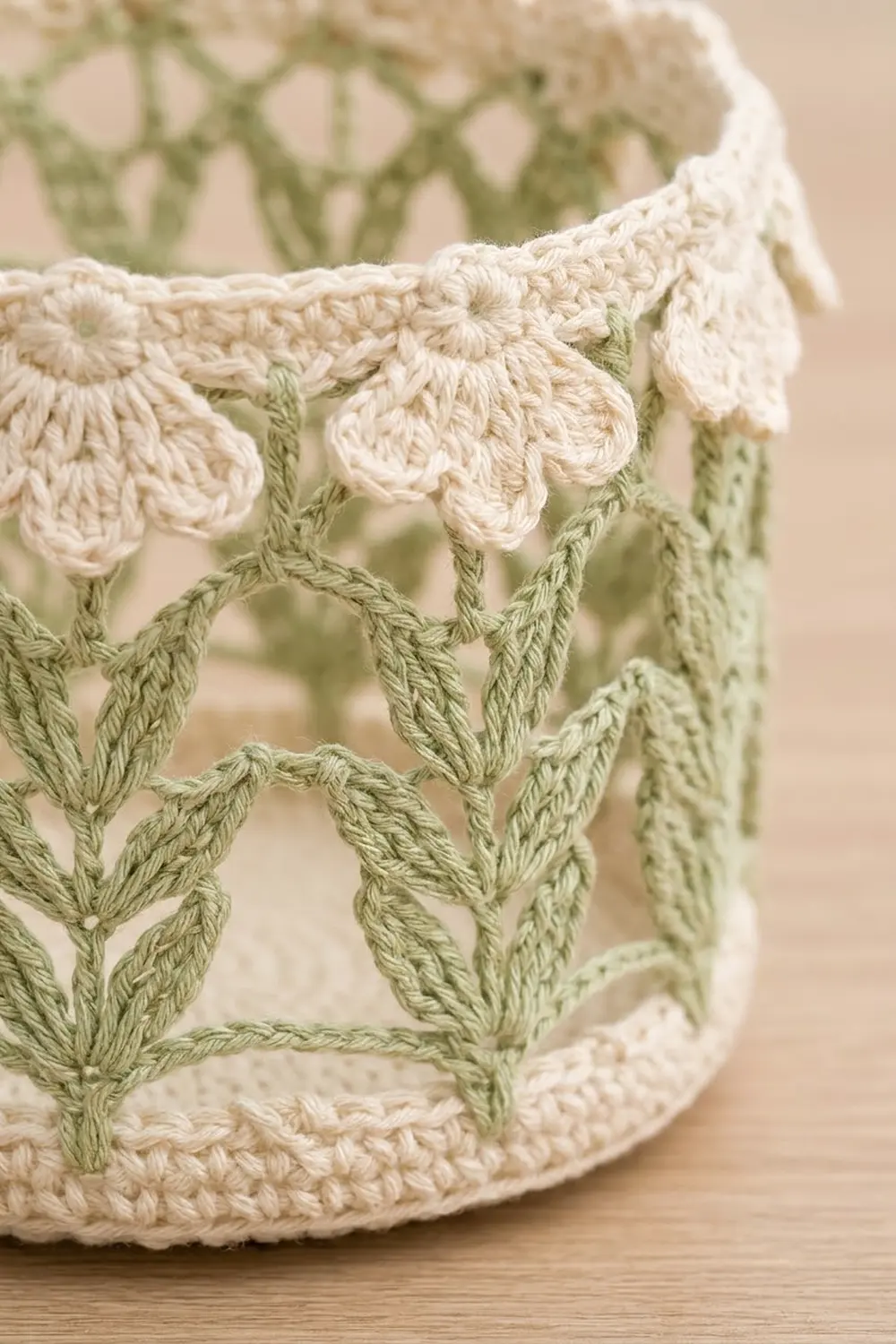
Basket (Make 3)
Join every round with a sl st to the first stitch. The beginning ch 1 never counts as a stitch.
Base (cream)
Rnd 1: Make a magic ring, ch 1, work 6 sc in the ring. (6 sts)
Rnd 2: Work 2 sc in each st. (12 sts)
Rnd 3: Sc in next st, 2 sc in next st; rep 6 times. (18 sts)
Rnd 4: Sc in next 2 sts, 2 sc in next st; rep 6 times. (24 sts)
Rnd 5: Sc in next 3 sts, 2 sc in next st; rep 6 times. (30 sts)
Rnd 6: Sc in next 4 sts, 2 sc in next st; rep 6 times. (36 sts)
Rnds 7–12: Continue the same way, working 1 more sc between increases each round. The totals are Rnd 7 (42 sts), Rnd 8 (48 sts), Rnd 9 (54 sts), Rnd 10 (60 sts), Rnd 11 (66 sts) and Rnd 12 (72 sts).
To keep the base round rather than hexagonal, stagger the increases on even rounds: start those rounds with half of the plain sc, then work the rest of the plain sc at the end of the round.
Bottom Band (cream)
Rnd 13: Ch 1, sc in BLO of each st. (72 sts) This round makes the turning edge where the wall begins.
Rnds 14–15: Ch 1, sc in each st. (72 sts) Change to sage green on the final sl st of Rnd 15, then fasten off the cream.
Lace Wall (sage green)
Rnd 16: Ch 1, sc in next st, ch 3, skip 3 sts; rep 18 times. (18 sc and 18 ch-3 sps, which is 72 sts counting chains)
From here on, the odd-numbered sc (the 1st, 3rd, 5th and so on) are the valley sc, and the even-numbered sc are the stem sc. There are 9 of each.
Rnd 17: Ch 1, sc in first valley sc, ch 2, Leaf group in next stem sc, ch 2, sc in next valley sc. Rep around, omitting the final sc, and join. (9 valley sc, 9 Leaf groups, 18 ch-2 sps)
Rnd 18: Ch 1, sc in first valley sc, ch 3, Tall leaf group in center dc of next Leaf group, ch 3, sc in next valley sc. Rep around, omitting the final sc, and join. (9 sc, 9 Tall leaf groups, 18 ch-3 sps)
Rnd 19: Ch 1, sc in first valley sc, ch 4, Tall leaf group in center tr of next group, ch 4, sc in next valley sc. Rep around, omitting the final sc, and join. (9 sc, 9 Tall leaf groups, 18 ch-4 sps)
Each stem now rises in three stacked leaf pairs. The valley sc stay low, which opens the pointed arches between the stems.
Rnd 20: Sl st in each of the next 4 ch, sl st in top of the next cluster, then sl st in the next ch-1 sp. Ch 1, then work sc in center tr, ch 1, sc in top of next cluster, ch 7, skip the valley, sc in top of first cluster of next group, ch 1. Rep 9 times and join. (27 sc, 9 ch-7 arches, 18 ch-1 sps, which is 108 sts counting chains)
Fasten off the green.
Make All Pieces
- Baskets: 3, each with Rnds 1–24 (the border follows below)
- Straps: 3, in cream
Strap (Make 3)
Row 1: Ch 127, then sc in the 2nd ch from the hook and in each ch across. (126 sts) Turn.
Rows 2–5: Ch 1, sc in each st across. (126 sts) Turn after each row.
The strap now measures 1 in (2.5 cm) × 28 in (71.1 cm).
Top loop: At the end of Row 5, ch 5. Take the hook out and pull the working loop through the swivel eye of a lobster clasp, then put the hook back in. Ch 5, then sl st in the last sc of Row 1 at the same end. Work 14 sc over the ch-10 loop, which also covers the clasp eye. Sl st to the strap and fasten off.
Bottom loop: Join cream in the first sc of Row 1 at the opposite end. Ch 10, sl st in the first sc of Row 5, work 14 sc over the loop, sl st and fasten off.
Layout grid (side view):
        [ wooden ring 3 in / 7.6 cm ]
        [ 3 lobster clasps ]
        |  strap drop 8 in / 20.3 cm  |
        [ TOP BASKET    4 in / 10.2 cm ]
        |  gap 4 in / 10.2 cm         |
        [ MIDDLE BASKET 4 in / 10.2 cm ]
        |  gap 4 in / 10.2 cm         |
        [ BOTTOM BASKET 4 in / 10.2 cm ]
Top view: Strap A at st 5, Strap B at st 29 and Strap C at st 53 of the 72-st round. The straps are 24 sts apart, or one third of the circle.
Joining
Method: Whipstitch the straps to the outside of the baskets with cream yarn and a tapestry needle.
Stitch-to-stitch logic: Every 4.5 strap stitches equal 1 in (2.5 cm), so the strap’s 126 sts divide into exact sections. Counting from the bottom-loop end, place markers after sts 18, 36, 54, 72 and 90:
- Sts 1–18: bottom basket, 4 in (10.2 cm)
- Sts 19–36: gap, 4 in (10.2 cm)
- Sts 37–54: middle basket, 4 in (10.2 cm)
- Sts 55–72: gap, 4 in (10.2 cm)
- Sts 73–90: top basket, 4 in (10.2 cm)
- Sts 91–126: top drop, 8 in (20.3 cm)
That makes 18 + 18 + 18 + 18 + 18 + 36 = 126 sts, or 28 in (71.1 cm).
On each basket, mark sts 5, 29 and 53 of Rnd 22. Each of these sits above the center of an arch, between two flowers. Line up each strap section so that its start meets the Rnd 13 turning edge and its end meets the flower tips.
Whipstitch both long edges of the strap through Rnds 13–15 and Rnds 21–22, which are the solid cream bands. Then tack the strap center once to the Rnd 16 sc behind it. Fold the bottom loop under the bottom basket and tack it to Rnd 12.
Tension advice: Pin all three straps to all three baskets first. Hang the holder and check that each rim is level before you sew. Sew firmly, but don’t pucker the strap. It should lie flat and keep its full 1 in (2.5 cm) width.
Size checkpoint: Each gap should measure 4 in (10.2 cm) from the flower tips down to the next basket’s base edge.
Border (Rnds 21–24, worked on each basket before joining)
Border gauge: 18 sc = 4 in (10.2 cm), the same as the base. The border must come back to exactly 72 sts so that the rim matches the base circumference.
Rnd 21 (cream, conversion): Join cream in the sc above the first center tr. Ch 1, then work sc in sc above the tr, skip the ch-1 sp, sc in sc above the cluster, 5 sc in the ch-7 arch, sc in sc above the next cluster, skip the ch-1 sp. Rep 9 times.
Count: 27 sc worked one into each existing sc, plus 45 sc added in the arches (9 × 5), gives 72 sts. That is 8 sts per repeat. The stem sits on the 1st st of each repeat and the center of the arch on the 5th.
Rnd 22: Ch 1, sc in each st. (72 sts)
Rnd 23 (flowers): Ch 2 (does not count), then Flower fan in the first st, skip 3 sts, sc in next st, skip 3 sts. Then Flower fan in next st, skip 3 sts, sc in next st, skip 3 sts; rep around and join to the top of the first cluster.
Each repeat uses 1 + 3 + 1 + 3 = 8 sts, so 9 repeats use 72 sts. That gives 9 Flower fans and 9 sc. Each fan sits directly above a stem.
Rnd 24 (petal outline): Ch 1, then sc in top of first cluster, (2 sc in next ch-2 sp, sc in top of next cluster) 4 times, sl st in the sc between fans. Rep 9 times. (117 sc + 9 sl sts = 126 sts)
Why the math works: The lace changes width with each round, but Rnd 21 converts it back to exactly the base count, 9 × 8 = 72. Rnd 23 uses those 72 sts in exact groups of 8. This means the flowers line up with the stems all the way around, with no partial repeat at the join.
Final Blocking
- Wash or soak the baskets and straps in cool water and press out the excess. Don’t wring.
- Slide each basket over a 5 in (12.7 cm) jar. Line up the stems so they are vertical.
- Gently open the arches with your fingers.
- Pin each flower fan so the petals spread outward and down.
- Lay the straps flat, pin them to 1 in × 28 in (2.5 cm × 71.1 cm) and let them dry.
- Let everything dry completely before you sew the joins.
Final Quality-Control Checklist
- Each base lies flat and measures 5 in (12.7 cm) across.
- Each wall is 4 in (10.2 cm) tall and has 9 stems and 9 flowers.
- Every flower sits directly above a stem.
- All three straps measure 28 in (71.1 cm) before the loops are added.
- Straps are 24 sts apart on every basket.
- Both gaps measure 4 in (10.2 cm).
- All three rims hang level.
- Clasps close fully on the ring.
- All ends are woven in at least 1 in (2.5 cm).
Troubleshooting
- Base cups or ruffles: Recheck your increase counts against Rnds 1–12, and adjust the hook size.
- Lace wall flares out: Your chains are too loose. Make the chains a little tighter, but keep the cluster tension the same.
- Lace wall pulls in: Your chains are too tight. Go up half a hook size for Rnds 16–20 only.
- Rnd 21 doesn’t come to 72: Check that you skipped both ch-1 sps in each repeat.
- Flowers sit off-center: Rnd 21 must start above a center tr. Rework from that round.
- Basket tilts when hanging: One strap section is off by a stitch. Re-pin it at the markers.
Care
Hand wash cool or machine wash gentle in a laundry bag, then reshape over the jar and air dry. Unclip the baskets from the ring before washing.
Final Notes
Everything depends on one chain of measurements. An accurate gauge gives a 72-stitch base that is 5 in (12.7 cm) across. The lace wall reaches 2.75 in (7.0 cm), and the border brings the count back to 72 and adds 1.25 in (3.2 cm), for a 4 in (10.2 cm) basket. The 126-stitch straps divide into exact 4 in (10.2 cm) sections, so the baskets hang level about 33 in (83.8 cm) below the ring. Measure at each checkpoint and the finished holder will match.
Happy crocheting!