

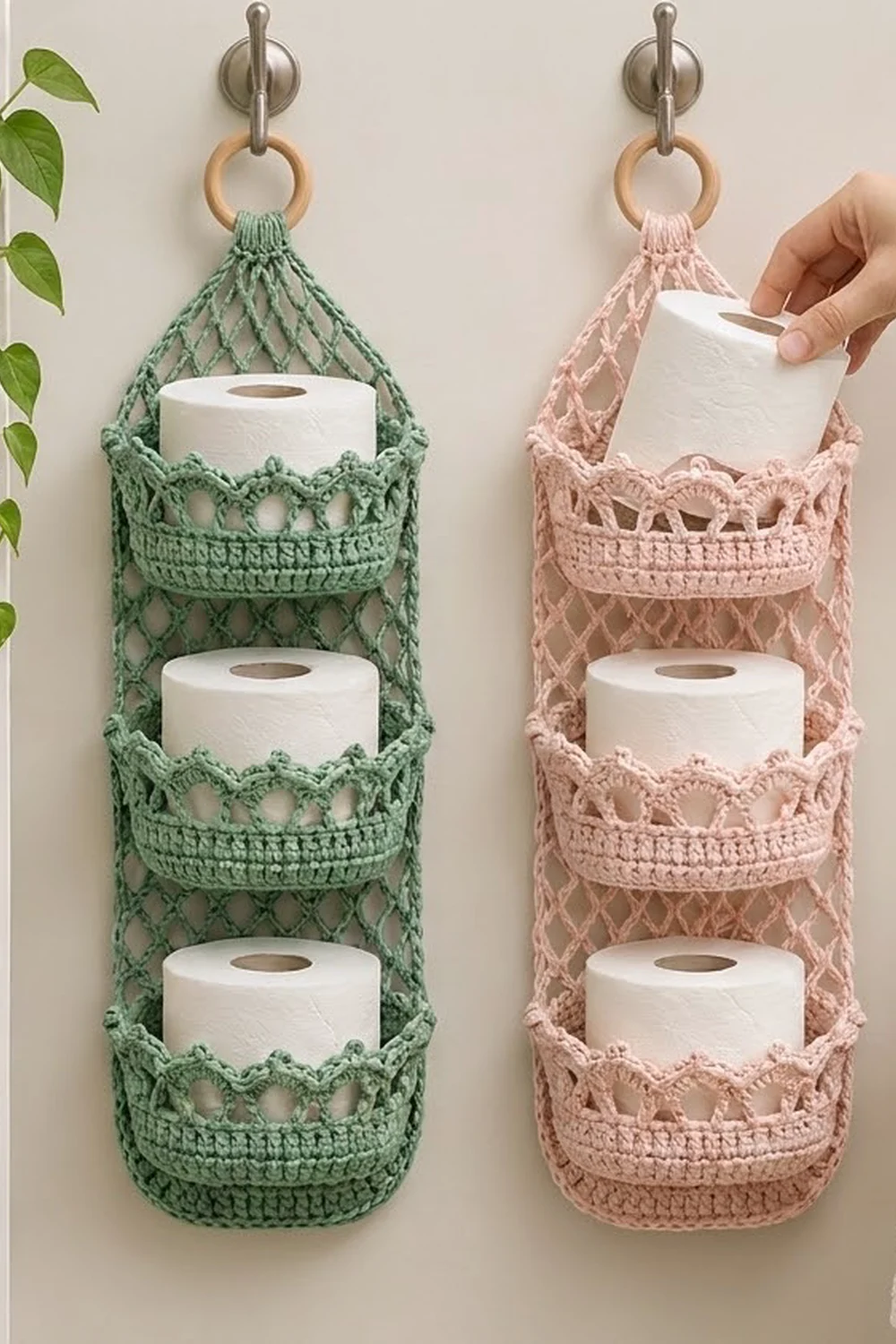
This hanging toilet paper holder has three oval lace pockets stacked on a diamond-net back panel. The panel narrows at the top into a strap that wraps around a wooden ring. Each pocket holds one standard roll standing upright.
The sample is in soft sage green cotton, and a blush pink version works the same way. The style is cottage-modern: solid double crochet bases, open arches, and a scalloped rim with a small picot on every scallop.
The pattern uses US crochet terms. The finished organizer is 8 in (20.3 cm) wide and about 22 in (55.9 cm) long, plus the 2 in (5.1 cm) ring.
You’ll make three pockets in the round and one flat net panel in rows. Sew the pockets to the panel, add a two-row edging along each long side, fold the strap over the ring, and block.
Finished Size and Construction
- Finished size: 8 in (20.3 cm) x 22 in (55.9 cm), plus 2 in (5.1 cm) ring
- Skill level: Intermediate
- Terminology: US
- Yarn weight: Worsted (#4) cotton
- Hook: 4.5 mm (US 7)
- Number of pieces: 4 (3 pockets + 1 back panel)
- Layout: 3 pockets stacked vertically, 5.3 in (13.5 cm) apart base to base
- Pocket size: base 7 x 3.25 in (17.8 x 8.3 cm); 3 in (7.6 cm) tall; rim about 7.75 x 3.75 in (19.7 x 9.5 cm)
- Panel before border: 7 x 21 in (17.8 x 53.3 cm), not counting the strap
- Border depth: 0.5 in (1.3 cm) per long side
Materials
Use a smooth, firm worsted cotton. It holds the pocket shape well and copes with bathroom humidity. Avoid splitty yarns, because the net needs crisp loops.
- Sage green: 175 g, about 300 m
- Alternate colorway: blush pink, same amount
These quantities include a margin of about 20%.
Tools:
- 4.5 mm (US 7) hook
- 2 in (5.1 cm) wooden ring
- Yarn needle
- 6 locking stitch markers
- Scissors and tape measure
- Rust-proof pins, blocking mat, and spray bottle
Abbreviations (US Terms)
- ch: chain
- sl st: slip stitch
- sc: single crochet
- dc: double crochet
- BLO: back loop only
- st(s): stitch(es)
- rnd: round
Picot: ch 3, sl st in 3rd ch from hook.
Shell: (3 dc, picot, 3 dc) in the same ch-5 loop.
Gauge and Checkpoints
- Dc gauge: 14 dc and 8 rnds = 4 in (10.2 cm)
- Net gauge: 4 ch-5 loops and 6 rows = 4 in (10.2 cm), gently stretched
- Border gauge: 15 sc = 4 in (10.2 cm) along the edge
Make one complete pocket first. It works as both your gauge swatch and your first finished piece.
Checkpoints:
- After Pocket Rnd 3, the base measures 7 x 3.25 in (17.8 x 8.3 cm).
- After Pocket Rnd 10, the pocket is 3 in (7.6 cm) tall.
- After Panel Row 2, the panel is 7 in (17.8 cm) wide.
- After Panel Row 26, the panel is 17 in (43.2 cm) long.
- After Panel Row 32, the panel is 21 in (53.3 cm) long.
If your base is more than 0.25 in (0.6 cm) too big, go down half a hook size. If it’s too small, go up half a size. Don’t change stitch counts, because the joining and border math depends on them.
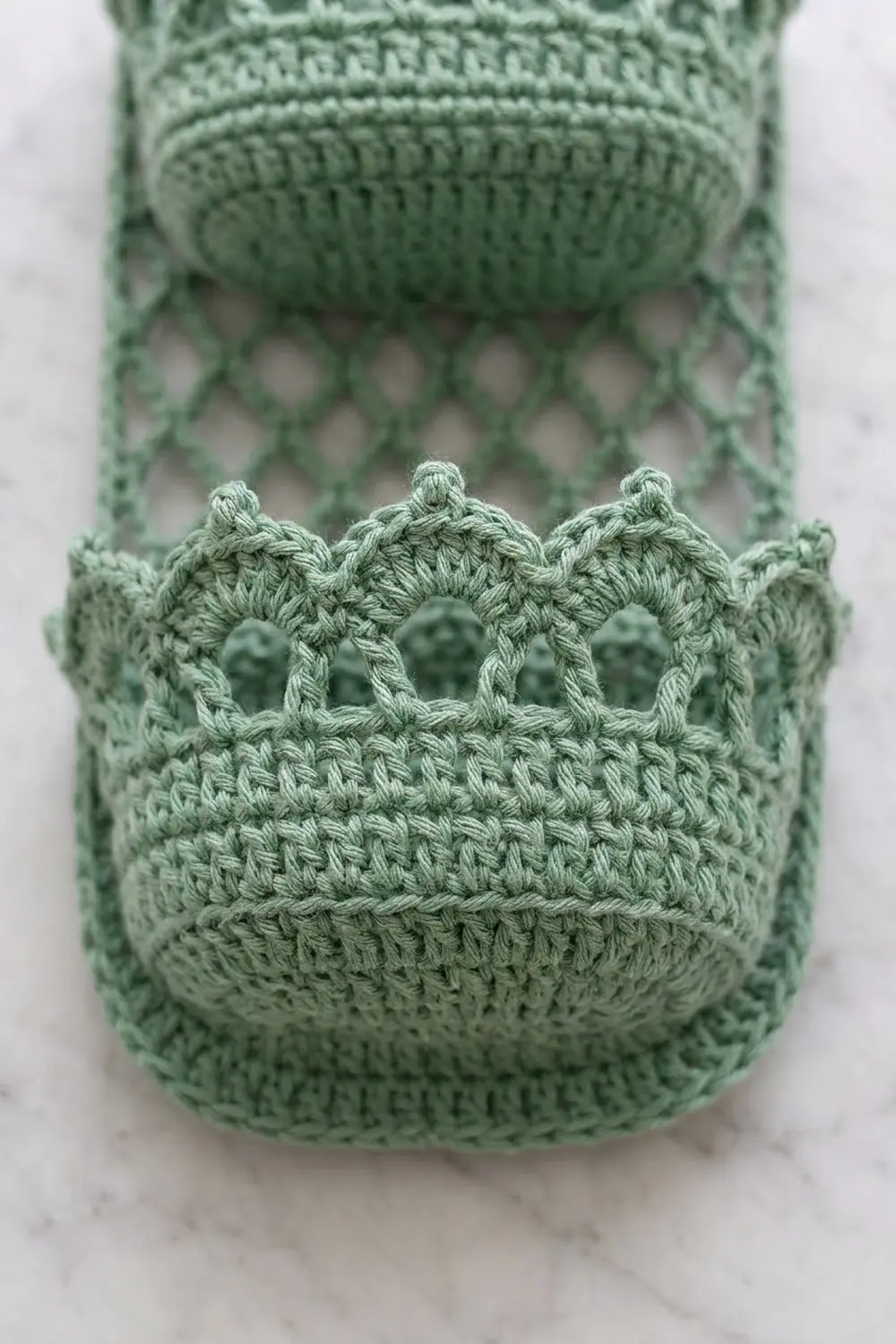
Pocket (Make 3)
Base
Ch 16.
Rnd 1: Dc in 3rd ch from hook (the skipped ch don’t count as a st), dc in next 12 ch, 6 dc in last ch. Working along the opposite side of the chain, dc in next 12 ch, 5 dc in last ch (the same ch as the first dc). Join with sl st to first dc. (36 dc)
Rnd 2: Ch 2 (doesn’t count as a st on any round), 2 dc in same st as join, dc in next 12 sts, 2 dc in each of next 6 sts, dc in next 12 sts, 2 dc in each of last 5 sts. Join. (48 dc)
Rnd 3: Ch 2, 2 dc in first st, dc in next st, dc in next 12 sts, (2 dc in next st, dc in next st) 6 times, dc in next 12 sts, (2 dc in next st, dc in next st) 5 times. Join. (60 dc)
Each straight side has 12 sts and each curved end has 18: 12 + 18 + 12 + 18 = 60.
Walls
Rnd 4: Ch 1, sc in BLO of each st around. Join. (60 sc)
The unworked front loops of Rnd 3 form a ridge around the base. The pocket’s back edge is 22 of these loops: the 12 loops on the second straight side plus 5 on each side of them. Place a marker at each end of the back edge.
Rnd 5: Ch 1, (sc in next 9 sts, 2 sc in next st) 6 times. Join. (66 sc)
Rnd 6: Ch 1, sc in each st around. Join. (66 sc)
Rnd 7: Ch 2, dc in each st around. Join. (66 dc)
Rnd 8 (arches): Ch 1, sc in first st, ch 5, skip 2 sts, sc in next st; repeat from * 20 more times, ch 2, skip last 2 sts, dc in first sc. The ch 2 and dc close the 22nd loop. (22 ch-5 loops)*
That uses 1 + (21 x 3) + 2 = 66 sts.
Rnd 9: Ch 1, sc around the post of the closing dc, ch 5, sc in next ch-5 loop; repeat from * 20 more times, ch 2, dc in first sc. (22 ch-5 loops)*
Rnd 10 (scalloped rim): Ch 1, sc around the post of the closing dc, shell in next loop, sc in next loop; repeat from * 9 more times, shell in last loop. Join with sl st to first sc. (11 shells, 11 sc, 11 picots)*
This uses 11 + 11 = 22 loops, and the rim holds 11 x 6 = 66 dc. Fasten off, leaving a 24 in (61.0 cm) tail for sewing.
Back Panel (Make 1)
Ch 23.
Row 1: Sc in 2nd ch from hook and in each ch across. Turn. (22 sc)
Row 2: Ch 1, sc in first st, ch 5, skip 2 sts, sc in next st; repeat from * across. Turn. (7 ch-5 loops, 8 sc)*
That uses 1 + (7 x 3) = 22 sts.
Row 3: Ch 5 (counts as dc + ch 2), sc in first ch-5 loop, ch 5, sc in next loop; repeat from * 5 more times, ch 2, dc in last sc. Turn. (6 ch-5 loops + 2 ch-2 half loops)*
Row 4: Ch 1, sc in first dc, ch 5, sc in next ch-5 loop; repeat from * 5 more times, ch 5, sc in 3rd ch of turning ch. Turn. (7 ch-5 loops, 8 sc)*
Rows 5–26: Repeat Rows 3–4 eleven more times. (7 ch-5 loops)
You now have 25 net rows: 13 even rows with sc edges and 12 odd rows with dc edges.
Taper
Row 27: Turn, sl st in first 3 ch of first loop, ch 1, sc in same loop, ch 5, sc in next loop; repeat from * 5 more times. Turn. (6 loops)*
Rows 28–32: Work as Row 27. Each row has one loop fewer: 5, 4, 3, 2, then 1 loop at Row 32.
Strap
Row 33: Turn, sl st in first 3 ch, ch 1, 5 sc in the loop. Turn. (5 sc)
Rows 34–43: Ch 1, sc in each st across. Turn. (5 sc)
Fasten off, leaving a 12 in (30.5 cm) tail.
Make All Pieces
Make all pieces in sage green (or all in pink):
- Pockets: 3, about 30 g each
- Back panel: 1, about 45 g, including the strap and border
Layout (front view, top to bottom):
ring + strap
taper (Rows 27-32)
net Rows 19-26
POCKET 3 on Row 18
net Rows 11-17
POCKET 2 on Row 10
net Rows 3-9
POCKET 1 on Row 2
Row 1 band
Joining
Each pocket’s 22-loop back edge is sewn to one even net row. An even row has 8 sc anchors and 7 ch-5 loops, which gives 1 + (7 x 3) = 22 sewing positions.
Placement: Sew the pockets to Rows 2, 10, and 18. That puts them 8 rows, or 5.3 in (13.5 cm), apart base to base. A 4.25 in (10.8 cm) roll then clears the pocket above by about 1 in (2.5 cm).
Stitch-to-stitch: With the panel right side up, use the pocket’s tail to whipstitch:
- Sew the first marked loop to the first sc anchor.
- Sew the next 2 loops into the ch-5 loop, spacing them evenly along the chain.
- Sew the next loop to the next sc anchor.
- Repeat Steps 2–3 to the end, for 22 loops joined.
Rim tack: Four rows above each base row (Rows 6, 14, and 22), tack the pocket to the panel in 3 places. Use the Rnd 9 loop at the center back and the loop above each marker, and attach each one to the nearest sc anchor with 3 small stitches.
Tension: Make the whipstitches snug but not tight. The net should stay flat between the pockets.
Size checkpoint: The panel should still be 7 in (17.8 cm) wide at every pocket line. If it’s narrower, unpick that seam and resew it more loosely.
Border
Work the border along each long side separately, from the bottom corner up to Row 32. Leave Row 1 and the strap plain. The border goes only into the panel’s row ends, so the pocket stitches are not part of the count.
Border gauge: 15 sc = 4 in (10.2 cm), or 3.75 sc per in.
Border Row 1: With the right side facing, join yarn at the bottom corner and work:
- 1 sc in the end of Row 1
- 2 sc in the end of each even row (Rows 2–26): 13 x 2 = 26
- 3 sc around each odd-row dc (Rows 3–25): 12 x 3 = 36
- 3 sc in the end of each taper row (Rows 27–32): 6 x 3 = 18
Turn. (81 sc)
Border Row 2: Ch 1, sc in each st across. (81 sc) Fasten off.
Repeat on the other long side. (81 sc per side)
Why the math works: The straight section gets 1 + 26 + 36 = 63 sc. At 3.75 sc per in, that is 16.8 in (42.7 cm), which matches the 17 in (43.2 cm) rectangle. Odd rows get 3 sc because their dc edges are taller.
Each taper row moves 0.5 in (1.3 cm) inward and rises 0.67 in (1.7 cm), so its edge is about 0.83 in (2.1 cm) long. That fits 3.1 sc, so 3 sc per row keeps the taper flat. The two border rows add 0.5 in (1.3 cm) per side, bringing the width from 7 in (17.8 cm) to 8 in (20.3 cm).
Ring: Pass the strap through the ring from front to back. Sew Row 43 to Row 33 on the back.
Final Blocking
- Soak the organizer in cool water for 10 minutes, then gently press out the water. Don’t wring it.
- Roll it in a towel.
- Pin the panel to 8 x 21 in (20.3 x 53.3 cm).
- Pin the side diamonds open so the loops look even.
- Fill each pocket with a roll in a plastic bag so the rims set at 7.75 x 3.75 in (19.7 x 9.5 cm).
- Pin each scallop and shape each picot into a point.
- Let it dry for at least 24 hours before hanging.
Final Quality-Control Checklist
- Each pocket has 66 rim dc, 11 shells, and 11 picots.
- Each pocket base is 7 x 3.25 in (17.8 x 8.3 cm).
- The panel has 25 net rows 7 loops wide, plus 6 taper rows.
- The pockets are on Rows 2, 10, and 18, with all 22 back-edge loops sewn.
- Each border row has 81 sc per side.
- The finished size is 8 x 22 in (20.3 x 55.9 cm).
- The strap is securely sewn and all ends are woven in.
Troubleshooting
- Base cups or ruffles: Recount Rnds 2–3. Increases go only on the curved ends.
- Walls flop outward: Check that Rnd 4 was worked in the back loops only.
- Uneven scallops: Start Rnd 10 around the closing dc post.
- Net narrows as it grows: Check that every odd row ends with ch 2 and a dc.
- Sides ripple: Work 2 sc instead of 3 at a few odd-row ends.
- Pocket sags forward: Add an extra rim tack at each back end.
- Roll won’t fit: These pockets fit rolls up to 4.5 in (11.4 cm) wide. For bigger rolls, add one more increase round to the base.
Care
Hand wash in cool water with mild soap, reshape, and dry flat. Don’t hang it while wet, or the weight can stretch the net.
Final Notes
Each step in this pattern sets the size of the next. The 60-stitch base makes a 7 x 3.25 in (17.8 x 8.3 cm) pocket. The 66-stitch walls give 22 arches and 11 scallops. Each 22-loop back edge matches one 22-position net row, and 7 loops make a 7 in (17.8 cm) panel. The 81 border stitches on each side bring the width to 8 in (20.3 cm).
If your stitch counts match at every checkpoint, the pockets will line up and the organizer will hang straight.
Happy crocheting!