

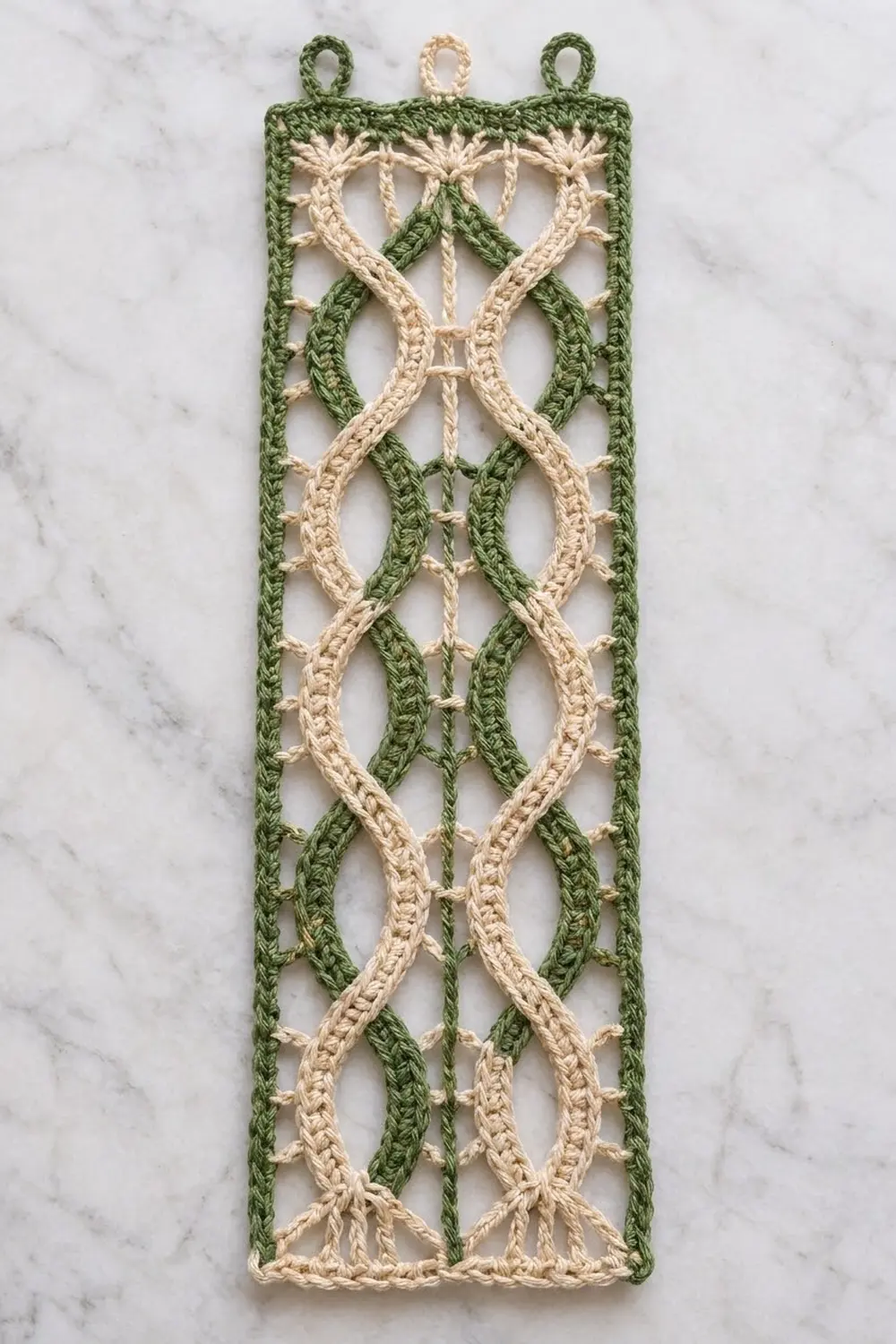
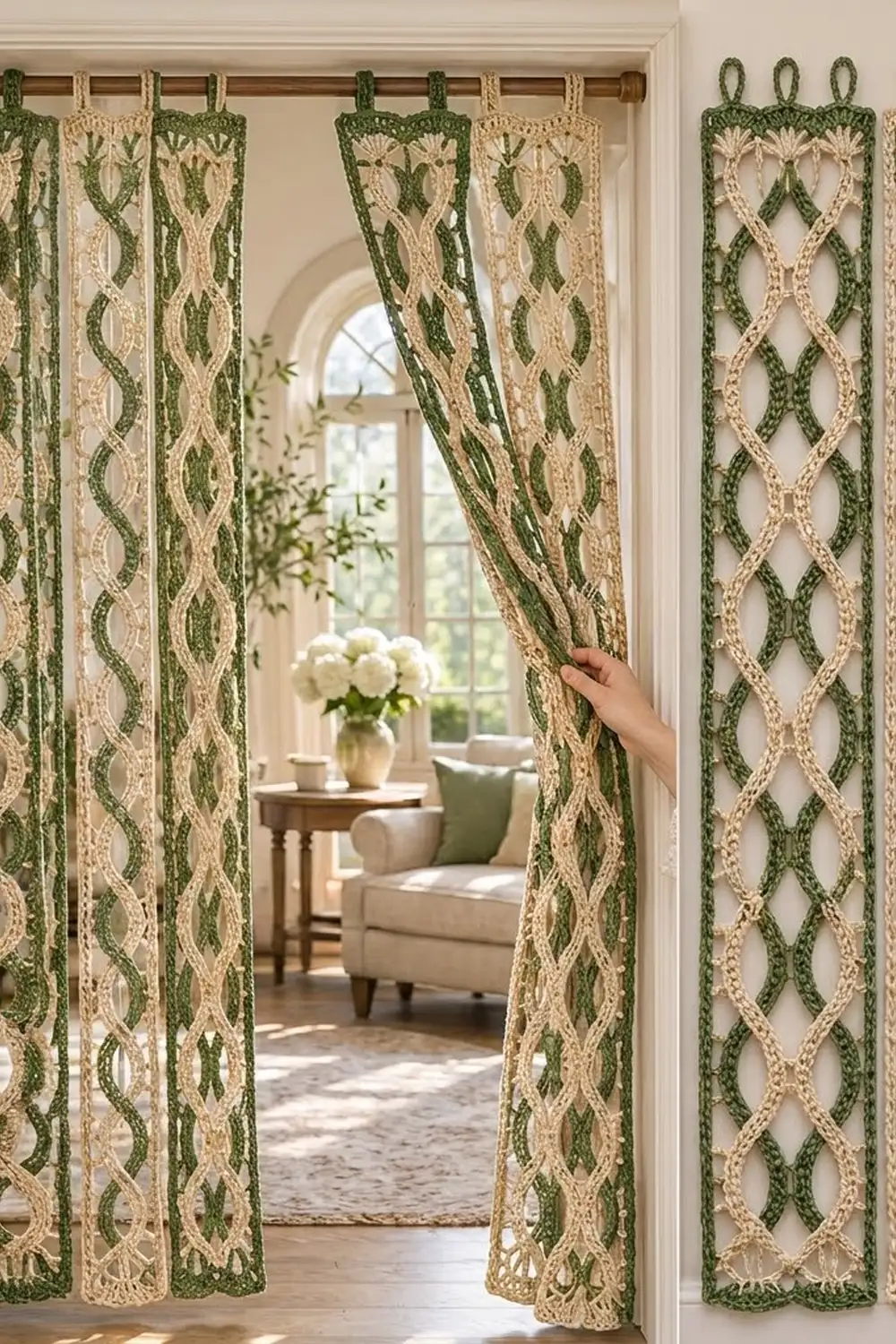
This door curtain is made of five long, narrow lace strips that hang side by side from a wooden rod. Each strip has two cream cables that cross and separate down its whole length. Where they separate, they leave open oval “eyes,” and a thin center spine runs through each one. Where they cross, solid green crescents fill the side pockets. A row of small fans finishes each short end, and a solid frame runs around each strip.
The colors are sage-to-forest green and warm cream. Three strips have a green frame and two have a cream frame. In the photo they hang green, cream, green on the left and green, cream on the right. The look is airy and botanical. Light comes through, but the doorway still gets some privacy.
This pattern uses US crochet terms. Each finished strip measures 7 in (17.8 cm) wide by 67 in (170.2 cm) long. Three hanging loops add 1.5 in (3.8 cm), so each strip hangs 68.5 in (174.0 cm) long.
Each strip is worked flat in short rows across its width. The body is a 25-stitch lace grid with a 6-row repeat. Fan rows close both short ends. Next, you work the green crescents around the cable posts. Last, a 3-round border adds the frame and the hanging loops. The strips are never sewn together.
Finished Size and Construction
- Finished size (one strip): 7 in x 67 in (17.8 x 170.2 cm), plus 1.5 in (3.8 cm) loops
- Skill level: Intermediate
- Terminology: US
- Yarn weight: DK (3), cotton or cotton blend
- Hook: 4.0 mm (G-6)
- Number of pieces: 5 separate strips (3 green-framed, 2 cream-framed)
- Layout: 5 strips side by side, each hung on its own, not joined
- Piece size: 7 in x 67 in (17.8 x 170.2 cm)
- Size before border: 5.5 in x 65.5 in (14.0 x 166.4 cm)
- Border depth: 0.75 in (1.9 cm) on every side
Materials
Use a smooth DK cotton. Cotton keeps the cables crisp and helps the strips hang straight. Fuzzy yarns blur the open eyes, so avoid them.
Per green-framed strip:
– Cream: 90 g (about 207 m)
– Green: 85 g (about 196 m)
Per cream-framed strip:
– Cream: 145 g (about 334 m)
– Green: 27 g (about 62 m)
Full curtain (3 green-framed + 2 cream-framed):
– Cream: 650 g (about 1,495 m)
– Green: 350 g (about 805 m)
These amounts assume about 115 m per 50 g. The full-curtain totals include a margin of roughly 10%.
Tools:
– 4.0 mm (G-6) hook
– Tapestry needle
– Stitch markers
– Tape measure
– Blocking mats and rust-proof pins
– Wooden rod, at least 36 in (91.4 cm) wide and no thicker than 1 in (2.5 cm)
Abbreviations (US Terms)
- ch – chain
- sl st – slip stitch
- sc – single crochet
- hdc – half double crochet
- dc – double crochet
- tr – treble crochet
- st(s) – stitch(es)
- sk – skip
- rep – repeat
Special stitch: post dc. Yo. Insert the hook on one side of the indicated dc and bring it out on the other side, so the hook passes behind the post. Yo, pull up a loop, and finish as a normal dc. The new stitch wraps around the whole post.
Grid rule: Every body row has 25 sts.
– A “ch” stands in for one stitch: chain 1 and skip the stitch below it.
– A “dc” goes into the stitch below it, even if that stitch is a chain. Work under the chain’s top loop.
Gauge and Checkpoints
Gauge: 18 sts and 9 rows = 4 in (10.2 cm) in the lace grid, after blocking.
Before you commit to a full strip, make Rows 1–13 as a test piece.
- Checkpoint 1 (Row 13): 5.5 in (14.0 cm) wide x 5.8 in (14.7 cm) tall. One 6-row repeat is about 2.7 in (6.9 cm).
- Checkpoint 2 (Row 73): 32.4 in (82.3 cm) long.
- Checkpoint 3 (Row 145): 64.4 in (163.6 cm) long.
- Checkpoint 4 (after both fan rows): 5.5 in x 65.5 in (14.0 x 166.4 cm).
- Checkpoint 5 (after border): 7 in x 67 in (17.8 x 170.2 cm).
If your piece is too big, go down 0.5 mm in hook size. If it is too small, go up 0.5 mm. Over 145 rows, a tiny error in row height turns into inches, so check again at Row 73.
Strip Body
Work the body of every strip in cream.
There are four row types, and every row has 25 sts. The numbers below are stitch positions, counted 1 to 25.
- M (merge): the cables cross as one 7-dc block at sts 10–16.
- A: the cables sit at sts 8–10 and 16–18.
- B: the cables sit at sts 6–8 and 18–20.
- C: the cables sit at sts 4–6 and 20–22 (widest).
The repeat is M, A, B, C, B, A. Every row type is symmetrical, so it doesn’t matter which side is facing.
Foundation: Ch 28.
Row 1 (M): Dc in 4th ch from hook. The 3 skipped ch do not count, and this dc is st 1. Ch 8, sk next 8 ch, dc in each of next 7 ch, ch 8, sk next 8 ch, dc in last ch. Turn. (9 dc + 16 ch = 25 sts)
From Row 2 on, ch 3 at the start of each row counts as st 1. Work the last dc of each row into the top of the turning ch-3.
Row 2 (A): Ch 3, ch 6, dc in sts 8–10, ch 2, dc in st 13, ch 2, dc in sts 16–18, ch 6, dc in st 25. Turn. (1 + 6 + 3 + 2 + 1 + 2 + 3 + 6 + 1 = 25 sts)
Row 3 (B): Ch 3, ch 4, dc in sts 6–8, ch 4, dc in st 13, ch 4, dc in sts 18–20, ch 4, dc in st 25. Turn. (1 + 4 + 3 + 4 + 1 + 4 + 3 + 4 + 1 = 25 sts)
Row 4 (C): Ch 3, ch 2, dc in sts 4–6, ch 6, dc in st 13, ch 6, dc in sts 20–22, ch 2, dc in st 25. Turn. (1 + 2 + 3 + 6 + 1 + 6 + 3 + 2 + 1 = 25 sts)
Row 5 (B): Work as Row 3. (25 sts)
Row 6 (A): Work as Row 2. (25 sts)
Row 7 (M): Ch 3, ch 8, dc in sts 10–16, ch 8, dc in st 25. Turn. (1 + 8 + 7 + 8 + 1 = 25 sts)
Rows 8–145: Repeat Rows 2–7 another 23 times. Row 145 is an M row. (25 sts; 64.4 in / 163.6 cm long)
The dc at st 13 in each A, B, and C row stacks up to form the center spine of each eye. The ch-2 spaces in the C rows form the short ladder ties out to the edge columns. Do not fasten off.
Top Fan Row
Row 146: Ch 1, sc in first st, sk 2 sts, 5 dc in next st, sk 2 sts, sc in next st; rep from * 3 more times. (4 shells + 5 sc, worked over 25 sts)* Fasten off.
Check your placement: the sc sit in sts 1, 7, 13, 19, and 25, and the shells sit in sts 4, 10, 16, and 22.
Bottom Fan Row
Row 147: Turn the strip upside down. Join cream in the first free loop of the foundation chain. Work as Row 146 across the 25 free loops. Fasten off. (5.5 in x 65.5 in / 14.0 x 166.4 cm)
Green Crescents
Each interior M row gets two crescents, one on each side. These are Rows 7, 13, 19, and so on through Row 139, which is 23 rows. Rows 1 and 145 do not get crescents. That makes 46 crescents per strip.
Left crescent: Find the B row 2 rows below the M row. Join green with a sl st around the post of the outer left-cable dc in that row (st 6), and work 3 post dc around it. Then work 3 post dc around the outer left-cable dc in each of the next 4 rows: A (st 8), M (st 10), A (st 8), and B (st 6). Sl st around the last post and fasten off. (15 dc)
Right crescent: Work the same way around the mirror posts: st 20 in the B rows, st 18 in the A rows, and st 16 in the M row. (15 dc)
The 15 dc are crowded along only about 2.2 in (5.6 cm) of cable edge. This makes them bow outward into a crescent about 0.75 in (1.9 cm) deep. Work all crescents on the same face of the strip.
Border
Work the border in green for green-framed strips and in cream for cream-framed strips.
Border gauge: Work 2 sc into the end of each dc row. Since 9 rows measure 4 in (10.2 cm), that gives 18 sc per 4 in, which matches the body’s stitch gauge exactly. Each per-side count below includes both corner sts.
Round 1 (sc): Join in the last sc of Row 146, and work 3 sc in that sc. The middle sc is the corner st.
- Short side: Sc in each of the next 5 dc, tr in next sc; rep from * 2 more times. Sc in each of the last 5 dc, then work 3 sc in the last sc. (23 sts between corner groups; 27 per side)*
- Long side: Work 2 sc in each dc row-end, for 290 sc. Then work 3 sc in the end sc of Row 147. (290 sts between corner groups; 294 per side)
Work the second short side and the second long side the same way. Sl st to first sc. (4 x 3 + 2 x 23 + 2 x 290 = 638 sts)
Each tr fills the dip between two shells, so the top and bottom of the frame come out straight.
Round 2 (hdc): Ch 2 (does not count as a st). Hdc in each st, working 3 hdc in each corner st. Sl st to first hdc. (Short sides 29, long sides 296; 638 + 8 = 646 sts)
Round 3 (sc and loops): Ch 1. Sc in each st, working 3 sc in each corner st. (Short sides 31, long sides 298; 646 + 8 = 654 sts)
Make the hanging loops on the top short side only. Number its 31 sts from the corner. At sts 5, 16, and 27, sc in the st, ch 14, and sl st back into that same st. Then work 20 sc over the ch-14 loop before you continue. The loops do not count as stitches. Sl st to first sc and fasten off. Each loop stands about 1.5 in (3.8 cm) tall.
Why the math works: The long sides start with 290 sc, which is 2 per row over 145 rows. At 18 sc per 4 in, that equals 64.4 in (163.6 cm), the same length as the body. Every round adds exactly 2 sts per side, and all of them go at the corners, so the frame stays flat and square.
Make All Pieces
Make 5 strips. The bodies and crescents are the same on every strip, and only the border color changes.
- Green-framed (G): 3 strips with a cream body, green crescents, and a green border.
- Cream-framed (C): 2 strips with a cream body, green crescents, and a cream border.
Layout (as shown, left to right on the rod):
| G | C | G | | G | C |
For an even alternation, hang them G | C | G | C | G instead.
Joining (Hanging the Strips)
Method: The strips are not sewn together. Each strip hangs from the rod by its 3 loops, so the panels part easily when someone walks through.
Stitch-to-stitch logic: On every strip, the loops sit at sts 5, 16, and 27 of the same 31-st top edge. Every loop has 20 sc, so all the strips hang at the same height.
Tension advice: Make all 15 loops in one sitting so your tension stays even. Before you cover each loop with sc, check it against a 1 in (2.5 cm) dowel.
Size checkpoint: Lay all 5 strips flat. Their lengths should be within 0.5 in (1.3 cm) of each other. Hung edge to edge, the 5 strips span 35 in (88.9 cm).
Final Blocking
- Weave in the ends along the cable dc or inside the border, never across an open eye.
- Soak each strip in cool water for 15 minutes. Roll it in a towel to press out the water.
- Pin the strip flat to 7 in x 67 in (17.8 x 170.2 cm), working in sections if needed.
- Pin each eye open, keeping the center spine vertical.
- Shape each crescent into a smooth curve.
- Pin the fans and loops into shape.
- Let the strip dry completely. Then hang it for 24 hours before trimming any tails.
Final Quality-Control Checklist
- Every body row has 25 sts.
- There are 145 body rows plus 2 fan rows.
- There are 46 crescents with 15 dc each, all on the same face.
- The border rounds total 638, 646, and 654 sts.
- The loops sit at sts 5, 16, and 27 of the top edge.
- Each strip measures 7 in x 67 in (17.8 x 170.2 cm).
- All 5 strips are within 0.5 in (1.3 cm) of each other in length.
Troubleshooting
- Spine wanders: A center dc missed st 13. Count the chains before each one.
- Eyes lopsided: A cable block is one st off. In the C rows, the cables must sit at sts 4–6 and 20–22.
- Crescents lie flat: Work all 3 dc around every post.
- Long edges ruffle: You worked more than 2 sc per row-end. Recount to 290.
- Short edges dip: Use tr, not dc, between the shells.
- Strips stretch when hung: Cotton relaxes over time. Block them slightly short and rehang.
Care
Hand wash in cool water, or machine wash on a gentle cycle inside a mesh bag. Lay flat to dry, then rehang the strips while they are still slightly damp.
Final Notes
This is how the measurements add up:
– 25 sts at 18 sts per 4 in make a 5.5 in (14.0 cm) wide body.
– 145 rows at 9 rows per 4 in make it 64.4 in (163.6 cm) long. The fan rows bring that to 65.5 in (166.4 cm).
– A 0.75 in (1.9 cm) border makes each strip 7 in x 67 in (17.8 x 170.2 cm).
– The loops add 1.5 in (3.8 cm).
If every checkpoint matches, the curtain will too.
Happy crocheting!