
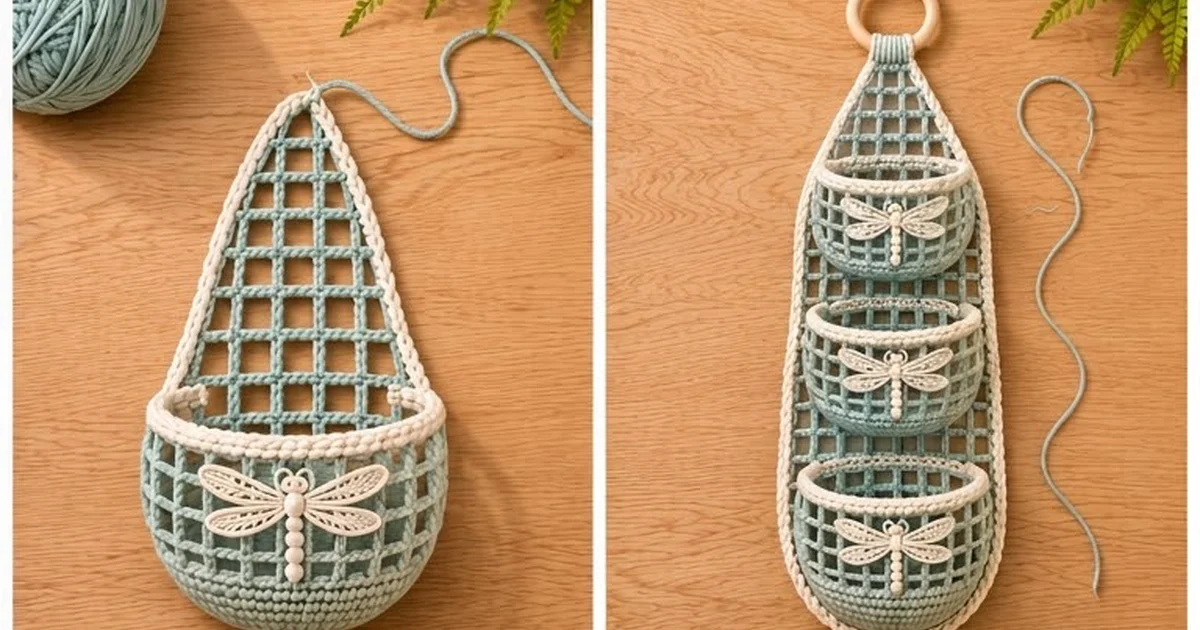
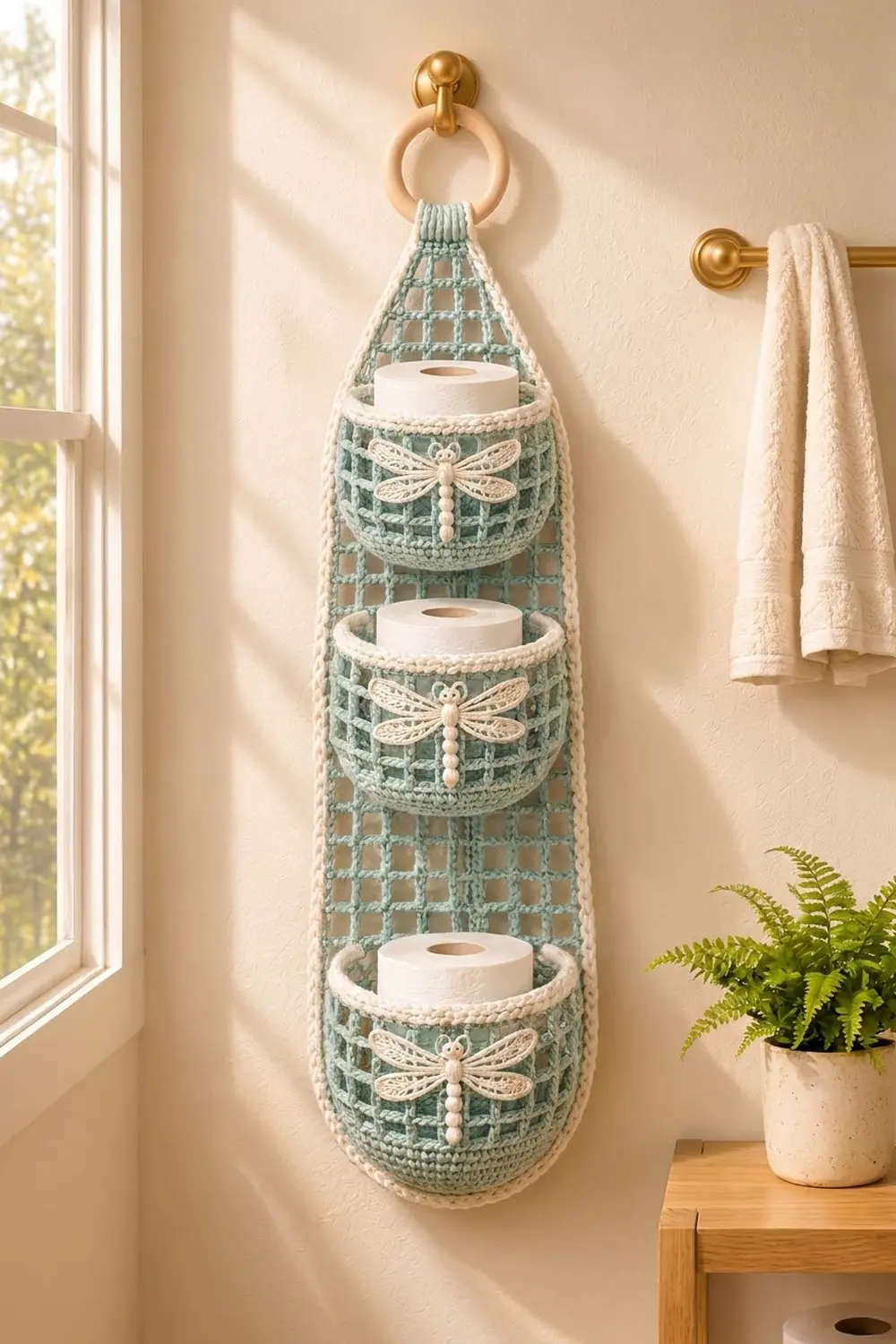
This hanging toilet paper holder has an open teal mesh back panel with three rounded pockets stacked down the front. Each pocket holds one standard roll. A cream rope-style border outlines the panel, each pocket has a matching cream rim, and a small lacy dragonfly sits on the front of every pocket.
The colors are calm and spa-like: seafoam teal for the structure and cream for the trims and appliqués. Hang it from a wooden ring on a hook or towel bar and it fits right into a bathroom.
This pattern uses US crochet terms throughout. The bordered back panel measures 8.0 in (20.3 cm) wide by 27.0 in (68.6 cm) long. Each pocket is about 4.5 in (11.4 cm) deep and holds a roll up to about 5 in (12.7 cm) across.
You’ll work the back panel top-down in filet mesh, then add the border. A separate strap wraps the ring. The pockets are worked in the round from a flat base, then trimmed in cream. Finally, you’ll sew the dragonflies to the pockets and the pockets to the panel.
Finished Size and Construction
- Finished size: 8.0 in x 27.0 in (20.3 cm x 68.6 cm), not counting the strap and ring
- Skill level: Intermediate
- Terminology: US
- Yarn weight: Bulky (#5) cotton for the panel and pockets; worsted (#4) cotton for the dragonflies
- Hooks: 6.0 mm (J-10) and 4.0 mm (G-6)
- Number of pieces: 8 components: 1 panel, 1 strap, 3 pockets and 3 dragonflies (each dragonfly is 1 body plus 4 wings)
- Layout: 3 pockets stacked in 1 vertical column
- Pocket size: 5.7 in (14.5 cm) base diameter, 4.5 in (11.4 cm) deep
- Panel size before border: 7.0 in x 26.0 in (17.8 cm x 66.0 cm)
- Border depth: 0.5 in (1.3 cm) per edge
Materials
Choose a smooth cotton or cotton blend. Cotton holds its shape, resists bathroom humidity well, and gives the mesh crisp, square openings.
- Teal, bulky (#5): 400 g, about 440 m (481 yd)
- Cream, bulky (#5): 100 g, about 110 m (120 yd)
- Cream, worsted (#4): 25 g, about 50 m (55 yd)
Tools:
– 6.0 mm (J-10) and 4.0 mm (G-6) hooks
– Wooden ring, 3 in (7.6 cm) across
– Tapestry needle
– Stitch markers
– Rust-proof pins
– Blocking mats
All quantities include a margin of about 15%.
Abbreviations (US Terms)
- ch – chain
- sl st – slip stitch
- sc – single crochet
- hdc – half double crochet
- dc – double crochet
- sk – skip
- sp – space
- st(s) – stitch(es)
- BLO – back loop only
- rsc – reverse single crochet (crab stitch)
- inc – 2 sc in the same st
Puff stitch (puff): (Yarn over, insert hook in the st, pull up a loop) 3 times in the same st, yarn over, and pull through all 7 loops on the hook.
Reverse sc (rsc): Work sc from left to right (right-handed), inserting the hook into the next st to the right. This makes the twisted rope edge.
Gauge and Checkpoints
Bulky yarn, 6.0 mm hook:
– 12 dc and 6 dc rows = 4 in (10.2 cm)
– 12 sc and 13 sc rows = 4 in (10.2 cm)
– One mesh square (dc, ch 1) is about 2/3 in (1.7 cm) each way.
Worsted yarn, 4.0 mm hook: 18 sc = 4 in (10.2 cm)
Make one pocket base (Rounds 1–9) first and use it as your gauge test. It should measure 5.7 in (14.5 cm) across.
If it’s too big, go down 0.5 mm in hook size. If it’s too small, go up 0.5 mm. Then check again at every checkpoint below.
Back Panel
The panel is worked top-down with the 6.0 mm hook and teal yarn.
A mesh row with N squares has 2N + 1 sts: each dc and each ch-1 counts as 1 st, and the turning ch-4 counts as 2 sts (dc + ch 1).
Standard mesh row: Ch 4 (counts as dc + ch 1), dc in next dc, ch 1, dc in next dc across, working the last dc in the 3rd ch of the turning ch. Turn.
Increase mesh row: Ch 4, dc in the first st (the same st as the ch-4), ch 1, dc in next dc across, ending with a dc in the 3rd ch of the turning ch. Then ch 1 and dc in that same ch. Turn. This adds 1 square at each end.
Foundation: Ch 7.
Row 1 (RS): Dc in 4th ch from hook (skipped ch count as the first dc) and in each remaining ch. Turn. (5 sts)
Row 2 (increase): Ch 4, dc in first st, [ch 1, sk next st, dc in next st] 2 times, ch 1, dc in same last st. Turn. (4 squares, 9 sts)
Rows 3–4: Standard mesh row. (9 sts each)
Row 5: Increase mesh row. (6 squares, 13 sts)
Rows 6–7: Standard mesh row. (13 sts each)
Row 8: Increase mesh row. (8 squares, 17 sts)
Rows 9–10: Standard mesh row. (17 sts each)
Row 11: Increase mesh row. (10 squares, 21 sts)
Checkpoint: The panel should be 7.0 in (17.8 cm) wide and about 7.3 in (18.5 cm) long.
Rows 12–37: Standard mesh row. (21 sts each)
Checkpoint: The panel should be about 24.7 in (62.7 cm) long.
Row 38 (decrease): Sl st in first ch-1 sp and in next dc. Ch 4, dc in next dc, ch 1 across until 1 square remains, then dc in the next dc. Leave the last ch-1 sp and the turning ch unworked. Turn. (8 squares, 17 sts)
Row 39: Repeat Row 38. (6 squares, 13 sts)
Fasten off. Checkpoint: The panel should be 7.0 in x 26.0 in (17.8 cm x 66.0 cm).
Hanging Strap
Use the 6.0 mm hook and teal yarn.
Ch 6.
Row 1: Sc in 2nd ch from hook and in each remaining ch. Turn. (5 sts)
Rows 2–12: Ch 1, sc in each st. Turn. (5 sts each)
Fasten off, leaving a 20 in (50.8 cm) tail. The strap should measure about 1.7 in x 3.7 in (4.3 cm x 9.4 cm).
Pockets (Make 3)
Use the 6.0 mm hook and teal yarn. Work in continuous rounds for the base and join the wall rounds with a sl st. Mark the beginning of each round: this point becomes the center back of the pocket.
Rnd 1: 6 sc in a magic ring. (6)
Rnd 2: Inc in each st. (12)
Rnd 3: Sc 1, inc around. (18)
Rnd 4: Sc 2, inc around. (24)
Rnd 5: Sc 3, inc around. (30)
Rnd 6: Sc 4, inc around. (36)
Rnd 7: Sc 5, inc around. (42)
Rnd 8: Sc 6, inc around. (48)
Rnd 9: Sc 7, inc around. Sl st to join. (54)
Checkpoint: The base should measure 5.7 in (14.5 cm) across and 18.0 in (45.7 cm) around.
Rnd 10: Ch 1, sc in BLO of each st, sl st to join. (54) The unused front loops form a ridge, which you’ll use later to sew the pocket on.
Rnds 11–13: Ch 1, sc in each st, sl st to join. (54 each)
Checkpoint: The solid wall should be 1.2 in (3.0 cm) tall.
Rnd 14: Ch 4 (counts as dc + ch 1), sk next st, dc in next st, ch 1, sk next st 26 times. Sl st to 3rd ch of ch-4. (27 dc + 27 ch-1 sps = 54 sts)
Rnds 15–17: Ch 4, dc in next dc, ch 1 around. Sl st to 3rd ch of ch-4. (54 each)
Checkpoint: The wall should be 3.9 in (9.9 cm) tall. Fasten off the teal.
Rnd 18 (rim): Join cream bulky yarn at center back. Ch 1, sc in each dc and each ch-1 sp, sl st to join. (54)
Rnd 19: Ch 1, rsc in each st, sl st to join. (54)
Fasten off, leaving a 24 in (61.0 cm) tail. Checkpoint: The pocket should be 4.5 in (11.4 cm) deep.
Dragonfly Appliqué (Make 3)
Use the 4.0 mm hook and cream worsted yarn.
Large wing (make 2 per dragonfly): Ch 11.
– Side A: Sc in 2nd ch from hook, hdc in next ch, [dc, ch 1] in each of next 5 ch, hdc in next ch, sc in next ch, 5 sc in last ch (this is the tip).
– Side B: Rotate and work along the opposite side of the chain: sc in next ch, hdc in next ch, [dc, ch 1] in each of next 5 ch, hdc in next ch, sc in last ch. Sl st to first sc.
– Count: 14 + 5 + 14 = 33 sts. Length is about 2.2 in (5.6 cm).
The ch-1 spaces create the open “vein” line down each wing.
Small wing (make 2 per dragonfly): Ch 9.
– Side A: Sc in 2nd ch from hook, hdc in next ch, [dc, ch 1] in each of next 3 ch, hdc in next ch, sc in next ch, 5 sc in last ch.
– Side B: Work back along the opposite side to match Side A, then sl st to first sc.
– Count: 10 + 5 + 10 = 25 sts. Length is about 1.8 in (4.6 cm).
Head and body:
– Head: 6 sc in a magic ring, sl st to join. (6)
– Body: Ch 11. Working back along the chain, puff in 3rd ch from hook, [sl st in next ch, puff in next ch] 4 times. (5 puffs + 4 sl sts = 9 sts) Sl st into the base of the head.
– Fasten off, leaving a 16 in (40.6 cm) tail. Total length is about 2.9 in (7.4 cm).
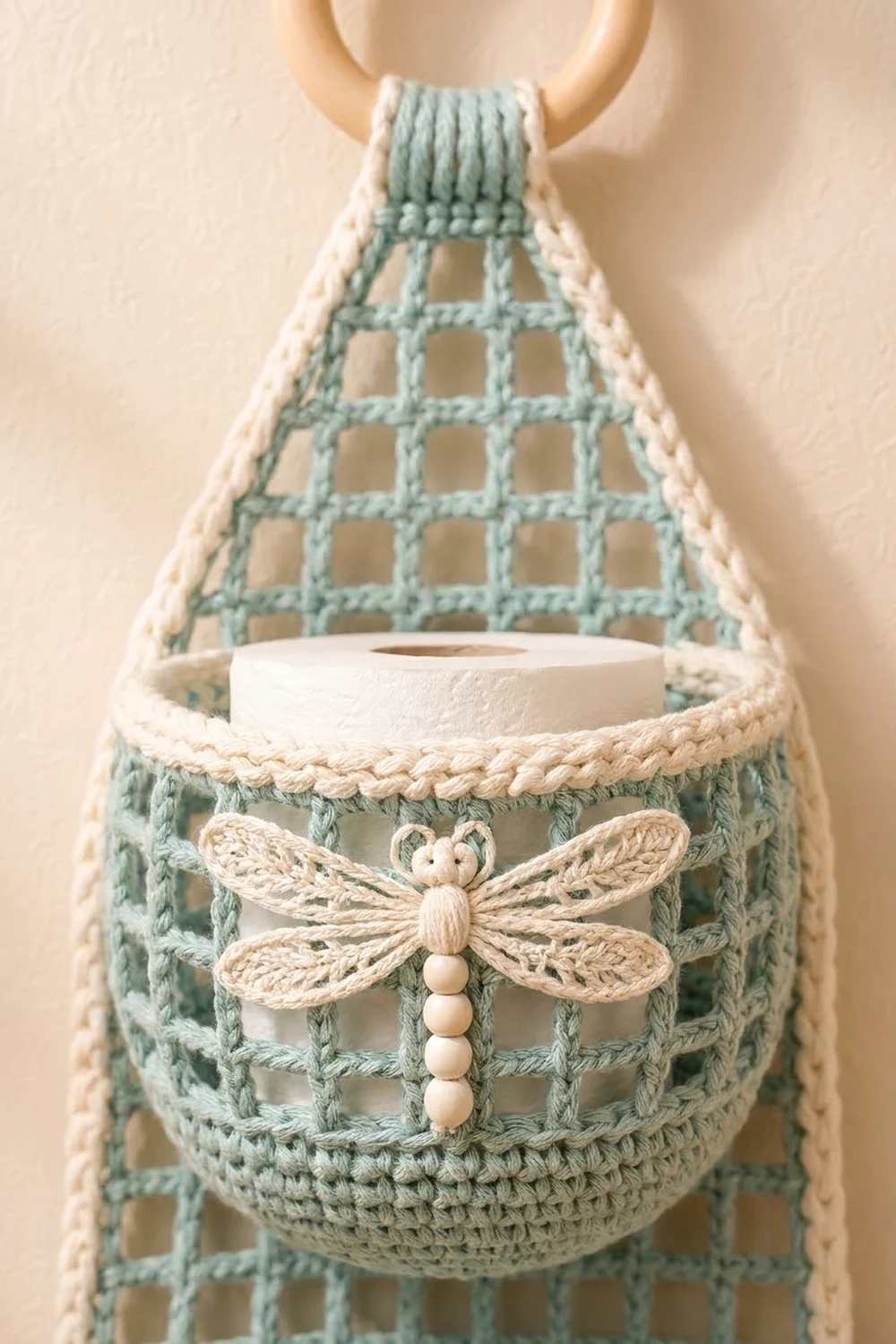
Assemble: Lay the narrow starting end of each large wing against the first puff below the head, angled slightly upward. Lay the small wings against the second puff, angled slightly downward. Sew them in place with the body tail. The wingspan should be about 4.8 in (12.2 cm).
Make All Pieces
Teal:
– 1 panel
– 1 strap
– 3 pockets (Rnds 1–17)
Cream bulky:
– Panel border
– 3 pocket rims (Rnds 18–19)
Cream worsted:
– 3 bodies
– 6 large wings
– 6 small wings
Layout, front view:
          ( wooden ring )
             [ strap ]
           /  Rows 1–11 \      taper
          | Pocket 1     |     rim Row 12, base Row 19
          | Pocket 2     |     rim Row 21, base Row 28
          | Pocket 3     |     rim Row 30, base Row 37
           \ Rows 38–39 /      rounded bottom
Joining
Sew each dragonfly to the center front of its pocket (opposite the round-start marker). The head should sit just below the rim and the wings should lie across Rnd 15. Use cream thread and small stitches through the wing edges, the head and every second puff.
Next, attach the pockets to the panel with a teal whipstitch. Work from the bottom pocket up, after the border is finished.
Rim seam: Count 9 sts each way from center back to get 19 rim sts. Whipstitch these 19 sts, one to one, to panel sts 2–20 of the rim row. That leaves 1 panel st free at each edge.
Base seam: Whipstitch the 19 matching front loops on the Rnd 10 ridge, one to one, to sts 2–20 of the base row.
The two seams are 7 rows apart, about 4.7 in (11.9 cm). The 4.5 in (11.4 cm) pocket wall eases flat between them.
Keep your tension snug but not pulling. The panel must stay 7.0 in (17.8 cm) wide at each seam, so measure after each pocket. If a seam has narrowed the panel, take it out and re-sew it more loosely.
Strap: Wrap the strap around the ring. Place Row 1 on the front of the panel and Row 12 on the back, both centered over Rows 1–2. Sew through all layers.
Border
The border uses cream bulky yarn and the 6.0 mm hook. Its gauge is 3 sc per inch.
Round 1: Join at the top right corner and sc evenly around:
– Top edge (foundation ch): 3 sc in the first ch, 1 sc in each of the next 3 ch, 3 sc in the last ch. (9 sc)
– Each long side: 2 sc in each of the 39 row-ends, plus 1 sc in each of the 4 stitches left exposed by the steps at Rows 38–39. (82 sc per side)
– Bottom edge (Row 39): 3 sc in the first st, 1 sc in each of the next 11 sts, 3 sc in the last st. (17 sc)
– Sl st to join. (9 + 82 + 17 + 82 = 190 sc)
Round 2: Ch 1, rsc in each st, sl st to join. (190)
Why the math works: Each dc row is 2/3 in tall. Two sc per row-end is 3 sc per inch, which matches the sc gauge, so the edge lies flat. The 3-sc corners turn the narrow top and the curved bottom without cupping. The border adds 0.5 in (1.3 cm) per edge, which brings 7.0 x 26.0 in (17.8 x 66.0 cm) to 8.0 x 27.0 in (20.3 x 68.6 cm).
Final Blocking
- Weave in all ends before blocking, except the seaming tails.
- Spritz the panel until it’s damp.
- Pin it to 7.0 in (17.8 cm) wide inside the border, squaring each mesh opening.
- Pin the border so the piece measures 8.0 in x 27.0 in (20.3 cm x 68.6 cm).
- Stuff each pocket with a toilet roll wrapped in a towel and spritz the pocket.
- Pin each dragonfly’s wings flat and open.
- Let everything dry completely.
- Attach the pockets and strap after blocking.
Final Quality-Control Checklist
- Panel rows are 21 sts for Rows 12–37.
- Border Round 1 has 190 sc.
- Each pocket has 54 sts in every round from Rnd 9 onward.
- Pocket rims sit on Rows 12, 21 and 30.
- Each dragonfly is centered and its wings lie flat.
- The strap is secure through all layers.
- Each pocket holds a roll and the panel hangs straight.
Troubleshooting
- Mesh squares look tall and narrow: Shorten your dc, or go down a hook size.
- Panel edges wave: Work fewer border sc (3 per 2 row-ends).
- Panel edges pull in: Your border sc are too tight. Go up a hook size for Round 1.
- Base cups before Rnd 10: Go up a hook size for the base only.
- Pocket sags forward: Re-sew the base seam with tighter stitches.
- Wings curl: Block them pinned flat, or work Side B more loosely.
Care
Hand wash in cool water, press out the water in a towel, and dry flat. Reshape the pockets with a roll while they’re damp.
Final Notes
The measurements build on each other:
– One square of about 2/3 in (1.7 cm) gives a 7.0 in (17.8 cm) panel.
– 39 rows give 26.0 in (66.0 cm).
– The 0.5 in (1.3 cm) border brings it to 8.0 x 27.0 in (20.3 x 68.6 cm).
– Each 54-stitch pocket is 5.7 in (14.5 cm) across and is sewn with 19 stitches across 7 rows.
If each checkpoint matches, the finished holder will too.
Happy crocheting!