

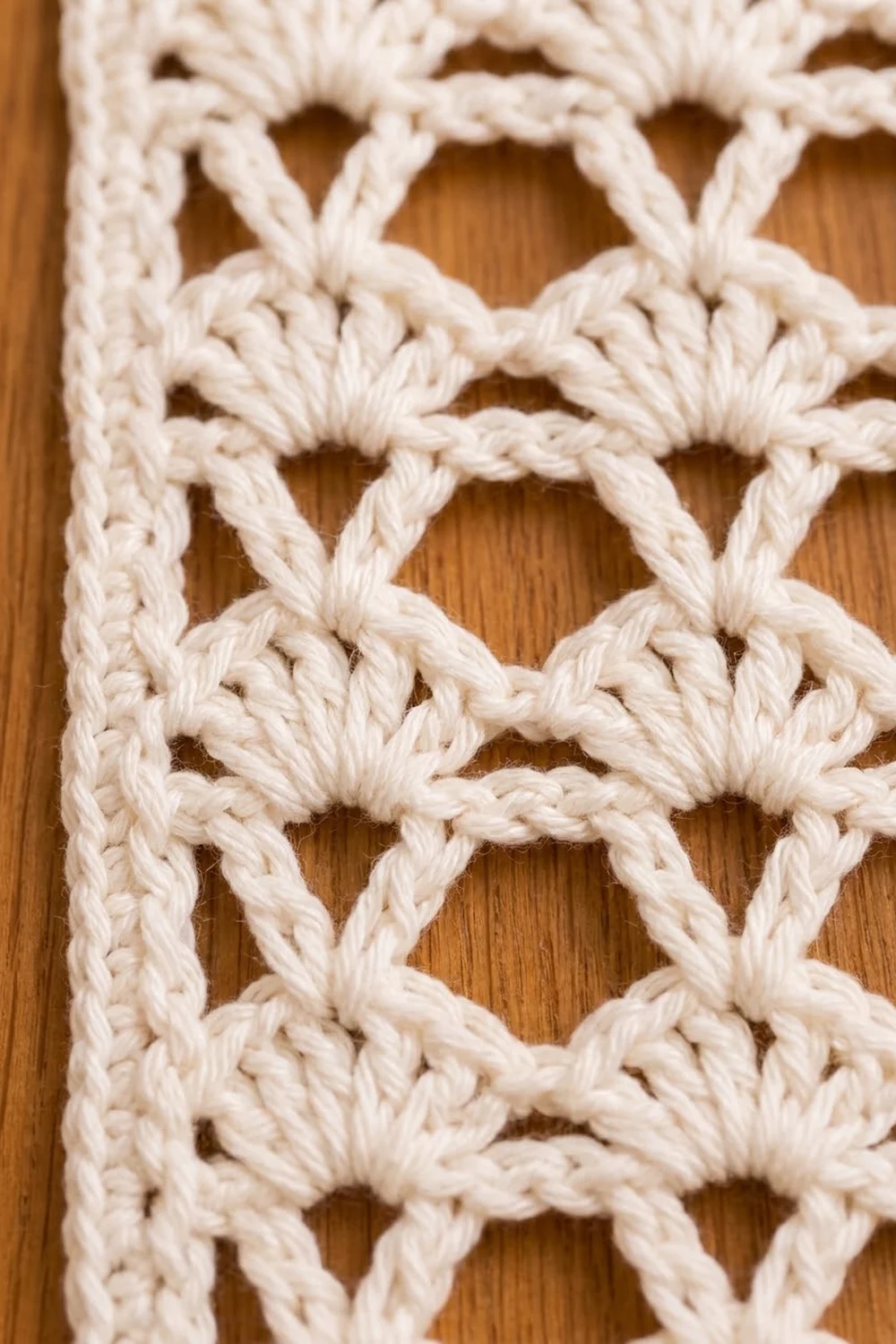
This runner is made of stacked columns of fan shells. Each shell sits on a V-stitch, and short chain bars between the shells leave rounded openings in the lace. Six shells run across the width, and the columns stay straight from one end to the other. You get an airy, vintage-style piece that still lies flat on a table.
It is worked in one ivory or soft white color. That keeps the focus on the texture, and it suits farmhouse, cottage, wedding, and everyday tables. Three tassels hang from each short end, one at each corner and one at the center.
The pattern uses US crochet terms. The finished runner is 13.75 in (34.9 cm) wide and 46.5 in (118.1 cm) long before tassels. With tassels, it measures about 56.5 in (143.5 cm) end to end.
It is made in one piece. You work a single crochet base row, then repeat a 2-row lace pattern (a V-stitch row and a shell row), then add a closing single crochet row. A 2-round edging goes around the whole runner, and the second round makes the tassel loops. The tassels are made last and tied onto those loops.
Finished Size and Construction
- Finished size: 13.75 in x 46.5 in (34.9 cm x 118.1 cm), not counting tassels
- Length with tassels: about 56.5 in (143.5 cm)
- Skill level: Easy / Intermediate
- Terminology: US crochet terms
- Yarn weight: Worsted (#4), cotton or cotton blend
- Hook: 5.0 mm (H-8)
- Number of pieces: 1 (single panel worked in rows)
- Layout: 6 shell columns across, 30 shell rows along the length
- Piece size before border: 12.75 in x 45.5 in (32.4 cm x 115.6 cm)
- Border depth: 2 rounds, 0.5 in (1.3 cm) on each side
- Tassels: 6 in total (3 per short end), each 4 in (10.2 cm) long
Materials
Yarn: Use a smooth worsted weight cotton or cotton blend. Cotton shows the shell texture clearly, holds its shape after blocking, and stands up to washing. Avoid fuzzy yarns, because they blur the openings.
- Ivory / Soft White: 450 g, about 700 m (765 yd)
That amount covers about 410 g for the runner and border, plus about 40 g for the six tassels (about 41.1 m / 45 yd).
Tools:
- 5.0 mm (H-8) crochet hook
- Tapestry needle
- Scissors
- Stiff card 4.5 in (11.4 cm) tall, for winding tassels
- Measuring tape
- Stitch markers
- Rust-proof pins and blocking mats (or a large towel)
- Spray bottle
Yarn quantities include a margin of about 10% for swatching, tension differences, and weaving in ends.
Abbreviations (US Terms)
- ch – chain
- sl st – slip stitch
- sc – single crochet
- dc – double crochet
- sp – space
- st(s) – stitch(es)
- rep – repeat
- RS / WS – right side / wrong side
Special stitches:
- V-stitch (V-st): (dc, ch 3, dc) in the same stitch.
- Shell: 7 dc in the same space. The 4th dc is the center of the shell.
- Tassel loop (TL): ch 8, sl st in the top of the sc just made.
Gauge and Checkpoints
Gauge (blocked):
- 16 sc = 4 in (10.2 cm) in Row 1
- One horizontal repeat (8 sts, from the center of one V-st to the next) = 2 in (5.1 cm)
- One 2-row pattern repeat (V row + shell row) = 1.5 in (3.8 cm)
- 4 pattern rows = 3 in (7.6 cm)
Make a test swatch first. Ch 20. Work Row 1 (19 sc), then Rows 2–9 as written below for 2 shells across. In this swatch, Row 2 is ch 6, skip 4 sc, V-st in next sc, ch 5, skip 7 sc, V-st in next sc, ch 3, skip 4 sc, dc in last sc. Block the swatch. It should measure 4.75 in (12.1 cm) wide and 6.25 in (15.9 cm) tall.
Checkpoints on the runner (lightly stretched flat):
- After Row 1: 12.75 in (32.4 cm) wide
- After Row 21: 15.25 in (38.7 cm) long
- After Row 41: 30.25 in (76.8 cm) long
- After Row 61: 45.25 in (114.9 cm) long
- After Row 62: 45.5 in (115.6 cm) long
If your gauge is off: If the swatch is bigger than listed, go down a hook size. If it is smaller, go up a hook size. If the width is right and only the length is off, check the chains: tight ch-5 bars shorten the rows, and loose ones make them longer. Blocking can fix about 0.25 in (0.6 cm) per 4 in (10.2 cm), but not more.
Pattern
Foundation: Ch 52.
Row 1 (RS): Sc in 2nd ch from hook and in each ch across, turn. (51 sc)
The V-sts in Row 2 go into sc 6, 14, 22, 30, 38, and 46. Each one is 8 sts after the last, with 4 sts left over at each edge. Before you start Row 2, put a stitch marker in each of these six sc so you can count them easily.
Row 2 (V row): Ch 6 (counts as dc and ch-3 sp). Skip next 4 sc and work a V-st in the next sc (the 6th sc). *Ch 5, skip next 7 sc, V-st in next sc; rep from * 4 more times. Ch 3, skip next 4 sc, dc in last sc, turn.
(6 V-sts, 5 ch-5 sps, 2 edge dc, 2 edge ch-3 sps)
Row 3 (shell row): Ch 5 (counts as dc and ch-2 sp). Work a shell in the ch-3 sp of the next V-st. *Ch 2, sc in next ch-5 sp, ch 2, shell in ch-3 sp of next V-st; rep from * 4 more times. Ch 2, dc in 3rd ch of turning ch, turn.
(6 shells = 42 dc, plus 2 edge dc = 44 dc; 5 sc; 12 ch-2 sps)
The single sc in each ch-5 sp pulls the chain bar down into a point between the shells. This is what makes the rounded openings.
Row 4 (V row): Ch 5 (counts as dc and ch-2 sp). V-st in the 4th (center) dc of the next shell. *Ch 5, V-st in center dc of next shell; rep from * 4 more times. Ch 2, dc in 3rd ch of turning ch, turn.
(6 V-sts, 5 ch-5 sps, 2 edge dc, 2 edge ch-2 sps)
Every V-st goes into the center of the shell below it, which keeps the columns straight.
Rows 5–61: Work Rows 3 and 4 in turn. Odd rows are shell rows and even rows are V rows, so you end with Row 61, a shell row. In the shell rows after Row 3, the turning ch is a ch-5, and you still work the last dc in its 3rd ch.
That makes 30 V rows (Rows 2–60, even) and 30 shell rows (Rows 3–61, odd).
Row 62 (closing row): Ch 1. Sc in first dc and 1 sc in the edge ch-2 sp. *Sc in each of next 7 dc. Skip the ch-2 sp, sc in the next sc, and skip the next ch-2 sp; rep from * 4 more times. Sc in each of the 7 dc of the last shell, 1 sc in the edge ch-2 sp, and sc in the 3rd ch of the turning ch. Do not fasten off.
(2 + 2 + 42 + 5 = 51 sc)
Both short ends now have 51 sc, so the border and tassels line up the same way at each end.
Border
Border gauge: 16 sc = 4 in (10.2 cm), the same as Row 1.
Rnd 1: Ch 1, then work around the whole runner as follows.
- Short end: Work 3 sc in the first st. Sc in each of the next 49 sts, then 3 sc in the last st.
- Long side: Work 3 sc in the side of each dc row (Rows 61 down to 2). That is 60 rows x 3 = 180 sc.
- Second short end: Work along the foundation ch: 3 sc in the first ch, sc in each of the next 49 ch, 3 sc in the last ch.
- Second long side: 180 sc, worked the same way.
Join with a sl st to the first sc.
Count the middle sc of each 3-sc group as the corner st. Each short side then has 1 + 49 + 1 = 51 sts between corners, or 53 including both corners. Each long side has 1 + 180 + 1 = 182 sts between corners, or 184 including corners.
(4 corners + 2 x 51 + 2 x 182 = 470 sc)
Rnd 2: Ch 1. Sc in each st around, working each corner st as (sc, sc + TL, sc). On each short end, work sc + TL in the 26th of the 51 sts between corners, which is the exact center. Join with a sl st to the first sc and fasten off.
After Rnd 2, each short side has 53 sts between corners (55 including corners), and each long side has 184 between corners (186 including corners).
(4 + 2 x 53 + 2 x 184 = 478 sc, plus 6 tassel loops)
Why the math works:
- Each dc row is 0.75 in (1.9 cm) tall, and 3 sc per row end is 4 sc per inch. That matches the border gauge.
- The short ends use the 51 sts of Row 1 and Row 62 one-to-one, so they stay at 12.75 in (32.4 cm).
- The only increases are the 2 extra sc at each corner per round, which is enough to keep the corners flat.
- The center TL adds no stitch, so it does not distort the edge.
- 182 sts / 4 = 45.5 in (115.6 cm), exactly the length of the runner body.
Tassels (make 6):
- Wind yarn 30 times around the 4.5 in (11.4 cm) card.
- Slide a 10 in (25.4 cm) tie strand under the wraps at the top and knot it tightly.
- Cut the wraps along the bottom edge.
- Wrap a separate strand tightly around the bundle 0.75 in (1.9 cm) below the top, 6–8 times, then knot it and bury the ends inside the tassel.
- Thread the tie strand through a tassel loop, knot it securely, and hide the tails inside the tassel head.
- Trim the tassel to 4 in (10.2 cm) below the head.
Final Blocking
- Weave in all ends along solid sc or dc stitches, not through chain bars.
- Soak the runner in cool water for 15 minutes, then press out the water. Do not wring it.
- Roll it in a towel to remove extra moisture.
- Lay it flat and pin the long sides straight to 46.5 in (118.1 cm).
- Pin the short ends to 13.75 in (34.9 cm), with one pin in each corner.
- Open each shell into a neat fan and pin the center of each chain bar so the openings look even.
- Let the tassel loops hang free off the edge so they dry straight.
- Let it dry completely. Then comb the tassels gently and trim them evenly.
Final Quality-Control Checklist
- Both short ends measure 13.75 in (34.9 cm)
- Both long sides measure 46.5 in (118.1 cm) and are straight, not wavy
- 6 shell columns run straight from end to end
- Every shell has 7 dc
- Row 62 and Row 1 both have 51 sc
- Corners lie flat, with 3 tassels evenly spaced on each end
- Tassels are all 4 in (10.2 cm) long and securely tied
- No visible knots or loose tails
Troubleshooting
- Shell columns drift sideways: A V-st missed the center dc. Count to the 4th dc of each shell.
- Edges pull in: The edge chains are too tight. Loosen the ch-2 and ch-3 edge spaces.
- Long sides ruffle: You worked more than 3 sc per row end. Recount Rnd 1.
- Long sides cup or cinch: You worked fewer than 3 sc per row end, or your border tension is tight.
- Openings look squashed: The ch-5 bars are too tight. Chain more loosely, or block more firmly.
- Corners curl: You skipped the 3-sc corner group in one of the rounds.
- Tassel heads slip: Wrap the neck tighter and add 2 more turns.
Care
Hand wash in cool water with mild soap and lay flat to dry, reshaping while damp. Comb the tassels gently and trim stray strands once dry.

Final Notes
The measurements build on each other. 51 sc at 16 sts = 4 in (10.2 cm) gives a 12.75 in (32.4 cm) width. Thirty V and shell row pairs at 1.5 in (3.8 cm) each, plus the two sc rows, give 45.5 in (115.6 cm). The 2-round border adds 0.5 in (1.3 cm) on every side, for 13.75 in x 46.5 in (34.9 cm x 118.1 cm). The six 4 in (10.2 cm) tassels bring the full length to about 56.5 in (143.5 cm). Check your swatch first, and each later checkpoint should follow.
Happy crocheting!