
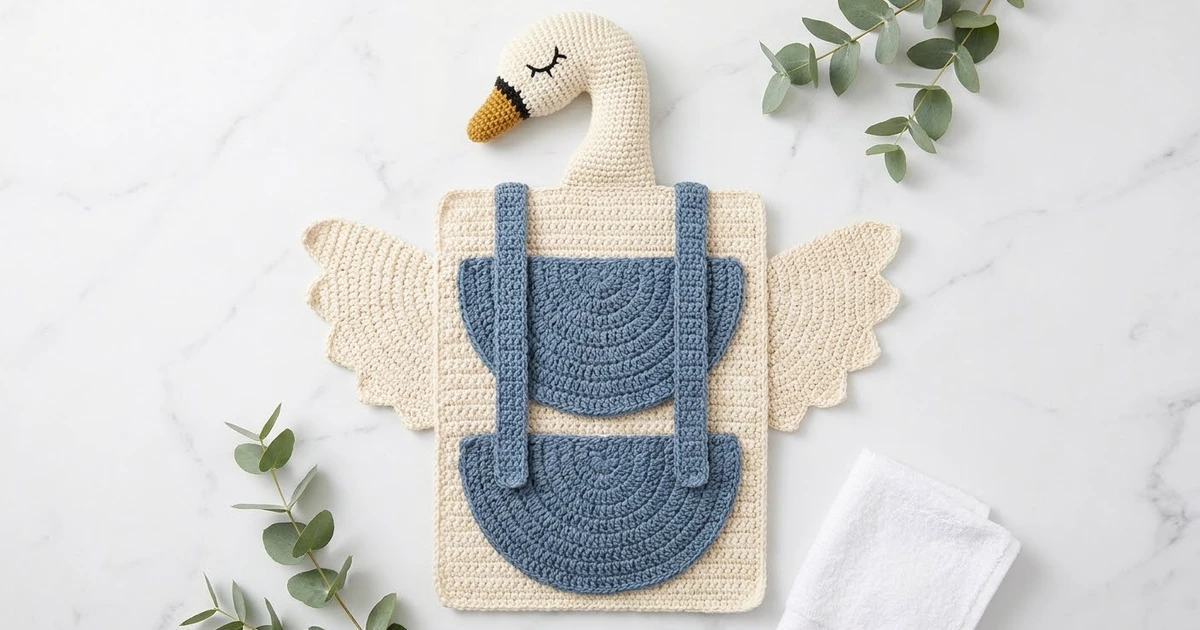
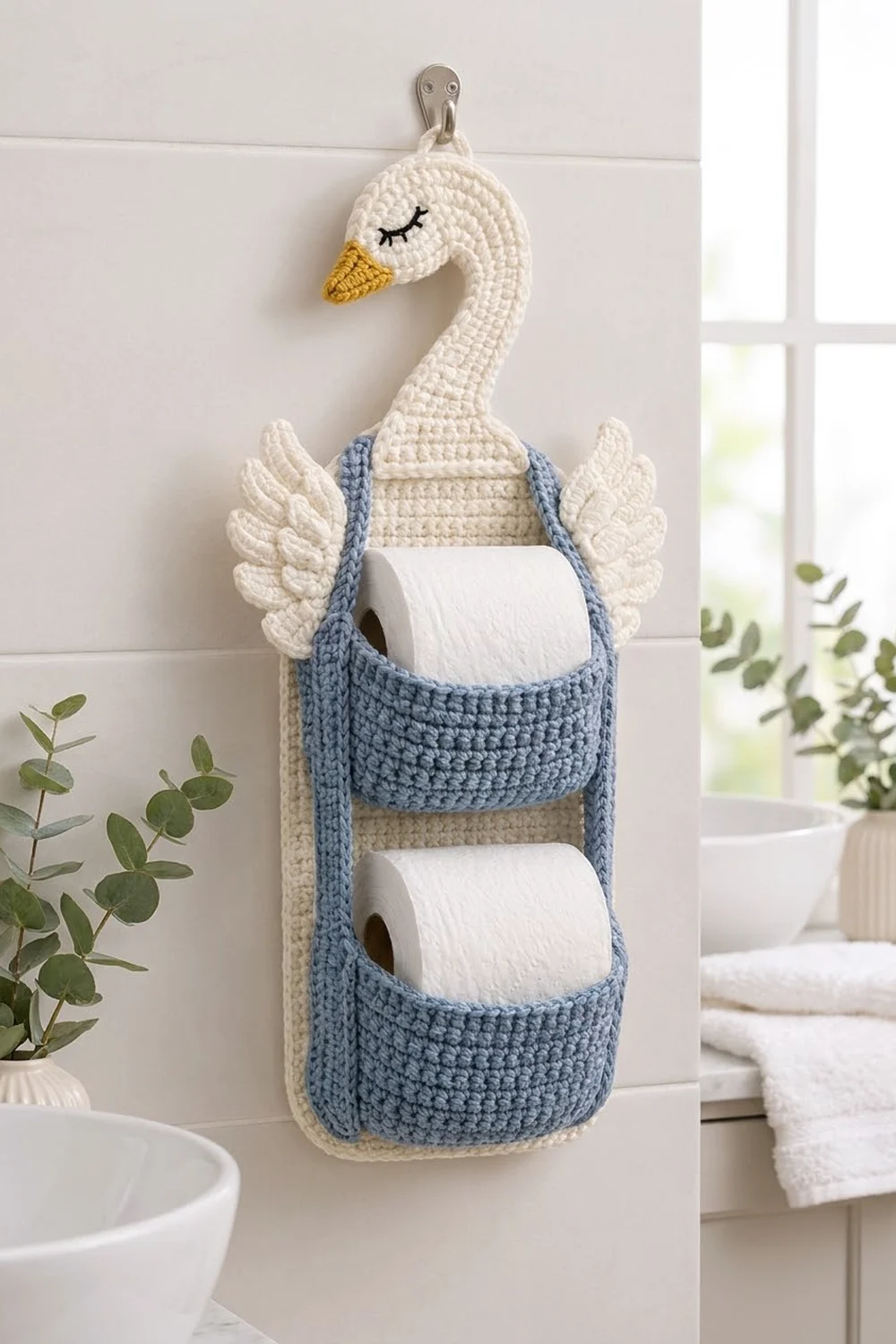
This swan holder hangs from one wall hook and keeps two spare rolls in reach. At the top is a round-headed swan with a mustard beak and a sleepy embroidered eye. Below her, a cream panel holds two dusty blue pockets, and layered cream wings stick out at the sides.
The colors are cream, denim blue and mustard, with a little black for the eye. The fabric is firm single crochet in cotton, so the pockets hold their shape and don’t stretch under the rolls.
This pattern uses US crochet terms. The finished holder is about 8 in (20.3 cm) wide across the panel, about 12 in (30.5 cm) across the wings, and about 22.25 in (56.5 cm) tall.
You work the panel in rows and add a two-round border. Next you make two oval pocket bases, two tube-shaped walls, the swan in one piece from head to base, a beak, two layered wings and two straps. Then you sew everything together.
Finished Size and Construction
- Finished size: 8 in × 22.25 in (20.3 cm × 56.5 cm), not counting the wings; 12 in (30.5 cm) across the wings
- Skill level: Intermediate
- Terminology: US
- Yarn weight: Worsted (#4) cotton
- Hook: 4.0 mm (G-6)
- Number of pieces: 13 (panel, 2 pocket bases, 2 pocket walls, swan, beak, 2 wing bases, 2 covert strips, 2 straps)
- Layout: One panel with two pockets stacked vertically and the swan on top
- Panel size before border: 7 in × 14 in (17.8 cm × 35.6 cm)
- Panel size after border: 8 in × 15 in (20.3 cm × 38.1 cm)
- Border depth: about 0.5 in (1.3 cm) per side
- Pocket size: base 6.25 in × 2.25 in (15.9 cm × 5.7 cm), 4 in (10.2 cm) tall
Materials
Use a smooth, firm worsted-weight cotton or cotton blend. Cotton keeps the pockets crisp and holds up well in a steamy bathroom. These amounts assume about 170 m per 100 g.
- Cream: 150 g (255 m) for the panel, border, swan, wings and loop
- Dusty denim blue: 130 g (221 m) for the pocket bases, walls and straps
- Mustard yellow: 10 g (17 m) for the beak
- Black embroidery floss: about 1 yd (0.9 m) for the eye
The quantities include a margin of about 15 percent.
Tools:
- 4.0 mm (G-6) hook
- Tapestry needle
- Stitch markers
- Scissors
- Measuring tape
- Blocking mat and rust-proof pins
- Optional: a 7 in × 14 in (17.8 cm × 35.6 cm) sheet of plastic canvas to stiffen the panel
- Wall hook with screws
Abbreviations (US Terms)
- ch – chain
- sl st – slip stitch
- sc – single crochet
- hdc – half double crochet
- dc – double crochet
- inc – 2 sc in the same stitch
- st(s) – stitch(es)
- MR – magic ring
- RS / WS – right side / wrong side
- sk – skip
Special stitch – Curve row: Work one edge in sc and the other edge in dc. The dc edge grows twice as fast, so the strip bends toward the sc side. Always keep the dc edge on the same side of the neck.
Gauge and Checkpoints
Gauge: 16 sc × 18 rows = 4 in (10.2 cm), worked firmly.
Make one pocket base first as your test piece. After Round 5 it should measure 6.25 in × 2.25 in (15.9 cm × 5.7 cm).
Checkpoints:
- Panel after Row 18: 4 in (10.2 cm) tall and 7 in (17.8 cm) wide
- Panel after Row 63: 14 in (35.6 cm) tall
- Pocket wall after Round 18: 4 in (10.2 cm) tall and 15.5 in (39.4 cm) around
- Swan head after Round 5: 2.25 in (5.7 cm) across
- Swan base after Row 28: 7 in (17.8 cm) wide
- Each strap: 15 in (38.1 cm) long
If your pieces come out too big, go down to a 3.75 mm hook. If they’re too small, go up to a 4.5 mm hook. Don’t change the stitch counts, because every piece is sized to fit the others.
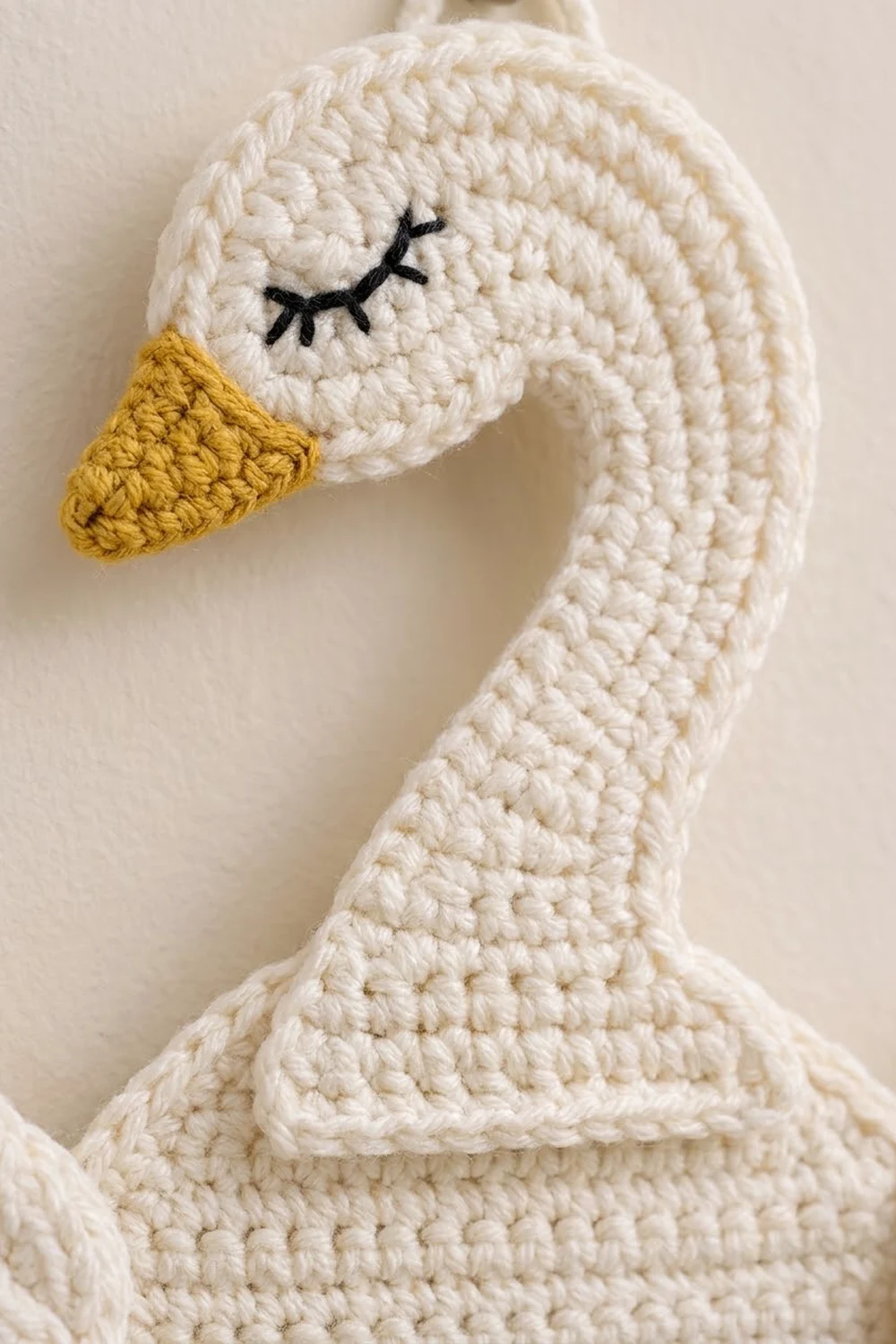
Panel (Cream, Make 1)
Ch 29.
Row 1 (RS): Sc in the 2nd ch from the hook and in each ch across, turn. (28 sts)
Rows 2–63: Ch 1 (doesn’t count as a st), sc in each st across, turn. (28 sts)
Don’t fasten off. Go straight on to the Border section below.
Pocket Bases (Blue, Make 2)
Ch 19.
Rnd 1: Sc in the 2nd ch from the hook, sc in the next 16 ch, 3 sc in the last ch. Working along the other side of the chain, sc in the next 16 ch, 2 sc in the first ch. (38 sts) Place a marker in the first st and move it up each round.
Rnd 2: Inc, sc 16, inc 3 times, sc 16, inc 2 times. (44 sts)
Rnd 3: [Sc 1, inc] once, sc 16, [sc 1, inc] 3 times, sc 16, [sc 1, inc] 2 times. (50 sts)
Rnd 4: [Sc 2, inc] once, sc 16, [sc 2, inc] 3 times, sc 16, [sc 2, inc] 2 times. (56 sts)
Rnd 5: [Sc 3, inc] once, sc 16, [sc 3, inc] 3 times, sc 16, [sc 3, inc] 2 times. (62 sts)
Sl st to the first st and fasten off. Each base now has 16 sts along each straight side and 15 sts around each curved end.
Pocket Walls (Blue, Make 2)
Ch 62 and join with a sl st to make a ring, without twisting the chain.
Rnd 1: Ch 1, sc in each ch around, sl st to the first sc. (62 sts)
Rnds 2–18: Ch 1, sc in each st around, sl st to the first sc. (62 sts)
Rnd 19 (rim): Sl st loosely in each st around. (62 sts)
Fasten off.
Assembling each pocket: Hold a base against the foundation edge of a wall with the WS together. With blue, sc through both layers all the way around, matching 1 st to 1 st. (62 sts) This leaves a crisp ridge along the bottom of the pocket.
Swan (Cream, Make 1)
Head
Rnd 1: 6 sc in a MR. (6 sts)
Rnd 2: Inc in each st around. (12 sts)
Rnd 3: [Sc 1, inc] 6 times. (18 sts)
Rnd 4: [Sc 2, inc] 6 times. (24 sts)
Rnd 5: [Sc 3, inc] 6 times. (30 sts)
Sl st to the first st. Don’t fasten off.
Neck
Row 1: Ch 1, sc in the next 8 sts of Rnd 5, turn. (8 sts) These 8 sts become the lower right edge of the head.
Rows 2–10: Ch 1, sc across, turn. (8 sts)
Row 11 (curve row, RS): Ch 1, sc in the first 3 sts, hdc in the next 2 sts, dc in the last 3 sts, turn. (8 sts)
Row 12 (curve row, WS): Ch 3 (counts as dc), dc in the next 2 sts, hdc in the next 2 sts, sc in the last 3 sts, turn. (8 sts)
Rows 13–18: Repeat Rows 11–12 three more times. (8 sts)
The dc edge stays along the back of the neck, so the front of the neck curves in under the head.
Flared Base
Rows 19–28: Ch 1, 2 sc in the first st, sc to the last st, 2 sc in the last st, turn. Each row is 2 sts wider than the one before: Row 19 has 10 sts, Row 20 has 12 sts, and so on until Row 28 has 28 sts.
Edging: Ch 1 and sc evenly around the whole swan. Work 1 sc in each st and in each sc row end, 2 sc in each dc row end, and 3 sc in each bottom corner. Sl st to join and fasten off. The swan is about 8.5 in (21.6 cm) tall.
Hanging loop: Join cream at the top back of the head. Ch 10 and sl st in the same st. Work 14 sc into the loop and fasten off.
Beak (Mustard, Make 1)
Row 1: Ch 2, sc in the 2nd ch from the hook, turn. (1 st)
Row 2: Ch 1, 2 sc in the st, turn. (2 sts)
Row 3: Ch 1, 2 sc in the first st, sc in the last st, turn. (3 sts)
Row 4: Ch 1, 2 sc in the first st, sc in the last 2 sts, turn. (4 sts)
Row 5: Ch 1, 2 sc in the first st, sc in the last 3 sts. (5 sts)
Fasten off. Sew the 5-st edge to the left side of the head with the point facing outward.
Eye: With black floss, backstitch a 0.5 in (1.3 cm) arc above the beak. Add 3 short lashes angling downward from the arc.
Wings (Cream, Make 2)
Wing Base
Row 1: In a MR, ch 2 (doesn’t count as a st), 7 hdc. Pull the ring closed and turn. (7 sts)
Row 2: Ch 2, 2 hdc in each st, turn. (14 sts)
Row 3: Ch 1, [sc 1, inc] 7 times, turn. (21 sts)
Row 4 (feathers): Ch 8. Starting in the 2nd ch from the hook and working back down the chain: sc, hdc, hdc, dc, dc, dc, dc. Sk the next 2 sts of Row 3 and sl st in the next st. Repeat from * 7 times. You now have 7 feathers, each using 3 base sts (7 × 3 = 21). Fasten off.
Covert Strip
Ch 22. Sc in the 2nd ch from the hook, then [sk 1 ch, 5 dc in the next ch, sk 1 ch, sc in the next ch] 5 times. (5 scallops, 31 sts) Fasten off.
Lay the strip across the curved top of Row 3 with the scallops pointing down over the feathers. Sew it down along its straight edge. On the second wing, sew the strip to the opposite face so the two wings mirror each other. Each wing measures about 4 in × 3 in (10.2 cm × 7.6 cm).
Straps (Blue, Make 2)
Ch 61.
Row 1: Sc in the 2nd ch from the hook and in each ch across, turn. (60 sts)
Rows 2–3: Ch 1, sc across, turn. (60 sts)
Fasten off. Each strap is 15 in (38.1 cm) long and about 0.67 in (1.7 cm) wide.
Make All Pieces
- Cream: 1 panel, 1 swan, 2 wing bases, 2 covert strips
- Blue: 2 pocket bases, 2 pocket walls, 2 straps
- Mustard: 1 beak
Layout (heights measured up from the bottom of the panel):
          [ swan head + loop ]
             [ swan neck ]
      [ swan base 13.75–15 in ]
 [W]  [S]  cream 12–13.75 in  [S]  [W]
 [W]  [S] [ upper pocket 8–12 ][S]  [W]
      [S]  cream 5–8 in        [S]
      [S] [ lower pocket 1–5 ] [S]
      [S]  cream 0–1 in        [S]
S = strap   W = wing
Joining
- Pockets: Center each pocket on the panel, leaving 0.875 in (2.2 cm) of panel showing on each side. Place the lower pocket’s base 1 in (2.5 cm) above the bottom edge and the upper pocket’s base 8 in (20.3 cm) above it. Whipstitch the 16 straight back sts of the base, and the 16 back rim sts of the wall, to the panel, matching 1 st to 1 st across 4 in (10.2 cm).
- Swan: Lay the swan’s Row 28 along panel Row 60 and sew the 28 base sts to the 28 panel sts, 1 to 1. The swan overlaps the panel by about 1.25 in (3.2 cm).
- Straps: Place each strap 0.5 in (1.3 cm) in from a side edge, running the full 15 in (38.1 cm). Each strap covers about 0.3 in (0.8 cm) of each pocket end. Whipstitch both long edges of the strap, sewing through the pocket layers where they sit underneath.
- Wings: Sew the wings to the WS of the panel so each one sticks out 2 in (5.1 cm) past the side edge. Line up the top of each wing with the top of the upper pocket.
Keep your sewing stitches snug but not tight, or the panel will pucker.
Size checkpoint: The holder should measure 8 in (20.3 cm) across the panel, 12 in (30.5 cm) across the wings, and about 22.25 in (56.5 cm) tall.
Border
Work the border before you sew anything to the panel. It uses the same gauge as the panel: 16 sc = 4 in (10.2 cm). The 2 rounds add about 0.5 in (1.3 cm) to each side.
Rnd 1: Continuing from Row 63, ch 1 and work around the panel as follows:
- Top: 3 sc in the first st, sc in the next 26 sts, 3 sc in the last st.
- First side: Work 56 sc evenly down the row ends (8 sc for every 9 rows).
- Bottom: Working along the foundation chain, 3 sc in the first ch, sc in the next 26 ch, 3 sc in the last ch.
- Second side: Work 56 sc evenly up the row ends.
Sl st to the first sc. (176 sts: 26 top + 26 bottom + 56 + 56 sides + 4 corner groups of 3)
This is a conversion round. The 56 sts along the top and bottom are worked 1 per st, the 112 sts along the sides come from row ends, and the corners add 8 extra sts: 56 + 112 + 8 = 176.
Rnd 2: Ch 1 and sc in each st around, except at the corners:
- Top corners: 3 sc in the middle st of each corner group, so each group becomes 5 sts.
- Bottom corners: 2 sc in each of the 3 sts of each corner group, so each group becomes 6 sts.
Sl st to join and fasten off. (186 sts: 176 worked 1 per st + 4 extra at the top corners + 6 extra at the bottom corners) Spreading the increases at the bottom corners rounds them off, while the top corners stay square.
Why the math works: The panel has 63 rows at 4.5 rows per inch, so the sides are 14 in tall. Picking up 56 sts at 4 sts per inch also covers 14 in, so the sides lie flat. Along the top and bottom, the 26 plain sts plus the 2 corner middles add up to the panel’s 28 sts.
Final Blocking
- Wet-block the bordered panel to 8 in × 15 in (20.3 cm × 38.1 cm) before you assemble anything.
- Pin the swan with a smooth neck curve and the base flat at 7 in (17.8 cm) wide.
- Fan out the wing feathers and pin each scallop to a point.
- Stuff each pocket with a towel so it dries in a D-shape.
- Let everything dry completely. If you’re using plastic canvas, sew it to the WS of the panel.
Final Quality-Control Checklist
- Panel is 28 sts by 63 rows, border Rnd 1 has 176 sts, and border Rnd 2 has 186 sts
- Each pocket base and wall has 62 sts
- Swan base has 28 sts and sits on panel Row 60
- Beak points left and the eye has 3 lashes
- Wings mirror each other
- Straps cover the pocket ends
- Hanging loop is firmly attached
Troubleshooting
- Pocket wall flares out: Your gauge is too loose. Use a smaller hook.
- Pocket base cups: Make sure you only increased at the curved ends.
- Neck is too straight or too curled: Add or remove one pair of curve rows.
- Border ripples: Count your side sts. Each side should have 56.
- Panel sags: Add the plastic canvas.
Care
Hand wash in cool water, roll in a towel to press out the water, and dry flat. Reshape the pockets while they’re still damp.
Final Notes
At a gauge of 16 sc × 18 rows = 4 in (10.2 cm), the 7 in × 14 in (17.8 cm × 35.6 cm) panel becomes 8 in × 15 in (20.3 cm × 38.1 cm) with its border. The 62-st pockets fit between the straps, and the 28-st swan base lines up stitch for stitch with the panel’s 28 sts. The finished holder stands about 22.25 in (56.5 cm) tall.
Happy crocheting!