

The Snowdrift Daisy Table Runner is a light, airy runner made from 36 six-petal flowers. You join them as you go into a grid 3 flowers wide and 12 flowers long. Short chain bars link the petal tips, so the open gaps let your table show through, and a plump tassel hangs from the end of each column.
It’s worked in one color, a creamy white cotton, which keeps the look clean and calm. It fits farmhouse, cottage and minimalist tables, and it looks lovely under a simple vase of flowers.
This pattern uses US crochet terms. The finished runner measures 11.5 in (29.2 cm) wide by 47.5 in (120.7 cm) long, not counting the tassels. With a 3.5 in (8.9 cm) tassel at each end, the total length is 54.5 in (138.4 cm).
Each flower is worked in four rounds: a center ring, a round of chain spaces, a round of petals and a single crochet outline. Every flower after the first joins to its neighbors with chain bars during that last outline round. Tassels finish both short ends.
Finished Size and Construction
- Finished size: 11.5 in x 47.5 in (29.2 cm x 120.7 cm), plus tassels
- Length with tassels: 54.5 in (138.4 cm)
- Skill level: Easy–Intermediate
- Terminology: US crochet terms
- Yarn weight: Worsted (#4), cotton
- Hook: 5.0 mm (H-8)
- Number of pieces: 36 flower motifs, plus 6 tassels
- Layout: 3 flowers wide x 12 flowers long
- Piece size: 3.5 in (8.9 cm) across, measured from petal tip to petal tip
- Center-to-center spacing: 4 in (10.2 cm) in both directions
- Size before border: 11.5 in x 47.5 in (29.2 cm x 120.7 cm)
- Border depth: 0 in (0 cm). The petal outline is the finished edge, and the only extra length is 3.5 in (8.9 cm) of tassel at each end.
Materials
Yarn: Use a smooth worsted-weight cotton or cotton blend. Cotton keeps the petals crisp and holds its shape after blocking. Avoid fuzzy or very stretchy yarns, because they blur the petal outline and let the chain bars sag.
- Cream white: 300 g, about 540 m (590 yd), based on yarn with 180 m per 100 g
One flower uses about 5 g (9.5 m), so all 36 flowers take about 180 g. The 6 tassels use about 20 g. The quantity above includes a margin of roughly 40% to cover gauge differences, tension swatches and the tassels.
Tools:
– 5.0 mm (H-8) crochet hook
– Tapestry needle
– Scissors
– A piece of stiff card 4 in (10.2 cm) wide, for the tassels
– Rust-proof pins and a blocking mat
– Spray bottle
– Measuring tape
Abbreviations (US Terms)
- ch – chain
- sl st – slip stitch
- sc – single crochet
- hdc – half double crochet
- dc – double crochet
- tr – treble crochet
- sp – space
- st(s) – stitch(es)
- MR – magic ring
Special stitch: Chain bar join (CB-n). Work the first sc of a petal’s 3-sc tip group. Ch n, sl st into the center tip sc of the matching petal on the finished neighbor flower, then ch n back. Then work the 2nd and 3rd sc of the tip group into the same tr as normal. The chains don’t count as stitches, so the petal still has 13 sc. In this pattern, CB-4 is the side-to-side join and CB-2 is the top-to-bottom join.
Gauge and Checkpoints
Make one complete flower before you start the runner. It’s your gauge swatch, and it becomes Flower 1.
Checkpoints for one flower:
– After Round 1: the ring measures 1 in (2.5 cm) across.
– After Round 2: 2 in (5.1 cm) across the chain loops.
– After Round 3: 3 in (7.6 cm) from petal tip to petal tip.
– After Round 4: 3.5 in (8.9 cm) from petal tip to petal tip.
If your flower is too big (more than 3.75 in / 9.5 cm), go down to a 4.5 mm hook. If it’s too small (under 3.25 in / 8.3 cm), go up to a 5.5 mm hook. A difference of 0.25 in (0.6 cm) per flower adds up to 3 in (7.6 cm) over 12 rows, so it’s worth getting this right.
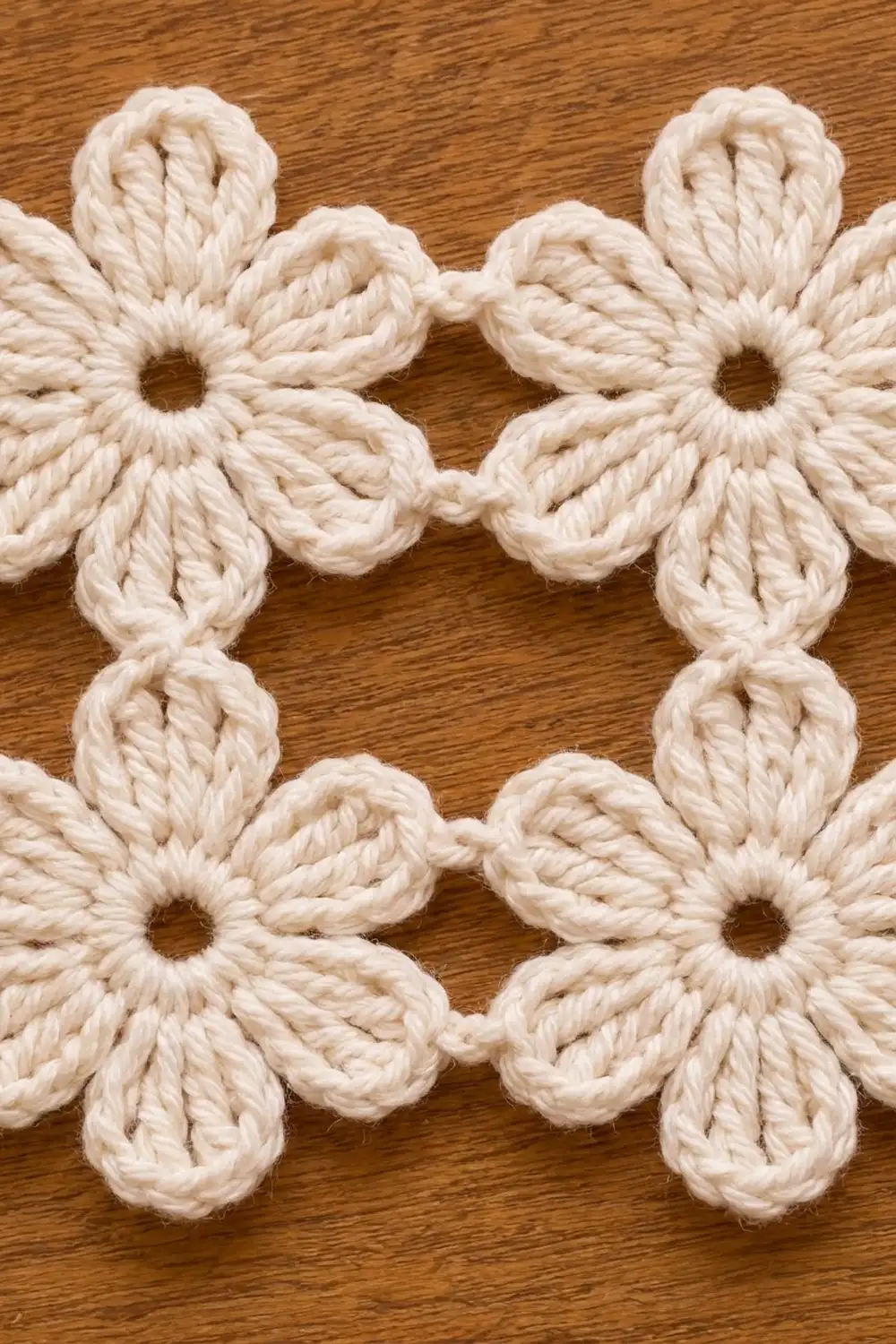
Flower Motif
Petals are numbered clockwise from the top: P1 is the top petal, then P2 upper right, P3 lower right, P4 bottom, P5 lower left and P6 upper left.
Round 1: Make a MR. Ch 1, then work 12 sc into the ring. Pull the ring closed until it leaves a hole about 0.5 in (1.3 cm) wide, then join with a sl st to the first sc. (12 sc)
Round 2: Ch 1. Sc in the same st, ch 4, skip the next sc. Sc in the next sc, ch 4, skip the next sc. Repeat from * to * 4 more times, then join with a sl st to the first sc. (6 sc and 6 ch-4 sps)
Round 3 (petals): Sl st into the first ch-4 sp. Work one petal into each ch-4 sp: (sc, hdc, 2 dc, 3 tr, 2 dc, hdc, sc). Join with a sl st to the first sc.
(11 sts per petal; 66 sts total)
The 3 tr in the middle of each petal give the long, fanned stitches you see in the photo. Because each petal starts and ends with a sc, the petals sit close together with a neat dip between them.
Round 4 (outline): Ch 1. On each petal, work sc in each of the first 5 sts, 3 sc in the center tr (the 6th st), then sc in each of the last 5 sts. Join with a sl st to the first sc and fasten off.
(13 sc per petal; 78 sc total)
This outline makes the raised rim around each petal, and the 3 sc in the center tr form the soft point at the tip. The middle sc of those 3 is the center tip sc, which is where all the joins attach.
Weave in the ends on the back, following the stitches, so they don’t show through the open center.
Make All Pieces
You need 36 flowers in total, all in cream white.
- Flower 1: work Rounds 1–4 as written.
- Flowers 2–36: work Rounds 1–3 as written, then join to the earlier flowers during Round 4.
Work row by row from the top, going left to right across each row:
Row 1:   F1   F2   F3
Row 2:   F4   F5   F6
Row 3:   F7   F8   F9
 ...
Row 12:  F34  F35  F36
The finished grid is 3 columns x 12 rows = 36 flowers.
Joining (Join-As-You-Go)
All joins happen at the center tip sc during Round 4 of the new flower. Work every other part of Round 4 exactly as written.
Side-to-side join (2 bars): The new flower’s left side meets the right side of the flower to its left.
– When you reach the tip of P5 on the new flower, work CB-4 into the center tip sc of P3 on the left neighbor.
– When you reach the tip of P6, work CB-4 into the center tip sc of P2 on the left neighbor.
This makes the pair of parallel bars between side-by-side flowers.
Top-to-bottom join (1 bar): When you reach the tip of P1 on the new flower, work CB-2 into the center tip sc of P4 on the flower above it.
Which joins each flower gets:
– Row 1: F1 has no joins. F2 and F3 each have 1 side-to-side join.
– Rows 2–12, first flower in the row: 1 top-to-bottom join.
– Rows 2–12, 2nd and 3rd flowers: 1 top-to-bottom join and 1 side-to-side join.
Stitch logic: The joins don’t add any stitches. Every flower still has 13 sc per petal and 78 sc in total, and each bar is made only of chains. Since the bars attach only at petal tips, the petal outlines stay smooth.
Tension: Keep the bar chains the same size as your normal chains. If they’re too tight, the grid puckers and the runner shrinks. If they’re too loose, the gaps sag. Don’t twist the neighbor flower before you sl st into it, and keep both flowers right side up.
Size checkpoints:
– After Row 1: 11.5 in (29.2 cm) wide.
– After Row 4: 15.5 in (39.4 cm) long.
– After Row 6: 23.5 in (59.7 cm) long.
– After Row 12: 47.5 in (120.7 cm) long.
Each row adds 4 in (10.2 cm) of length. That’s a 3.5 in (8.9 cm) flower plus a 0.5 in (1.3 cm) gap for the CB-2 bar.
Border: Edge Finish and Tassels
No stitched border. The runner has no border round. The scalloped petal outline is the finished edge on all four sides.
Edge gauge: Along each long side, 12 flowers show their P2 and P3 petals on the right side, or P5 and P6 on the left side. That’s 24 outlined petals per long side, and each one has 13 sc, which keeps the edge firm without a border. The 3 flowers in each end row show their P1 or P4 petal at the end of the runner, which is where the tassels hang.
Why the math works:
– Width: 3 flowers at 4 in (10.2 cm) center to center gives 2 spacings × 4 in + 3.5 in = 11.5 in (29.2 cm).
– Length: 12 rows gives 11 spacings × 4 in + 3.5 in = 47.5 in (120.7 cm).
Tassels (make 6):
1. Wrap yarn 30 times around the 4 in (10.2 cm) card.
2. Slide a 12 in (30.5 cm) tie strand under the wraps at one edge and knot it tightly. Leave both tails long.
3. Cut through the wraps at the opposite edge.
4. Wrap a separate strand 6–8 times around the bundle, 0.5 in (1.3 cm) below the top, to form the head. Knot it, then hide the tails inside the tassel.
5. Trim the ends evenly to 3.5 in (8.9 cm), measured from the top of the head.
To attach the tassels:
– Thread the tie tails through the center tip sc of P4 on F34, F35 and F36.
– Thread them through the center tip sc of P1 on F1, F2 and F3.
– Knot each tassel securely on the back, then bury the tails inside the head.
Final Blocking
- Lay the runner face down on a blocking mat, keeping the 3 columns straight.
- Spray it evenly with water until it’s damp but not soaked.
- Pin through the center tip sc of each outer petal.
- Check that each flower is 3.5 in (8.9 cm) across and the spacing is 4 in (10.2 cm) center to center.
- Pull each chain bar gently until it’s straight, with no twists.
- Press each center ring flat with your fingertips.
- Let it dry completely, which takes 12–24 hours.
- Unpin it, then brush the tassels and trim them again if needed.
Final Quality-Control Checklist
- [ ] All 36 flowers have 6 petals and 78 sc in Round 4.
- [ ] Each center ring is closed to about 0.5 in (1.3 cm).
- [ ] Each side-to-side join has 2 bars and each top-to-bottom join has 1 bar.
- [ ] No petals are joined in the wrong place, and no bars are twisted.
- [ ] Width is 11.5 in (29.2 cm) and length is 47.5 in (120.7 cm).
- [ ] All 6 tassels are 3.5 in (8.9 cm) long and hang from petal tips.
- [ ] All ends are woven in on the back.
Troubleshooting
- The petals cup or ruffle: Your Round 4 is too loose. Go down a hook size for that round only.
- A flower curls into a bowl: Round 1 is pulled too tight. Leave the ring slightly larger, about 0.5 in (1.3 cm).
- The grid leans to one side: You probably joined the wrong petals. Check that P5 joins to P3 and P6 joins to P2.
- The bars sag: Your chains are too loose. Try a tighter grip or a smaller hook for the bars only.
- The runner is too short: Your CB-2 bars are too tight. Each one should leave a 0.5 in (1.3 cm) gap.
- The tassels look flat: Add 5–10 more wraps per tassel.
Care
Hand wash in cool water with mild soap, then lay flat in shape to dry. Avoid hanging it while wet, because the weight can stretch the chain bars.

Final Notes
The measurements build on each other:
– One flower is 3.5 in (8.9 cm) across.
– Adding the bar gap gives 4 in (10.2 cm) spacing.
– 3 columns make the 11.5 in (29.2 cm) width.
– 12 rows make the 47.5 in (120.7 cm) length.
– The tassels bring the total length to 54.5 in (138.4 cm).
Check your gauge flower first and keep the bar chains even, and the runner will come out right.
Happy crocheting!