

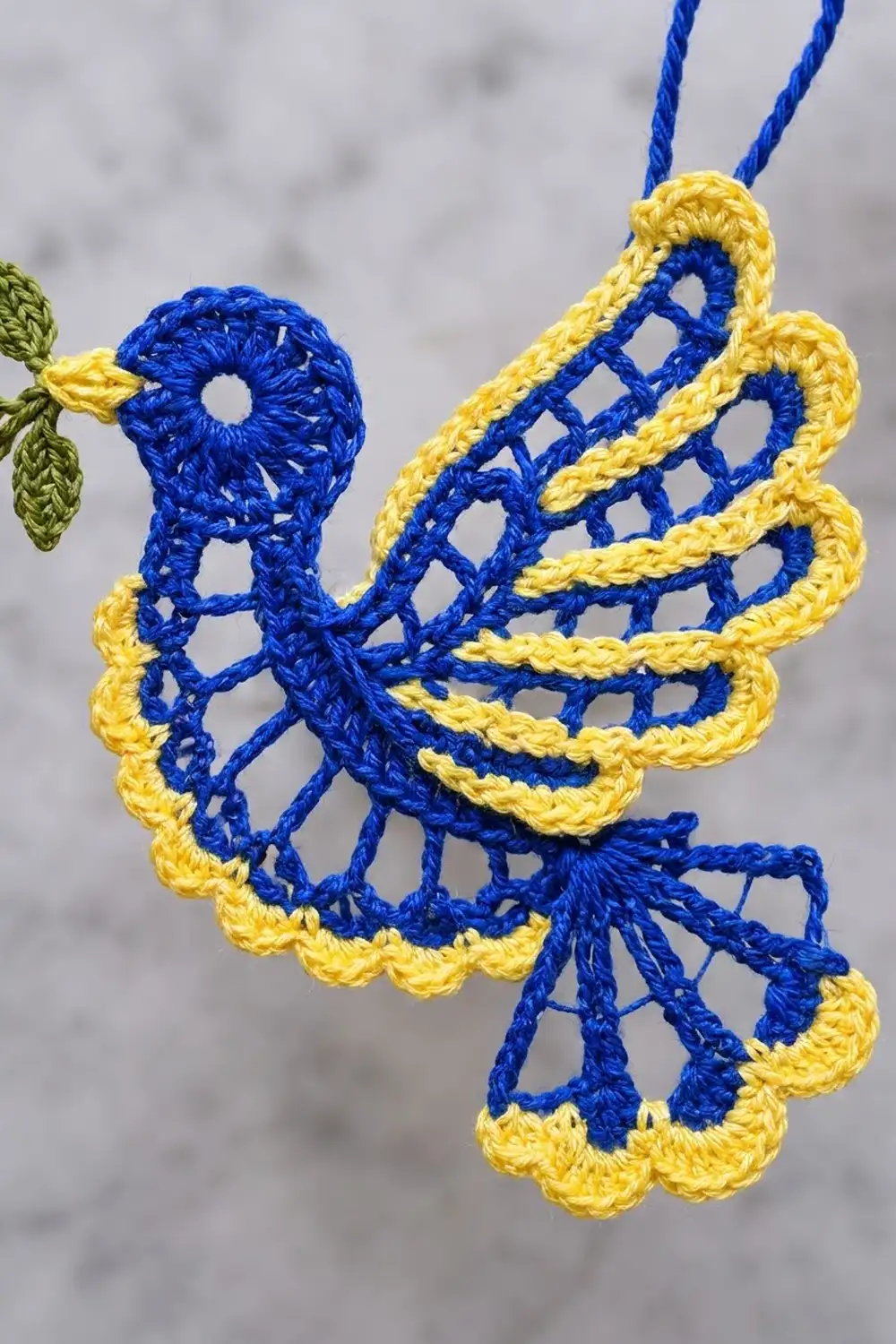
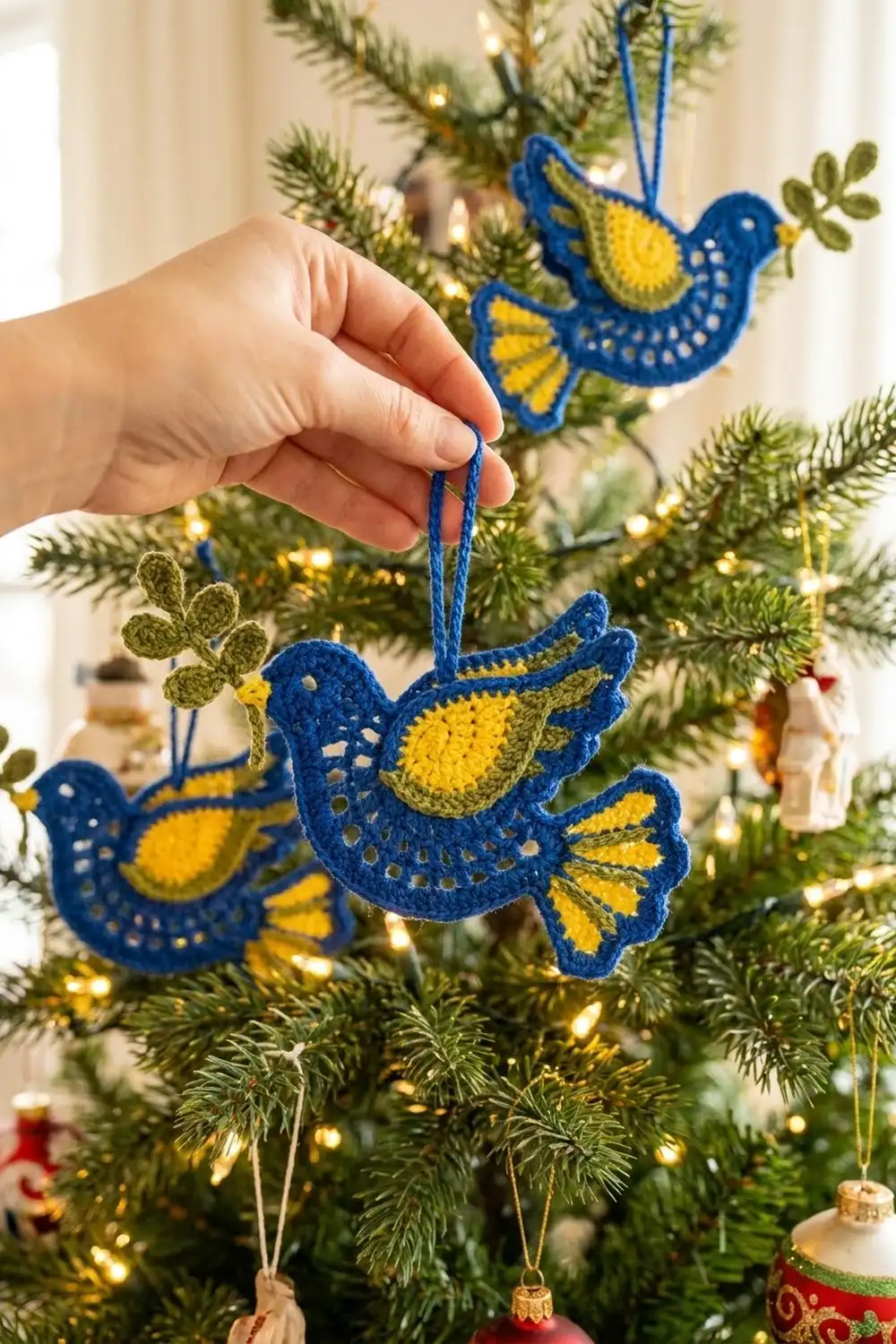
The Sunlit Peace Dove is a lacy hanging ornament in cobalt blue and sunny yellow. It has a round blue head with an open eye, a curved openwork body, a fan-shaped wing rising from its back and a spread fan tail behind. A yellow beak holds a small olive-green sprig.
The look is light and airy. Open ladders of tall stitches give the body, wing and tail their texture, and yellow scallops and feather rims mark the edges. The bold colors and outlined shape are easy to read from across the room, which is why the dove looks so good on a lit tree.
This pattern uses US crochet terms. The finished dove measures about 5.5 in (14.0 cm) wide by 4.5 in (11.4 cm) tall, not counting the hanging loop, which adds 2 in (5.1 cm).
The construction is simple. You crochet the head and body as one piece, then make a separate tail fan, a separate wing and a leaf sprig. Each blue section gets a yellow edging. Then you stack and sew the parts into one flat ornament and finish with a beak and a hanging loop.
Finished Size and Construction
- Finished size: 5.5 in (14.0 cm) wide x 4.5 in (11.4 cm) tall, plus 2 in (5.1 cm) loop
- Skill level: Intermediate
- Terminology: US crochet terms
- Yarn weight: Size 3 mercerized cotton thread (fingering weight)
- Hook: 2.25 mm (B-1)
- Number of pieces: 1 ornament made of 4 crocheted parts (head-and-body, tail, wing, sprig). The beak and loop are worked in place.
- Layout: Wing layered on top of the body, tail tucked behind the body’s tail tip, sprig behind the beak
- Part sizes: Head 1.25 in (3.2 cm) across; wing 3.5 in (8.9 cm) wide x 2.5 in (6.4 cm) tall; tail 2.25 in (5.7 cm) wide x 1.5 in (3.8 cm) tall
- Size before border: about 5.25 in (13.3 cm) x 4 in (10.2 cm)
- Border depth: 0.3 in (0.8 cm) shells on the body; 0.25 in (0.6 cm) on the wing and tail
Materials
Use a smooth mercerized cotton thread. It gives crisp stitches, holds starch well and won’t fuzz on the tree. Avoid soft acrylic, because the open ladders will sag.
- Cobalt blue: 8 g / 34 m
- Bright yellow: 4 g / 17 m
- Olive green: 1 g / 4 m
These amounts include extra for swatching and weaving in ends.
Tools:
– 2.25 mm (B-1) crochet hook
– Tapestry needle with a small eye
– Scissors
– Rust-proof pins and a foam blocking board
– Spray starch or fabric stiffener
– Ruler or tape measure
Abbreviations (US Terms)
- ch: chain
- sl st: slip stitch
- sc: single crochet
- hdc: half double crochet
- dc: double crochet
- tr: treble crochet
- dtr: double treble crochet
- dc2tog: double crochet 2 together
- sp(s): space(s)
- sk: skip
- st(s): stitch(es)
Special stitch, cluster (cl): *Yarn over, insert hook in the stitch, pull up a loop, yarn over and draw through 2 loops; repeat from * 2 more times in the same stitch. Yarn over and draw through all 4 loops on the hook.
Beginning cluster (beg cl): Ch 2, dc2tog in the same stitch.
Gauge and Checkpoints
Gauge is 9 hdc = 1 in (2.5 cm) and 10 sc = 1 in (2.5 cm). Exact gauge matters less here than for a garment, but it decides whether the parts fit together.
Make the head first and use it as your swatch. After Round 2 it should measure 1.25 in (3.2 cm) across.
Checkpoints:
– Head after Round 2: 1.25 in (3.2 cm) across
– Body Row 1 (spine): 3.7 in (9.4 cm) long
– Body after Row 3: lower edge 4.9 in (12.4 cm) along the curve, depth 0.9 in (2.3 cm)
– Tail before border: 1.25 in (3.2 cm) tall
– Wing before border: 2.25 in (5.7 cm) tall, 3.25 in (8.3 cm) wide
If the head is larger than 1.25 in (3.2 cm), go down to a 2 mm hook. If it is smaller, go up to 2.5 mm. A head within 0.1 in (0.3 cm) of the target is fine.
Head and Body (Blue)
The body is worked directly off the head. A row of hdc forms the spine, a ladder of tr hangs from it and a row of sc closes the lower edge. The ch-2 spaces are wider than the stitches you skip, so the lower edge comes out longer than the spine and the body curves into a crescent.
Rnd 1: With blue, ch 6, sl st in first ch to form a ring. Ch 3 (counts as dc), 15 dc in ring, sl st in top of beginning ch-3. (16 dc) The open ring is the eye.
Rnd 2: Ch 1, 2 hdc in each dc around, sl st in first hdc. (32 hdc) Do not fasten off.
Row 1 (spine): Ch 35. Hdc in 3rd ch from hook and in each ch back toward the head. (33 hdc) Sl st in the next 2 hdc of head Rnd 2 to anchor. Turn.
Row 2 (ladder): Ch 6 (counts as tr + ch 2), sk next hdc, tr in next hdc, ch 2, sk next hdc, tr in next hdc; repeat from * across. (17 tr, 16 ch-2 sps)* The last tr lands in the 33rd hdc at the tail end. Turn.
Row 3 (lower edge): Ch 1, sc in first tr, 2 sc in next ch-2 sp, sc in next tr; repeat from * across, working the last sc in the 4th ch of the turning ch-6. (49 sc: 17 sc in tr + 32 sc in spaces)* Sl st in the next free hdc of the head. Fasten off.
Checkpoint: the spine measures 3.7 in (9.4 cm) and the lower edge measures 4.9 in (12.4 cm) along the curve.
Tail (Blue)
The tail is a small fan with long spokes and a row of clusters near the edge.
Row 1: With blue, ch 4. Work 6 dc in 4th ch from hook. (7 dc, counting the skipped ch as 1 dc) Turn.
Row 2 (spokes): Ch 7 (counts as dtr + ch 2), dtr in next dc, ch 2, dtr in next dc; repeat from * across. (7 dtr, 6 ch-2 sps)* Turn.
Row 3 (clusters): Beg cl in first dtr, ch 3, cl in next dtr; repeat from * across, working the last cl in the 5th ch of the turning ch-7. (7 cl, 6 ch-3 sps)* Fasten off.
Checkpoint: the tail measures 1.25 in (3.2 cm) from the starting chain to the cluster row.
Wing (Blue)
The wing is a fan that opens into four rounded feather lobes.
Row 1: With blue, ch 4. Work 12 dc in 4th ch from hook. (13 dc, counting the skipped ch as 1 dc) Turn.
Row 2: Ch 5 (counts as tr + ch 1), tr in next dc, ch 1, tr in next dc; repeat from * across. (13 tr, 12 ch-1 sps)* Turn.
Row 3: Ch 1, sc in first tr, sc in next ch-1 sp, sc in next tr; repeat from * across, working the last sc in the 4th ch of the turning ch-5. (25 sc: 13 sc in tr + 12 sc in spaces)* Turn.
Row 4 (feather ladders): Ch 8 (counts as dtr + ch 3), sk next sc, dtr in next sc, ch 3, sk next sc, dtr in next sc; repeat from * across. (13 dtr, 12 ch-3 sps)* Turn.
Row 5 (lobes): Each lobe spans 3 ch-3 spaces. Ch 1, sc in first dtr, 3 hdc in next ch-3 sp, hdc in next dtr, (3 dc, ch 2, 3 dc) in next ch-3 sp, hdc in next dtr, 3 hdc in next ch-3 sp, sc in next dtr; repeat from * 3 more times. Work the final sc in the 5th ch of the turning ch-8. (4 lobes of 14 sts each + 5 dividing sc = 61 sts, plus 4 ch-2 tips)* Fasten off.
The dividing sc sit on dtr 1, 4, 7, 10 and 13, so the five dividers and four lobes fit exactly.
Checkpoint: the wing measures 2.25 in (5.7 cm) tall and 3.25 in (8.3 cm) wide.
Olive Sprig (Green)
Leaf: Ch 6, sc in 2nd ch from hook, hdc in next ch, dc in next ch, hdc in next ch, sl st in next ch. (5 sts)
Sprig: With green, ch 14. Make 1 leaf for the tip. Sl st in the next 3 ch of the stem. Make 2 leaves from that same point, one on each side. Sl st in the next 3 ch. Make 2 more leaves from that point. Sl st in each of the remaining 8 ch. (5 leaves; 3 + 3 + 8 = 14 stem ch) Fasten off, leaving a 6 in (15.2 cm) tail for sewing.
The sprig measures about 1.5 in (3.8 cm) long.
Border (Yellow)
Add the yellow edging to each blue part before you assemble the dove. Border gauge: 1 body shell repeat (sc + shell, using 4 base stitches) = 0.4 in (1.0 cm).
Body border, Row 4: Join yellow with a sc in the first sc of Row 3 at the tail end. Sk next sc, 5 dc in next sc, sk next sc, sc in next sc; repeat from * across. (12 shells, 13 sc = 73 sts)* Fasten off.
Why it works: each repeat uses 4 stitches, plus 1 extra sc to finish. 4 x 12 + 1 = 49, which is exactly the Row 3 count. Twelve repeats at 0.4 in (1.0 cm) each give 4.8 in (12.2 cm), which matches the 4.9 in (12.4 cm) edge after a light stretch in blocking.
Tail border, Row 4: Join yellow with a sc in the first cl. 5 dc in next ch-3 sp, sc in next cl; repeat from * across. (6 shells, 7 sc = 37 sts)* Fasten off.
Why it works: there is one shell per ch-3 space and one sc per cluster. Six spaces and 7 clusters give 6 shells and 7 sc with nothing left over. The tail now measures 1.5 in (3.8 cm) tall and 2.25 in (5.7 cm) wide.
Wing border, Row 6: Join yellow with a sc in the first dividing sc. Hdc in each of the next 7 sts, (2 hdc, ch 2, 2 hdc) in the ch-2 tip, hdc in each of the next 7 sts, sc in the next dividing sc; repeat from * 3 more times. (4 lobes of 18 hdc each + 5 sc = 77 sts, plus 4 ch-2 tips)* Fasten off.
Why it works: each lobe has 7 stitches on each side of its tip (3 hdc + 1 hdc + 3 dc). One hdc per stitch keeps the rim flat, and the 4 extra hdc at each tip turn the point: 7 + 4 + 7 = 18. The wing now measures 3.5 in (8.9 cm) wide and 2.5 in (6.4 cm) tall.
Beak, Assembly, and Hanging Loop
Beak: Hold the head with the body trailing to the right. Find the hdc at the front of the head, about a quarter turn up from where the spine leaves. Join yellow there. Ch 4, sl st in 2nd ch from hook, sc in next ch, hdc in next ch, sl st in the next head hdc. Fasten off. The beak is about 0.25 in (0.6 cm) long.
Wing: Lay the wing on top of the body with its narrow base about 1.25 in (3.2 cm) from the head and the lobes sweeping up and back toward the tail. Whipstitch the wing base to the spine for about 1 in (2.5 cm) with blue thread.
Tail: Tuck the base of the tail 0.25 in (0.6 cm) behind the tail end of the body, with the fan angled down and out. Sew it in place from the back.
Sprig: Slide the plain end of the stem 0.5 in (1.3 cm) behind the beak so the leaves fan forward. Stitch it to the back of the head.
Hanging loop: Turn the dove over. With blue, join with a sl st in the back of the middle dividing sc at the top of the wing (the 3rd of 5). Ch 40, sl st in the same st, then sl st in each ch around. (40 sl sts) Fasten off. The loop stands 2 in (5.1 cm) tall.
Final Blocking
- Weave in all ends on the back, running each one through stitches of the same color.
- Dampen the ornament and press out the extra water in a towel.
- Lay it face down on the blocking board.
- Pin the head round first and check that it is 1.25 in (3.2 cm) across.
- Pin each body shell, keeping the crescent curve smooth.
- Pin each wing lobe tip and the dividing points so the four lobes separate cleanly.
- Pin the tail shells into an even fan.
- Check the overall size: 5.5 in (14.0 cm) wide x 4.5 in (11.4 cm) tall.
- Spray with starch, let it dry completely, then unpin.
Final Quality-Control Checklist
- Head Rnd 2 has 32 hdc, and the eye ring is open and round
- Body has 33 hdc, 17 tr, 49 sc and 12 yellow shells
- Tail has 7 dtr spokes, 7 clusters and 6 yellow shells
- Wing has 13 dtr spokes, 4 lobes and 77 yellow border sts
- Sprig has 5 leaves
- Wing, tail and sprig are sewn on firmly, with no stitches showing on the front
- Loop is centered at the top of the wing so the dove hangs level
- All ends are woven in and trimmed
Troubleshooting
The body won’t curve. Check Row 2. Make sure there is a ch 2 between each tr and you skip only 1 hdc.
The body edge ruffles. You may have worked 3 sc into the ch-2 spaces in Row 3. Use exactly 2.
The wing cups. Your Row 4 chains may be tight. Loosen your chains or go up a hook size for that row only.
The wing lobes run together. Make sure each dividing sc sits on dtr 1, 4, 7, 10 and 13. Pin the dividers firmly when blocking.
The dove tilts on the tree. Move the loop one stitch toward the heavier side.
The shell count is off. Recount Row 3 of the body. It must be 49 sc for 12 even shells.
Care
Hand wash in cool water with mild soap, press dry in a towel, then re-block and starch. Store flat in tissue paper between seasons.
Final Notes
Each step builds on the one before. A 1.25 in (3.2 cm) head confirms your gauge. That gauge gives a 3.7 in (9.4 cm) spine and a 4.9 in (12.4 cm) lower edge, which holds exactly 12 yellow shells. The 25-stitch wing row gives 13 dtr spokes and four lobes that block to 3.5 in (8.9 cm) wide, and the tail adds its 6 shells. Stacked together, the parts make a 5.5 in (14.0 cm) by 4.5 in (11.4 cm) dove, ready to hang.
Happy crocheting!