
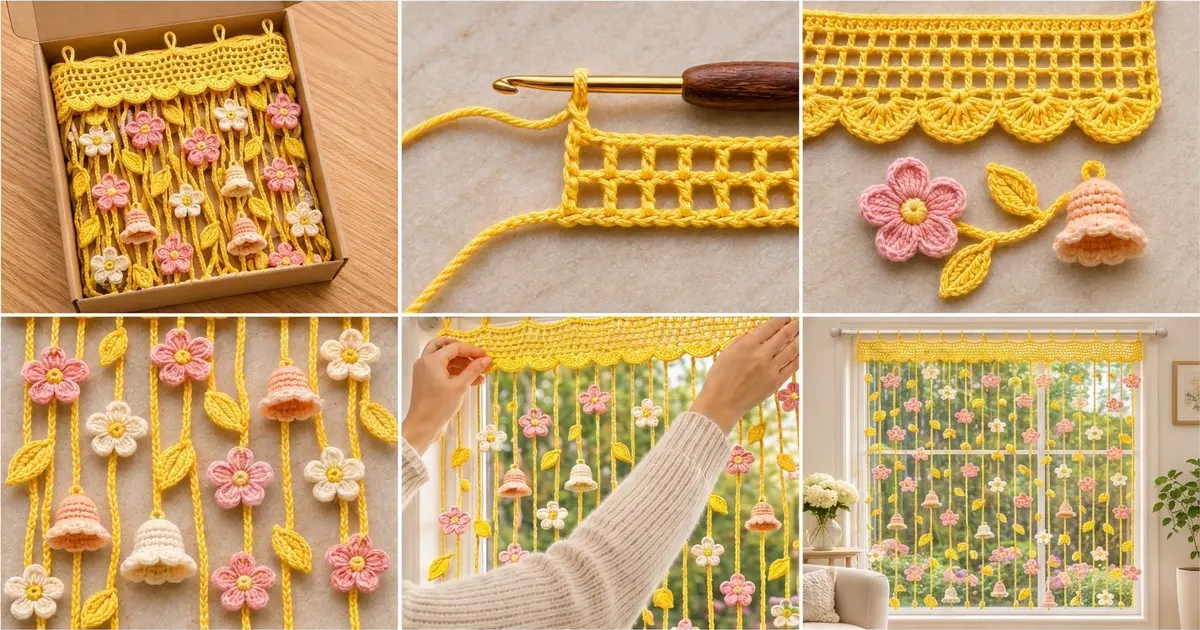
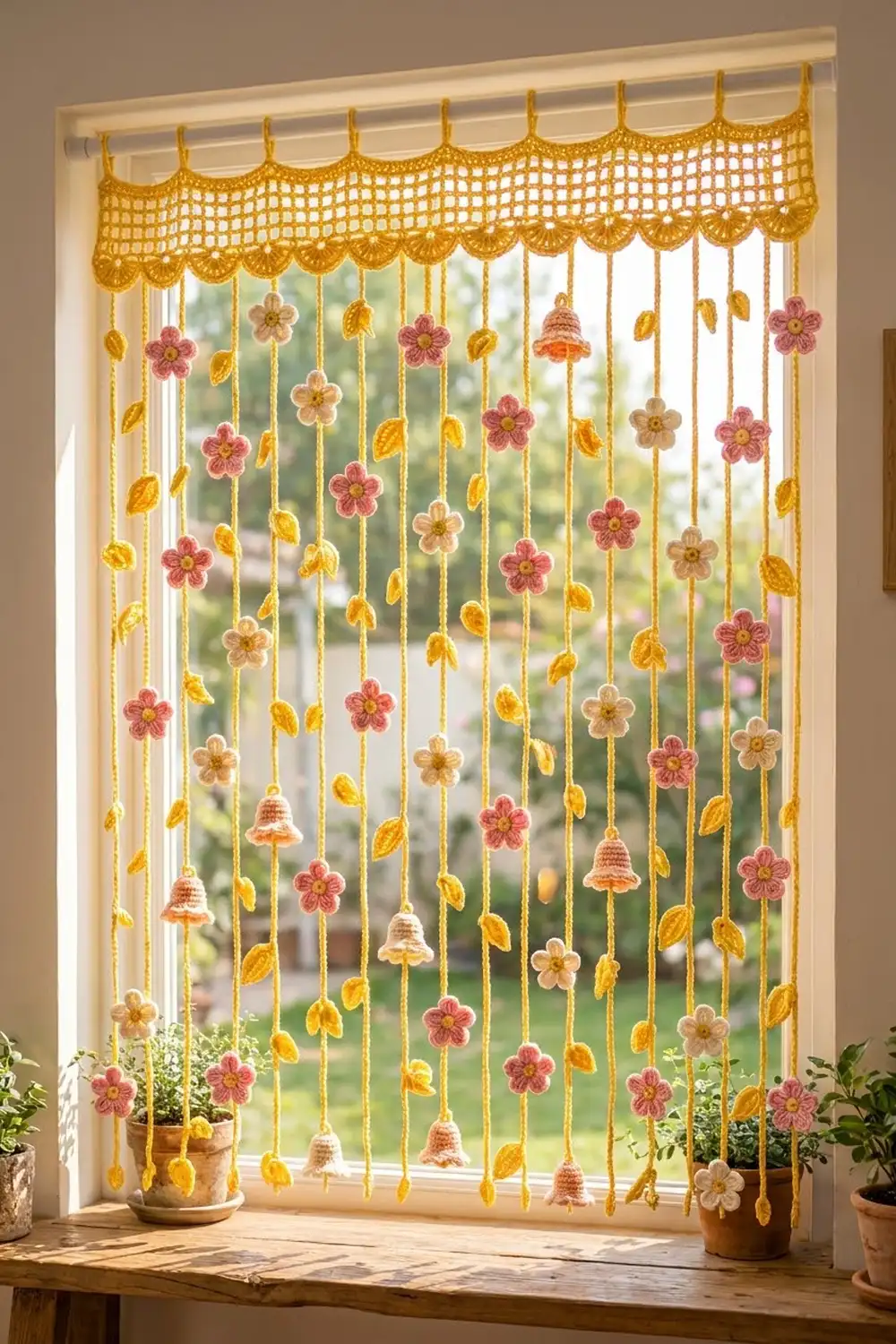
The Sunny Blossom Curtain is a light, airy window panel that lets sunshine through. A bright yellow filet-mesh header with a scalloped edge holds 25 hanging strands decorated with flowers, leaves and little bells.
The colors are cheerful and soft. The header, strands, leaves and flower centers are sunny yellow. The flowers are pink and cream. The bells are peach and cream. The style is cottage-garden meets boho, and it suits a kitchen, a nursery or a sunny reading nook.
This pattern uses US crochet terms. The finished curtain is about 36 in (91.4 cm) wide and 48 in (121.9 cm) long from the top of the header to the strand tips. The hanging tabs add another 1.5 in (3.8 cm) above that.
Construction is simple and modular. First you work the header in rows, ending with the scallop row. Next you chain the strands directly from the scallop edge. Then you make the small motifs and sew them on. Finally, you add the border with the hanging tabs across the top edge.
Finished Size and Construction
- Finished size: 36 in (91.4 cm) wide × 48 in (121.9 cm) long, plus 1.5 in (3.8 cm) tabs
- Skill level: Intermediate
- Terminology: US
- Yarn weight: Worsted (#4) cotton
- Hook: 5 mm (H-8)
- Number of pieces: 1 header, 25 strands, 75 flowers, 25 bells, 75 leaves
- Layout: 25 strands spaced 1.5 in (3.8 cm) apart, with motifs sewn along each one
- Header size before border: 36 in (91.4 cm) × 5 in (12.7 cm), including the scallops
- Border depth: 0.25 in (0.6 cm) of single crochet, plus 1.5 in (3.8 cm) tabs
Materials
Use a smooth, mercerized or matte worsted-weight cotton of about 160 m per 100 g. Cotton holds the shape of the mesh and the bells, and it won’t sag as much as acrylic in sunlight.
- Sunny yellow: 450 g (720 m) for the header, strands, leaves and flower centers
- Pink: 100 g (160 m) for the flowers
- Cream: 150 g (240 m) for the flowers and bells
- Peach: 75 g (120 m) for the bells
Tools:
– 5 mm (H-8) crochet hook
– Tapestry needle
– Locking stitch markers (at least 25)
– Measuring tape
– Blocking mat and rust-proof pins
– Spray starch (optional, for the bells)
– Curtain rod up to 1 in (2.5 cm) in diameter
All quantities include a margin of about 20% for swatching and tails.
Abbreviations (US Terms)
- ch: chain
- sl st: slip stitch
- sc: single crochet
- hdc: half double crochet
- dc: double crochet
- st(s): stitch(es)
- sk: skip
- sp: space
- RS: right side
Special stitch – Shell: 11 dc worked into the same stitch.
Special stitch – Mesh square: ch 1, sk 1 st, dc in the next st. Each square is 2 sts wide.
Gauge and Checkpoints
Header gauge: 16 dc = 4 in (10.2 cm) and 8 rows = 4 in (10.2 cm). This means 8 mesh squares = 4 in (10.2 cm), so each square is 0.5 in (1.3 cm).
Chain gauge: 12 ch = 4 in (10.2 cm), measured after slip-stitching back along the chain.
Test first. Ch 19. Dc in the 4th ch from the hook and in each ch across, which gives 17 dc. Work 7 mesh rows as in Rows 2–6 below. The swatch should measure 4 × 4 in (10.2 × 10.2 cm). Also make 1 flower, 1 bell and 1 leaf, then check them against the sizes below.
Checkpoints:
– After Row 1: about 36 in (91.4 cm) wide
– After Row 7: 3.5 in (8.9 cm) deep
– After Row 8: 5 in (12.7 cm) deep at the scallop centers
– Each strand: 43 in (109.2 cm)
– Flower: 2 in (5.1 cm) across
– Bell: 2 in (5.1 cm) tall × 2 in (5.1 cm) wide at the rim
– Leaf: 2 in (5.1 cm) long × 1 in (2.5 cm) wide
If your piece is too big, go down a half size or 1 mm in hook. If it is too small, go up. Don’t change stitch counts, because the scallop and strand spacing depend on them.
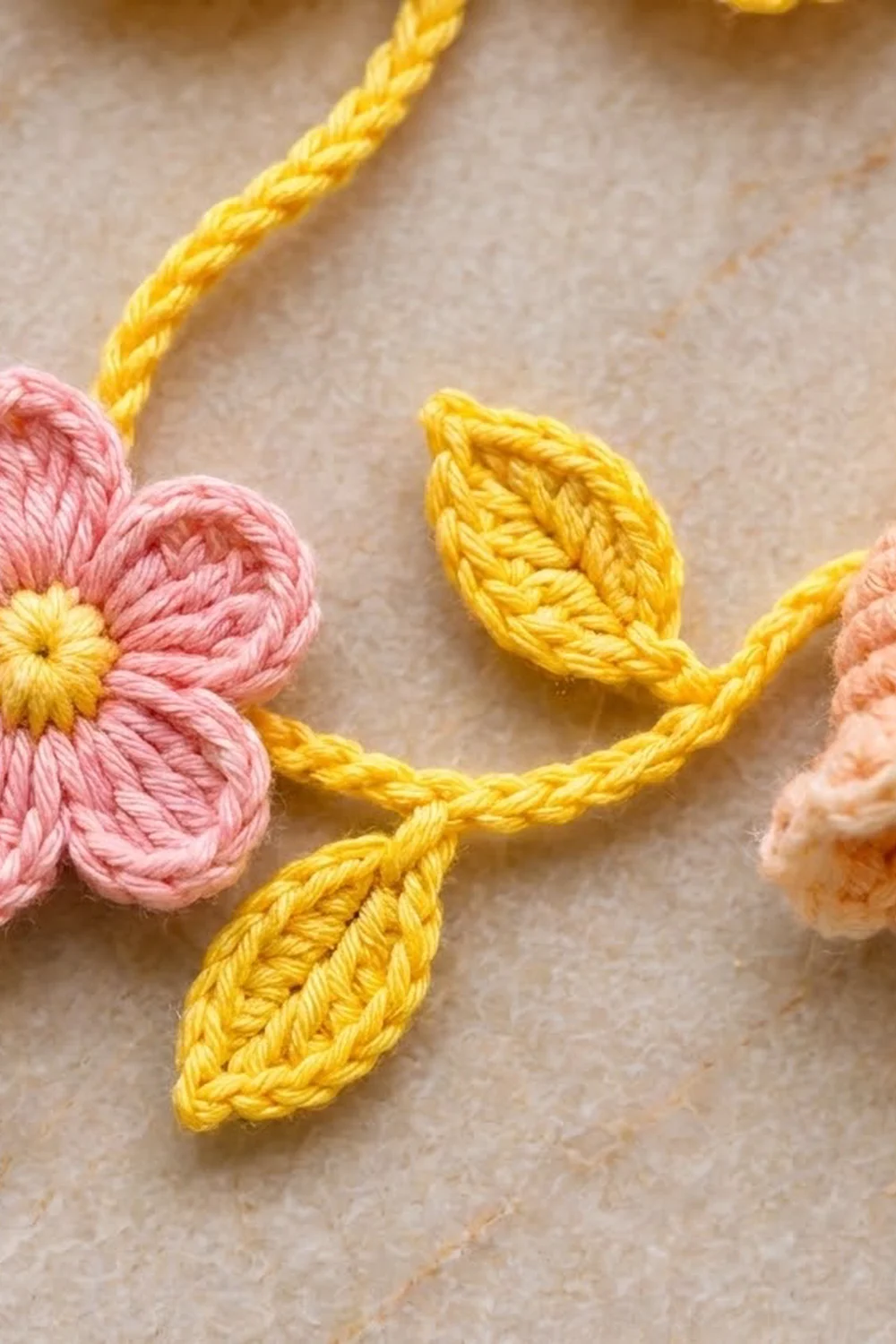
Header
With yellow, ch 147.
Row 1 (RS): Dc in the 4th ch from the hook and in each ch across. The skipped ch-3 counts as a dc. Turn. (145 dc)
Row 2: Ch 4 (counts as dc + ch 1). Sk the next st, dc in the next st. Ch 1, sk 1 st, dc in the next st; repeat from * across, ending with a dc in the top of the turning ch. Turn. (73 dc posts + 72 ch-1 sps = 145 sts, 72 mesh squares)
Rows 3–6: Ch 4 (counts as dc + ch 1). Dc in the next dc. Ch 1, dc in the next dc; repeat from * across, ending with a dc in the 3rd ch of the turning ch. Turn. (145 sts each row)
Row 7: Ch 3 (counts as dc). Work 1 dc in each ch-1 sp and 1 dc in each dc across, ending with a dc in the 3rd ch of the turning ch. Turn. (145 dc)
Checkpoint: the header is 36 in (91.4 cm) × 3.5 in (8.9 cm).
Row 8 (scallops): Ch 1. Sc in the first st. Sk 5 sts, Shell in the next st, sk 5 sts, sc in the next st; repeat from * 11 more times. Fasten off. (13 sc + 12 shells of 11 dc = 145 sts)
Each repeat uses 12 sts: 5 skipped + 1 shell base + 5 skipped + 1 sc. Then 1 + (12 × 12) = 145, so the row ends exactly on the last stitch. Each scallop is 3 in (7.6 cm) wide and about 1.5 in (3.8 cm) deep.
Flowers (make 75)
Rnd 1: With yellow, make a magic ring. Ch 1, work 10 sc in the ring, then sl st to the first sc. Fasten off. (10 sc)
Rnd 2: Join pink or cream in any sc. (Hdc, 3 dc, hdc) in the next sc, sl st in the next sc; repeat from * 4 more times. Fasten off, leaving a 10 in (25.4 cm) tail. (5 petals, 30 sts)
Bells (make 25)
Rnd 1: With peach or cream, make a magic ring. Work 6 sc in the ring. (6)
Rnd 2: Work 2 sc in each st. (12)
Rnd 3: Sc in the next st, 2 sc in the next st; repeat around. (18)
Rnds 4–7: Sc in each st around. (18)
Rnd 8: Sc in the next 2 sts, 2 sc in the next st; repeat around. (24)
Rnd 9 (rim): Sk 1 st, 5 dc in the next st, sk 1 st, sl st in the next st; repeat around. Fasten off. (6 shells, 36 sts)
Hanging loop: Join the same color at the top center. Ch 6, then sl st in the same spot. Fasten off, leaving a 10 in (25.4 cm) tail.
Leaves (make 75)
With yellow, ch 9.
Working in the 2nd ch from the hook, work: sc, hdc, 3 dc, hdc, sc. Then work 3 sc in the last ch to make the tip. Rotate and work along the other side of the foundation ch: sc, hdc, 3 dc, hdc, sc. Sl st to the first sc. Fasten off, leaving a 10 in (25.4 cm) tail. (17 sts)
Make All Pieces
There are two strand types. The A strands (13) start from the sc between scallops. The B strands (12) start from the shell centers.
Totals by color:
– Pink flowers: 38 (26 for A strands, 12 for B strands)
– Cream flowers: 37 (13 for A strands, 24 for B strands)
– Peach bells: 13 (A strands)
– Cream bells: 12 (B strands)
– Yellow leaves: 75 (39 for A strands, 36 for B strands)
Layout grid (scallop edge seen from the front):
Scallop:   |  1  |  2  |  3  | ... | 12  |
Strand:    A  B  A  B  A  B  ... A  B  A    (25 total)
Stitch #:  1  7  13 19 25 31 ... 133 139 145
Positions below the scallop edge:
Depth            Strand A        Strand B
4 in (10.2 cm)   pink flower     -
6 in (15.2 cm)   -               leaf
10 in (25.4 cm)  leaf            -
12 in (30.5 cm)  -               cream flower
16 in (40.6 cm)  peach bell      -
18 in (45.7 cm)  -               leaf
22 in (55.9 cm)  leaf            -
24 in (61.0 cm)  -               pink flower
28 in (71.1 cm)  cream flower    -
30 in (76.2 cm)  -               cream bell
34 in (86.4 cm)  leaf            -
36 in (91.4 cm)  -               leaf
40 in (101.6 cm) pink flower     -
42 in (106.7 cm) -               cream flower
Each strand carries 3 flowers, 1 bell and 3 leaves.
Joining
Strands. Hold the header with the RS facing and the scallops pointing down. Count the Row 8 stitches from right to left.
- Strand A: Join yellow in a sc between scallops (sts 1, 13, 25 … 145).
- Strand B: Join yellow in the 6th dc of a shell, which is its center stitch (sts 7, 19, 31 … 139).
Every strand is 6 sts, or 1.5 in (3.8 cm), from its neighbor.
To make each strand: ch 130. Sl st in the back bump of the 2nd ch from the hook and in each ch back up to the header, for 129 sl sts. Sl st into the starting stitch and fasten off. The strand measures 43 in (109.2 cm).
Keep the slip stitches loose enough that the strand stays straight. Tight slip stitches make it curl and shorten. Check each strand against the first one before you weave in the ends.
Motifs. Lay the curtain flat. Place a marker on each strand at the depths in the grid. Use the motif’s tail and a tapestry needle to sew each piece on:
- Flowers: Stitch through the center ring 3–4 times.
- Leaves: Tack the base of the leaf so it angles slightly away from the strand.
- Bells: Sew through the hanging loop so the bell dangles freely.
Don’t pull the strand into a pucker while sewing.
Size checkpoint: The curtain measures 36 in (91.4 cm) × 48 in (121.9 cm) laid flat.
Border
Border gauge: 4 sc = 1 in (2.5 cm), which matches the dc gauge.
Border Row 1: With the RS facing, join yellow at the lower left corner of the header, at the end of Row 7.
- Work 2 sc around each row-end post up the left side. (14 sc)
- Ch 1 at the corner.
- Work 1 sc in each foundation ch across the top. (145 sc)
- Ch 1 at the corner.
- Work 2 sc in each row end down the right side. (14 sc)
Fasten off. (173 sc; the corner ch-1s are not counted)
Border Row 2 (tabs): With the RS facing, join yellow in the first top sc. Work this row across the 145 top sts only.
(Sc, ch 12, sc) in the tab stitch, then sc in the next 11 sts. Repeat from * 11 more times, then work (sc, ch 12, sc) in the last st. (13 tabs; 26 + 132 = 158 sc + 13 ch-12 loops)
Border Row 3: Do not turn. Ch 1. Sl st in each sc, and work 16 sc into each ch-12 loop. Fasten off. (158 sl sts + 208 sc)
Why the math works:
– The 7 dc rows are 3.5 in (8.9 cm) tall. Two sc per row end gives 14 sc at 4 sc per inch, so the sides lie flat.
– Tabs fall on sts 1, 13, 25 … 145. That is 12 sts, or 3 in (7.6 cm), apart, the same repeat as the scallops. So each tab sits directly above an A strand.
– The 13 tabs leave 12 gaps of 3 in (7.6 cm), which spans exactly 36 in (91.4 cm).
Final Blocking
- Wet the header and the top 6 in (15.2 cm) of the strands, then press out the water in a towel.
- Pin the header to 36 in (91.4 cm) × 5 in (12.7 cm). Pin each scallop into a round curve and square up every mesh opening.
- Spray the bells lightly with starch. Shape the rims over a fingertip so they flare.
- Pin the flower petals flat and the leaves to a point.
- Let everything dry completely.
- Hang the curtain on the rod for 24 hours so the strands straighten under their own weight.
Final Quality-Control Checklist
- Header is 36 in (91.4 cm) wide with 72 mesh squares
- 12 even scallops, 13 tabs and 25 strands
- Every strand is 43 in (109.2 cm) long
- Strands follow the A/B pattern and are 1.5 in (3.8 cm) apart
- Each strand has 3 flowers, 1 bell and 3 leaves at the grid depths
- Tabs fit over the rod
- All ends are woven in securely
Troubleshooting
- The header ripples: Your turning chains are too loose. Try ch 3 + ch 1 instead of ch 4.
- The header is too narrow: Your dc gauge is tight. Remake it with a larger hook.
- The scallops cup: Check that you skipped exactly 5 sts on each side of every shell.
- Strands curl or twist: Loosen your slip stitches, then hang the curtain with light weights at the tips while blocking.
- Strands stretch past 43 in (109.2 cm): Remove a few chains at the tip, then re-fasten.
- Bells collapse: Starch them again, or work Rnds 4–7 more firmly.
- Flowers cup: Rnd 1 is too tight. Work it with a loose magic ring.
Care
Hand wash in cool water, press out the water in a towel, and dry flat or hanging. Re-starch the bells after washing if needed.
Final Notes
Everything comes back to one measurement chain:
– 4 dc = 1 in (2.5 cm), so 145 sts make a 36 in (91.4 cm) header.
– 12 sts = 3 in (7.6 cm), so there are 12 scallops and 13 tabs.
– 6 sts = 1.5 in (3.8 cm), so there are 25 strands.
– 129 chains = 43 in (109.2 cm), so the curtain measures 48 in (121.9 cm).
If you match the swatch, everything else falls into place.
Happy crocheting!