

This curtain is a garden of little daisies climbing a cream lace trellis. Five lace strips hang side by side, and each one holds seven round flower motifs. Leafy green vines run down the seams between the strips. It’s light and airy, and it softens a sunny window without blocking the light.
The flowers alternate between coral-red and soft peach, and every flower has a bright yellow center. The cream lace, the olive-green vines and the warm flowers give the curtain a soft cottage-boho style. Coral and peach swap places on each new strip, so the panel reads as a checkerboard.
The pattern uses US crochet terms. The finished curtain is 22.5 in (57.2 cm) wide. The lace body is 33.25 in (84.5 cm) long, and the total drop from the top of the tabs to the bottom of the flower dangles is 38.5 in (97.8 cm).
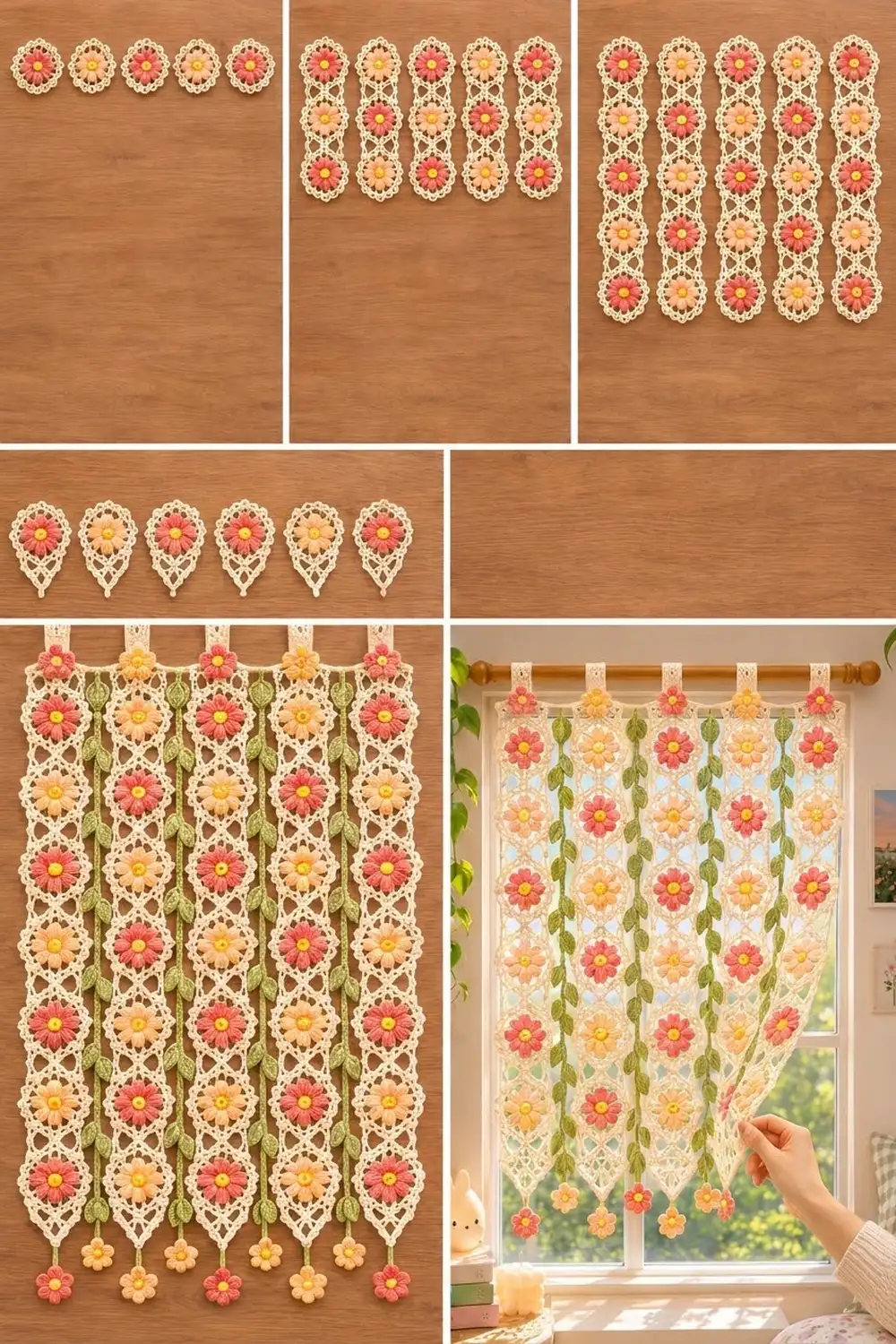
Here’s the construction order. First you make 35 flower motifs and link them into five strips with lattice connectors. Next you add a pointed tip to each strip. Then you edge each strip and join the strips to each other on the last edging round. Last, you tack on the vines, the tabs and the flower dangles.
Finished Size and Construction
- Finished size: 22.5 in (57.2 cm) wide × 33.25 in (84.5 cm) lace body; 38.5 in (97.8 cm) total drop
- Skill level: Intermediate
- Terminology: US
- Yarn weight: DK (#3) cotton
- Hook: 3.5 mm (E-4)
- Number of pieces: 35 motifs, 5 strips, 4 vines, 5 tabs, 5 large and 9 small flowers
- Layout: 5 strips across, 7 motifs down each strip
- Motif size: 3.5 in (8.9 cm) across
- Strip size before border: 3.5 × 32.25 in (8.9 × 81.9 cm)
- Border depth: 0.5 in (1.3 cm) on every edge, so each strip ends up 4.5 in (11.4 cm) wide
Materials
Choose a smooth mercerized DK cotton of about 125 m per 50 g. Cotton keeps the lace crisp, shows the picots clearly and stands up to sunlight.
- Cream: 160 g (400 m)
- Coral-red: 30 g (75 m)
- Peach: 30 g (75 m)
- Yellow: 20 g (50 m)
- Olive green: 40 g (100 m)
These amounts include a safety margin of about 15–20%.
Tools: 3.5 mm (E-4) hook, tapestry needle, stitch markers, scissors, blocking mats, rust-proof pins, spray bottle, measuring tape.
Abbreviations (US Terms)
- ch – chain
- sl st – slip stitch
- sc – single crochet
- hdc – half double crochet
- dc – double crochet
- MR – magic ring
- st(s) – stitch(es)
- sp(s) – space(s)
Picot: ch 3, sl st in 3rd ch from hook.
Join-picot: ch 2, sl st in the matching picot of the neighboring strip, ch 1, sl st in 3rd ch from hook (this is the first ch you made).
Loop numbering: After Round 6, lay the motif with one ch-5 loop at the top. Number the loops 1–12 like a clock, so Loop 12 is the top, Loop 3 is far right, Loop 6 is the bottom and Loop 9 is far left.
Gauge and Checkpoints
Gauge is 20 sc and 22 rows = 4 in (10.2 cm). The motif is the gauge that matters most, so make one complete motif and block it before you go on.
- After Round 2: 1 in (2.5 cm) across
- After Round 3, tip to tip of the petals: 2.25 in (5.7 cm)
- After Round 5: 3 in (7.6 cm)
- After Round 6: 3.5 in (8.9 cm)
- Two motifs linked by a connector: 8 in (20.3 cm)
If your motif is too big, go down 0.25 mm in hook size. If it’s too small, go up 0.25 mm. Ruffled petals mean your tension is too loose. Cupping in Round 5 means it’s too tight.
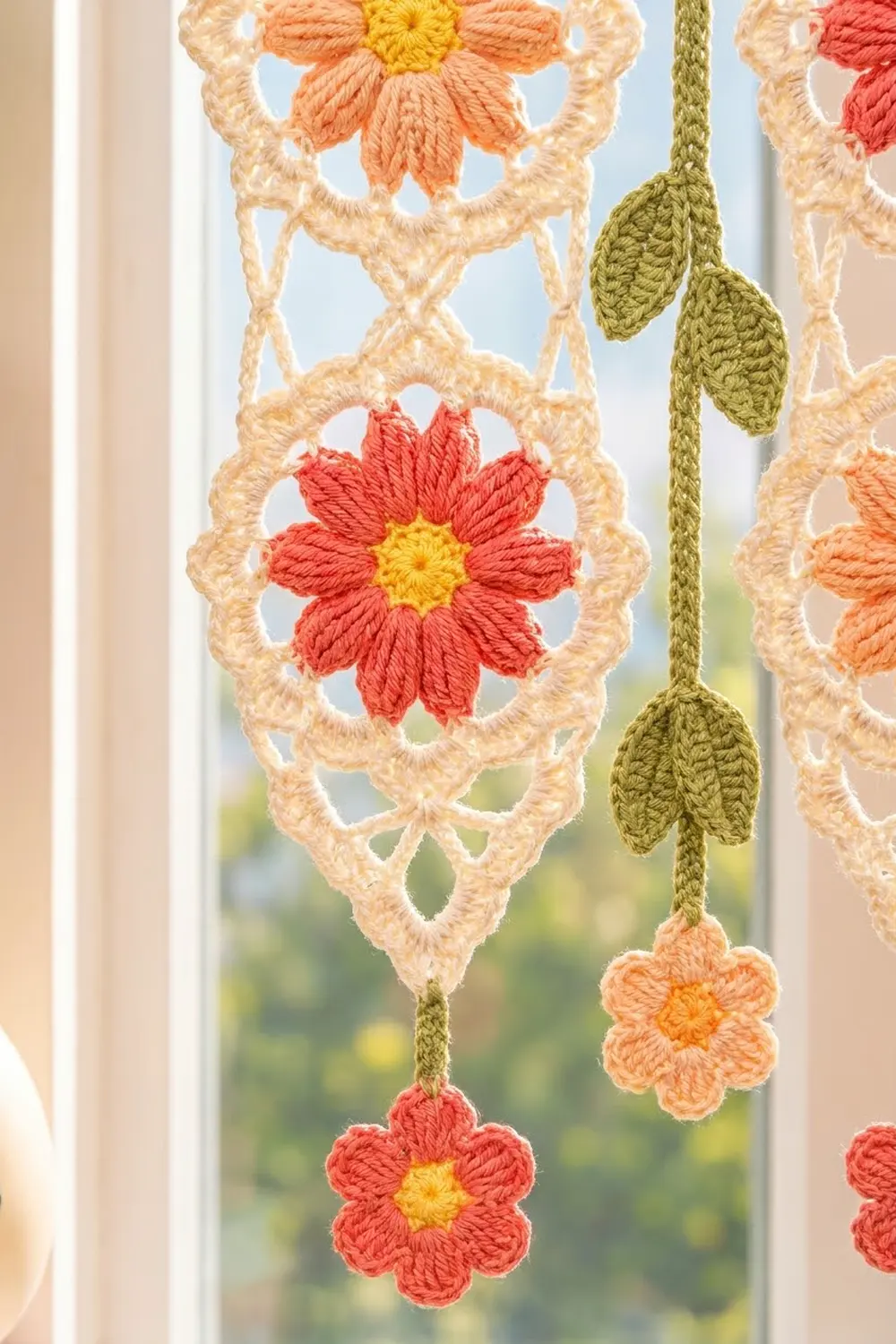
Flower Motif (make 35)
Round 1 (yellow): Work 6 sc in MR. Join with a sl st to the first sc. (6 sts)
Round 2 (yellow): Ch 1, then work 2 sc in each st around. Join and fasten off. (12 sts)
Round 3 (coral or peach): Join with a sl st in any st. Ch 4, sc in 2nd ch from hook, hdc in next ch, dc in next ch, sl st in next st of Round 2. Repeat from * around. (12 pointed petals)
Round 4 (cream): Work this round behind the petals. Join with a sc in the tip ch of any petal. Ch 3, sc in the tip of the next petal. Repeat from * around, ending with ch 3. Join. (12 sc + 12 ch-3 sps)
Round 5 (conversion round): Ch 1. Sc in sc, 3 sc in ch-3 sp. Repeat from * around. Join. (12 sc worked 1 per existing sc + 36 sc added in the spaces = 48 sts)
Round 6: Ch 1, sc in the first st. Ch 5, skip 3 sts, sc in next st. Repeat from * around, ending with ch 5, skip 3 sts. Join to the first sc. (12 ch-5 loops) Fasten off.
Lattice Connectors (6 per strip)
Lay out Motif A above Motif B with a 1 in (2.5 cm) gap between them.
- Join cream with a sc in A5. Ch 10, then sc in B11. The 5th ch of this chain is the center.
- Ch 2, sc in B12, ch 3, sl st in the center, ch 3, sc in A6.
- Ch 2, sc in A7, ch 5, sl st in the center, ch 5, sc in B1. Fasten off.
This makes an X with a vertical bar through the middle, which is the trellis diamond between the flowers. Link all 7 motifs of a strip this way, top to bottom.
Checkpoint: a linked strip of 7 motifs measures 30.5 in (77.5 cm).
Pointed Tip (1 per strip)
Work the tip in cream into the bottom loops of Motif 7.
Row 1: Join with a sc in Loop 5, ch 5, (sc, ch 5, sc) in Loop 6, ch 5, sc in Loop 7. (3 ch-5 sps)
Row 2: Turn. Sl st to the center of the first sp and sc in that sp. Ch 5, sc in next sp. Work from * twice. (2 ch-5 sps)
Row 3: Turn. Sl st to the center of the first sp, sc in it, ch 5, sc in next sp. (1 ch-5 sp) Fasten off.
The tip adds 1.75 in (4.4 cm), so the strip before border measures 32.25 in (81.9 cm).
Make All Pieces
- Motifs: 18 coral and 17 peach, 35 in total. Use 35 yellow centers.
- Strips 1, 3 and 5: coral, peach, coral, peach, coral, peach, coral
- Strips 2 and 4: peach, coral, peach, coral, peach, coral, peach
- Connectors: 30. Tips: 5.
- Large dangle flowers: make 5, using Rounds 1–3 of the motif: 3 coral and 2 peach.
- Small flowers: make 9. Work 6 sc in MR in yellow. Join peach or coral, then work (sl st, ch 2, 2 dc, ch 2, sl st) in each sc for 6 petals. Each small flower is 1.25 in (3.2 cm) across. Make 3 coral and 6 peach.
- Vines: 4. Tabs: 5.
Layout (C = coral, P = peach, | = vine):
C | P | C | P | C
P | C | P | C | P
C | P | C | P | C
P | C | P | C | P
C | P | C | P | C
P | C | P | C | P
C | P | C | P | C
V   V   V   V   V   (tips)
Joining
The strips are joined to each other during Border Round 2 with join-as-you-go. You don’t sew any seams.
Each seam is joined only at the widest point of every motif: the right-side picot at Loop 3 of one strip meets the left-side picot at Loop 9 of the next strip. That gives 7 joins per seam and 28 joins in all. Between the joins, the strips stay slightly open, and the vines cover those gaps.
Tension: keep the join chains the same length as an ordinary picot. If you pull them tight, the curtain narrows and puckers at the seams. Keep the tops of all strips level as you go.
Checkpoint: after joining 2 strips, the piece measures 9 in (22.9 cm) across. The full curtain measures 22.5 in (57.2 cm).
Border
Border gauge: each ch-5 loop takes 4 sc. A ch-5 arch is about 0.8 in (2 cm), and 4 sc at 5 sc per inch also cover 0.8 in (2 cm), so the edge lies flat.
Round 1 (cream): Join with a sc in Loop 11 of Motif 1. Work 4 sc in each of Loops 11, 12 and 1 of Motif 1.
– Right side: On each motif, work 4 sc in each of Loops 2, 3 and 4. Between motifs, work a bridge: 3 sc in A5 (working around the connector sc), ch 7, 3 sc in B1.
– Tip: Work 4 sc in the outer half of the Row 1 sp, then 4 sc in the outer half of the Row 2 sp. In the Row 3 sp, work (4 sc, ch 3, 4 sc). Then work 4 sc in the Row 2 sp and 4 sc in the Row 1 sp.
– Left side: On each motif, work 4 sc in each of Loops 8, 9 and 10, with bridges of 3 sc in B11, ch 7, 3 sc in A7, up to Motif 1.
– Join to the first sc.
Round 1 counts:
– Top: 12 sc
– Each long side: (7 motifs × 12 sc) + (6 bridges × 6 sc) = 120 sc + 6 ch-7 sps
– Tip: 24 sc + 1 ch-3 sp
– Total: 12 + 120 + 24 + 120 = 276 sc, 12 ch-7 sps, 1 ch-3 sp
Round 2: Ch 1.
– On each 4-sc group from Round 1, work 2 sc, picot, 2 sc.
– On the 3-sc parts of the bridges, work 1 sc in each sc.
– In each ch-7 sp, work (4 sc, picot, 4 sc).
– At the point, work (sc, picot, sc) in the ch-3 sp.
– Join and fasten off.
On strips 2–5, replace each left-side picot at Loop 9 with a join-picot.
Round 2 counts:
– Each long side: 120 + (6 × 8) = 168 sc and 27 picots
– Total: 276 + 96 + 2 = 374 sc and 64 picots
Why the math works: every long side has exactly 7 motifs × 12 sc. The only extras are the bridges, and their stitches are stated exactly. Round 2 adds stitches only inside spaces, so both long sides of every strip match and line up at the joins.
Vines (olive green): Ch 6. For the leaf: ch 7, sc in 2nd ch from hook, then hdc, dc, dc, hdc, sc in the next 5 ch, and sl st in the base ch where the leaf began. Ch 6. Repeat from * 27 more times for 28 leaves. Fasten off. Each leaf is 1.25 in (3.2 cm) long, and the vine is 34 in (86.4 cm) unstretched.
Sew the top of each vine to the top of a seam and tack it down every 2 in (5.1 cm). Turn the leaves so they alternate left and right. Sew a small peach flower to the bottom end of each vine.
Tabs (cream): Ch 8, then work 7 sc starting in the 2nd ch from hook.
– Even rows: ch 1, sc in the first st, ch 1, skip 1, sc in next st 3 times. (7 sts)
– Odd rows: ch 1, sc in each st and ch-1 sp. (7 sc)
Work 22 rows, which gives 4 × 1.4 in (10.2 × 3.6 cm). Fold the tab in half and sew both ends to the back of the top edge at Loop 12. This makes a 2 in (5.1 cm) rod loop. Sew a small flower to the front of each tab base: coral, peach, coral, peach, coral.
Dangles: Join cream at the point picot, ch 5 (about 1 in / 2.5 cm), and sew on a large flower in the same color as Motif 7 of that strip.
Final Blocking
- Wet the curtain thoroughly in cool water, then gently press the water out with a towel.
- Lay it flat and pin the top edge straight across 22.5 in (57.2 cm).
- Pin each strip to 4.5 in (11.4 cm) wide, with a pin at every Loop 3 and Loop 9.
- Pin out every picot and pull each tip to a sharp point.
- Open the lattice crosses into even diamonds.
- Fluff the petals forward with your fingers.
- Let it dry completely, at least 24 hours.
Final Quality-Control Checklist
- All 35 motifs measure 3.5 in (8.9 cm).
- Colors alternate both down and across the curtain.
- Every connector forms a clean X with its center bar.
- Each long side has 168 sc and 27 picots.
- 28 joins, with all strip tops level.
- 4 vines are tacked flat with their leaves alternating.
- 5 tabs, 5 large dangles and 9 small flowers are sewn on securely.
- All yarn tails are woven in and trimmed.
Troubleshooting
- Petals cup or curl: Work Round 3 more loosely, or block with steam.
- Motif too wavy: Go down a hook size for Rounds 4–6 only.
- Lattice sags: Shorten the diagonal chains by 1 ch on each half.
- Strip edge puckers: The bridge ch is too tight. Rework it at ch 8.
- Strips uneven in length: Check the 1 in (2.5 cm) gaps between motifs before you start the edging.
- Vine twists: Lay it flat and tack it more often.
Care
Hand wash in cool water with mild soap, then press out the water in a towel. Dry the curtain flat and re-pin the tips if needed, because hanging it wet will stretch the lace.
Final Notes
The measurement chain is:
– Motif: 3.5 in (8.9 cm)
– Linked strip: 30.5 in (77.5 cm)
– With tip: 32.25 in (81.9 cm)
– With border: 4.5 × 33.25 in (11.4 × 84.5 cm)
– Five joined strips: 22.5 in (57.2 cm) wide
– With tabs and dangles: a 38.5 in (97.8 cm) drop
If each stage measures right, the next one will fall into place.
Happy crocheting!