
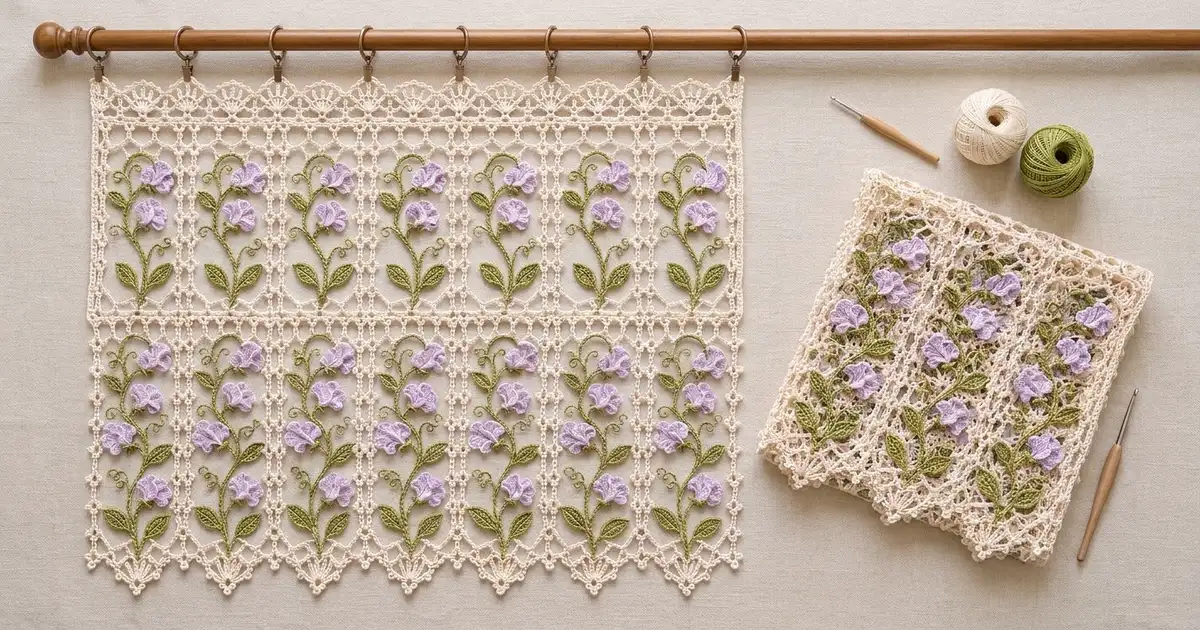
This curtain brings a climbing garden to your window. Each panel is an open cream mesh with a green vine sewn up the middle. The vine has curling tendrils, lacy leaves, and ruffled lilac sweet pea flowers. Panels are joined into tall columns, and a fan-scallop edge finishes the top and bottom.
The palette is soft and vintage: cream for the lace, olive green for the vines, and pale lilac for the blossoms. Light comes through the mesh, so the flowers seem to float against the glass. The style suits a cottage kitchen, a sunroom, or French doors.
The pattern uses US crochet terms. One curtain measures 20.5 x 73.5 in (52.1 x 186.7 cm) after blocking. The photo shows a pair, so make two curtains for a matching set.
The construction is modular:
- Work 18 filet mesh panels, each with a single-crochet edge.
- Sew a sweet pea vine onto each panel.
- Join the panels 3 across and 6 down.
- Add a two-round border.
Finished Size and Construction
- Finished size (one curtain): 20.5 x 73.5 in (52.1 x 186.7 cm)
- Skill level: Intermediate
- Terminology: US
- Yarn weight: Light / DK (#3) mercerized cotton
- Hook: 3.5 mm (E-4)
- Number of pieces: 18 panels per curtain (36 for the pair)
- Layout: 3 panels across x 6 panels down
- Panel size: 6.5 x 12 in (16.5 x 30.5 cm)
- Size before border: 19.5 x 72 in (49.5 x 182.9 cm)
- Border depth: 0.75 in (1.9 cm) at the top and bottom; 0.5 in (1.3 cm) at the sides
Materials
Choose a smooth mercerized DK cotton. It holds the lace shape, resists sagging on a rod, and handles sunlight better than acrylic. The amounts below assume about 115 m per 50 g.
For one curtain:
- Cream (mesh and border): 300 g, about 690 m
- Olive green (vines, leaves, tendrils, calyxes): 130 g, about 299 m
- Pale lilac (flowers): 130 g, about 299 m
Double every amount for a pair. The quantities include a margin of about 15% for swatching, tails, and tension differences.
Tools:
- 3.5 mm (E-4) hook
- Tapestry needle
- Sewing pins
- Stitch markers
- Tape measure
- Blocking mats and rust-proof pins
- Spray bottle
- Curtain rod with 12 clip rings
Abbreviations (US Terms)
- ch: chain
- sl st: slip stitch
- sc: single crochet
- hdc: half double crochet
- dc: double crochet
- sk: skip
- sp: space
- st(s): stitch(es)
- RS / WS: right side / wrong side
Special stitches:
- Picot: ch 3, sl st in the 3rd ch from the hook.
- Picot loop: ch 2, picot, ch 2.
- Fan: 9 dc in the same stitch.
Gauge and Checkpoints
Gauge: 8 mesh squares and 8 rows = 4 x 4 in (10.2 x 10.2 cm) in blocked filet mesh (dc, ch 2).
Make one complete panel first. It is your real gauge swatch, and it shows how the vine will fit.
Checkpoints:
- After Row 8: the mesh measures 6 x 4 in (15.2 x 10.2 cm).
- After Row 23: the mesh measures 6 x 11.5 in (15.2 x 29.2 cm).
- After the edging round: the panel measures 6.5 x 12 in (16.5 x 30.5 cm).
If the panel is too big, use a 3.25 mm hook. If it is too small, use a 3.75 mm hook. Change the hook, never the counts. The joining and border math depends on every panel having exactly 37 sts on each short side and 71 sts on each long side.

Mesh Panel (make 18)
Use cream.
Foundation: Ch 41.
Row 1 (RS): Dc in 8th ch from hook, [ch 2, sk 2 ch, dc in next ch] 11 times, turn. (12 mesh squares; 13 dc counting the skipped chains as the first dc)
Row 2: Ch 5 (counts as dc and ch 2), dc in next dc, [ch 2, dc in next dc] 10 times, ch 2, dc in the 5th ch of the Row 1 skipped chain, turn. (12 squares; 13 dc)
Rows 3–23: Work as Row 2, but end with dc in the 3rd ch of the turning ch-5. Do not fasten off. (23 rows of 12 squares)
Edging Round: Work around all four sides. Each corner gets [sc, ch 2, sc]. Each corner sc counts toward the side it begins or ends.
- Top: Work [sc, ch 2, sc] in the last dc worked. Work 2 sc in each of the 12 ch-2 sps and 1 sc in each of the 11 inner dc. (35 sc) Work [sc, ch 2, sc] in the turning ch.
- Long side: Work 3 sc around each of the 23 row-end posts. (69 sc) Work [sc, ch 2, sc] in the first foundation ch.
- Bottom: Work 2 sc in each of the 12 ch-2 sps and 1 sc in each of the 11 inner base sts. (35 sc) Work [sc, ch 2, sc] in the last base st.
- Second long side: Work 3 sc around each row end. (69 sc) Sl st to the first sc and fasten off.
Per-side counts, including that side’s 2 corner sc:
- Short sides: 35 + 2 = 37 sc
- Long sides: 69 + 2 = 71 sc
- Round total: 2 x 37 + 2 x 71 = 216 sc, plus 4 corner ch-2 sps
Block each panel lightly to 6.5 x 12 in (16.5 x 30.5 cm) before you add the vine.
Sweet Pea Vine Appliqué (1 set per panel)
Each set has 1 main stem, 4 flower stalks, 4 tendrils, 5 leaves, and 4 flowers. Each flower is made from a back petal, a front petal, and a calyx.
Main Stem (olive green)
Ch 50. Sl st in the back bump of the 2nd ch from hook and in each ch across. (49 sl st; about 11 in / 27.9 cm) Leave a long tail for sewing.
Flower Stalks (olive green, make 4)
Ch 8. Sl st in the back bump of the 2nd ch from hook and in each ch across. (7 sl st)
Tendrils (olive green, make 4)
Ch 16. Sl st in 2nd ch from hook, then work 2 sc in each of the next 14 ch. (1 sl st + 28 sc) The extra stitches twist the strip into a springy curl.
Lacy Leaf (olive green, make 5)
Ch 12.
Rnd 1: Work the first side into the chain:
- Sc in 2nd ch from hook, hdc in next ch, dc in next ch.
- [Ch 1, sk 1, dc in next ch] 3 times.
- Hdc in next ch, then 3 sc in the last ch for the tip.
Rotate and work the second side into the free loops:
- Hdc in next ch.
- [Dc in next ch, ch 1, sk 1] 3 times.
- Dc in next ch, hdc in next ch, sc in last ch.
- Sl st to the first sc.
(17 sts + 6 ch-1 sps)
Rnd 2: Sl st loosely in each st and in each ch-1 sp around. In the center tip sc, work [sl st, ch 3, sl st]. (23 sl st + 1 tip ch-3 loop) This forms the raised chain outline.
Vein: Use the tail to surface sl st up the center from base to tip. The ch-1 gaps on each side become the open veins. Each leaf measures about 2.5 x 1 in (6.4 x 2.5 cm).
Back Petal (lilac, make 4)
Ch 4.
Row 1: 9 dc in 4th ch from hook, turn. (10 sts; the skipped ch count as 1 dc)
Row 2 (growth): Ch 3 (counts as dc), dc in the same st, 2 dc in each st across, turn. (20 sts)
Row 3 (ruffle): Ch 3, dc in the same st, 2 dc in each st across. (40 sts) The crowded stitches make the wavy ruffle. Fasten off.
Front Petal (lilac, make 4)
Ch 4.
Row 1: 6 dc in 4th ch from hook, turn. (7 sts)
Row 2: Ch 3, dc in the same st, 2 dc in each st across, turn. (14 sts)
Row 3 (trim): Ch 1, [sc, ch 2] in each st across. (14 sc, 1 per existing stitch, + 14 ch-2 sps added) Fasten off.
Calyx (olive green, make 4)
Ch 4 and sl st to form a ring. [Ch 4, sl st in 2nd ch from hook, sc in next 2 ch, sl st in ring] 3 times. (3 points)
Assembling Each Flower
- Lay the back petal RS up with the fan opening upward.
- Fold the front petal in half lengthwise. Center it over the lower third of the back petal and stitch it at the base only, so the ruffles stand free.
- Sew the calyx beneath, with its points wrapping the petal bases.
Each flower is about 2.25 in (5.7 cm) across.
Placing the Vine
Pin the stem up the panel center. Start at the bottom edge, curve it gently left and right, and end near the top. Attach the stalks on alternating sides and sew a flower to each one. Place 4 leaves in pairs on the lower stem and 1 higher up. Tuck the tendrils between the leaves and flowers.
Whipstitch each piece to the mesh with matching yarn. Catch only back loops so no stitches show on the RS. Leave the petal edges and tendril tips free.
Make All Pieces
One curtain:
- Cream: 18 mesh panels
- Olive green: 18 stems, 72 stalks, 72 tendrils, 90 leaves, and 72 calyxes
- Lilac: 72 back petals and 72 front petals
Double every quantity for the pair.
Layout (P = panel, with every vine growing upward):
Row 1 (top):    P  P  P
Row 2:          P  P  P
Row 3:          P  P  P
Row 4:          P  P  P
Row 5:          P  P  P
Row 6 (bottom): P  P  P
Joining
Method: flat slip-stitch seam through back loops, with RS facing up.
- Strips: Join 3 panels along their long sides. Match 71 sts to 71 sts, corner sc to corner sc. Make 6 strips.
- Stacking: Join the strips along their short edges. Each edge has 3 x 37 = 111 sc, so match 111 to 111. Where panel corners meet, sl st through the stacked corner ch-2 sps.
Work every seam stitch to stitch. Never skip a stitch and never add one.
Tension: Keep the sl sts as relaxed as the mesh. If a seam puckers, go up one hook size for seaming only.
Checkpoint: The joined piece measures 19.5 x 72 in (49.5 x 182.9 cm), which is 3 x 6.5 in across by 6 x 12 in down.
Border
Border gauge: About 5.7 sc per inch on the top and bottom (111 sc over 19.5 in) and 5.9 sc per inch on the sides (426 sc over 72 in). This matches the panel edging, so the border lies flat.
Starting counts:
- Top and bottom: 3 panels x 37 sc = 111 sts each
- Sides: 6 panels x 71 sc = 426 sts each
No stitches are added at the seams. Do not work into the corner ch-2 sps inside the seam lines.
Rnd 1: With RS facing, join cream in the first sc of the top edge. Sc in each sc around. At each of the 4 outer corners, ch 2 and sk the panel corner sp. Sl st to the first sc. (Top 111, bottom 111, each side 426, plus 4 corner ch-2 sps)
Rnd 2:
- Top: Sc in first st, [sk 4, fan in next st, sk 4, sc in next st] 11 times. (11 fans + 12 sc, using 1 + 11 x 10 = 111 sts)
- Corner: 3 sc in the corner ch-2 sp.
- Side: Sc in first st, [picot loop, sk 4, sc in next st] 85 times. (85 loops + 86 sc, using 1 + 85 x 5 = 426 sts)
- Corner: 3 sc in the corner ch-2 sp.
- Bottom, then second side: Work them the same way, with 3 sc in the last corner. Sl st to the first sc and fasten off.
Why the math works: 111 − 1 = 110, which divides by the 10-stitch fan repeat exactly 11 times. 426 − 1 = 425, which divides by the 5-stitch loop repeat exactly 85 times. Every repeat ends on a sc, so no stitches are left over before a corner.
Final Blocking
- Weave in the ends along the mesh posts. Trim them after blocking.
- Soak the curtain in cool water with a little wool wash for 15 minutes.
- Press out the water and roll the curtain in towels. Do not wring it.
- Lay it RS up and pin it to 20.5 x 73.5 in (52.1 x 186.7 cm).
- Pin every fan point and every side picot loop.
- Straighten the seams with a long ruler.
- Lift the ruffles and tendrils so they stand up from the mesh.
- Let it dry for 24–48 hours, then unpin.
Final Quality-Control Checklist
- [ ] Every panel has 37 sts on each short side and 71 sts on each long side.
- [ ] Every panel has 1 stem, 4 flowers, 5 leaves, and 4 tendrils.
- [ ] All vines grow upward.
- [ ] The seams are flat, with no puckers.
- [ ] The joined piece measured 19.5 x 72 in (49.5 x 182.9 cm).
- [ ] The border has 11 fans on the top and bottom and 85 loops on each side.
- [ ] The finished curtain measures 20.5 x 73.5 in (52.1 x 186.7 cm).
- [ ] No sewing shows on the RS.
Troubleshooting
- The mesh slants: The turning chains are too tight. Loosen the ch 5.
- The panel edges ruffle: Keep the counts, but work the edging round with a smaller hook.
- The panel edges cup: Work the edging round with a larger hook.
- The petals lie flat: Check that Row 3 has 40 sts. Steam lightly while you pinch the ruffles.
- The tendrils won’t curl: Work the sc more tightly.
- The curtain sags: Space all 12 clip rings evenly along the top.
Care
Hand wash in cool water with a mild detergent. Dry flat and reshape the flowers while damp, and never hang the curtain wet.

Final Notes
Each measurement builds on the one before it:
- A mesh of 12 squares x 23 rows makes a 6 x 11.5 in (15.2 x 29.2 cm) ground.
- The edging brings each panel to 6.5 x 12 in (16.5 x 30.5 cm), with 37 and 71 sts per side.
- Three panels across and six down make 19.5 x 72 in (49.5 x 182.9 cm).
- The 111 and 426 border stitches take the fan and picot repeats with nothing left over.
- The finished curtain measures 20.5 x 73.5 in (52.1 x 186.7 cm).
Check every step, and the next one will fall into place.
Happy crocheting!