

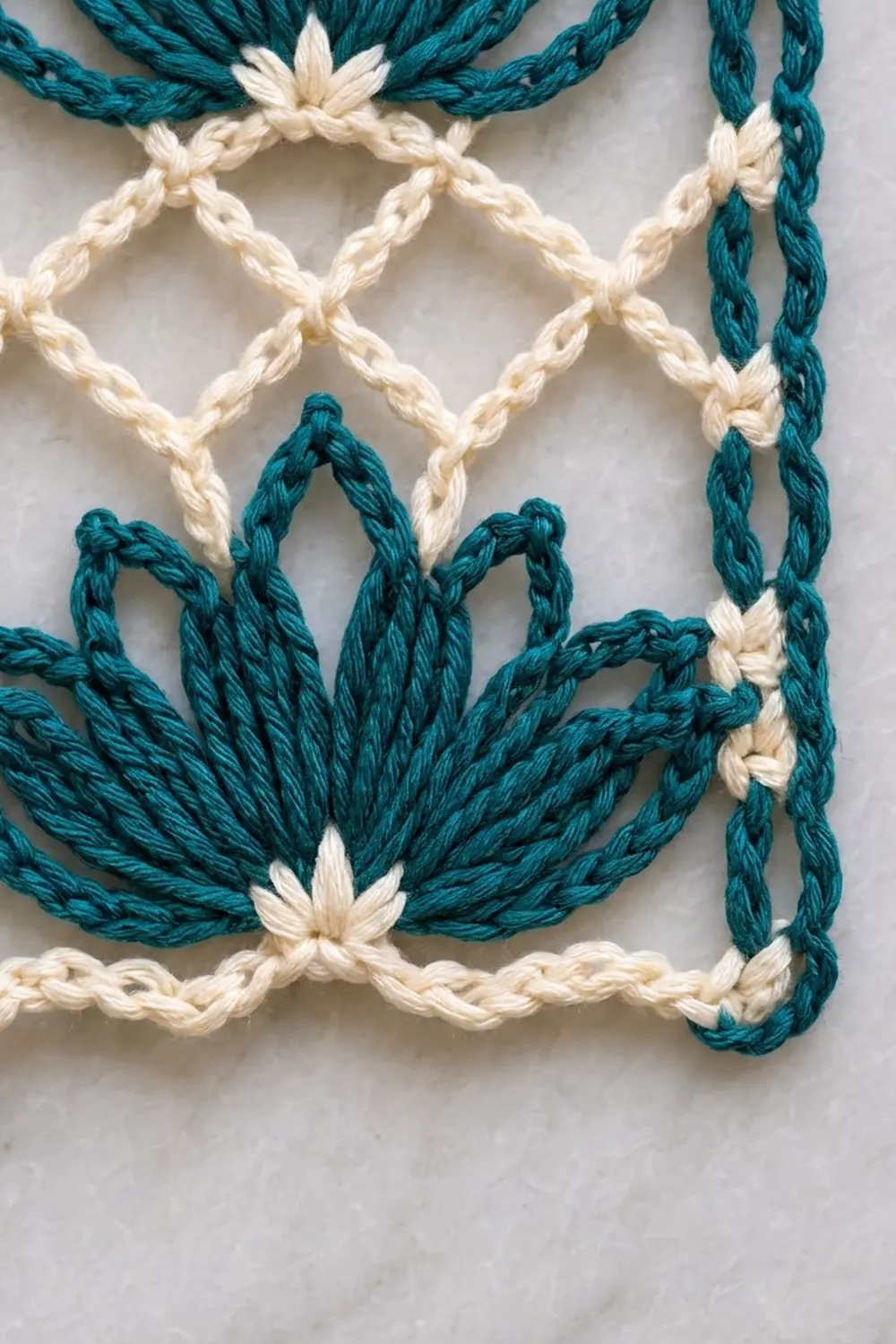
The Teal Lotus Lace Strip is a narrow lace panel with three deep teal lotus fans set into a column of cream diamond mesh. Each lotus grows from a single cream point. It has five solid petals in the middle and an open, outlined petal on each side.
The design uses two colors. Teal is used for the lotus bands and the side cords. Cream is used for the mesh, the lotus bases, and the scalloped bottom edge. The look is part vintage filet, part modern botanical.
This pattern uses US crochet terms. After blocking, the strip measures 7.25 in x 12.5 in (18.4 cm x 31.8 cm).
The strip is made in one piece from the bottom up, in turned rows. It starts with a cream base row, followed by three teal lotus bands with a cream mesh band between each pair. A cream scallop row is then worked along the foundation chain, and a corded teal border finishes each long side.
Finished Size and Construction
- Finished size: 7.25 in x 12.5 in (18.4 cm x 31.8 cm)
- Skill level: Intermediate
- Terminology: US crochet terms
- Yarn weight: Worsted (#4), cotton or cotton blend
- Hook: 5.0 mm (H-8)
- Number of pieces: 1
- Layout: single vertical strip with 3 lotus bands and 2 mesh bands
- Piece size: 7.25 in x 12.5 in (18.4 cm x 31.8 cm)
- Size before border: 6.25 in x 12.5 in (15.9 cm x 31.8 cm), including the 0.5 in (1.3 cm) bottom scallop
- Border depth: 0.5 in (1.3 cm), on each long side only
Materials
Choose a smooth worsted-weight cotton, either mercerized or matte. Cotton shows the petal shapes clearly and blocks flat. Avoid fuzzy yarns, which blur the mesh.
- Color A, teal: 30 g, about 60 m
- Color B, cream: 25 g, about 50 m
- 5.0 mm (H-8) crochet hook
- Tapestry needle
- Scissors
- 4 locking stitch markers
- Blocking mat, rustproof pins, and a spray bottle
- Measuring tape
The quantities include about 20 percent extra for swatching and weaving in ends.
Abbreviations (US Terms)
- ch – chain
- sl st – slip stitch
- sc – single crochet
- dc – double crochet
- tr – treble crochet
- trtr – triple treble crochet: yo 4 times, insert hook, pull up a loop, (yo, pull through 2 loops) 5 times
- rsc – reverse single crochet (crab stitch)
- sk – skip
- sp – space
- st(s) – stitch(es)
- yo – yarn over
- RS / WS – right side / wrong side
Special stitch – trtr3-cl (triple treble 3-cluster): *Yo 4 times, insert hook in the indicated st, pull up a loop, (yo, pull through 2 loops) 4 times; rep from * 2 more times in the same st (4 loops on hook), yo and pull through all 4 loops. Each cluster makes one solid lotus petal: narrow at the base, full in the middle, and pointed at the tip.
Gauge and Checkpoints
Gauge: 16 sc and 16 sc rows = 4 in (10.2 cm). That means 4 sc = 1 in (2.5 cm) in both directions.
Test the strip before committing to it. Work Rows 1–3 below as your sample, measure it, and then continue. Check these measurements as you go:
- After Row 1: width is 6.25 in (15.9 cm) across 25 sc.
- After Row 3: height is 2.5 in (6.4 cm) from the foundation.
- After Row 7: height is 5.0 in (12.7 cm).
- After Row 9: height is 7.25 in (18.4 cm).
- After Row 13: height is 9.75 in (24.8 cm).
- After Row 15: height is 12.0 in (30.5 cm).
Each lotus band (2 rows) measures 2.25 in (5.7 cm). Each mesh band (4 rows) measures 2.5 in (6.4 cm).
Too big? Go down to a 4.5 mm hook. Too small? Go up to a 5.5 mm hook. If the width is right but the lotus bands are short, your trtr stitches are too tight. Pull the first loop of each trtr up to the full height of the hook before working off the loops.
Pattern
Carrying colors: Every color change happens at the left edge (as seen from the RS). Don’t cut the yarn. Carry the unused color loosely up that edge, and the side border will cover it.
Foundation and Base
With Color B (cream), ch 26.
Row 1 (WS): Sc in 2nd ch from hook and in each ch across. Turn. (25 sc)
Place a marker in the 13th sc. Every petal of the first lotus grows from this center stitch, which shows as a small cream point.
Lotus Band 1
Row 2 (RS): Join Color A (teal) with a sl st in the first sc. Ch 6 (counts as the first trtr, which is the left side post), then ch 6 more and sk the next 11 sc. In the marked 13th sc, work the Lotus Fan: trtr, ch 4, [trtr3-cl, ch 3] 4 times, trtr3-cl, ch 4, trtr. Then ch 6, sk the next 11 sc, and trtr in the last sc. Turn.
Count: 4 trtr (2 side posts + 2 outer petal stitches) + 5 clusters = 9 stitches, with 8 spaces: 2 ch-6, 2 ch-4, and 4 ch-3.
Each single outer trtr and its ch-4 space become an open, outlined petal once the next row closes the tip. The 5 clusters are the solid center petals.
Row 3 (WS, tip row): Ch 1, sc in first trtr (post), ch 4, sc in outer trtr, ch 2, sc in next cluster, [ch 1, sc in next cluster] 4 times, ch 2, sc in outer trtr, ch 4, sc in top of turning ch (post). Turn.
Count: 9 sc + 16 ch = 25 stitches. If you count each sc and each ch as one stitch, the sc land on positions 1, 6, 9, 11, 13, 15, 17, 20, and 25. The layout is symmetrical, with the center petal on stitch 13.
This teal row pulls the petal tips into a level line and brings the strip back to its 25-stitch width.
Mesh Band 1
For Row 4, count each sc and each ch of Row 3 as one stitch.
Row 4 (RS): Pick up Color B at the left edge. Ch 1, sc in first st, [ch 7, sk next 5 sts, sc in next st] 4 times. Turn. (5 sc, 4 ch-7 loops)
The sc land on positions 1, 7, 13, 19, and 25.
Row 5 (WS): Ch 4 (counts as tr), ch 3, sc in 4th ch of next ch-7 loop, [ch 7, sc in 4th ch of next ch-7 loop] 3 times, ch 3, tr in last sc. Turn. (2 tr, 4 sc, 2 ch-3 sps, 3 ch-7 loops)
Row 6 (RS): Ch 1, sc in first tr, [ch 7, sc in 4th ch of next ch-7 loop] 3 times, ch 7, sc in top of turning ch. Turn. (5 sc, 4 ch-7 loops)
Rows 4–6 form the diamond net. The loops of Row 5 sit offset between the loops of Rows 4 and 6.
Row 7 (WS, conversion row): Ch 1, [sc in next sc, 5 sc in next ch-7 loop] 4 times, sc in last sc. Turn.
Count: 5 sc worked into existing sc + 20 sc worked into loops = 25 sc.
Move the marker to the 13th sc.
Lotus Band 2 and Mesh Band 2
Rows 8–9: With Color A, repeat Rows 2–3. (9 stitches, then 25 stitches)
Rows 10–13: With Color B, repeat Rows 4–7. (5 sc and 4 loops; 2 tr and 4 sc; 5 sc and 4 loops; 25 sc)
Lotus Band 3
Rows 14–15: With Color A, repeat Rows 2–3. (9 stitches, then 25 stitches)
Fasten off both colors and weave in the ends. The top edge is the teal tip row and needs no other edging.
Bottom Scallop Row
Turn the strip upside down so the foundation chain is at the top. Join Color B in the first foundation ch, which is the loop under the first sc of Row 1.
Scallop Row: Ch 1, sc in first ch, [sk 2 ch, 5 dc in next ch, sk 2 ch, sc in next ch] 4 times. Fasten off. (5 sc + 20 dc = 25 sts, 4 scallops)
The sc fall on chains 1, 7, 13, 19, and 25, so they line up with the mesh anchors above. The scallops add 0.5 in (1.3 cm), which brings the length to 12.5 in (31.8 cm).
Border
The border goes on the two long sides only. The scallops finish the bottom edge and the teal tip row finishes the top.
Border gauge: 4 sc per 1 in (2.5 cm) of row-end edge, the same as the body gauge.
Work this many sc into the row ends on each long side:
- Row 1 (sc): 1 sc
- Each lotus row (Rows 2, 8, 14): 8 sc
- Each tip row (Rows 3, 9, 15): 1 sc
- Each mesh row (Rows 4–6 and 10–12): 3 sc
- Each conversion row (Rows 7, 13): 1 sc
Side Border Row 1: With RS facing, join Color A at the top corner of one long side. Ch 1, then sc along the row ends using the counts above, ending at the bottom corner. Skip the end of the scallop row. Do not turn. (48 sc)
Side Border Row 2: Ch 6, sl st in last sc made (corner loop). Ch 1, rsc in each sc back along the side. (48 rsc) Ch 6, sl st in last rsc (corner loop). Fasten off.
Repeat on the second long side. Each side now has 48 rsc and 2 corner loops.
Why the math works: Each lotus band takes 8 + 1 = 9 sc, or 2.25 in (5.7 cm). Each mesh band takes 3 + 3 + 3 + 1 = 10 sc, or 2.5 in (6.4 cm). Row 1 takes 1 sc. The total is 1 + (3 x 9) + (2 x 10) = 48 sc. At 4 sc per inch, 48 sc = 12.0 in (30.5 cm), which is exactly the body height. The two border rows add 0.5 in (1.3 cm) to each side, so the width grows from 6.25 in (15.9 cm) to 7.25 in (18.4 cm).
The crab stitch makes the twisted, rope-like teal cord down each edge, and the corner loops echo the open petal shapes.
Final Blocking
- Weave in all ends inside the side borders, where the sc hide them.
- Spray the strip until it is evenly damp, or soak it briefly and roll it in a towel.
- Lay it RS up on the blocking mat.
- Pin the corners to a 7.25 in x 12.5 in (18.4 cm x 31.8 cm) rectangle.
- Pin the long sides straight, with a pin every 1 in (2.5 cm).
- Pin each lotus: spread the 5 center petals into an even fan, and ease each outer petal into a smooth outlined loop.
- Pin the mesh so every loop opens into a clean diamond, and pin out each bottom scallop.
- Let it dry completely before unpinning.
Final Quality-Control Checklist
- Every base row and tip row has 25 stitches.
- Every lotus has 5 solid petals plus 2 open outer petals, centered on stitch 13.
- The cream center stitch shows as a small point at the base of each lotus.
- The mesh loops form clean, even diamonds with no twisted chains.
- Each long side has 48 rsc and a ch-6 loop at each end.
- The bottom has 4 even cream scallops.
- The finished size is 7.25 in x 12.5 in (18.4 cm x 31.8 cm).
- All carried yarn is hidden under the border.
Troubleshooting
The lotus petals look stubby. Your trtr stitches are too tight. Pull each loop up fully and work off the loops loosely, or go up a hook size for Rows 2, 8, and 14 only.
The center stitch is crowded. Seventeen trtr legs share one sc. Insert the hook under both loops, and push earlier stitches back along the hook to make room.
The tip row puckers. Check that you made 16 ch in total. The ch-4 and ch-2 spaces on each side are needed to reach 25 stitches.
The mesh is lopsided. Count to the exact 4th ch of each ch-7 loop on Rows 5 and 6.
The edges ripple after the border. You worked too many sc into the row ends. Recount to 48 per side.
The edges pull in. Either there are too few sc or the carried yarn is too tight. Loosen the strands and recount.
Care
Hand wash in cool water with mild soap, roll in a towel, and dry flat. If needed, re-pin to restore the petal and diamond shapes.

Final Notes
Here is how the measurements add up. 25 sc at 4 sc per inch gives a width of 6.25 in (15.9 cm). Three 2.25 in (5.7 cm) lotus bands, two 2.5 in (6.4 cm) mesh bands, and a 0.25 in (0.6 cm) base row add up to 12.0 in (30.5 cm). The scallop row adds 0.5 in (1.3 cm) for a length of 12.5 in (31.8 cm). The 48-sc border on each side brings the width to 7.25 in (18.4 cm). If you check your measurements at Rows 1, 3, 7, 9, 13, and 15, the strip will block to the right size.
Happy crocheting!