
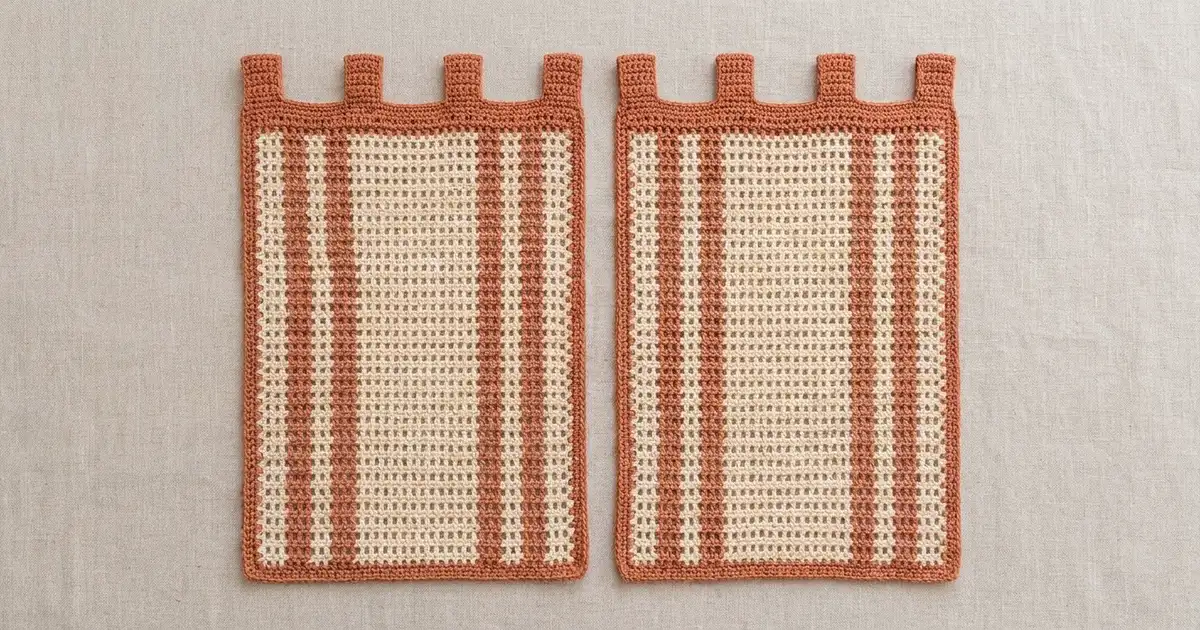
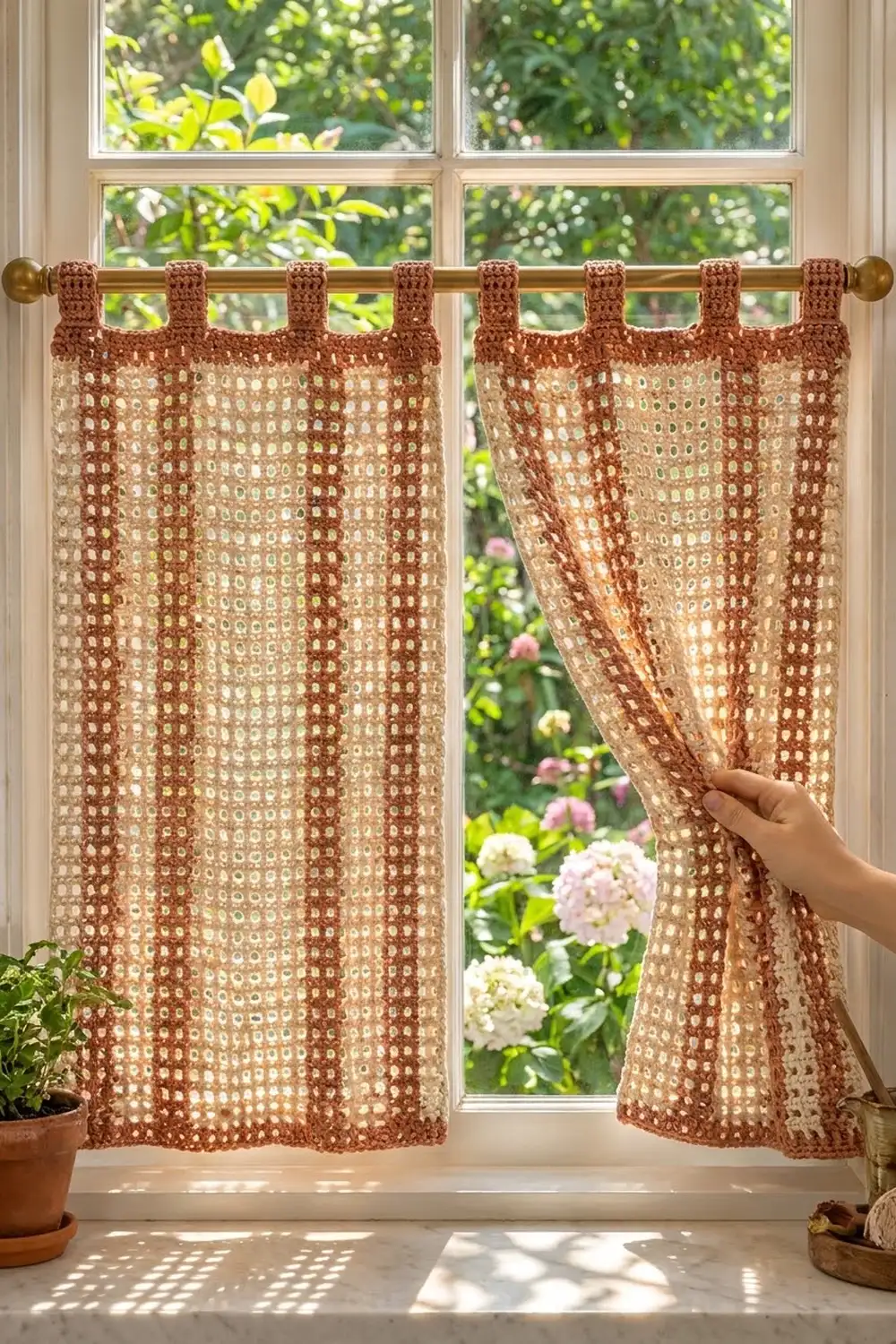
The Terracotta Lane café curtain is a pair of light, airy panels that filter sunlight into a soft grid on your windowsill. Each panel is open filet mesh in natural cream with four slim terracotta stripes running from top to bottom. A crisp rust edging and four rust tabs finish each panel so it slides straight onto a café rod.
The style is simple farmhouse with a warm, earthy palette. Rust and cream suit kitchens, bathrooms and cottage windows, and the mesh lets in plenty of light while softening the view.
This pattern uses US crochet terms. Each finished panel measures 14.4 in wide x 23.8 in long (36.6 x 60.5 cm) from the top band to the bottom edge. The tab loops add about 1.7 in (4.3 cm) above that.
Construction overview: Each panel is worked sideways in rows of filet mesh, so every row runs the full length of the curtain. That makes the stripes simple: a rust stripe is just one rust row. After the mesh, you work a rust border around all four sides, then a rust top band, then four tabs that fold to the back and are sewn down. Make two panels.
Finished Size and Construction
- Finished panel size: 14.4 x 23.8 in (36.6 x 60.5 cm), plus 1.7 in (4.3 cm) tab loops
- Skill level: Easy / advanced beginner
- Terminology: US crochet terms
- Yarn weight: DK (light worsted / #3) cotton
- Hook: 4.0 mm (G-6)
- Number of pieces: 2 separate panels, each made in one piece
- Layout: 2 panels hung side by side on one rod (not joined)
- Mesh size before border: 13.2 x 22 in (33.5 x 55.9 cm)
- Size after border: 14.4 x 23.2 in (36.6 x 58.9 cm)
- Border depth: 0.6 in (1.5 cm) on all sides, plus a 0.6 in (1.5 cm) top band
Materials
Yarn: Use a smooth DK cotton or cotton blend of about 125 m per 50 g. Cotton keeps the mesh crisp, holds up to sunlight and washes well. Avoid fuzzy or very stretchy yarns, which blur the grid.
- Cream (main color): 100 g / 250 m
- Rust (stripes, border, tabs): 75 g / 185 m
These amounts are for both panels and include a margin of about 15% for your gauge swatch and small tension differences.
Tools:
– 4.0 mm (G-6) crochet hook
– Tapestry needle
– Scissors
– Stitch markers (at least 8)
– Measuring tape
– Blocking mats and rust-proof pins
– Spray bottle
– Café curtain rod up to 1 in (2.5 cm) in diameter
Abbreviations (US Terms)
- ch – chain
- sc – single crochet
- dc – double crochet
- sk – skip
- sp – space
- st(s) – stitch(es)
- rep – repeat
- RS / WS – right side / wrong side
Special stitch – mesh square: A mesh square is one ch-1 space plus the dc after it. One row of the panel is 1 dc followed by 55 mesh squares: 56 dc and 55 ch-1 spaces, or 111 stitches in total.
Color change: Work the last dc of the row until 2 loops are left on the hook. Pull the new color through to finish the stitch, then turn. Cut the old color, leaving a 6 in (15.2 cm) tail.
Gauge and Checkpoints
Mesh gauge (blocked): 5 mesh squares and 5 rows = 2 in (5.1 cm), or 2.5 squares and 2.5 rows per 1 in (2.5 cm).
Border gauge: 5 sc and 5 rounds of sc = 1 in (2.5 cm).
Test first: Chain 34 and work Row 1 below (dc in the 6th ch from the hook), which gives 15 mesh squares. Work 10 rows in total. Block the swatch, then measure it: it should be 6 x 4 in (15.2 x 10.2 cm).
- Too big: Go down a hook size (3.75 mm).
- Too small: Go up a hook size (4.5 mm).
- Too tall but the right width: Pull up less on the dc loops, or chain the turning chain more tightly.
Checkpoints for each panel:
– After Row 1: the row measures 22 in (55.9 cm) when gently flattened.
– After Row 8: the width is 3.2 in (8.1 cm).
– After Row 25: the width is 10 in (25.4 cm).
– After Row 33: the mesh measures 13.2 x 22 in (33.5 x 55.9 cm).
– After the border: 14.4 x 23.2 in (36.6 x 58.9 cm).
Panel Pattern (Make 2)
The panel is worked sideways. Row 1 becomes one long side edge and Row 33 becomes the other. The row ends form the top and bottom of the curtain.
Stripe sequence (33 rows):
| Rows | Color | Number of rows |
|---|---|---|
| 1–3 | Cream | 3 |
| 4 | Rust | 1 |
| 5–7 | Cream | 3 |
| 8 | Rust | 1 |
| 9–25 | Cream | 17 |
| 26 | Rust | 1 |
| 27–29 | Cream | 3 |
| 30 | Rust | 1 |
| 31–33 | Cream | 3 |
That adds up to 3 + 1 + 3 + 1 + 17 + 1 + 3 + 1 + 3 = 33 rows. The sequence is symmetrical, so both side edges look the same.
Foundation: With cream, ch 114.
Row 1 (cream): Dc in the 6th ch from the hook. The skipped chains count as the first dc and a ch-1 space. *Ch 1, sk next ch, dc in next ch; rep from * across. Turn.
Count: 56 dc and 55 ch-1 spaces (111 sts, 55 mesh squares).
Row 2 (cream): Ch 4 (counts as dc and ch 1), sk first ch-1 sp, dc in next dc. *Ch 1, sk ch-1 sp, dc in next dc; rep from * across. Work the last dc in the 3rd ch of the turning chain. Turn.
Count: 111 sts, 55 mesh squares.
Rows 3–33: Rep Row 2, following the stripe table. Change color at the end of the row before each new color (end of Rows 3, 4, 7, 8, 25, 26, 29 and 30). Do not carry the rust yarn. Cut it after each rust row and rejoin later, because the rows are too far apart to carry neatly.
Count for every row: 111 sts, 55 mesh squares. Fasten off cream after Row 33.
Each rust row makes one vertical stripe one square wide when the curtain hangs. Weave in all tails now. Work each tail along the dc posts of its own color so it stays hidden in the mesh.
Checkpoint: 13.2 x 22 in (33.5 x 55.9 cm). Lay the panel flat and check the edges. If the mesh is noticeably off, steam-block it lightly before you start the border.
Make All Pieces
Make 2 identical panels. Each one uses about 50 g / 125 m of cream and about 37 g / 92 m of rust, including the border and tabs.
Layout on the rod (seen from the room side):
Rod: ======================================
     [T]  [T]  [T]  [T]   [T]  [T]  [T]  [T]
     | Panel A        |   | Panel B        |
     | R . R . . . R  |   | R . R . . . R  |
     | 14.4 in wide   |   | 14.4 in wide   |
Here T = tab and R = rust stripe. The panels meet in the middle and can be pushed apart or tied back.
Joining
The two panels are not joined to each other. The only sewing is tacking each folded tab down, which is covered after the top band. When you sew a tab, match its last row stitch for stitch to the matching stitch of top band Row 1. Use whipstitch with even, relaxed tension so the top band doesn’t pucker.
Size checkpoint: Both panels should match in width to within 0.2 in (0.5 cm) before you add tabs. If they don’t, block the narrower panel to match.
Border
Border gauge: 5 sc = 1 in (2.5 cm), and 5 rounds = 1 in (2.5 cm).
Edge rules:
– Along the long edges (the top of Row 33 and the base of Row 1), work 1 sc in each stitch or base chain.
– Along the row-end edges, work 2 sc around each dc row end.
– At the corners, work a ch-2 corner space. The corner chains are not counted in the side totals below.
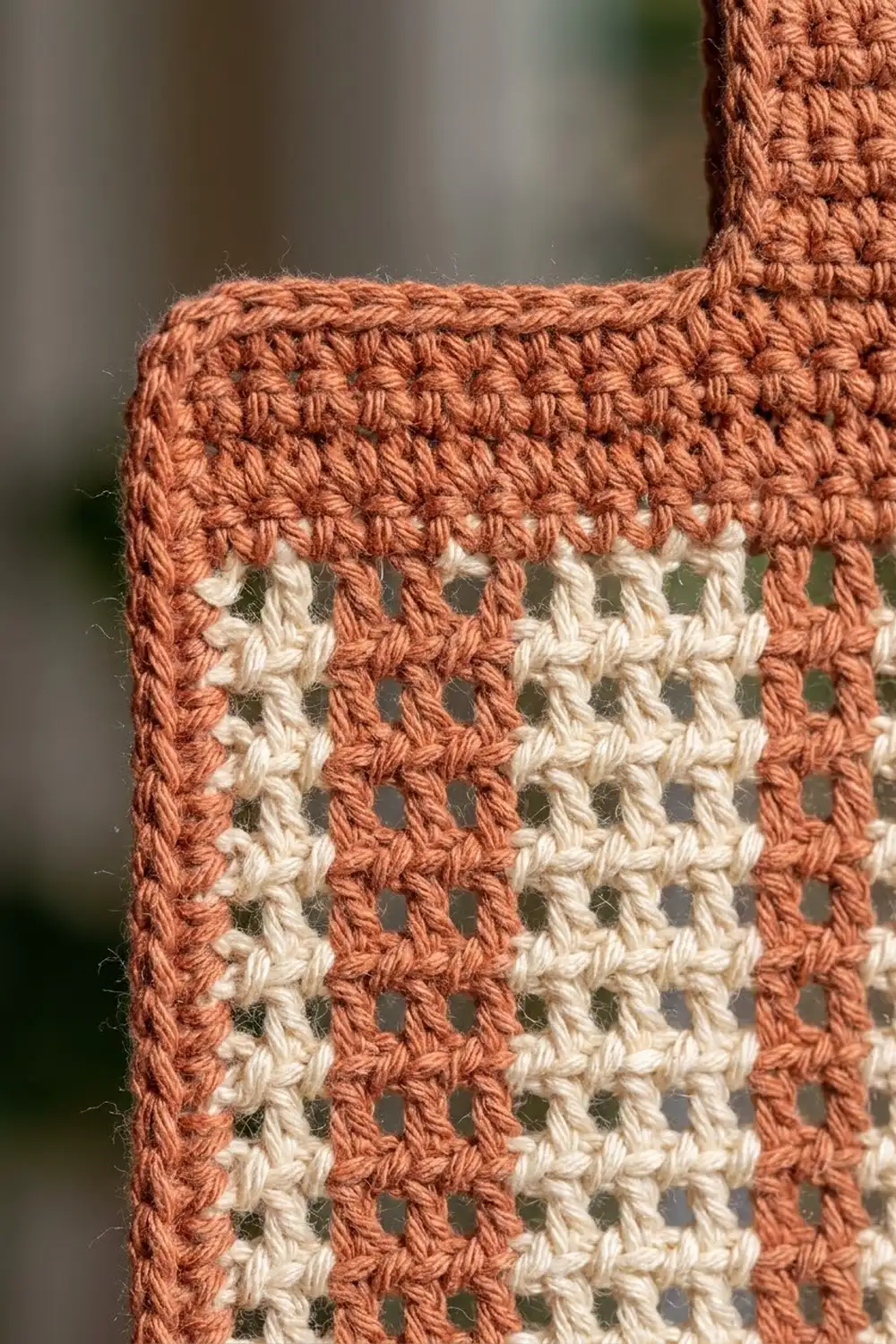
Round 1 (rust, RS): Join rust in the first st of Row 33. Ch 1, then sc in each of the 111 sts across Row 33. Ch 2 (corner). Work 2 sc in each of the 33 row ends (66 sc) and ch 2. Sc in each of the 111 base chains of Row 1 and ch 2. Work 2 sc in each of the 33 row ends (66 sc) and ch 2. Sl st to the first sc.
Count: long sides 111 sc each, short sides 66 sc each, 354 sc in total plus 4 ch-2 corners.
Round 2: Ch 1. Sc in each sc. In each ch-2 corner space work (sc, ch 2, sc). Sl st to the first sc.
Count: long sides 111 + 2 = 113 sc, short sides 66 + 2 = 68 sc, 362 sc in total plus 4 ch-2 corners.
Round 3: Rep Round 2.
Count: long sides 113 + 2 = 115 sc, short sides 68 + 2 = 70 sc, 370 sc in total plus 4 ch-2 corners. Fasten off.
Why the math works: The long edge is 22 in (55.9 cm) of mesh with 111 stitches, which is just over 5 sts per inch. That matches the sc border gauge, so Round 1 lies flat. Each mesh row is 0.4 in (1.0 cm) tall, and 2 sc at 5 sc per inch also cover 0.4 in, so the 66 sc on each short edge span the full 13.2 in (33.5 cm).
Each round adds 0.2 in (0.5 cm) on every side, so three rounds add 0.6 in (1.5 cm). The panel grows to 14.4 x 23.2 in (36.6 x 58.9 cm). The 2 extra sc per side in each round fill the extra length at the corners.
Top Band
Pick one short edge as the top. With the RS facing, join rust in the corner ch-2 space at the right end of that edge.
Row 1: Ch 1, sc in the corner ch-2 sp, sc in each of the 70 sc, sc in the next corner ch-2 sp. Turn.
Count: 70 (1 per existing st) + 2 (corner spaces) = 72 sc.
Rows 2–3: Ch 1, sc in each sc across. Turn.
Count: 72 sc. Do not fasten off after Row 3. Continue straight into Tab 1.
The top band adds 0.6 in (1.5 cm), so the panel body is now 23.8 in (60.5 cm) long. At 5 sc per inch, the 72 sts give a width of 14.4 in (36.6 cm).
Tabs
The 72 band stitches divide into 4 tabs of 9 sts and 3 gaps of 12 sts: 36 + 36 = 72. Place markers before you start:
- Tab 1: sts 1–9
- Gap: sts 10–21
- Tab 2: sts 22–30
- Gap: sts 31–42
- Tab 3: sts 43–51
- Gap: sts 52–63
- Tab 4: sts 64–72
Each tab is 1.8 in (4.6 cm) wide and each gap is 2.4 in (6.1 cm). The outer tabs sit flush with the side edges.
Tab 1, Row 1: Ch 1, sc in the first 9 sts. Turn. (9 sc)
Rows 2–20: Ch 1, sc in each sc across. Turn. (9 sc) Fasten off, leaving an 8 in (20.3 cm) tail.
The tab is 4 in (10.2 cm) long. For Tabs 2, 3 and 4, join rust with the RS facing in the first stitch of that tab (st 22, 43 or 64) and work Rows 1–20 the same way.
Sewing the tabs: Fold each tab to the WS. Line up its last row with top band Row 1 so the tab end overlaps the 3 band rows. Whipstitch the 9 tab stitches to the 9 band stitches below them, one to one.
The finished loop stands about 1.7 in (4.3 cm) above the band and fits a rod up to 1 in (2.5 cm) in diameter.
Final Blocking
- Weave in any remaining tails and trim them close.
- Soak the panel in cool water for 10 minutes. Press out the water gently; do not wring.
- Roll the panel in a towel to remove excess moisture.
- Lay it flat on blocking mats, RS up.
- Pin the corners to 14.4 x 23.8 in (36.6 x 60.5 cm).
- Pin along each edge every 2 in (5.1 cm). Keep the rust stripes perfectly straight and parallel to the side edges.
- Square up the mesh by eye so each space is an even square. Measure with a ruler 0.4 in (1.0 cm) apart.
- Pin the tabs flat and straight.
- Let the panel dry completely, then unpin it. Block the second panel to exactly the same size.
Final Quality-Control Checklist
- [ ] Each panel has 33 mesh rows of 55 squares.
- [ ] Rust stripes are on Rows 4, 8, 26 and 30, so both sides look the same.
- [ ] Border Round 3 counts: 115 sc on each long side and 70 sc on each short side.
- [ ] Top band has 72 sc.
- [ ] There are 4 tabs of 9 sts, with 12-st gaps between them.
- [ ] Each tab is sewn stitch to stitch with no twisting.
- [ ] Each panel measures 14.4 x 23.8 in (36.6 x 60.5 cm).
- [ ] Both panels match in length to within 0.2 in (0.5 cm).
- [ ] All tails are hidden along same-color posts.
Troubleshooting
Mesh is slanting or the panel leans: Make sure every row starts with ch 4 and ends with a dc in the turning chain. A missed last stitch makes the panel narrow and lean. Blocking fixes small slants.
Row 1 is shorter than 22 in: The foundation chain is tight. Chain with a hook one size larger, then switch back for Row 1.
Border ruffles: You are working too many sc along the edges. Check that you have 2 sc per row end, not 3.
Border cups or pulls: Your tension is tight. Loosen your grip or go up a half hook size for the border only.
Tabs flare out: Count 9 sc in every row. An extra stitch at the turn is the usual cause.
Stripes look jagged: Change color on the final yarn-over of the previous row, not at the start of the new row.
Panels differ in length: Re-block the longer panel slightly narrower and the shorter one slightly longer. Cotton will move about 0.4 in (1.0 cm).
Care
Machine wash cold on a gentle cycle inside a mesh laundry bag, or hand wash. Reshape and dry flat, and press with a warm iron through a cloth if needed.
Final Notes
Here is the measurement chain at a glance:
- Gauge: 2.5 squares and 2.5 rows per 1 in (2.5 cm)
- Mesh: 55 squares x 33 rows = 22 x 13.2 in (55.9 x 33.5 cm)
- Border: three rounds of sc add 0.6 in (1.5 cm) per side, giving 14.4 x 23.2 in (36.6 x 58.9 cm)
- Top band: 72 sc adds 0.6 in (1.5 cm), giving a body of 14.4 x 23.8 in (36.6 x 60.5 cm)
- Tabs: four 9-st tabs fold into 1.7 in (4.3 cm) loops
Check your gauge at each stage and the two panels will match. Then slide them onto the rod and enjoy the light coming through.
Happy crocheting!