
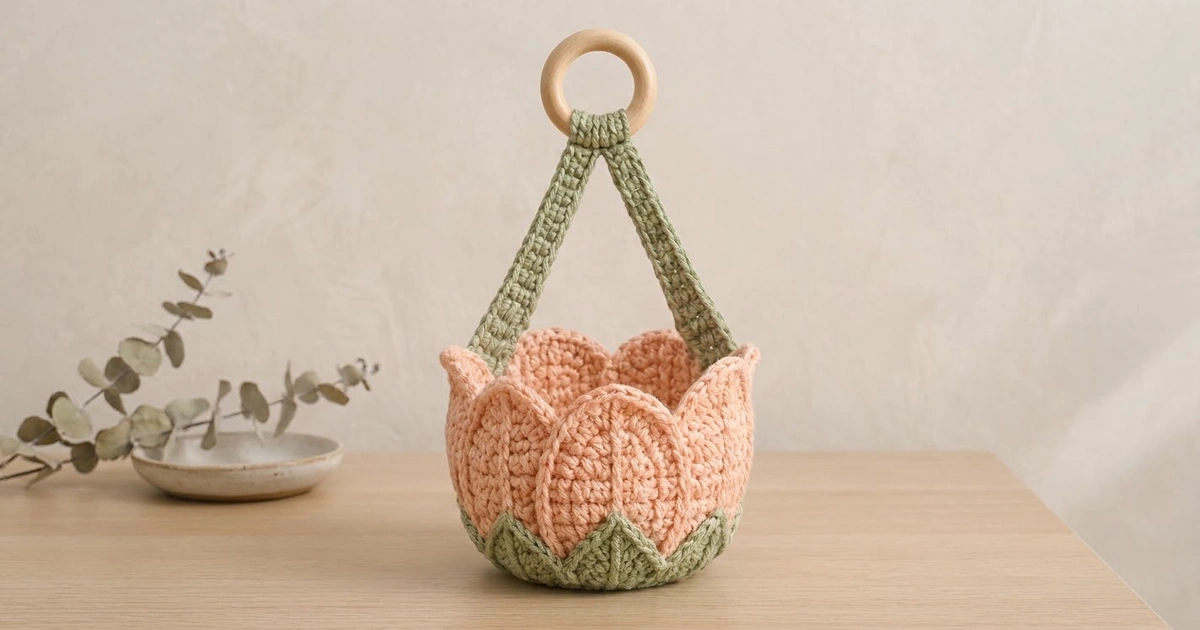
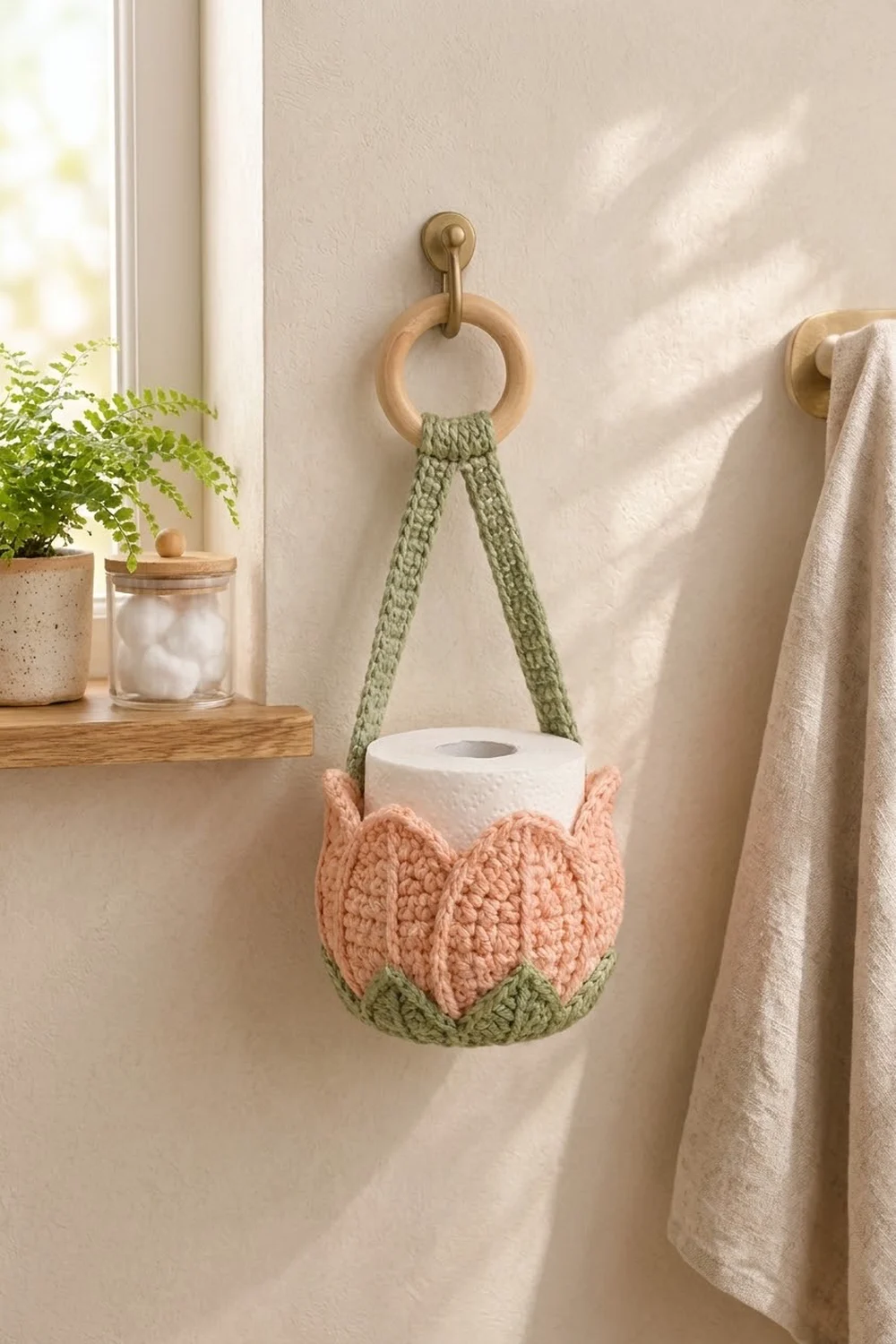
This hanging basket holds one toilet paper roll. It looks like a tulip just starting to open: a round peach cup with a sage green base band, small green pointed sepals rising from that band, and eight rounded peach petals around the outside. The petal tips stand above the rim and give it a soft scalloped edge. Two sage straps run up to a natural wooden ring, so the basket hangs from any wall hook.
The palette is muted peach and sage green, which suits warm bathrooms with wood, brass, and cream linens. The fabric is dense single crochet, so it holds its shape and stays upright without stiffener. It also makes a good small gift, since it uses less than one ball of each color.
The pattern uses US crochet terms. The basket measures about 5 in (12.7 cm) across and 4.4 in (11.2 cm) tall to the petal tips. Each strap hangs 8 in (20.3 cm) free between the rim and the ring.
You start with a flat peach base. A back-loop round turns the work up into the walls. Next come green rounds and four rounds of tapestry crochet for the sepal points, then plain peach walls and a slip stitch rim. Eight petals are made separately and sewn on, then the straps are added and wrapped around the ring.
Finished Size and Construction
- Finished size: about 5 in (12.7 cm) diameter x 4.4 in (11.2 cm) tall; circumference 16 in (40.6 cm)
- Skill level: Intermediate (simple tapestry crochet)
- Terminology: US crochet terms
- Yarn weight: Worsted (#4), cotton or cotton blend
- Hook: 4.0 mm (G-6)
- Number of pieces: 1 basket body, 8 petals, 2 straps, all joined into one finished basket
- Layout: petals evenly spaced around the wall, one petal centered over each green sepal point
- Body wall height before border: 3.6 in (9.1 cm), 18 rounds
- Border depth: 1 round of slip stitches, adds almost no height
- Petal size: 2 in (5.1 cm) wide x 3 in (7.6 cm) tall
- Strap size: 0.9 in (2.3 cm) wide x 11 in (27.9 cm) long before attaching
Materials
Cotton or a cotton blend works best because it gives crisp stitch definition and a firm fabric that holds up to a damp bathroom. Soft acrylic will also work, but the walls will be floppier. Choose two colors that contrast clearly so the sepal points show up.
- Color A, Peach: 90 g, about 153 m
- Color B, Sage Green: 40 g, about 68 m
These amounts are for a cotton yarn of about 170 m per 100 g, and they include a margin of roughly 20% for gauge swatches and tails.
Tools:
- 4.0 mm (G-6) crochet hook
- 1 wooden ring, 2 in (5.1 cm) outer diameter
- Stitch markers (at least 10)
- Tapestry needle
- Scissors
- Measuring tape
- Rust-proof pins
Abbreviations (US Terms)
- ch = chain
- sc = single crochet
- hdc = half double crochet
- dc = double crochet
- sl st = slip stitch
- inc = 2 sc in the same stitch
- BLO = back loop only
- MR = magic ring
- st(s) = stitch(es)
- rnd(s) = round(s)
- A / B = Peach / Sage Green
Tapestry sc: lay the color you are not using along the tops of the stitches below, and work your sc around it so it is hidden inside. To change color, work the last sc before the change until 2 loops remain on the hook. Then yarn over with the new color and pull through.
Gauge and Checkpoints
Gauge: 18 sc x 20 rnds = 4 in (10.2 cm) in sc worked in the round. That is 4.5 sts and 5 rnds per inch (2.5 cm). Each round is 0.2 in (0.5 cm) tall.
Make one petal first and measure it. It should be 2 in (5.1 cm) wide x 3 in (7.6 cm) tall. This tells you quickly whether your tension is right before you start the body.
Checkpoints:
- After Rnd 12, the flat base measures about 5 in (12.7 cm) across and lies flat without ruffling or cupping.
- After Rnd 20, the wall stands 1.6 in (4.1 cm) above the turning ridge.
- After Rnd 30, the wall stands 3.6 in (9.1 cm) and the circumference is 16 in (40.6 cm).
- Each strap measures 11 in (27.9 cm) after 55 rows.
If your piece is too big, go down to a 3.75 mm (F-5) hook. If it is too small, go up to a 4.5 mm (7) hook. Do not add or remove stitches, because the 72-stitch count is what makes the eight 9-stitch repeats work.
Basket Body
Work in continuous rounds without joining. Move your marker to the first st of each round as you go.
Base (Color A)
- Rnd 1: 6 sc in MR. (6)
- Rnd 2: inc in each st around. (12)
- Rnd 3: (sc 1, inc) x6. (18)
- Rnd 4: (sc 2, inc) x6. (24)
- Rnd 5: (sc 3, inc) x6. (30)
- Rnd 6: (sc 4, inc) x6. (36)
- Rnd 7: (sc 5, inc) x6. (42)
- Rnd 8: (sc 6, inc) x6. (48)
- Rnd 9: (sc 7, inc) x6. (54)
- Rnd 10: (sc 8, inc) x6. (60)
- Rnd 11: (sc 9, inc) x6. (66)
- Rnd 12: (sc 10, inc) x6. (72)
Each base round is a growth round that adds 6 sts. On the last sc of Rnd 12, change to Color B. Check the base now: it should be about 5 in (12.7 cm) across.
Green Band (Color B)
- Rnd 13: sc in BLO of each st around. (72) The unused front loops make a crisp ridge, and the wall begins to turn upward.
- Rnds 14–16: sc in each st around. (72)
The green band is now 0.8 in (2.0 cm) tall. Join Color A and carry it inside the stitches for the next four rounds.
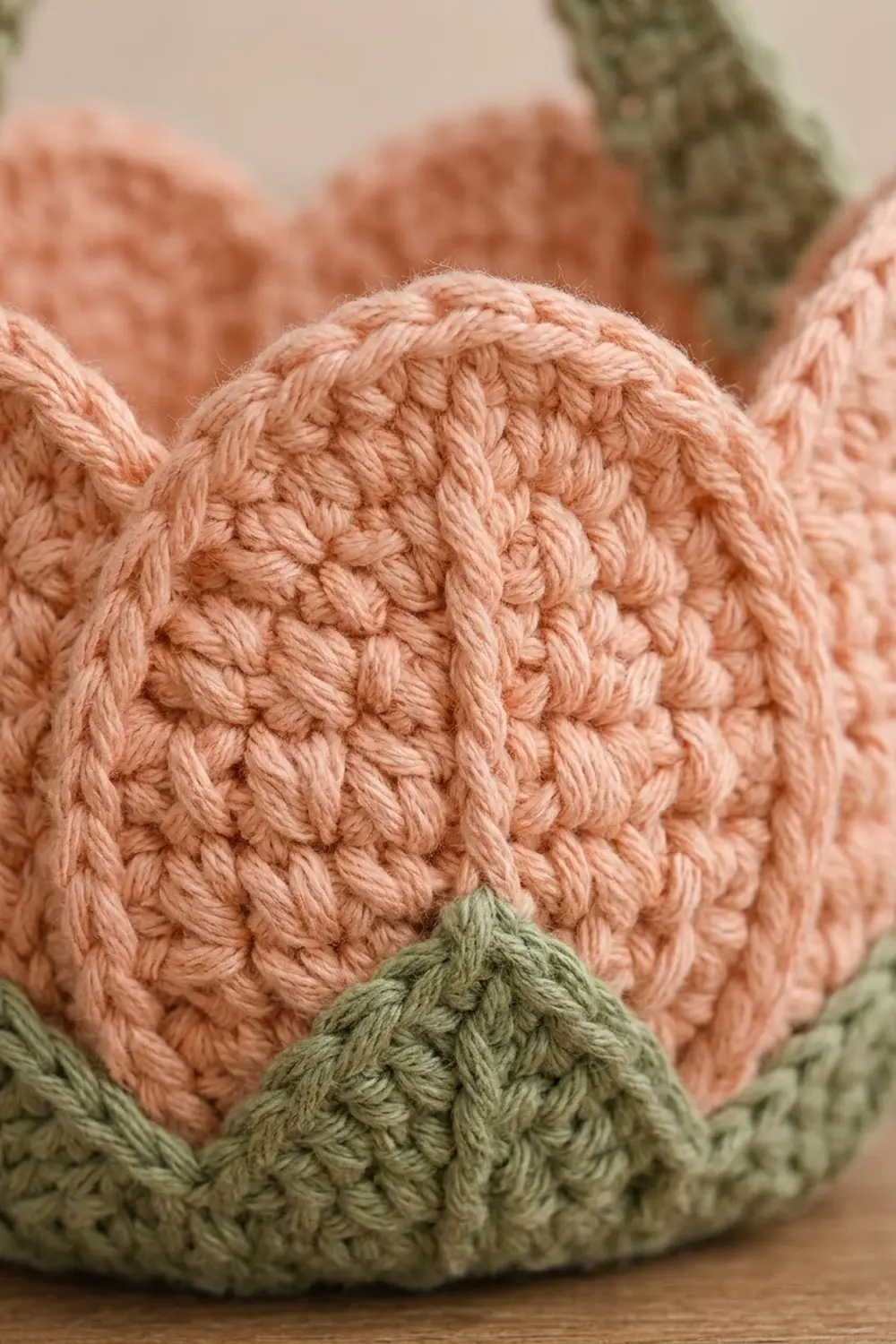
Sepal Points (Colors A and B, tapestry sc)
Each round has 8 repeats of 9 sts.
- Rnd 17: (1 A, 7 B, 1 A) x8. (72: 56 B + 16 A)
- Rnd 18: (2 A, 5 B, 2 A) x8. (72: 40 B + 32 A)
- Rnd 19: (3 A, 3 B, 3 A) x8. (72: 24 B + 48 A)
- Rnd 20: (4 A, 1 B, 4 A) x8. (72: 8 B + 64 A)
That gives eight green triangles. Each one is 7 sts wide at the bottom and narrows to a single point at st 5 of its repeat. Place a marker in each green point stitch of Rnd 20, because the petals will be centered on these. Cut Color B, leaving a 4 in (10.2 cm) tail.
Upper Wall (Color A)
- Rnds 21–30: sc in each st around. (72)
The wall now stands 3.6 in (9.1 cm) above the turning ridge. Leave the working loop on a marker for the border.
Petals (make 8, Color A)
The petals are worked in rows around both sides of a foundation chain. The narrow single crochet end becomes the base, and the taller double crochet end becomes the rounded top. The chain stays in the middle and shows as a fine center vein.
Ch 13.
- Row 1 (RS): sc in 2nd ch from hook and next 2 ch, hdc in next 3 ch, dc in next 5 ch, 7 dc in last ch. Turn the work so you are working along the opposite side of the chain: dc in next 5 ch, hdc in next 3 ch, sc in next 3 ch. (29: 11 + 7 + 11)
- Row 2 (WS): ch 1, turn. sc in next 11 sts, inc in each of next 7 sts, sc in next 11 sts. (36: 11 + 14 + 11)
- Row 3 (RS): ch 1, turn. sc in next 12 sts, (inc, sc 1) x6, sc in next 12 sts. (42: 12 + 18 + 12)
Fasten off and leave a 12 in (30.5 cm) tail for sewing. The petal should measure 2 in (5.1 cm) wide x 3 in (7.6 cm) tall. If you want a stronger vein, work a line of surface sl sts in Color A along the center chain, from the base to where the 7-dc fan begins.
Border
The border is one round of slip stitches on the rim of the basket body. It firms up the top edge and gives the inner rim a clean finish behind the petals.
Border gauge: the slip stitches must keep the body gauge of 4.5 sts per inch (2.5 cm). If they are tighter, the rim pulls in and the petal tops tilt inward.
- Rnd 31 (Color A): sl st loosely in each st around. (72) Join with a sl st to the first sl st and fasten off.
Why the math works: you have 72 sts, made of 8 sections of 9 sts, and each section sits above one sepal repeat. 72 sts divided by 4.5 sts per inch gives 16 in (40.6 cm) around. 8 petals at 2 in (5.1 cm) wide also add up to 16 in (40.6 cm), so the petal edges meet exactly around the wall. Because the tops flare outward, the petals overlap a little and look layered. The rim has the same 72 sts as Rnds 13–30, so the wall stays straight.
Attach the petals: with the RS facing out, pin each petal so its narrow sc base sits on Rnd 20, centered on a marked green point. The green tip should peek out under the petal base like a sepal. The petal stretches up the wall, and its top 0.8 in (2.0 cm) stands above the rim. Use the long tail to whipstitch around the petal edge to the wall. Stop sewing where the petal crosses Rnd 30 so the tip stays free. Do the same for all 8 petals.
Straps (make 2, Color B):
- Row 1: ch 5, sc in 2nd ch from hook and each ch across. (4)
- Rows 2–55: ch 1, turn, sc in each st across. (4)
Each strap is 0.9 in (2.3 cm) wide x 11 in (27.9 cm) long. Fasten off and leave a 12 in (30.5 cm) tail.
Attach the straps: count 72 sts around Rnd 30. Mark the gap between st 9 and st 10, which is where petals 1 and 2 meet. Then mark the gap between st 45 and st 46, which is directly across the basket, 36 sts away. Pin the bottom 1.5 in (3.8 cm) of one strap to the inside of the wall at each mark, and whipstitch all four edges in place. Bring both straps up without twisting them. Pass the top 1.5 in (3.8 cm) of each strap through the ring, fold it back onto itself, and sew it down firmly. Each strap now hangs 8 in (20.3 cm) free between the rim and the ring.
Final Blocking
- Weave in all ends on the inside of the basket.
- Mist the whole basket lightly with water until it is damp but not wet.
- Put a toilet paper roll or a 4.5 in (11.4 cm) jar inside so the walls dry straight.
- Shape each petal tip with your fingers so it curves slightly outward.
- Lay the straps flat and pin them straight to dry.
- Let everything dry completely, about 12–24 hours.
Final Quality-Control Checklist
- The base is 5 in (12.7 cm) across and sits flat.
- The wall is 3.6 in (9.1 cm) tall with exactly 72 sts.
- There are 8 green points, evenly spaced, with no carried peach showing through.
- All 8 petals are centered over the green points and their tips stand 0.8 in (2.0 cm) above the rim.
- The straps are opposite each other, 36 sts apart, and are not twisted.
- Each strap hangs 8 in (20.3 cm) free and is firmly sewn to the ring.
- All ends are woven in on the inside.
Troubleshooting
The base ruffles: your stitches are too loose, or you added extra stitches. Recount the rounds, then go down one hook size.
The base cups up before Rnd 13: your tension is too tight. Go up one hook size for the base only.
Carried yarn shows through: keep the yarn you are carrying relaxed and pull each sc firmly around it. If that doesn’t fix it, choose a less contrasting color.
The sepal points lean: in a spiral, each round drifts by about one stitch. If your triangles slant noticeably, start each color sequence one stitch earlier.
The petals gap or overlap too much: your petal gauge does not match the body gauge. Remake the petals with a hook size that gives a 2 in (5.1 cm) width.
The basket tilts when it hangs: the straps are not exactly opposite each other, or they are different lengths. Recount the 36 sts and make sure both straps have 55 rows.
Care
Hand wash in cool water with mild soap. Press out the water gently and reshape the basket around a roll to dry flat.
Final Notes
All the sizing comes from the gauge of 18 sc x 20 rnds = 4 in (10.2 cm). A 72-stitch base gives a 5 in (12.7 cm) diameter and a 16 in (40.6 cm) circumference. That circumference holds 8 petals of 2 in (5.1 cm) each. 18 wall rounds give 3.6 in (9.1 cm) of height. The petals sit on Rnd 20 and reach 4.4 in (11.2 cm), and the 11 in (27.9 cm) straps leave 8 in (20.3 cm) of free hanging length. Check each number in this chain as you go and the basket will come out right.
Happy crocheting!