
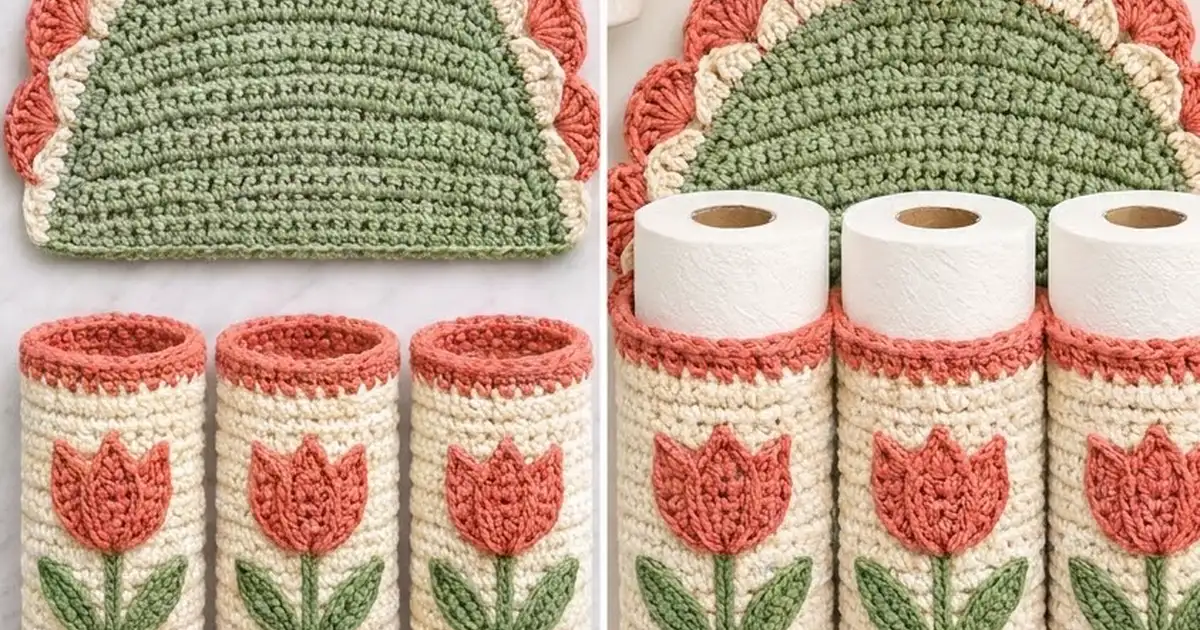
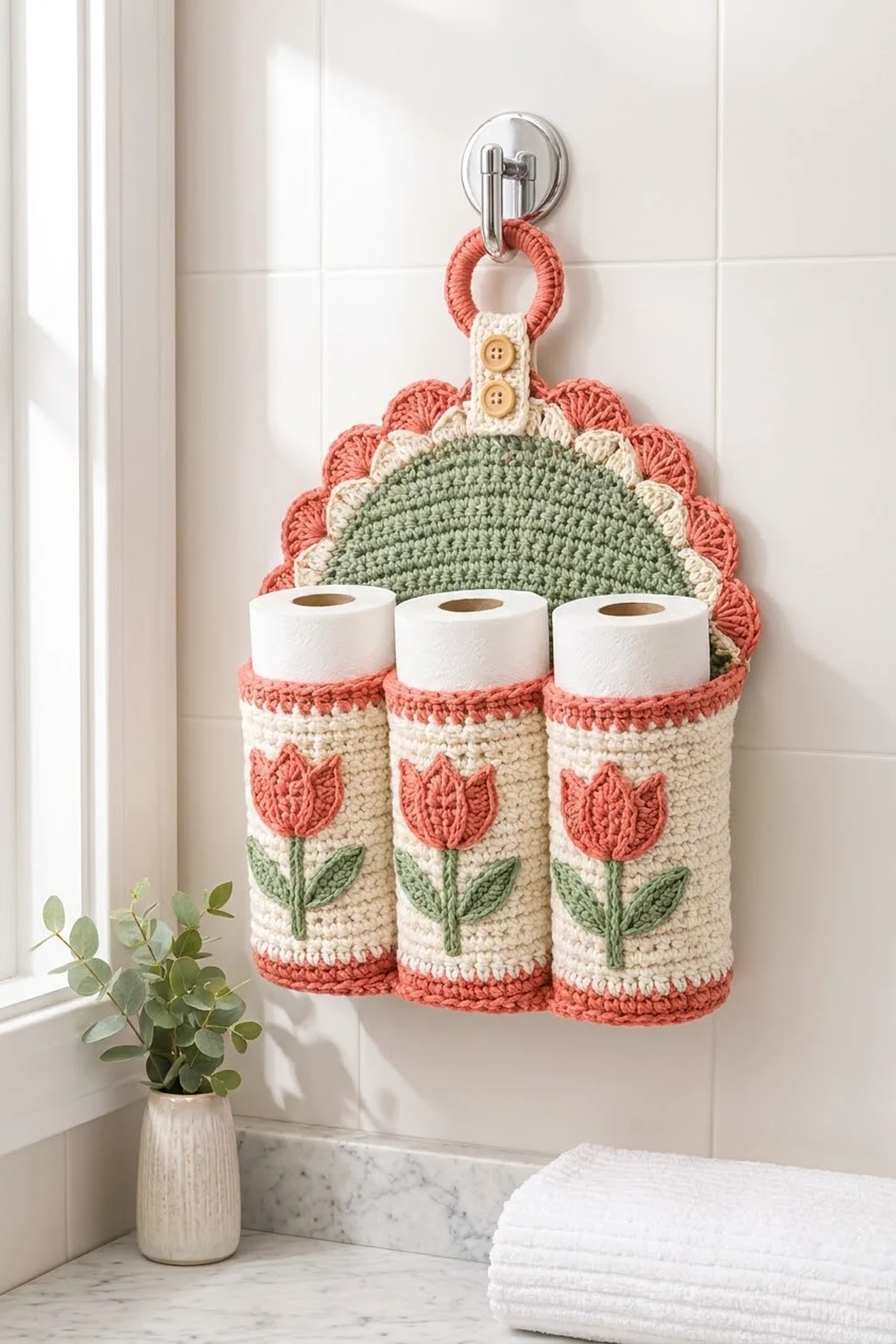
The Tulip Trio is a hanging toilet paper holder that keeps three spare rolls on the wall. A sage green half-circle panel forms the back. Three cream pockets sit across its lower edge, and each pocket has a small coral tulip with a green stem and leaves.
The palette is coral, cream and sage green. Coral shells frame the green along the curved edge of the panel, and small cream scallops peek out between them. The pockets have coral bases, coral rims and a speckled round of cream and coral just inside each band. A coral ring and a cream button strap at the top center finish the look.
This pattern uses US crochet terms. The finished holder measures about 16.5 in (41.9 cm) wide and 11 in (27.9 cm) tall including the hanger. Each pocket holds one standard roll.
You will crochet the panel flat in turned rows of half double crochet, then add the border. The pockets are worked in the round from an oval base straight up into the wall. The tulips, stems and leaves are small appliqués that you sew on. Last, you sew the pockets to the panel and attach the ring and strap.
Finished Size and Construction
- Finished size: about 16.5 in (41.9 cm) wide x 11 in (27.9 cm) tall
- Skill level: Intermediate
- Terminology: US
- Yarn weight: Worsted (#4), cotton or cotton blend
- Hook: 4.5 mm (US 7)
- Number of pieces: 18 (1 panel, 3 pockets, 3 tulip heads, 3 stems, 6 leaves, 1 ring cover, 1 strap)
- Layout: 3 pockets side by side across the bottom of 1 half-circle panel
- Panel size before border: 14 in (35.6 cm) wide x 7 in (17.8 cm) tall
- Border depth: about 1.25 in (3.2 cm), curved edge only
- Panel size after border: about 16.5 in (41.9 cm) wide x 8.25 in (21.0 cm) tall
- Pocket size: base 5 in (12.7 cm) x 4.5 in (11.4 cm), wall 4 in (10.2 cm) tall
Materials
Choose a smooth worsted cotton. Cotton holds its shape in a humid bathroom and shows stitch texture clearly. Acrylic also works, but it makes softer, slouchier pockets.
- Coral: 70 g, about 119 m (130 yd)
- Cream: 70 g, about 119 m (130 yd)
- Sage green: 50 g, about 85 m (93 yd)
These amounts include a margin of about 15 percent for your gauge swatch and small differences in tension.
Tools and notions:
- 4.5 mm (US 7) crochet hook
- 1 plastic or metal ring, 2 in (5.1 cm) outer diameter
- 2 round wooden buttons, 0.75 in (1.9 cm)
- Tapestry needle
- Stitch markers
- Scissors and measuring tape
- Pins and a blocking mat
- Wall hook (for display)
Abbreviations (US Terms)
- ch – chain
- sl st – slip stitch
- sc – single crochet
- hdc – half double crochet
- dc – double crochet
- inc – 2 sc in the same stitch
- sc2tog – single crochet 2 together
- BLO – back loop only
- st(s) – stitch(es)
Speckle round: Work in sc, alternating colors: 1 sc in cream, 1 sc in coral around. Carry the unused color inside the stitches. Change color on the last yarn-over of the stitch before.
Gauge and Checkpoints
- Single crochet (pockets): 16 sts x 18 rows = 4 in (10.2 cm)
- Half double crochet (panel): 16 sts x 12 rows = 4 in (10.2 cm)
Make one pocket first and measure it before you make the rest. That pocket tests your sc gauge and also checks the fit around a real roll.
Checkpoints:
- Pocket base after Rnd 5: about 2.75 in (7.0 cm) across the long direction.
- Pocket base after Rnd 10: 5 in (12.7 cm) x 4.5 in (11.4 cm).
- Pocket wall after Rnd 28: 4 in (10.2 cm) tall.
- Panel after Row 6: straight edge 4 in (10.2 cm).
- Panel after Row 12: straight edge 8 in (20.3 cm).
- Panel after Row 21: straight edge 14 in (35.6 cm), height 7 in (17.8 cm).
If your pieces come out too big, go down half a hook size. If they come out too small, or the roll won’t slide in, go up half a hook size. Check row height too. If the panel is too tall but the right width, it will cup, so change your hdc height, not the stitch count.
Pocket (make 3)
The base and wall are one continuous piece. Work in joined rounds: join with a sl st to the first st, then ch 1 (does not count as a st).
Base (coral):
Rnd 1: Ch 4. Sc in 2nd ch from hook, sc in next ch, 3 sc in last ch. Working along the other side of the chain, sc in next ch, 2 sc in the same ch as the first sc. Join. (8 sts)
Rnd 2: Inc in first st, sc in next st, inc in each of next 3 sts, sc in next st, inc in each of last 2 sts. Join. (14 sts)
Rnds 3–10: Sc in each st around, with 3 increases spread evenly across each curved end (6 increases per round). Stagger the increases so the ends stay round. Work 1 sc in each st along the two short straight sides.
- Rnd 3: 20 sts
- Rnd 4: 26 sts
- Rnd 5: 32 sts
- Rnd 6: 38 sts
- Rnd 7: 44 sts
- Rnd 8: 50 sts
- Rnd 9: 56 sts
- Rnd 10: 62 sts
The base is now an oval about 5 in (12.7 cm) x 4.5 in (11.4 cm).
Wall:
Rnd 11 (coral): Sc in BLO of each st around. Join. (62 sts) This turns the wall upward.
Rnds 12–13 (coral): Sc in each st around. (62 sts)
Rnd 14 (speckle): 1 sc cream, 1 sc coral 31 times. (62 sts: 31 cream, 31 coral)
Rnds 15–25 (cream): Sc in each st around. (62 sts) At the start of Rnd 15, cut coral and leave a 4 in (10.2 cm) tail.
Rnd 26 (speckle): Join coral and repeat Rnd 14. (62 sts)
Rnds 27–28 (coral): Sc in each st around. (62 sts) Fasten off and weave in the ends.
The wall is 18 rounds, or 4 in (10.2 cm) tall. The rim measures 15.5 in (39.4 cm) around.
Tulip Appliqué (make 3 sets)
Tulip head (coral):
Row 1: Ch 4. Sc in 2nd ch from hook and in each ch across. Turn. (3 sts)
Row 2: Ch 1, inc in first st, sc in next st, inc in last st. Turn. (5 sts)
Row 3: Ch 1, inc in first st, sc in next 3 sts, inc in last st. Turn. (7 sts)
Rows 4–5: Ch 1, sc in each st across. Turn. (7 sts)
Row 6 (points): Sl st in first st. Ch 4, sc in 2nd ch from hook, hdc in next ch, dc in next ch, skip next st, sl st in next st. Repeat from * 2 more times. (3 points, all 7 sts used)
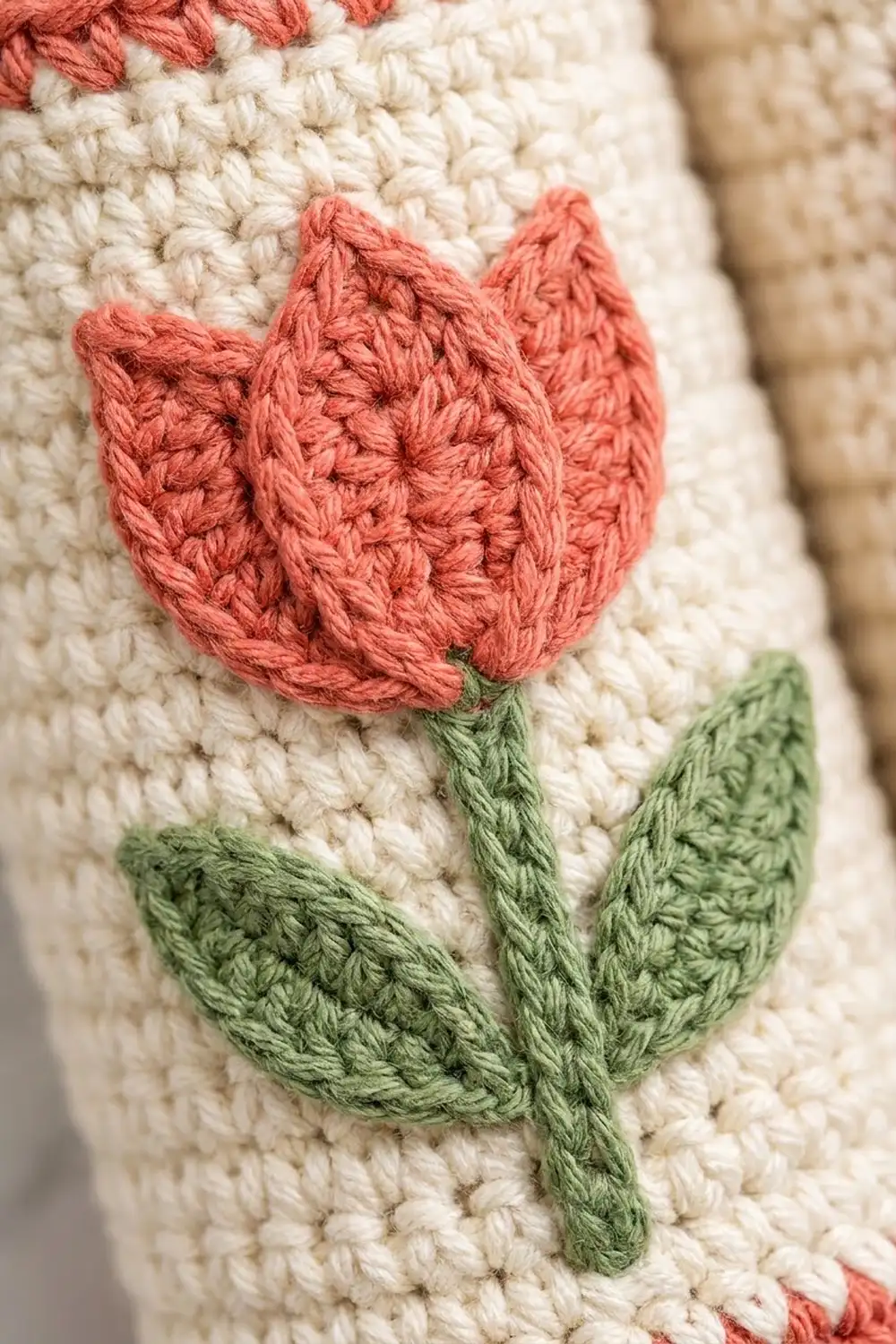
Fasten off. With coral, work a line of surface sl sts from the center point down to Row 1 to make the center ridge. The head is about 1.75 in (4.4 cm) wide.
Stem (green): Ch 9. Sl st in the back bump of the 2nd ch from hook and of each ch across. (8 sl sts) Fasten off and leave a long tail.
Leaf (green, make 2 per tulip): Ch 7. Sl st in 2nd ch from hook, sc in next ch, hdc in next ch, dc in next ch, hdc in next ch, 3 sc in last ch. Working along the other side of the chain, hdc in next ch, dc in next ch, hdc in next ch, sc in next ch, sl st in last ch. (13 sts) Fasten off. The two sides meet along the chain and form a visible center vein.
Placement: Center each tulip on the front of a pocket. Put the base of the head on Rnd 21, with the points reaching Rnd 25. Run the stem down to Rnd 16. Sew one leaf on each side of the stem, angled up and out, with the leaf bases touching the stem around Rnd 17. Whipstitch all edges flat.
Back Panel (green)
Work in turned rows. The ch 2 at the start of each row does not count as a stitch.
Row 1: Make a magic ring. Ch 2, 6 hdc in ring. Pull the ring closed. Turn. (6 sts)
Rows 2–21: Ch 2, hdc in each st across, with 4 increases (2 hdc in one st) spread evenly across the row. Stagger their positions from row to row. Turn.
Each row has 4 more sts than the row before. Row n has (4 x n) + 2 sts:
- Row 2: 10 sts
- Row 6: 26 sts
- Row 12: 50 sts
- Row 18: 74 sts
- Row 21: 86 sts
Do not fasten off.
Straight edge (green): Ch 1 and rotate to work along the straight edge. Work 28 sc across the 21 row ends of the first half (4 sc for every 3 row ends), 1 sc into the magic ring, and 28 sc across the second half. (57 sts) Fasten off.
The panel now measures 14 in (35.6 cm) wide x 7 in (17.8 cm) tall.
Make All Pieces
| Piece | Qty | Color |
|---|---|---|
| Back panel | 1 | Green |
| 3 | Coral and cream | |
| Tulip head | 3 | Coral |
| Stem | 3 | Green |
| Leaf | 6 | Green |
| Ring cover | 1 | Coral |
| Strap | 1 | Cream |
Ring cover (coral): Join coral around the ring. Work 40 sc tightly around the ring, pushing the sts together so no plastic shows. Join and fasten off.
Strap (cream): Ch 6. Sc in 2nd ch from hook and in each ch across. (5 sts) Rows 2–22: Ch 1, sc in each st across. Turn. Fasten off. The strap measures 1.25 in (3.2 cm) x 4.9 in (12.4 cm).
Layout:
                 [ ring ]
                 [strap ]
        (  green half-circle panel  )
        ( with cream/coral border   )
    [ Pocket 1 ][ Pocket 2 ][ Pocket 3 ]
Joining
Work the border (next section) before joining, so the panel is complete before the pockets cover its lower half.
Method: Whipstitch with matching yarn through both loops of each stitch.
Pockets to panel: Center the middle pocket below the magic ring, with its base edge level with the green straight edge. Flatten the back of the pocket slightly. Mark the 12 back sts of Rnd 28, which span 3 in (7.6 cm). From each end of that 12-stitch section, sew straight down to the panel through all 18 wall rounds. Then whipstitch the 12 rim sts across. Place the outer pockets so they touch the middle pocket, with their centers 5 in (12.7 cm) to the left and right, and sew them the same way.
Pockets to each other: Where neighboring pockets touch, tack them together at Rnds 12, 16, 20 and 24.
Tension: Pull each stitch snug but not tight. If you pull too hard, the panel puckers behind the pockets.
Size checkpoint: The three pockets span 15 in (38.1 cm). That leaves about 0.75 in (1.9 cm) of panel and border showing on each side.
Border
The border runs only along the curved edge (Row 21), from one bottom corner to the other. Border gauge matches the panel: 4 sts = 1 in (2.5 cm) along the arc. Only one piece gets a border, so there are no seams to count.
Border Row 1 (cream): Join cream in the first st of Row 21. Ch 1, sc in next 42 sts, sc2tog, sc in next 42 sts. Turn. (42 + 1 + 42 = 85 sts)
Border Row 2 (cream scallops): Ch 1, sc in first st. Skip 2 sts, 5 dc in next st, skip 2 sts, sc in next st. Repeat from * 14 times. Turn. (14 scallops and 15 sc; 70 dc + 15 sc = 85 sts) Fasten off.
Border Row 3 (coral shells): Join coral in the first sc. Ch 3 (counts as dc), 3 dc in same sc (half shell). Sc in center dc of next cream scallop, 7 dc in next sc. Repeat from * 12 more times. Sc in center dc of last scallop, 4 dc in last sc (half shell). (4 + 14 sc + 91 dc + 4 = 113 sts) Fasten off.
Why the math works: The scallop repeat is 6 sts plus 1, and 85 = (6 x 14) + 1. That’s why Row 1 takes one stitch away from Row 21’s 86. The coral shells sit in the 13 inner sc between the cream scallops, with a half shell at each corner. That puts every cream scallop between two coral shells.
Final Assembly
Fold the strap in half around the bottom of the covered ring. Lay the doubled strap over the top center of the panel so it covers Border Rows 1–3 and reaches 1 in (2.5 cm) onto the green. Sew around the edges through all layers. Sew one button just below the ring and one just above the border.
Final Blocking
- Wet the panel, then roll it in a towel to remove the extra water.
- Pin it face up on the mat, keeping the straight edge at 14 in (35.6 cm).
- Pin each coral shell into a rounded fan, with each cream scallop between two shells.
- Put a toilet roll or a rolled towel inside each pocket and mist the wall.
- Let everything dry completely before hanging.
Final Quality-Control Checklist
- Each pocket base has 62 sts and measures 5 in (12.7 cm) x 4.5 in (11.4 cm).
- Each wall is 18 rounds and 4 in (10.2 cm) tall.
- Panel Row 21 has 86 sts, and the straight edge is 14 in (35.6 cm).
- The border has 14 cream scallops, 13 full coral shells and 2 half shells.
- The tulips are centered and the stems are straight.
- The pocket bases line up with the green straight edge.
- The ring and strap are centered and secure.
Troubleshooting
- Panel ruffles: Your hdc rows are too short. Make your hdc a little taller or go up half a hook size.
- Panel cups: Your rows are too tall. Go down half a hook size.
- Ends of the oval base come to a point: Stagger the increases more.
- Roll doesn’t fit: Add one base round (68 sts) and keep that count up the wall.
- Speckle round is lumpy: Carry the unused color loosely inside the stitches.
- Border corners curl: Pin both sides of the half shells flat when blocking.
Care
Hand wash in cool water and lay flat to dry, reshaping the pockets around rolls. Don’t use the dryer, because it can shrink the cotton and distort the shells.
Final Notes
Each measurement sets up the next one. Each pocket has 62 sts, which gives a 5 in (12.7 cm) base and a 4 in (10.2 cm) wall. The panel grows by 4 sts per row up to 86 sts, for a 14 in (35.6 cm) straight edge. The border trims that to 85 sts for 14 cream scallops and 13 coral shells, which brings the width to 16.5 in (41.9 cm). Three 5 in (12.7 cm) pockets span 15 in (38.1 cm) across the bottom, and the ring and strap bring the height to 11 in (27.9 cm). Check your gauge on the first pocket, and the rest will follow.
Happy crocheting!