
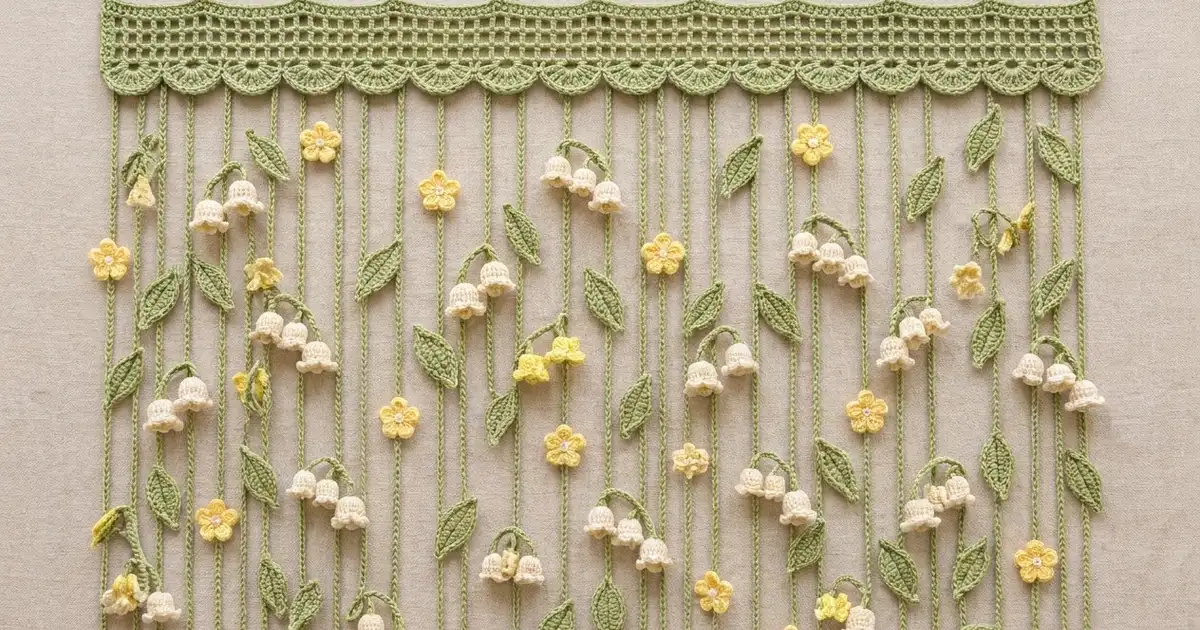
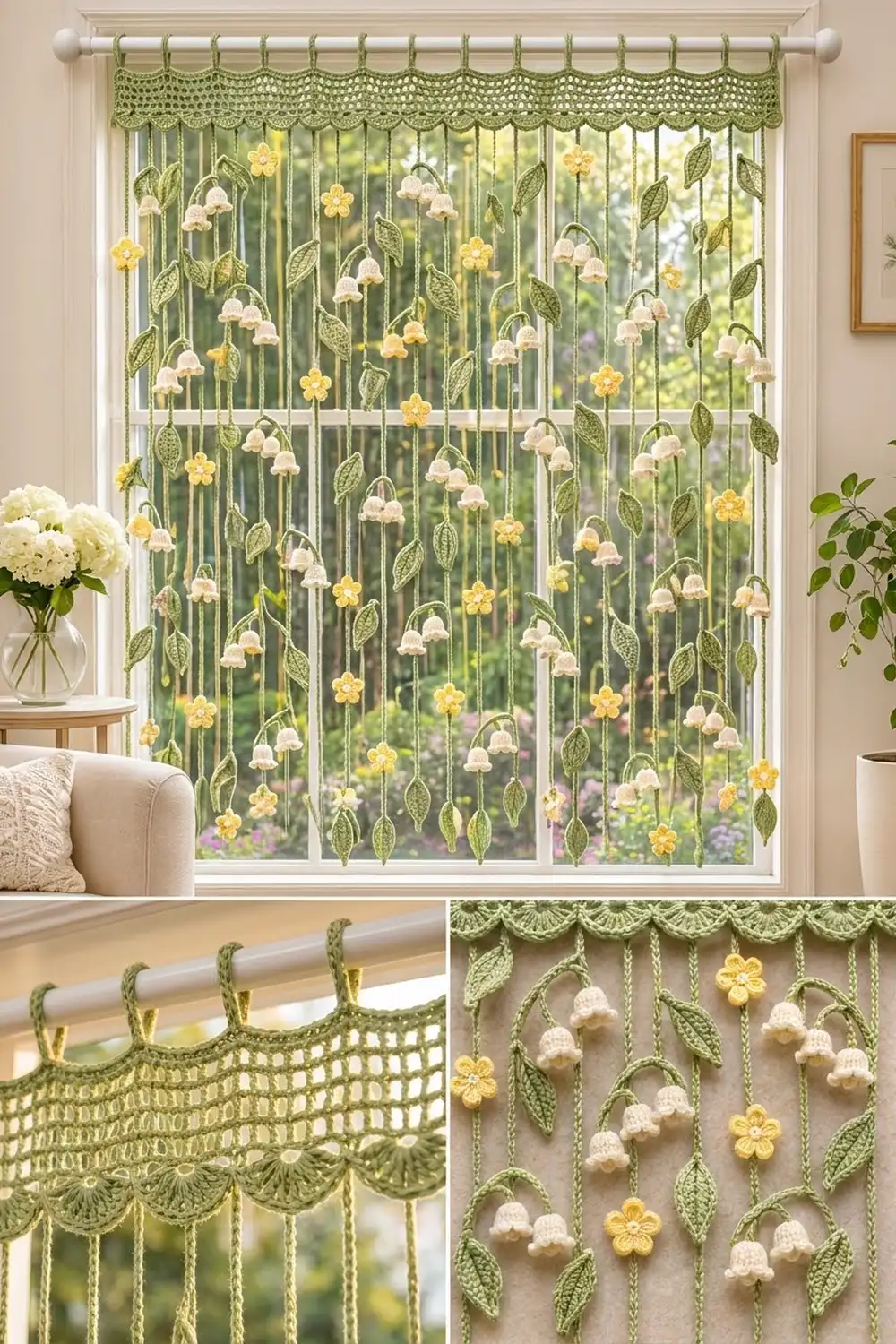
This window curtain has a sage-green filet mesh header with a scalloped bottom edge. Light, thin chain strands hang from the header, each one dotted with cream lily-of-the-valley bells, butter-yellow blossoms, and pointed green leaves. When it hangs in a window, light comes through between the strands and the garden outside stays visible.
The palette is soft and springlike: sage green for the header, cords, stems, and leaves; cream for the bells and flower centers; and pale yellow for the five-petal blossoms. The style is cottage-garden and suits a kitchen window, a nursery, or a doorway.
The pattern uses US crochet terms. The finished curtain measures 30 in (76.2 cm) wide and 39.75 in (101.0 cm) long, not counting the hanging loops.
You’ll make the header in rows, add the scallop edge and hanging loops, and then chain the 21 cord strands directly off the header. After that, you’ll crochet the bells, spray stems, leaves, and flowers and sew them onto the strands following a fixed layout.
Finished Size and Construction
- Finished size: 30 in × 39.75 in (76.2 cm × 101.0 cm), excluding loops
- Skill level: Intermediate
- Terminology: US
- Yarn weight: Worsted (#4) cotton
- Hook: 5 mm (H-8)
- Number of pieces: 1 header with 21 attached strands, plus 22 spray stems, 66 bells, 31 flowers, and 63 leaves
- Layout: 21 strands, 1.5 in (3.8 cm) apart
- Header before border: 30 in × 4.5 in (76.2 cm × 11.4 cm)
- Border depth: scallops 1.25 in (3.2 cm); hanging loops rise 2.5 in (6.4 cm) above the header
- Header with scallops: 30 in × 5.75 in (76.2 cm × 14.6 cm)
- Strand length: 34 in (86.4 cm)
Materials
Use a smooth mercerized or matte cotton. Cotton holds the bell shapes, blocks crisply, and doesn’t sag much in sunlight. Avoid fuzzy yarns, because they blur the mesh.
- Sage green: 300 g / about 480 m
- Cream: 110 g / about 176 m
- Butter yellow: 60 g / about 96 m
These quantities include roughly a 15% margin for gauge differences and swatching.
Tools:
– 5 mm (H-8) hook
– Tapestry needle
– Stitch markers
– Rust-proof pins and a blocking board
– Measuring tape
– Spray bottle
– Optional: light spray starch for the bells
Abbreviations (US Terms)
- ch: chain
- sl st: slip stitch
- sc: single crochet
- hdc: half double crochet
- dc: double crochet
- sk: skip
- st(s): stitch(es)
- sp: space
- BLO: back loop only
- tch: turning chain
- MR: magic ring
Special stitch – mesh: ch 2, sk 2 sts (or sk the ch-2 sp), dc in the next st. One mesh = 3 sts of width.
Back-bump slip stitch: insert the hook under the bump on the back of the chain and sl st. This makes a firm, round cord that doesn’t twist.
Gauge and Checkpoints
Mesh gauge: 4 meshes × 4 rows = 3 in × 3 in (7.6 cm × 7.6 cm), blocked. That works out to 4 sts per inch across and 0.75 in (1.9 cm) per row.
Chain gauge: 4 ch = 1 in (2.5 cm).
Before starting the full header, test with one motif. Make a bell and a leaf: the bell should be about 0.75 in (1.9 cm) tall and 1 in (2.5 cm) across the rim, and the leaf about 2.5 in (6.4 cm) long.
Checkpoints:
– After Row 1, the header measures 30 in (76.2 cm) wide.
– After Row 6, it measures 30 in × 4.5 in (76.2 cm × 11.4 cm).
– After Row 7, the depth is 5.75 in (14.6 cm).
– Each finished strand measures 34 in (86.4 cm).
If your work is too big: go down to a 4.5 mm hook. If it’s too small: go up to a 5.5 mm hook. Change the hook rather than the stitch counts, because the scallop and strand spacing depend on the exact 121-stitch width.
Header
With sage green, ch 123.
Row 1 (solid): dc in the 4th ch from the hook and in each ch across. Turn. (121 sts: 120 dc + tch)
Row 2 (mesh): ch 5 (counts as dc + ch 2), sk 2 sts, dc in the next st. [Ch 2, sk 2, dc in next st] 39 times, working the last dc in the top of the tch. Turn. (40 meshes: 41 dc + 40 ch-2 sps = 121 sts)
Rows 3–5: ch 5 (counts as dc + ch 2), dc in the next dc. [Ch 2, dc in next dc] 39 times, working the last dc in the 3rd ch of the tch. Turn. (40 meshes, 121 sts per row)
Row 6 (solid): ch 3 (counts as dc). [2 dc in next ch-2 sp, dc in next dc] 40 times. Turn. (1 + 40 × 3 = 121 sts)
Checkpoint: the header is 30 in × 4.5 in (76.2 cm × 11.4 cm).
Make All Pieces
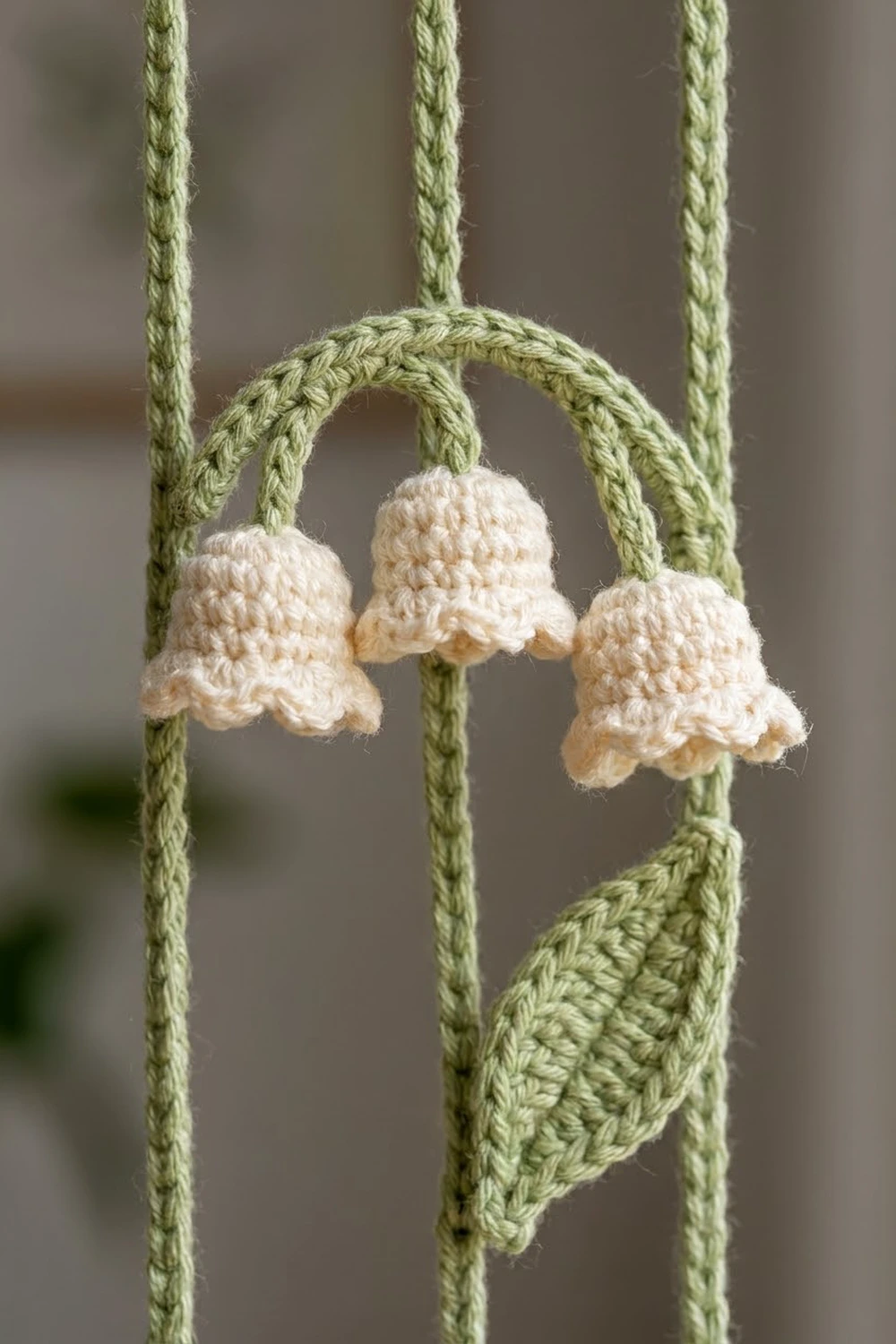
Bells (cream, make 66)
Rnd 1: 6 sc in a MR. (6)
Rnd 2: 2 sc in each st. (12)
Rnds 3–4: sc in BLO of each st. (12 each round)
Working in the back loop creates the fine vertical ridges you see on the bells.
Rnd 5 (ruffled rim): [sl st in next st, (hdc, dc, hdc) in next st] 6 times. (24 sts: 6 sl st + 18, making 6 rim scallops)
Fasten off and leave a 6 in (15.2 cm) tail. Weave the tail up through the center so it comes out at the top of the bell.
Spray Stems (green, make 22)
Ch 19. Starting in the 2nd ch from the hook, work into the back bumps:
- sl st in each of the next 5 ch.
- Ch 4, sl st in the 2nd ch from the hook and in the next 2 ch (one pedicel), then sl st in each of the next 4 stem ch. Repeat from * to * 2 more times.
- sl st in the last ch.
Recount the stem: 5 + 4 + 4 + 4 + 1 = 18 sl sts, carrying 3 pedicels of 3 sl sts each. The stem is 4.5 in (11.4 cm) long. Fasten off and leave an 8 in (20.3 cm) tail at the base.
Leaves (green, make 63)
Ch 11.
Rnd 1, first side: sc in the 2nd ch from the hook, hdc in the next ch, dc in each of the next 5 ch, hdc in the next ch, sc in the next ch. (9 sts)
Tip: (sc, ch 2, sc) in the last ch.
Second side: working in the opposite loops of the foundation chain, sc, hdc, dc in each of the next 5, hdc, sc. (9 sts)
Finish: sl st in the first sc. (20 sts + ch-2 tip)
Ch 3 for the petiole and fasten off. The leaf measures 2.5 in × 1 in (6.4 cm × 2.5 cm). The point where the two sides meet forms a natural center vein.
Flowers (yellow, make 31)
Rnd 1: 10 sc in a MR. (10)
Rnd 2: [sl st in next st, (hdc, 3 dc, hdc) in next st] 5 times. (30 sts: 5 sl st + 25, making 5 petals)
Fasten off. With cream, work a 3-wrap French knot in the center. The flower measures 1.75 in (4.4 cm) across.
Piece Totals
| Color | Pieces |
|---|---|
| Green | 21 strands (made on the header), 22 stems, 63 leaves |
| Cream | 66 bells, plus 31 French knots |
| Yellow | 31 flowers |
Layout Grid
The strands are numbered 1–21 from left to right. Odd-numbered strands are type O (11 strands). Even-numbered strands are type E (10 strands).
Strand:  1  2  3  4  5  6  7  8  9 10 11 12 13 14 15 16 17 18 19 20 21
Type:    O  E  O  E  O  E  O  E  O  E  O  E  O  E  O  E  O  E  O  E  O
Positions are measured down from the top of each strand, where it meets the header:
- Type O: spray at 5 in (12.7 cm), flower at 15 in (38.1 cm), spray at 25 in (63.5 cm), end leaf at 34 in (86.4 cm).
- Type E: flower at 9 in (22.9 cm), leaf at 14 in (35.6 cm), flower at 21 in (53.3 cm), leaf at 27 in (68.6 cm), end leaf at 34 in (86.4 cm).
Check the totals against the layout:
– Sprays: 11 × 2 = 22, so 22 × 3 = 66 bells.
– Flowers: 11 × 1 + 10 × 2 = 31.
– Leaves: 22 (1 per spray) + 11 (Type O end leaves) + 30 (3 per Type E strand) = 63.
Border
Border Gauge
One scallop uses 6 header sts, which is 1.5 in (3.8 cm). 20 scallops × 1.5 in = 30 in (76.2 cm), exactly the header width.
Row 7 (scallops, bottom edge)
Continue from Row 6 without turning the piece over. Ch 1, sc in the first st. [Sk 2 sts, 7 dc in next st, sk 2 sts, sc in next st] 20 times, working the last sc in the top of the tch. (161 sts: 21 sc + 140 dc)
Why the math works: the first sc uses 1 st, and each repeat uses 6 sts. 1 + 20 × 6 = 121, which matches the Row 6 count exactly. The 21 sc between the scallops become the anchor points for the strands. Fasten off.
Top Edge with Loops
Turn the header so the foundation chain is on top. Join green in the first st.
Ch 1. Make 121 sc, one into the base of each Row 1 st, including the base of the tch. As you go, add a loop at sc numbers 1, 13, 25, 37, 49, 61, 73, 85, 97, 109, and 121: after working that sc, ch 20 and sl st into the same sc. (121 sc + 11 ch-20 loops)
Why the math works: (121 − 1) ÷ 12 = 10 intervals, so you get 11 loops spaced 3 in (7.6 cm) apart. Each ch-20 loop is 5 in (12.7 cm) around and fits a rod up to 1.25 in (3.2 cm) in diameter. Fasten off.
Joining
Strands
With the header right side facing and the scallops at the bottom, join green with a sl st in sc #1 of Row 7.
Ch 137. sl st in the back bump of the 2nd ch from the hook and in each ch back up the chain. (136 sl sts = 34 in / 86.4 cm)
sl st into the same sc and fasten off. Repeat in each of the 21 sc valleys. Since 21 anchors span 20 gaps of 1.5 in (3.8 cm), the strands fill exactly 30 in (76.2 cm).
Tension: keep the back-bump slip stitches loose enough to fit the hook easily. If they’re tight, the cord will curl.
Motifs
Pin every motif in place according to the layout before you sew anything.
Sprays:
1. Sew one bell to the tip of each pedicel using the bell’s own tail.
2. Lay the stem so it arcs outward from the strand and hangs downward. Tack it to the strand at its base and at one midpoint.
3. Sew a leaf flat beside the stem base, angled upward.
Flowers: center each flower over its strand and stitch around Rnd 1 through the middle of the cord.
Leaves: sew each petiole to the strand. For end leaves, attach the petiole over the last 0.5 in (1.3 cm) of the strand.
Weave every tail through the cord, not around it. This keeps the strands straight.
Size checkpoint: hang the curtain. The strands should measure 34 in (86.4 cm), and the total length should be 39.75 in (101.0 cm).
Final Blocking
- Pin the header to 30 in × 5.75 in (76.2 cm × 14.6 cm), easing each mesh square.
- Pin out each scallop as a semicircle 1.25 in (3.2 cm) deep.
- Mist the header until it’s damp and let it dry completely.
- Lightly starch the bells, shaping each one over a fingertip so the rim flares.
- Hang the curtain from its rod, mist the strands, and let them dry so they hang straight.
Final Quality-Control Checklist
- 40 even meshes in each of Rows 2–5
- 20 scallops, the same size and evenly spaced
- 11 loops, 3 in (7.6 cm) apart
- 21 strands, each 34 in (86.4 cm) long
- 66 bells, each with 6 rim scallops
- 31 flowers with cream centers
- 63 leaves, all pointing the same way
- Positions match the layout grid on every strand
- All tails woven into cords or motifs, with none visible from the front
Troubleshooting
- The header is wider than 30 in (76.2 cm): go down a hook size and remake it. Don’t skip meshes, because the strand math depends on 121 sts.
- The scallops ruffle: work 6 dc per scallop instead of 7, or use a smaller hook for Row 7 only.
- The strands twist: re-steam them while they hang, and make sure you worked into the back bumps.
- The bells collapse: starch them again, or turn Rnd 2’s sc into BLO sc so the bells stand stiffer.
- The strands are uneven lengths: count the slip stitches; every strand should have 136.
Care
Hand wash in cool water, roll the curtain in a towel to remove water, and dry it flat before rehanging. Re-block the header and re-starch the bells as needed.
Final Notes
Each measurement leads to the next. A 3-st mesh at 4 sts per inch gives a 121-st header that is 30 in (76.2 cm) wide and 4.5 in (11.4 cm) tall. The 20 six-stitch scallops add 1.25 in (3.2 cm) and leave 21 anchor points 1.5 in (3.8 cm) apart. Each of the 136-sl-st strands drops 34 in (86.4 cm), for a total of 39.75 in (101.0 cm). Check each step and the curtain will hang straight.
Happy crocheting!