

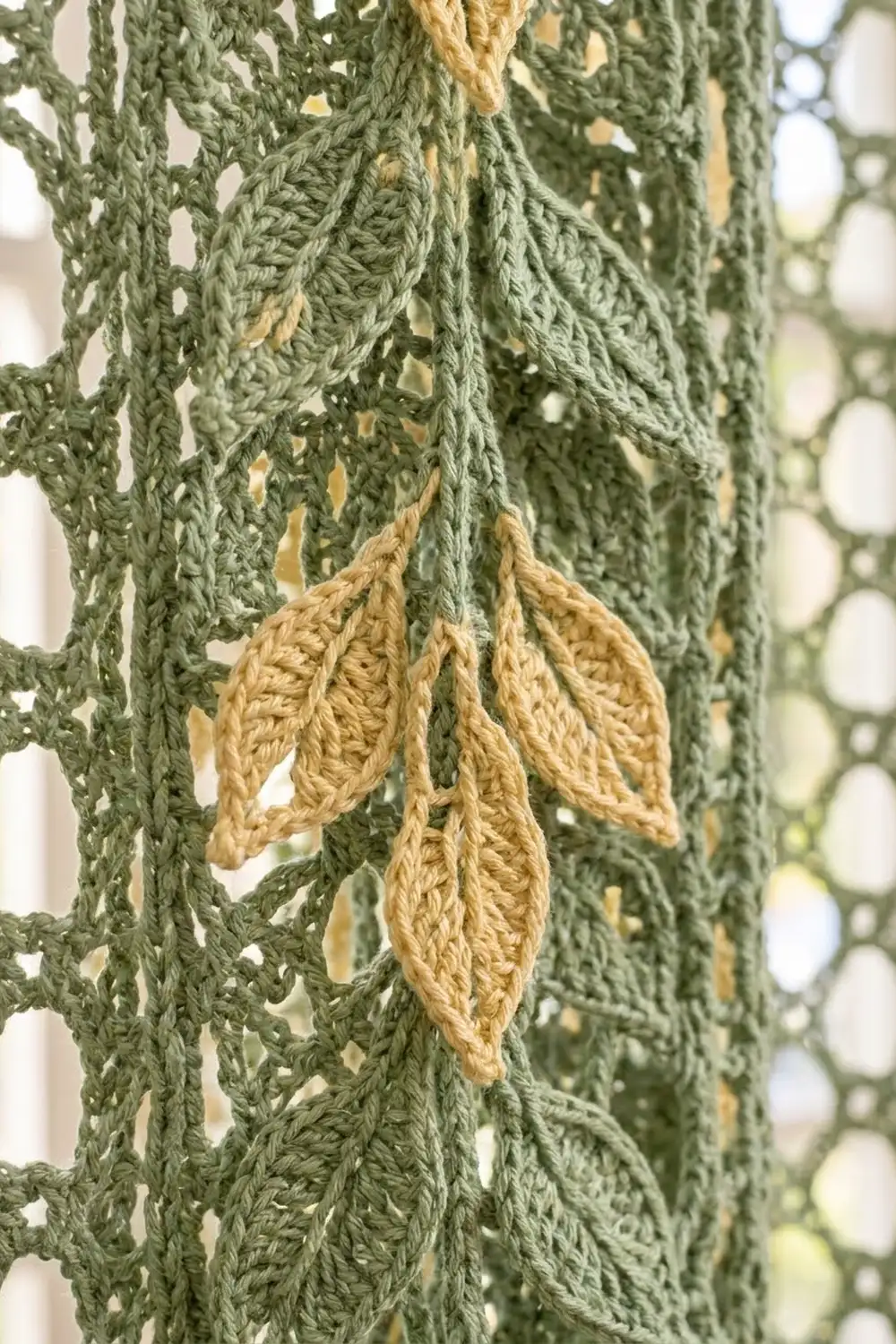
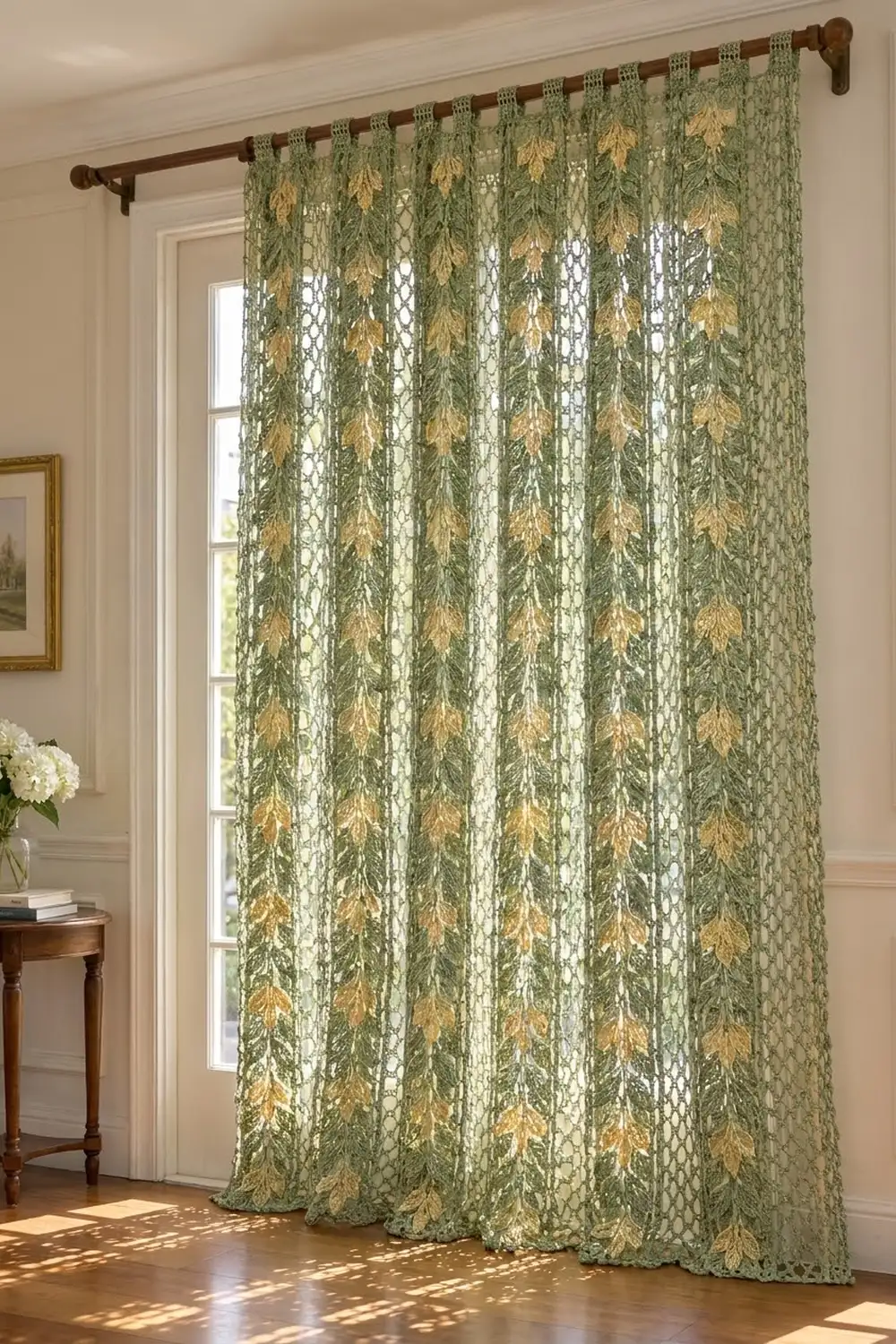
This curtain panel brings a garden indoors. Nine tall lace strips hang side by side, and each one carries a climbing vine of paired leaves up its center. Open mesh along both edges of every strip lets daylight through, while the leaves add soft, raised texture.
The colors are calm and natural. Sage green covers the mesh, the stems and most of the leaves, and butter-golden leaves repeat every third pair like sunlight catching the vine. The cottage, botanical style suits a living room window, a French door or a sunny bedroom.
The pattern uses US crochet terms. Without tabs, the finished panel measures 56.8 in wide by 71.5 in long (144.3 cm by 181.6 cm). It hangs from nine folded tabs that slip over a standard curtain rod.
The construction is simple and repetitive. You crochet nine identical mesh strips flat in rows and add a surface slip-stitch stem to each. Then you sew on leaves made separately, join the strips with flat slip-stitch seams, work a two-round border and add the tabs.
Finished Size and Construction
- Finished size: 56.8 in x 71.5 in (144.3 cm x 181.6 cm), excluding tabs
- Skill level: Intermediate
- Terminology: US crochet terms
- Yarn weight: DK (light worsted, #3) cotton
- Hook: 4 mm (US G-6)
- Number of pieces: 9 strips plus 387 leaf appliqués (261 green, 126 golden)
- Layout: 9 strips side by side, 1 strip tall
- Strip size: 6.2 in x 70.5 in (15.7 cm x 179.1 cm)
- Size before border: 55.8 in x 70.5 in (141.7 cm x 179.1 cm)
- Border depth: 0.5 in (1.3 cm) on each edge
- Tabs: 9 tabs, 1.8 in (4.6 cm) wide, folded into 2 in (5.1 cm) loops
Materials
Choose a smooth mercerized or matte cotton in DK weight. Cotton keeps the leaf shapes crisp, blocks flat and stretches less than acrylic when it hangs. The amounts below assume about 110 m per 50 g ball.
- Sage green (Color A): 1,950 g (approx. 4,290 m) for the strips, stems, green leaves, seams, border and tabs
- Golden yellow (Color B): 130 g (approx. 286 m) for the golden leaves
These amounts include about 10% extra for swatching and differences in tension. Buy all of Color A from the same dye lot.
Tools:
- 4 mm (US G-6) crochet hook
- Tapestry needle
- Stitch markers (at least 10)
- Measuring tape
- Rust-proof pins and blocking mats, or a clean carpet covered with a sheet
- Scissors
Abbreviations (US Terms)
- ch – chain
- sl st – slip stitch
- sc – single crochet
- hdc – half double crochet
- dc – double crochet
- sk – skip
- sp – space
- st(s) – stitch(es)
- tch – turning chain
- RS / WS – right side / wrong side
Special stitch – surface slip stitch: Hold the yarn at the back (WS). Insert the hook from the front (RS) through the fabric, yarn over, and pull a loop up through the fabric and through the loop on your hook. This makes a raised chain line on the RS.
Gauge and Checkpoints
Gauge: In the strip pattern, 20 sts and 10 dc rows = 4 in (10.2 cm). In sc, 20 sts and 16 rows = 4 in (10.2 cm).
Test one piece first. Before you start all nine strips, work Strip 1 through Row 11. Measure it unblocked, patted gently flat.
- After Row 11: 6.2 in wide x 4.25 in tall (15.7 cm x 10.8 cm)
- After Row 176: 6.2 in x 70.25 in (15.7 cm x 178.4 cm)
- After Row 177: 6.2 in x 70.5 in (15.7 cm x 179.1 cm)
- Each leaf: 2.25 in long x 1 in wide (5.7 cm x 2.5 cm)
If your strip measures 6.4 in (16.3 cm) or wider, go down half a hook size. If it measures 6.0 in (15.2 cm) or narrower, go up half a size. To change the length, add or remove 5 pattern rows for every 2 in (5.1 cm). Every strip must have the same number of rows.
Strip (Make 9)
Each strip has open mesh down both sides and a solid band of 7 dc in the center, which holds the stem and leaves.
With Color A, ch 32.
Row 1 (RS): Sc in 2nd ch from hook and in each ch across, turn. (31 sc)
Row 2: Ch 3 (counts as dc here and throughout), sk first st, [ch 1, sk next st, dc in next st] 6 times, dc in next 6 sts, [ch 1, sk next st, dc in next st] 6 times, turn. (19 dc and 12 ch-1 sps = 31 sts)
Stitch positions 13 through 19 form the solid center band of 7 dc. Every other position on each side alternates dc and ch-1 sp.
Rows 3–176: Ch 3, [ch 1, sk ch-1 sp, dc in next dc] 6 times, dc in next 6 dc, [ch 1, sk ch-1 sp, dc in next dc] 5 times, ch 1, sk ch-1 sp, dc in 3rd ch of tch, turn. (31 sts)
Row 177: Ch 1, sc in each dc and each ch-1 sp across, ending with sc in 3rd ch of tch. (31 sc)
Fasten off and weave in the ends. Check: the strip should measure 6.2 in x 70.5 in (15.7 cm x 179.1 cm).
Stem
Use the center stitch column, which is position 16 (the 4th dc of the solid band). Place markers in that column at Row 8 and Row 160. Row 8 sits 3.05 in (7.7 cm) above the bottom edge, and Row 160 sits 63.85 in (162.2 cm) above it.
With the RS facing and Color A, work surface slip stitch straight up the center column from Row 8 to Row 160, with 2 sl sts per row (306 sl sts). Keep the stem loose enough that it doesn’t pucker the strip. Fasten off on the WS.
Leaf (Make 261 in Color A and 126 in Color B)
Ch 11.
Round 1: Sc in 2nd ch from hook, hdc in next ch, dc in next 5 ch, hdc in next ch, sc in next ch, then work (sc, ch 2, sc) in last ch to make the tip. Rotate and work along the other side of the foundation chain: sc in next ch, hdc in next ch, dc in next 5 ch, hdc in next ch, sc in next ch, sl st in first sc. (20 sts plus one ch-2 tip)
Fasten off, leaving a 12 in (30.5 cm) tail for sewing. The leaf has a rounded base at the stem end and a pointed tip. It measures 2.25 in x 1 in (5.7 cm x 2.5 cm).
Attaching the Leaves
Each strip gets 21 leaf pairs plus one top leaf. Space the pairs every 7 rows (2.8 in / 7.1 cm), starting at Row 12 and ending at Row 152 (Rows 12, 19, 26 and so on). Row 12 is 4.65 in (11.8 cm) above the bottom edge, and Row 152 is 60.65 in (154.1 cm) above it.
Color order from the bottom: green pair, green pair, golden pair. Repeat this order 7 times, for 14 green pairs and 7 golden pairs.
- Place the base of one leaf against the stem at the marked row, with the tip angled up and outward at about 45 degrees.
- Place the second leaf of the pair as a mirror image on the other side of the stem.
- Whipstitch each leaf to the strip through its outer loops. Sew all the way around the leaf so the tip can’t curl away from the mesh.
- Sew one more green leaf at the top of the stem at Row 160, pointing straight up. Its tip ends 66.1 in (167.9 cm) above the bottom edge.
Each strip has 29 green leaves and 14 golden leaves. The leaves cover the solid band and overlap the inner mesh, leaving open mesh along both outer edges.
Make All Pieces
- Strips: 9 in Color A, each with a stem
- Green leaves: 9 x 29 = 261
- Golden leaves: 9 x 14 = 126
Finish each strip’s stem and leaves before joining. It is much easier to sew leaves onto a single 6.2 in (15.7 cm) strip than onto a whole curtain.
Layout grid (RS facing, Row 177 at the top):
 T    T    T    T    T    T    T    T    T
[S1] [S2] [S3] [S4] [S5] [S6] [S7] [S8] [S9]
S = strip, T = tab position (tabs are added after the border).
Joining
Method: Flat slip-stitch seam, worked on the WS with Color A.
Each long side edge of a strip counts as 352 sts. The 175 dc rows give 2 sts per row end, for 350 sts. The two sc row ends (Row 1 and Row 177) add 1 st each, and these are the corner sts. So the 352 already includes both corner sts.
- Hold S1 and S2 with RS together, edges lined up and Row 1 at the bottom.
- Sl st through both corner sts at Row 1.
- Work 2 sl sts in each dc row end, going through the matching row ends of both strips.
- Sl st through both corner sts at Row 177 (352 sl sts per seam).
- Fasten off. Add each remaining strip in order the same way, for 8 seams in total.
Tension: Keep your sl sts as loose as the dc rows. A tight seam makes the curtain shorter at the seams than in the mesh. If a seam puckers, work it with a hook one size larger.
The seams add no width. Size checkpoint: 9 x 6.2 in = 55.8 in wide, and the length is 70.5 in (141.7 cm x 179.1 cm). The top and bottom edges each have 9 x 31 = 279 sts.
Border
Border gauge: 20 sc and 16 rows = 4 in (10.2 cm). Two sc rounds add 0.5 in (1.3 cm) to each edge.
The corner sts are the first and last sts of the top and bottom edges. Not counting corners, the top and bottom each have 279 – 2 = 277 sts. Each side has 350 row-end sts (2 per dc row).
Round 1: With the RS facing and Color A, join with a sc in the top right corner st. Work 3 sc in each corner st, 1 sc in each st along the top and bottom, and 2 sc in each dc row end along the sides. Sl st to first sc.
Counts between the center sc of each corner: top 279, each side 352, bottom 279. Total: 279 + 352 + 279 + 352 + 4 corner centers = 1,266 sc.
Round 2: Ch 1, sc in each sc around, working 3 sc in each corner center sc. Sl st to first sc.
Counts between corner center sc: top 281, each side 354, bottom 281. Total: 281 + 354 + 281 + 354 + 4 = 1,274 sc.
Why the math works: Each corner’s 3-sc group adds 1 st to each side it touches, so every side grows by 2 sts per round. On the sides, one dc row is 0.4 in tall, and 2 sc at 5 sc per inch also cover 0.4 in. Because these match, the border lies flat without ruffling or cupping.
Size after border: 56.8 in x 71.5 in (144.3 cm x 181.6 cm).
Tabs (Make 9)
Number the sts along the top edge of Round 2. St 1 is the right corner center sc and st 283 is the left corner center sc. The center st of each strip is at position 18 + 31 x (strip number – 1).
Mark these tab positions: sts 14–22, 45–53, 76–84, 107–115, 138–146, 169–177, 200–208, 231–239 and 262–270. Each tab is centered over one strip. There are 22 sts between tabs and 13 sts at each end.
Row 1: With the RS facing, join Color A in the first marked st, ch 1, sc in the same st and the next 8 sts, turn. (9 sc)
Rows 2–16: Ch 1, sc in each st across, turn. (9 sc)
Fasten off, leaving a 12 in (30.5 cm) tail. Fold the tab to the WS and whipstitch Row 16 to the back of Round 1, directly behind the tab base. Each loop is 1.8 in (4.6 cm) wide and 2 in (5.1 cm) tall. It fits rods up to 1.25 in (3.2 cm) in diameter.
Final Blocking
- Soak the curtain in cool water, then gently press the water out. Don’t wring it.
- Roll it in towels to remove more water.
- Lay it flat, RS up, on blocking mats or a sheet-covered carpet.
- Pin the corners first, to 56.8 in x 71.5 in (144.3 cm x 181.6 cm).
- Pin along each edge every 4 in (10.2 cm), keeping the seams straight and vertical.
- Smooth each leaf with your fingers so the tips point up and outward. Pin any tips that curl.
- Let the curtain dry completely, for at least 24 hours, before removing the pins.
Final Quality-Control Checklist
- All 9 strips have 177 rows and measure 6.2 in x 70.5 in (15.7 cm x 179.1 cm).
- Each strip has 21 leaf pairs in green, green, golden order, plus one green top leaf.
- Every leaf is sewn down all the way around.
- Each seam has 352 sl sts and lies flat.
- Border Round 2 has 1,274 sc in total.
- All 9 tabs are centered over their strips and sewn securely.
- The blocked panel measures 56.8 in x 71.5 in (144.3 cm x 181.6 cm).
- All ends are woven in on the WS.
Troubleshooting
Strips are different lengths: Count rows instead of measuring. Undo or add rows until every strip has exactly 177.
Mesh slants: Make sure the last dc of each row goes into the 3rd ch of the tch, not into the ch-1 sp next to it.
Stem puckers the strip: Work the surface sl sts more loosely, or use a larger hook just for the stem.
Leaves curl: Block the leaves before sewing them on, and sew around the whole edge, not just the base.
Border ruffles: You may have more than 2 sc in some dc row ends. Recount: each side should have 350 sts between corners.
Border cups or pulls in: Work the border with a hook one size larger.
Tabs are too tight on the rod: Add 2 sc rows to each tab. This makes the folded loop 0.25 in (0.6 cm) longer.
Care
Hand wash in cool water with a mild detergent, then dry flat and reshape as you did when blocking. Keep it out of strong direct sun for long hours if you want the golden leaves to keep their warm color.
Final Notes
Every measurement in this curtain builds on the one before it. A gauge of 20 sts and 10 rows = 4 in (10.2 cm) gives a 31-st strip 6.2 in (15.7 cm) wide, and 177 rows give a length of 70.5 in (179.1 cm). Nine strips joined with flat seams measure 55.8 in (141.7 cm) across, with 279 sts along the top and bottom and 352 along each side. Two border rounds add 0.5 in (1.3 cm) to each edge, for a final size of 56.8 in x 71.5 in (144.3 cm x 181.6 cm), and the tabs finish the panel for hanging. Check each measurement as you go, and your vines will line up neatly.
Happy crocheting!