
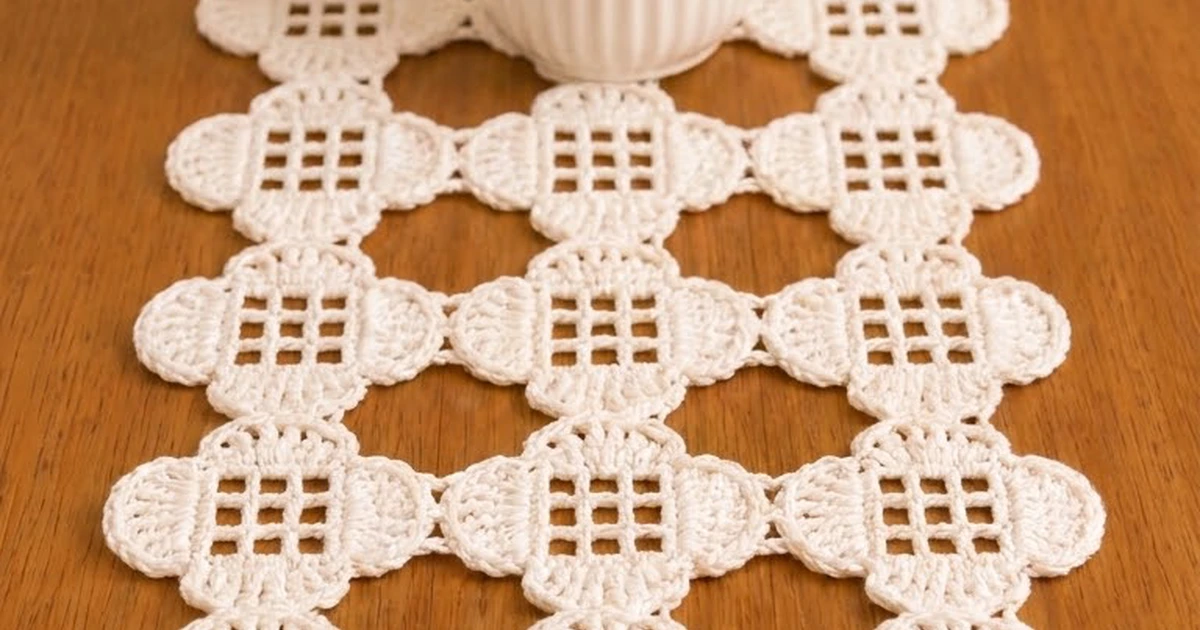
The Window Clover Table Runner is made from small four-lobed motifs. Each one has an open 3 x 3 filet “window” in the center and a rounded double-crochet fan on every side. When the motifs are joined tip to tip, the lobes create a lacy pattern of scallops and diamond-shaped openings, and the wood of the table shows through.
The runner is worked in a single soft white cotton, so all of the interest comes from texture: crisp grid holes, radiating stitches in the fans, and a raised single-crochet rim around every motif. Three tassels finish each short end. The style is classic and light, and it suits both farmhouse and minimalist tables.
This pattern uses US crochet terms. The finished runner measures 12 in x 36 in (30.5 cm x 91.4 cm) without tassels, or 12 in x 44 in (30.5 cm x 111.8 cm) with the 4 in (10.2 cm) tassels at both ends.
Each motif is worked separately: a filet square, then an edging round, then four fan lobes, then a rim round. From the second motif onward, the rim round also joins the new motif to its neighbors at the lobe tips. The lobes form the scalloped edge, so there is no added border.
Finished Size and Construction
- Finished size: 12 in x 36 in (30.5 cm x 91.4 cm), plus tassels
- Skill level: Easy-intermediate
- Terminology: US
- Yarn weight: Light / DK (#3) cotton
- Hook: 3.5 mm (E-4)
- Number of pieces: 27 motifs + 6 tassels
- Layout: 3 motifs wide x 9 motifs long
- Motif size: 4 in (10.2 cm) from lobe tip to lobe tip
- Size before border: 12 in x 36 in (30.5 cm x 91.4 cm)
- Border depth: none; the lobes and rims form the edge (0 in / 0 cm added)
Materials
Yarn: Use a smooth, mercerized or combed cotton in DK weight, about 110 m per 50 g. Cotton gives the stitch definition this design needs and blocks flat. Avoid fuzzy blends, because they blur the grid holes.
- White (or soft ivory): 200 g (440 m), which is 4 balls of 50 g / 110 m
Each motif uses about 5 g (11 m) and each tassel about 3.5 g (8 m). The runner needs about 160 g (350 m) in total, and the quantity listed above includes a safety margin.
Tools:
– 3.5 mm (E-4) crochet hook
– Tapestry needle
– Scissors
– Stitch markers (2–3)
– Stiff card, 4.5 in (11.4 cm) tall, for tassels
– Blocking mat, rust-proof pins, and a spray bottle
– Measuring tape
Abbreviations (US Terms)
- ch – chain
- sl st – slip stitch
- sc – single crochet
- dc – double crochet
- sk – skip
- sp – space
- st(s) – stitch(es)
- RS – right side
- rep – repeat
Special technique – Tip join: While working the rim round of a new motif, you join it to a neighbor at the two middle stitches of the lobe tips. Work sc 12 of the current lobe top, then sl st into sc 13 of the neighbor’s matching lobe. Next, work sc 13 of the current lobe, then sl st into sc 12 of the neighbor’s lobe. The neighbor’s numbers are reversed because the two lobes face each other. The 2 joining sl sts are never counted in the new motif’s stitch total.
Gauge and Checkpoints
Make one complete motif first and block it before you make the rest. Every runner measurement depends on this motif.
- Filet gauge: 1 mesh = 0.5 in (1.3 cm) wide, and 1 filet row = 0.5 in (1.3 cm) tall
- Checkpoint A (after Row 3): center square is 1.5 in x 1.5 in (3.8 cm x 3.8 cm)
- Checkpoint B (after Rnd 1): square is 1.75 in (4.4 cm) per side
- Checkpoint C (after all lobes): 3.75 in (9.5 cm) from lobe tip to lobe tip; each lobe extends 1 in (2.5 cm) and is about 2.25 in (5.7 cm) wide at its widest point
- Checkpoint D (after rim round, blocked): 4 in (10.2 cm) from tip to tip
If your motif is too big: go down to a 3.25 mm hook, or tighten the chain-2 spaces in the grid.
If your motif is too small: go up to a 3.75 mm hook, or check that each dc is pulled up fully before you yarn over.
Even a difference of 0.25 in (0.6 cm) per motif adds 2.25 in (5.7 cm) to the runner length over 9 motifs, so match gauge carefully.
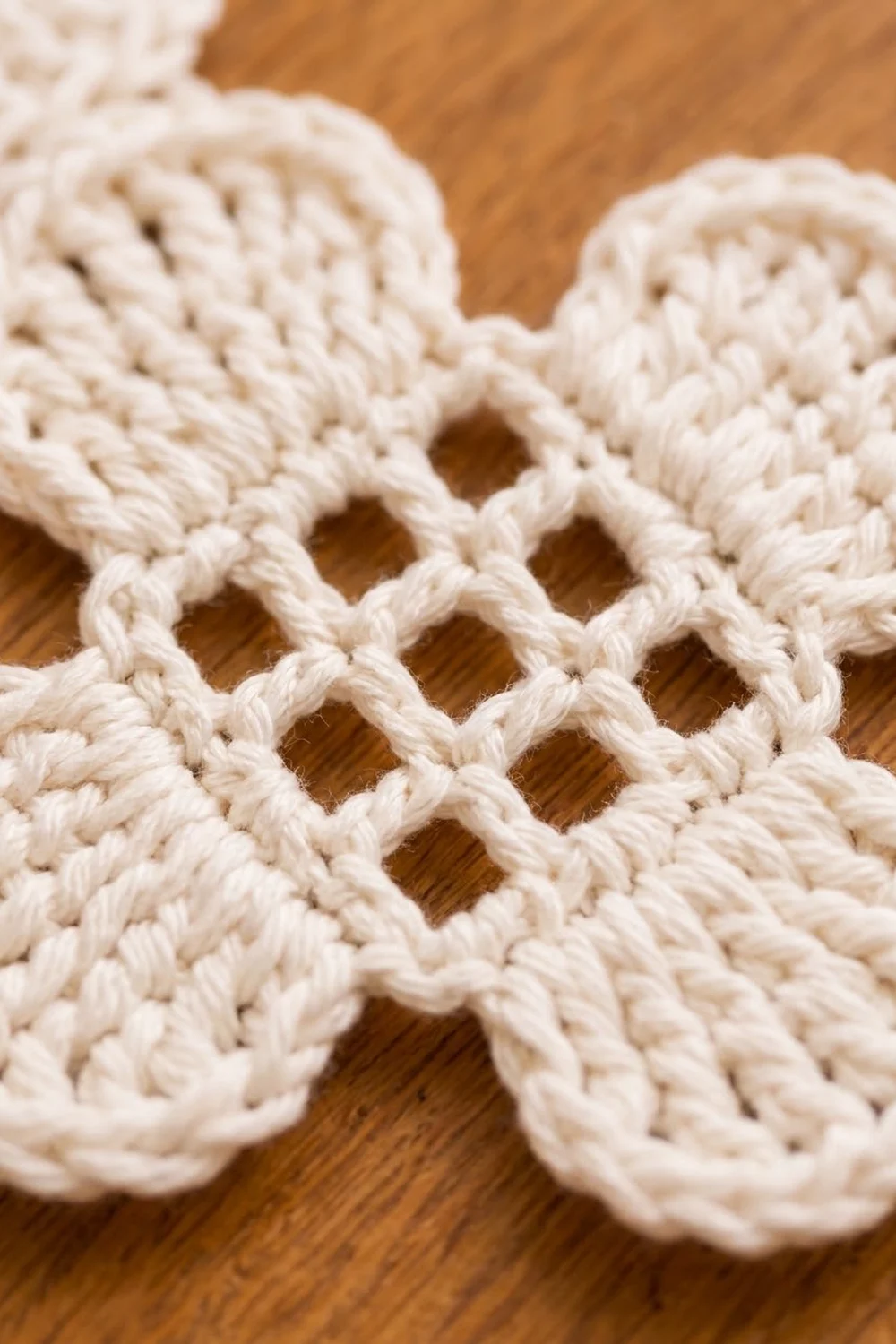
Motif (Make 27)
Center Filet Square
Ch 14.
Row 1 (RS): Dc in 8th ch from hook. Ch 2, sk 2 ch, dc in next ch. Rep from * once more. Turn. (3 meshes; 4 dc posts counting the turning chain.)
Row 2: Ch 5 (counts as dc + ch 2). Dc in next dc, ch 2, dc in next dc, ch 2. Dc in 3rd ch of the turning ch. Turn. (3 meshes)
Row 3: Rep Row 2. Do not turn. (3 meshes; 3 x 3 grid = 9 window holes)
Checkpoint A: the square measures 1.5 in (3.8 cm) per side.
Square Edging
Rnd 1: Ch 1. Rotate the work to go along the side edge. Work 3 sc around each of the 3 row-end posts (9 sc), then ch 2 for the corner. Turn the corner and work 3 sc in each of the 3 ch-2 spaces of the next side (9 sc), then ch 2 for the corner. Rep from * once more. Join with a sl st to the first sc. Fasten off.
Count: 36 sc (9 per side) + 4 corner ch-2 spaces.
On every side, the 9 sc lie between the corner spaces; the corner ch-2 spaces are not included in that 9. Checkpoint B: 1.75 in (4.4 cm) per side.
Fan Lobes (Make 4 per Motif)
Work one lobe on each side of the square.
Row 1: With RS facing, join yarn in the first sc of any side, just after a corner ch-2 sp. Ch 3 (counts as dc), then dc in the next 8 sc. Turn. (9 dc)
Row 2: Ch 3 (counts as dc). Dc in the same st, then work 2 dc in each st across, ending with 2 dc in the top of the turning ch. Turn. (18 dc)
Row 3: Ch 3 (counts as dc). Dc in next st, then 2 dc in next st. Dc in next 2 sts, 2 dc in next st. Rep from * 4 more times. Fasten off. (24 dc)
Count check for Row 3: The opening group turns 3 stitches into 4, and the 5 repeats turn 15 stitches into 20. That uses all 18 stitches of Row 2 and gives 24 dc.
Rep Rows 1–3 on the remaining three sides. Leave the corner ch-2 spaces empty. The lobes fan wider than their base, which creates the rounded mushroom shape.
Checkpoint C: 3.75 in (9.5 cm) from tip to tip.
Rim Round
First motif only: Join yarn with a sc in any corner ch-2 sp.
Work 2 sc in each of the 3 row-ends up the side of the lobe (6 sc). Sc in each of the 24 dc across the top (24 sc). Work 2 sc in each of the 3 row-ends down the other side (6 sc). Sc in the next corner ch-2 sp. Rep from * around, leaving out the final corner sc because the joining sc already filled that space. Join with a sl st to the first sc. Fasten off and weave in ends.
Count: 4 lobes x 36 sc + 4 corner sc = 148 sc.
Each lobe top has 24 sc, and its tip is sc 12 and sc 13, the two center stitches. Place a marker in the tip of each lobe before blocking.
Checkpoint D: 4 in (10.2 cm) from tip to tip after blocking.
Make All Pieces
- Motifs: 27 in white. The first is worked completely; the other 26 are joined during their rim round.
- Tassels: 6 in white, 3 for each short end. The photo shows one end, and this pattern repeats the tassels at the other end for symmetry.
Layout grid (3 wide x 9 long):
Row 1:  [ 1][ 2][ 3]   <- tassels hang here
Row 2:  [ 4][ 5][ 6]
Row 3:  [ 7][ 8][ 9]
Row 4:  [10][11][12]
Row 5:  [13][14][15]
Row 6:  [16][17][18]
Row 7:  [19][20][21]
Row 8:  [22][23][24]
Row 9:  [25][26][27]   <- tassels hang here
Joining
Method: Join as you go with the tip join (see Special Technique). You only join while working the rim round.
Order:
– Work across each row from left to right.
– Motif 2 joins motif 1 with one tip join between motif 1’s right lobe and motif 2’s left lobe.
– From Row 2 on, the first motif in a row joins only the motif above it, through its top lobe and that motif’s bottom lobe.
– Every other motif joins both its left neighbor and the motif above it.
Stitch-to-stitch logic: Each join connects 2 tip stitches to 2 tip stitches. All other rim stitches stay free. Because the joining sl sts are worked into the neighbor and never counted, every motif still has exactly 148 sc. Diamond-shaped openings form wherever four motifs meet at their corner notches.
Tension: Work the sl sts at the same height as your sc, without pulling tight. A tight join puckers the tips and pulls the grid out of square. A loose join leaves a gap you can see. Lay the joined pieces flat after every row and look at them.
Size checkpoint:
– Each row of 3 motifs measures 12 in (30.5 cm) wide (3 x 4 in).
– After 3 rows, the length is 12 in (30.5 cm).
– After 9 rows, the length is 36 in (91.4 cm).
Border
This runner has no added border. The scalloped edge comes from the free outer lobes, each one already finished with its 36 sc rim (6 + 24 + 6). Adding a border round would fill in the scallops and change the look.
Edge gauge: In the rim, 24 sc across a lobe top cover about 2.25 in (5.7 cm), measured on the curve.
Free scallop counts:
– Each long side: 9 motifs x 1 outer lobe x 36 sc = 324 sc of free scallop.
– Each short side: 3 motifs x 1 outer lobe x 36 sc = 108 sc of free scallop.
The corner sc and the half-lobe edges inside the notches between motifs are not part of these totals.
Why the math works: Joins use only the 2 tip stitches of the inner lobes, and those sl sts never add to any motif’s count. The outer lobes are never touched, so every edge count is just (motifs along that side) x 36. Width = 3 x 4 in = 12 in (30.5 cm), and length = 9 x 4 in = 36 in (91.4 cm), with nothing added at the seams.
Tassels (Make 6)
- Wrap yarn 30 times around the 4.5 in (11.4 cm) card.
- Thread a 10 in (25.4 cm) strand under the wraps at the top and tie it tightly. Leave both tails long.
- Cut the wraps at the bottom.
- Wrap a separate strand 6 times around the bundle, 0.75 in (1.9 cm) below the top, and knot it. Hide the ends inside the tassel.
- Trim the tassel to 4 in (10.2 cm).
- Use the top tails to tie the tassel to the tip (sc 12–13) of an outer lobe on a short end. Weave the tails into the rim.
Final Blocking
- Weave in all remaining ends before blocking, through rim stitches only.
- Lay the runner on blocking mats, RS up.
- Pin it to 12 in x 36 in (30.5 cm x 91.4 cm). Use a measuring tape along both long edges.
- Pin the 4 corners of each grid square so the 9 holes are square.
- Pin each outer lobe tip so the scallops are round and even.
- Mist with water until damp, but not soaked.
- Let it dry completely, at least 12 hours, before you remove the pins.
- Comb the tassels straight and trim any uneven strands.
Final Quality-Control Checklist
- [ ] All 27 motifs measure 4 in (10.2 cm) from tip to tip
- [ ] Every grid shows 9 open, square holes
- [ ] Every lobe has 9, 18, and 24 dc in Rows 1–3
- [ ] Every rim has 148 sc
- [ ] Every interior tip join uses exactly 2 sl sts
- [ ] The runner measures 12 in x 36 in (30.5 cm x 91.4 cm)
- [ ] The diamond openings are even across the whole runner
- [ ] 3 tassels hang at each short end, 4 in (10.2 cm) long
- [ ] No ends are visible on the RS
Troubleshooting
Grid holes are rectangles, not squares: Your dc are too tall or your chains too tight. Try ch 2 more loosely, or use a shorter yarn-over pull.
Lobes ruffle: Your Row 3 increases are too loose. Check the 24 dc count, and drop to a smaller hook for the lobes only.
Lobes cup inward: Your tension is too tight on Row 2. Relax your tension, or work the lobe rows with a hook 0.25 mm larger.
Tips pucker at the joins: The sl sts are too tight. Rework them more loosely.
The runner is shorter than 36 in (91.4 cm): Block it harder to the measured size. If it is short by more than 1 in (2.5 cm), your motif gauge is off.
Ends show through the grid: Reweave the tails inside the rim sc, not along the chain bars.
Care
Hand wash in cool water with mild soap, roll it in a towel to remove the water, and dry it flat, re-pinning if needed. Iron through a cloth on the cotton setting if it needs extra crispness.

Final Notes
The size of this runner follows a simple chain of measurements:
– The 3 x 3 grid is 1.5 in (3.8 cm).
– The edging brings it to 1.75 in (4.4 cm).
– The fan lobes bring it to 3.75 in (9.5 cm).
– The rim finishes each motif at 4 in (10.2 cm).
– Three motifs across make 12 in (30.5 cm), and nine down make 36 in (91.4 cm).
Check each step, and the finished runner will measure what it should.
Happy crocheting!