

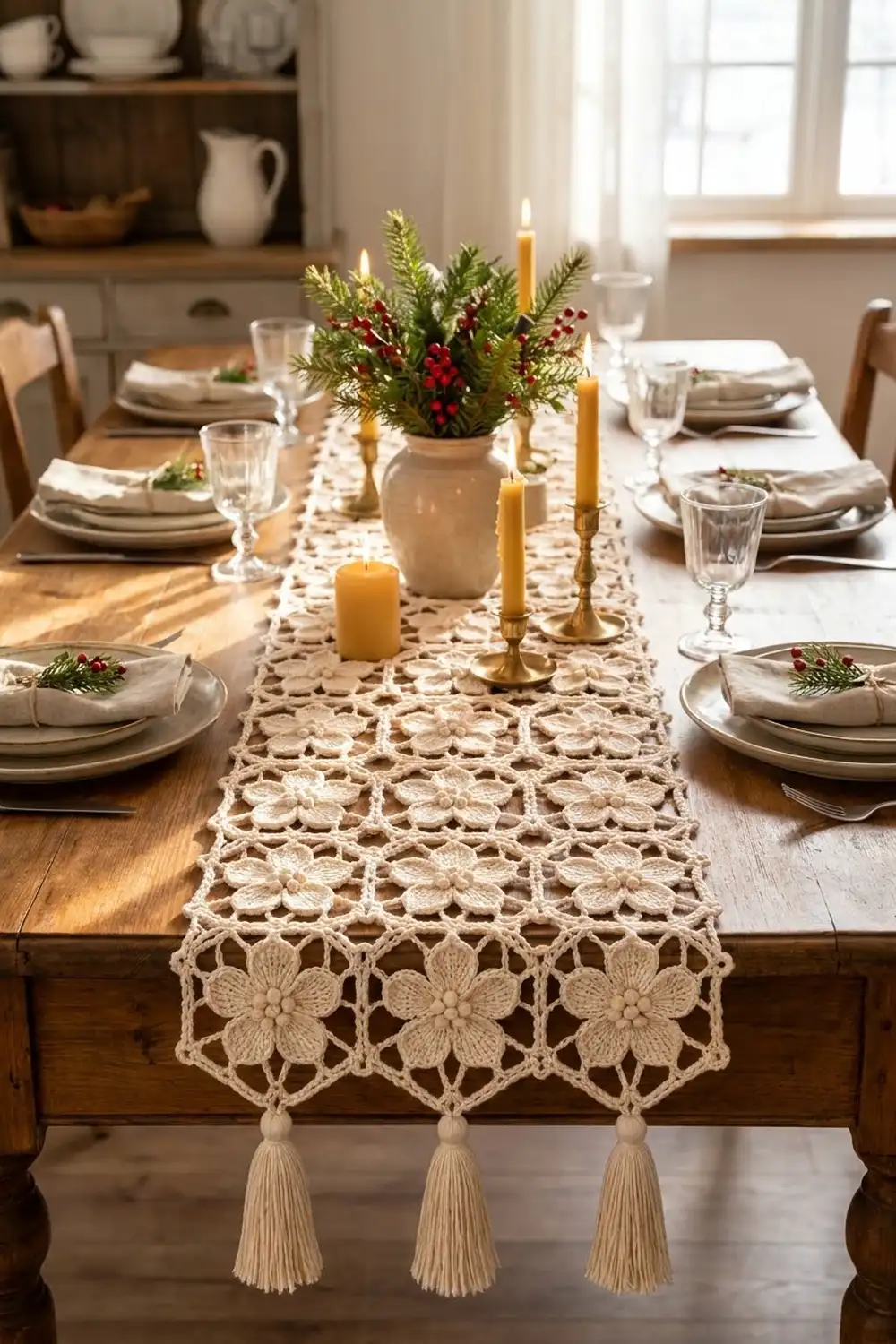
This runner is made of lacy cream hexagons, each with a raised five-petal flower in the middle. The petals have fine ridges from their tall stitches, the center is a small cluster of round bobbles, and an open chain frame around each flower lets the table show through.
It’s worked in one color, a warm cream or ivory cotton, so it suits a holiday table and works just as well the rest of the year. Because there’s only one color, you never have to manage color changes, and the texture does all the work. The pattern uses US crochet terms.
The finished runner measures 19 x 57 in (48.3 x 144.8 cm) before tassels. The tassels add 4 in (10.2 cm) at each end, for 65 in (165.1 cm) overall.
You make 24 identical hexagon motifs and join them in 8 rows of 3. Then you work a two-round border around the zigzag outline and add three tassels to each short end. Every motif has the same number of stitches per side, so the seams and the border line up stitch for stitch.
Finished Size and Construction
- Finished size: 19 x 57 in (48.3 x 144.8 cm); 65 in (165.1 cm) long with tassels
- Skill level: Intermediate
- Terminology: US crochet terms
- Yarn weight: Worsted (#4) cotton
- Hook: 4.0 mm (US G-6)
- Number of pieces: 24 hexagon motifs plus 6 tassels
- Layout: 3 motifs wide x 8 rows long, pointy-top hexagons
- Motif size: 6 in (15.2 cm) flat-to-flat, 7 in (17.8 cm) point-to-point, 3.5 in (8.9 cm) per side
- Size before border: 18 x 56 in (45.7 x 142.2 cm)
- Border depth: 0.5 in (1.3 cm), two rounds
Materials
Use a smooth, mercerized or combed worsted-weight cotton with good stitch definition. Cotton shows the bobbles and petal ridges clearly and blocks flat. Avoid fuzzy or very soft acrylic yarns, which blur the lace. Buy all of your yarn from the same dye lot, because shade differences show up clearly in a single-color piece.
- Cream/ivory: 400 g, about 680 m (744 yd)
- Motifs: about 240 g
- Joining: about 15 g
- Border: about 45 g
- Tassels: about 40 g
Tools:
– 4.0 mm (US G-6) crochet hook
– Tapestry needle
– Scissors
– Stitch markers
– A 4.5 in (11.4 cm) piece of stiff cardboard for tassels
– Blocking mats and rust-proof pins
– Spray bottle
The quantities include about a 15% margin for a test motif, gauge differences and weaving in ends.
Abbreviations (US Terms)
- ch – chain
- sl st – slip stitch
- sc – single crochet
- dc – double crochet
- tr – treble crochet
- sc2tog – single crochet 2 together
- sc3tog – single crochet 3 together
- BLO – back loop only
- sp(s) – space(s)
- st(s) – stitch(es)
- MR – magic ring
- RS – right side
Bobble: (Yarn over, insert hook in stitch, yarn over and pull up a loop, yarn over and pull through 2 loops) 5 times in the same stitch, then yarn over and pull through all 6 loops on hook. The bobble pops toward the back of the work as you make it; push it to the RS.
Gauge and Checkpoints
Gauge: 16 sc = 4 in (10.2 cm) with a 4.0 mm hook.
Make one complete motif before starting the rest. Check it at each stage:
- After Rnd 3: center measures 1.75 in (4.4 cm) across
- After Rnd 5: flower measures 4.25 in (10.8 cm) from one petal tip to the opposite valley edge
- After Rnd 7: ring measures 4.75 in (12.1 cm) across
- After Rnd 9 (blocked): 6 in (15.2 cm) flat-to-flat and 7 in (17.8 cm) point-to-point
If the motif is too big, go down half a hook size. If it is too small, go up half a hook size. A difference of 0.25 in (0.6 cm) per motif adds up to 2 in (5.1 cm) over the length of the runner, so get this right before moving on.
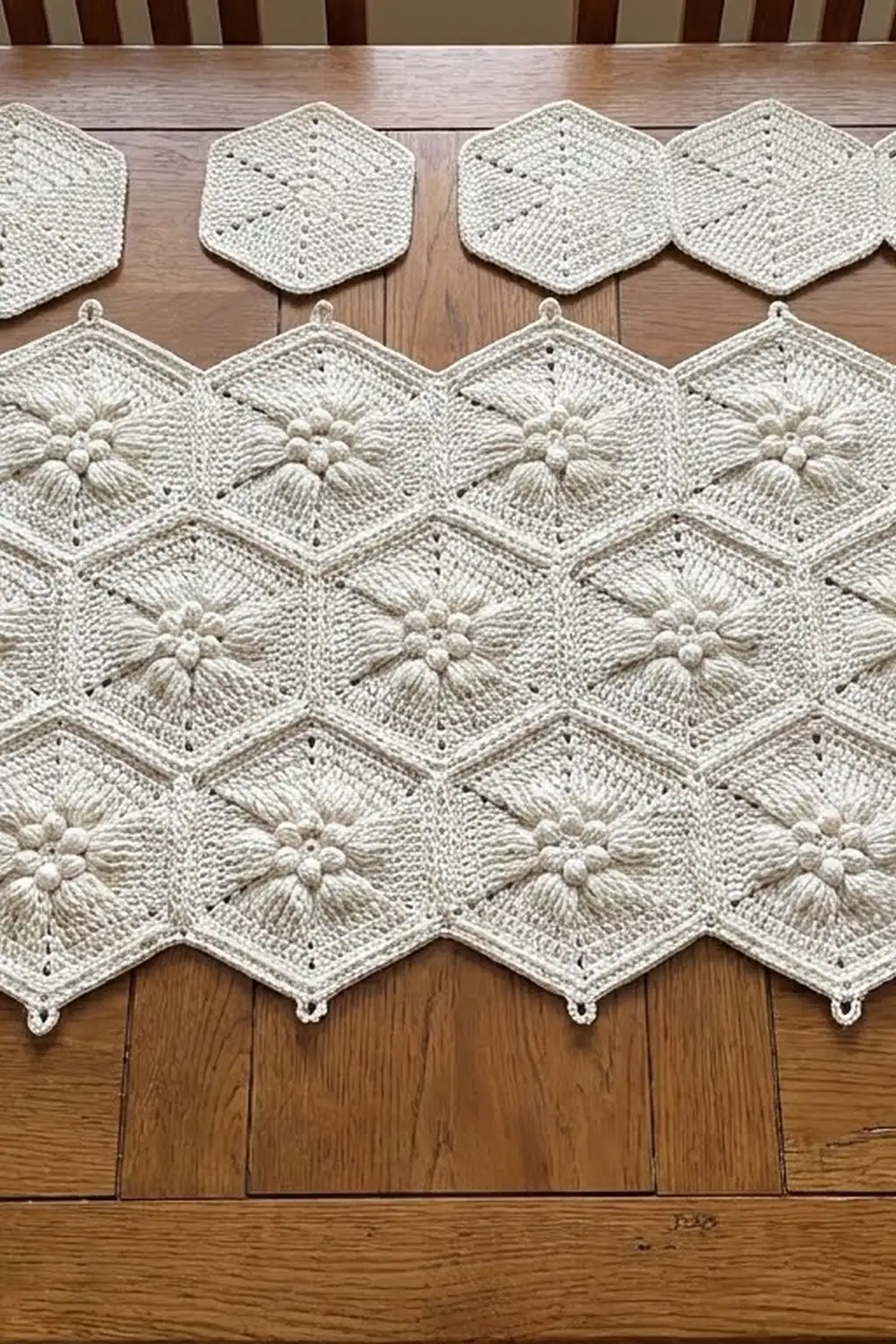
Hexagon Motif (Make 24)
The RS faces you throughout. Join each round with a sl st to the first stitch unless the pattern says otherwise. The beginning ch 1 does not count as a stitch.
Rnd 1: In MR, ch 1, 10 sc. Pull the ring tight. (10 sts)
Rnd 2: Ch 1, *sc in next st, bobble in next st; repeat from * 4 more times. (10 sts: 5 sc, 5 bobbles)
Push all bobbles to the RS. Together they make the round, bead-like cluster in the center.
Rnd 3: Ch 1, 2 sc in each st around. (20 sts)
Rnd 4 (petals): Ch 1, *sc in next st, (2 dc, 3 tr) in next st, ch 2, (3 tr, 2 dc) in next st, sc in next st; repeat from * 4 more times. (5 petals; 60 sts + 5 ch-2 tips)
Each petal uses 4 stitches of Rnd 3 (5 x 4 = 20). The tall treble posts fan out and form the fine radiating ridges.
Rnd 5 (petal outline): Ch 1, working in BLO, *sc in each of next 6 sts, (sc, ch 2, sc) in ch-2 tip, sc in each of next 6 sts; repeat from * 4 more times. (70 sc + 5 ch-2 tips; 14 sc per petal)
Working in the back loops leaves the front loops as a crisp rim around each petal. Each petal now has 7 sc on each side of its tip.
Rnd 6 (chain loops): Sl st into first ch-2 tip. Ch 1, *sc in ch-2 tip, ch 7, skip next 6 sc, sc2tog over the next 2 sc (last sc of this petal and first sc of next petal), ch 7, skip next 6 sc; repeat from * 4 more times. (10 anchor sts + 10 ch-7 loops)
This anchors the chain loops at every petal tip and in every valley between petals.
Rnd 7 (rope ring): Sl st into first ch-7 loop. Ch 1, 6 sc in each ch-7 loop around. (60 sc)
Do not work into the anchor stitches. Pack the 6 sc firmly so the ring looks like cord.
Rnd 8 (chain bars): Ch 1, *sc in next st, ch 5, skip next 4 sts, sc in next st, ch 8, skip next 4 sts; repeat from * 5 more times. (12 sc, 6 ch-5 sps, 6 ch-8 sps)
Each repeat uses 10 stitches (1 + 4 + 1 + 4), and 6 x 10 = 60. The single crochets become the bars that hold the frame to the ring, and the spaces between them become the open triangular windows. The ch-5 spaces will be the middles of the hexagon sides and the ch-8 spaces will be the corners.
Rnd 9 (outer hexagon): Sl st into first ch-5 sp. Ch 1, *6 sc in ch-5 sp, (4 sc, ch 3, 4 sc) in next ch-8 sp; repeat from * 5 more times. Fasten off. (84 sc + 6 ch-3 corner loops)
Count per side: 4 sc (second half of a corner) + 6 sc (side space) + 4 sc (first half of the next corner) = 14 sc per side, between 2 ch-3 corner loops. The ch-3 loops are not counted in the 14. Six sides x 14 = 84 sc.
Weave in the ends. Lightly steam-block each motif to 6 x 7 in (15.2 x 17.8 cm) before joining. Blocked motifs are much easier to line up, and the petals settle into an even fan.
Make All Pieces
- Cream motifs: 24
- Cream tassels: 6 (made after the border)
Layout: 3 columns x 8 rows. Each H is one pointy-top hexagon. Neighbors in a row share a vertical side, and rows touch point-to-point.
Row 1:  H  H  H
Row 2:  H  H  H
Row 3:  H  H  H
Row 4:  H  H  H
Row 5:  H  H  H
Row 6:  H  H  H
Row 7:  H  H  H
Row 8:  H  H  H
Joining
Side seams (within a row): Hold two motifs with RS together and their vertical sides lined up. Working through both layers with a sl st: 1 sl st through both ch-3 corner loops, 1 sl st through each of the 14 sc pairs, then 1 sl st through the next pair of ch-3 corner loops. That makes 16 sl sts per seam. The stitches match one-to-one because every side has exactly 14 sc. Each row has 2 seams, so the runner has 16 side seams.
Point joins (between rows): Line up the bottom point of each motif with the top point of the motif below it. Sew the two ch-3 point loops together with 3 or 4 firm whipstitches using a yarn tail. That makes 3 point joins between each pair of rows, or 21 in total. Don’t join the slanted edges. They stay apart and form the diamond-shaped openings.
Tension: Keep the sl sts as loose as the sc. Tight seams pucker and make the runner narrower. If a seam ripples, go up one hook size for joining.
Size checkpoint: The joined runner should measure 18 in (45.7 cm) across the vertical sides and 56 in (142.2 cm) point-to-point.
Border
Border gauge: Same as the motifs, 16 sc = 4 in (10.2 cm). Two rounds add 0.25 in (0.6 cm) per round, for 0.5 in (1.3 cm) on every edge.
The outline has 56 motif edges of 14 sc each. Its corners come in two kinds:
- 38 outward corners: 16 corners along each long side, plus 3 end points at each short end
- 18 notches: 7 V-notches along each long side, plus 2 notches at each short end
Edge types:
- 20 edges run from an outward corner to an outward corner: the 16 vertical sides, plus the 4 outer slanted edges at the runner’s corners.
- 36 edges run from an outward corner to a notch.
Check: 20 + 36 = 56 edges, and 36 = 18 notches x 2.
Rnd 1: Join yarn in any outward corner. Ch 1, then work around the outline:
- sc in each sc
- (sc, ch 2, sc) in each outward ch-3 corner
- at each notch, sc2tog with one leg in each of the two joined ch-3 loops
Join. (878 sts + 38 ch-2 corners)
Counts per edge:
- Corner-to-corner edges: 1 + 14 + 1 = 16 sc (20 edges = 320)
- Corner-to-notch edges: 1 + 14 = 15 sc (36 edges = 540)
- Plus the 18 sc2tog stitches
320 + 540 + 18 = 878.
Rnd 2: Ch 1, then:
- sc in each st
- (sc, ch 2, sc) in each ch-2 corner
- at each notch, sc3tog over the sc before the sc2tog, the sc2tog and the sc after it
Join and fasten off. (918 sts + 38 ch-2 corners)
Counts per edge:
- Corner-to-corner edges: 18 sc (20 edges = 360)
- Corner-to-notch edges: 15 sc (36 edges = 540)
- Plus the 18 sc3tog stitches
360 + 540 + 18 = 918.
Why the math works: Each outward corner adds 1 stitch to each edge it touches in every round, which keeps the points sharp and flat. Each notch removes 1 stitch from each edge it touches, which keeps the V crisp. On a corner-to-notch edge, the gain and loss cancel out, so the edge stays at 15 sc. Across the whole round, the 38 corners add 76 stitches and the 18 notches remove 36, so 878 + 76 − 36 = 918.
Tassels (Make 6)
- Wrap yarn 40 times around the 4.5 in (11.4 cm) card.
- Slide a 12 in (30.5 cm) strand under the wraps at the top and tie it tightly.
- Cut the wraps at the bottom.
- Wrap a second strand tightly around the tassel 0.75 in (1.9 cm) below the top, 8 times, to form the rounded head. Secure the strand and bury its ends inside the tassel.
- Trim the tassel to 4 in (10.2 cm).
Tie one tassel to the ch-2 point of each of the 3 end motifs at both short ends.
Final Blocking
- Lay the runner RS up on blocking mats.
- Spray it evenly until it is damp, not soaked.
- Pin the 18 in (45.7 cm) width first, placing a pin at every vertical side.
- Pin the length to 56 in (142.2 cm) at the motif points, then check the full 57 in (144.8 cm) including the border.
- Pin out each outward corner and each notch so the zigzag outline is sharp.
- Shape each diamond opening and push the bobbles and petals up from below.
- Let it dry completely, then unpin.
- Comb out the tassels and trim them evenly.
Final Quality-Control Checklist
- 24 motifs, each 6 x 7 in (15.2 x 17.8 cm)
- Every motif has 5 bobbles, 5 outlined petals and 84 sc + 6 corner loops in Rnd 9
- 16 side seams of 16 sl sts each and 21 point joins
- Border Rnd 2 count is 918 sts + 38 corners
- Runner measures 19 x 57 in (48.3 x 144.8 cm)
- 6 tassels, each 4 in (10.2 cm), are secure
- All ends are woven in and invisible from the RS
Troubleshooting
- The flower cups: Rnd 4 is too tight. Go up half a hook size for the petal round only.
- The ring ruffles: Alternate 5 sc and 7 sc in the ch-7 loops. That keeps the total at 60 (12 per pair of loops x 5 pairs).
- The hexagon isn’t flat: Check that each repeat in Rnd 8 uses exactly 10 stitches.
- The side seams don’t match: Recount for 14 sc per side, and redo Rnd 9 on any motif that has 13 or 15.
- The border flares at the corners: Use ch 1 instead of ch 2 at the outward corners.
- The notches pull in too much: In Rnd 2, use sc2tog over the sc2tog and the sc after it, then sc in the next st. That adds 1 stitch per notch, for 936 total.
Care
Hand wash in cool water with a mild detergent and roll in a towel to remove the water. Reshape and dry flat. Avoid hanging the runner, because the weight of the tassels can stretch it.
Final Notes
The measurement chain is simple:
- Gauge is 16 sc = 4 in (10.2 cm).
- Each motif has 14 sc per side and measures 6 x 7 in (15.2 x 17.8 cm).
- Three motifs across make 18 in (45.7 cm), and 8 rows make 56 in (142.2 cm).
- The two-round border adds 0.5 in (1.3 cm) on each edge, for a finished size of 19 x 57 in (48.3 x 144.8 cm).
If you check each stage against these numbers, you’ll end up with a flat, even runner.
Happy crocheting!