

This runner is made of airy oval frames, each holding a raised iris. Three ovals sit side by side, and each oval touches its neighbors only at small trefoil clusters, so the table shows through the open spaces. A plump tassel hangs from each oval at the short ends.
The whole runner is worked in one cream cotton. Because there’s only one color, the texture of the iris stands out: ribbed petals, curled side petals, a round center knob, and pointed leaves on a slim stem. The style is close to Irish crochet, but the steps are simpler.
The pattern uses US crochet terms. The finished runner is 13.5 in (34.3 cm) wide and 42 in (106.7 cm) long without tassels. The tassels add 5 in (12.7 cm) at each end, for an overall length of 52 in (132.1 cm).
How it’s built: For each motif, crochet an iris flower head and a stem with two leaves. Work the first two rounds of the oval frame and sew the iris inside. The last frame round adds chain loops and trefoils and joins each motif to its neighbors as you go. There’s no added border. The tassels go on last.
Finished Size and Construction
- Finished size: 13.5 x 42 in (34.3 x 106.7 cm), plus 5 in (12.7 cm) tassels at each end
- Skill level: Intermediate
- Terminology: US crochet terms
- Yarn weight: DK (#3 light) mercerized cotton
- Hook: 3.5 mm (E-4)
- Number of pieces: 21 oval motifs (each one is a frame, a flower head, and a stem with leaves) plus 6 tassels
- Layout: 3 motifs wide x 7 motifs long
- Single motif size: 4.5 x 6 in (11.4 x 15.2 cm), measured from trefoil tip to trefoil tip
- Size before border: 13.5 x 42 in (34.3 x 106.7 cm)
- Border depth: 0 in (0 cm). The scalloped motif edges are the finished edge.
Materials
Yarn: Use DK mercerized cotton with about 115 m per 50 g. Cotton keeps the petals crisp and the ovals from stretching.
- Cream (the only color): 300 g, about 690 m (6 balls of 50 g / 115 m)
- Motifs: about 9 g (21 m) each, 189 g (441 m) in total
- Tassels: about 6 g (14 m) each, 36 g (84 m) in total
Tools:
- 3.5 mm (E-4) crochet hook
- Tapestry needle
- 6 wooden beads, 0.5 in (1.3 cm) across, for the tassel heads
- Cardboard 5.5 in (14.0 cm) wide, for wrapping tassels
- Rust-proof pins and a blocking board
- Spray starch (optional)
- Scissors and a tape measure
The yarn amounts include a margin of about 20%, so you have enough for a test motif and some redos.
Abbreviations (US Terms)
- ch – chain
- sl st – slip stitch
- sc – single crochet
- hdc – half double crochet
- dc – double crochet
- tr – treble crochet
- st(s) – stitch(es)
- sk – skip
- rnd – round
Special stitches:
- Picot: Ch 4, sl st in 4th ch from hook.
- Trefoil: (Picot) 3 times, then sl st in the base of the first picot. This makes a three-lobed cluster.
- Joining picot: Ch 2, sl st in the middle picot of the matching trefoil on the finished motif, ch 2, sl st in the base of this picot. Use this in place of a trefoil’s middle picot.
- 5-dc bobble: (Yarn over, insert hook in st, pull up a loop, yarn over, pull through 2 loops) 5 times in the same st, then yarn over and pull through all 6 loops on the hook.
Gauge and Checkpoints
Gauge: 18 sc and 20 rows = 4 in (10.2 cm). For chains, 6 ch = 1 in (2.5 cm).
Make one complete motif before you start the runner, and check it at each stage:
- Flower head: About 2.75 in (7.0 cm) wide from one side-petal tip to the other, and 2 in (5.1 cm) tall.
- Stem: About 3.75 in (9.5 cm) long. Each leaf is about 2 in (5.1 cm) long.
- Frame after Rnd 2: Lay it out as a loose circle. It should measure about 16 in (40.6 cm) around.
- Frame after Rnd 3, blocked: 4.5 in (11.4 cm) wide and 6 in (15.2 cm) tall, trefoil tip to trefoil tip.
Motif too big: Use a 3.25 mm hook or make your chains tighter. Motif too small: Use a 3.75 mm hook. Don’t change any stitch counts. The joining only works if every motif has 36 loops and 4 trefoils.
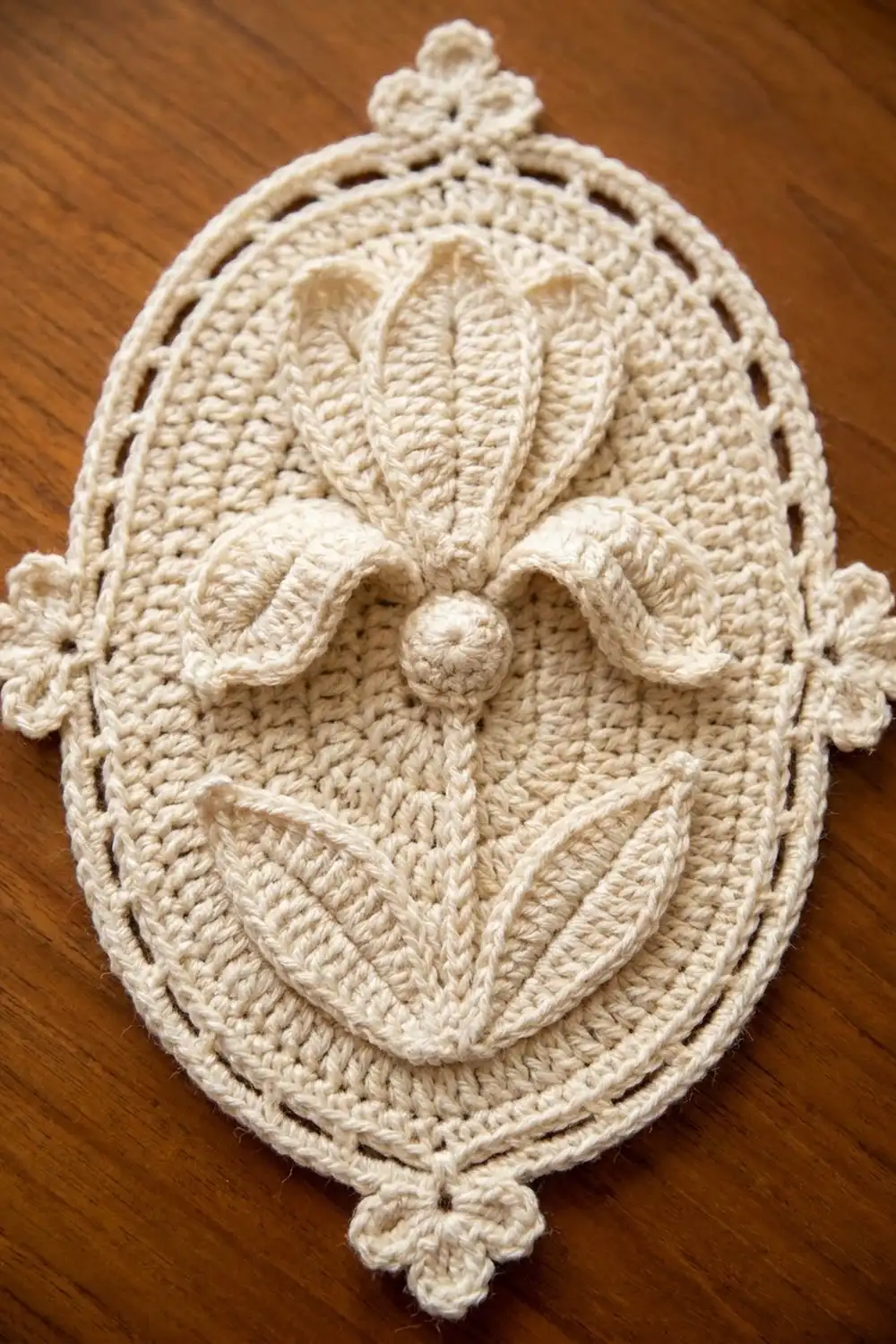
Iris Flower Head
How to work a petal: Each petal is worked around its own foundation chain.
- Side A: Start in the 2nd ch from the hook and work back along the chain toward the ring. Then sl st in the same ring sc where the petal started.
- Side B: Work in the free loops of the same chain, from the ring out to the tip.
- Tip and vein: Work 3 sc in the skipped tip ch, then sl st in the first st of Side A. Work loose surface sl sts down the center of the petal back to the ring, one for each chain. This makes the raised rib.
Ring: Ch 4, sl st to join.
Rnd 1: Ch 1, 10 sc in the ring, sl st to the first sc. (10 sc) Number these sc 1 to 10, going clockwise, with sc 1 at the top.
Center standard (on sc 1): Ch 10.
- Side A: sc, hdc, dc in next 5, hdc, sc. (9 sts)
- Sl st in sc 1.
- Side B: sc, hdc, dc in next 5, hdc, sc. (9 sts)
- Tip: 3 sc. Vein: 9 sl st.
- Petal edge total: 21 sts.
Right standard: Sl st in sc 2, then ch 8.
- Side A: sc, hdc, dc in next 3, hdc, sc. (7 sts)
- Sl st in sc 2.
- Side B: the same 7 sts.
- Tip: 3 sc. Vein: 7 sl st.
- Petal edge total: 17 sts.
Right fall: Sl st in sc 3 and sc 4, then ch 10.
- Side A (upper edge): sc, hdc, dc in next 2, tr in next 3, dc, sc. (9 sts)
- Sl st in sc 4.
- Side B (lower edge): sc, hdc, dc, 2 tr in each of next 3 chs, dc, hdc, sc. (12 sts over 9 chs)
- Tip: 3 sc. Vein: 9 sl st.
- Petal edge total: 24 sts.
The 3 extra sts on the lower edge make the fall curl outward and down.
Left fall: Sl st in sc 5, 6, 7, and 8. Work a fall on sc 8, with Side B as the lower edge. (24 sts)
Left standard: Sl st in sc 9 and sc 10. Work a standard on sc 10. (17 sts)
Sl st in sc 1. Fasten off and leave a 12 in (30.5 cm) tail.
Center knob: Ch 3, 5-dc bobble in the 3rd ch from hook, ch 1, fasten off. Sew the knob over the ring just above sc 6, a little below center.
Stem and Leaves
Stem: Ch 24. Sl st in the back bump of the 2nd ch from hook and in each of the next 17 chs. (18 sl st, 5 chs left)
Left leaf: Ch 13.
- Rnd 1: Sl st in 2nd ch from hook (this is the point), then sc, hdc, dc in next 2, tr in next 3, dc in next 2, hdc, sc. (12 sts) Work 3 sc in the stem st. Working up the free loops: sc, hdc, dc in next 2, tr in next 3, dc in next 2, hdc, sc, then sl st at the point. (12 sts) Total: 27 sts around.
- Rnd 2: Sl st in the back loop only of each st around. (27 sl st) The front loops left behind make a ridged outline.
Right leaf: Work it in the same stem st, the same way. (27 sts each rnd)
Finish: Sl st in the 5 remaining chs down to the base, for a stem total of 23 sl st. Fasten off and leave a 12 in (30.5 cm) tail.
Oval Frame
Rnd 1: Ch 72 and sl st in the first ch to make a ring, without twisting it. (72 ch)
Rnd 2: Ch 1, sc in each ch around, sl st to the first sc. (72 sc)
Number these sc 1 to 72. Sc 1 is at the top, sc 19 is the right side, sc 37 is the bottom, and sc 55 is the left side. Each quarter of the oval spans 18 sts. Check that the ring measures 16 in (40.6 cm) around.
Sew in the iris: Pin the frame flat into an oval 5.8 in (14.7 cm) tall and 4.3 in (10.9 cm) wide, measured along the middle of the frame cord. Then:
- Tack the tip of the center standard to the inner edge at sc 1.
- Tack each fall tip to the inner edge near sc 16 and sc 58, about 1 in (2.5 cm) above the side points.
- Sew the stem base to the inner edge at sc 37.
- Tack the top of the stem behind sc 6 of the flower ring.
- Leave the leaf tips free.
Rnd 3 (loops and trefoils): Sl st in sc 1.
- Ch 1, sc in sc 1, then make a trefoil.
- *Ch 3, sk 1 sc, sc in next sc.* Repeat from * to * up to and including sc 19. (9 loops)
- Make a trefoil on sc 19.
- Continue the same way, making trefoils on sc 37 and sc 55.
- End with ch 3 and sl st in the first sc. Fasten off.
Rnd 3 total: 36 sc + 36 ch-3 loops, with 4 trefoils (12 picots). That’s 9 loops in each quarter.
Make All Pieces
Make 21 of each piece in cream: 21 flower heads, 21 stems with leaves, and 21 frames. Finish all the iris parts and Rnds 1–2 of every frame first. Then work Rnd 3 on each motif in this order, joining as you go:
Row 1:  [A1] - [A2] - [A3]
          |      |      |
Row 2:  [B1] - [B2] - [B3]
  ...    (repeat for Rows 3-6)
Row 7:  [G1] - [G2] - [G3]
Each “-” is a join between side trefoils. Each “|” is a join between a top and bottom trefoil.
Joining
Join each new motif while you work its Rnd 3. Use a joining picot in place of the middle picot of the trefoil:
- Top trefoil (sc 1): From Row 2 on, join it to the bottom trefoil (sc 37) of the motif above.
- Left trefoil (sc 55): From Column 2 on, join it to the right trefoil (sc 19) of the motif on the left.
Each join links one picot to one picot and adds no stitches, so every motif still has 36 loops and 4 trefoils. There are 2 side joins per row x 7 rows = 14, plus 6 vertical joins per column x 3 columns = 18, for 32 joins in total.
Tension: Make your joining chains the same size as your regular picot chains. Tight joins make the runner pucker, and loose joins let the ovals drift apart.
Checkpoint: After Row 2, the piece should measure 13.5 in (34.3 cm) wide and 12 in (30.5 cm) long.
Border (Edge Finish and Tassels)
There are no added border rounds, so the border depth is 0 in (0 cm). The edge is the motifs’ own Rnd 3, so the edge gauge is the motif gauge: 9 loops per quarter oval.
Long sides: 7 motifs x 18 loops (each motif’s outer half from top trefoil to bottom trefoil) = 126 ch-3 loops and 7 free side trefoils per side.
Short ends: 3 motifs x 18 loops (each motif’s half from side trefoil to side trefoil) = 54 ch-3 loops and 3 free trefoils per end. The side trefoils at the corners are already counted with the long sides.
Why the math works: Every motif is exactly 4.5 x 6 in (11.4 x 15.2 cm), and the motifs touch only at their trefoil tips. That gives a width of 3 x 4.5 = 13.5 in (34.3 cm) and a length of 7 x 6 = 42 in (106.7 cm). A straight border would flatten the scallops and change these sizes.
Tassels (make 6):
- Wrap yarn 40 times around the 5.5 in (14.0 cm) card. Tie a 10 in (25.4 cm) strand through the top and slide the bundle off.
- Push a bead into the top of the bundle and spread the strands evenly over it.
- Tie a strand tightly just below the bead, about 0.75 in (1.9 cm) from the fold, to make the round head.
- Cut the bottom loops and trim the tassel to 5 in (12.7 cm).
- Sew one tassel to the free bottom trefoil of each Row 7 motif and one to the free top trefoil of each Row 1 motif.
Final Blocking
- Weave in all tails.
- Soak the runner in cool water for 10 minutes. Roll it in a towel to press out the water. Don’t wring it.
- Pin it out to 13.5 x 42 in (34.3 x 106.7 cm), with a pin in every trefoil.
- Shape each oval to 4.5 x 6 in (11.4 x 15.2 cm). Curl the falls and lift the petals with your fingers.
- Mist with starch if you like, then let it dry completely.
- Unpin the runner and lightly steam the tassels.
Final Quality-Control Checklist
- 21 motifs, each with 36 loops and 4 trefoils
- 32 joins, none of them twisted
- Each iris has 3 standards, 2 falls, a knob, a stem, and 2 leaves
- The runner measures 13.5 x 42 in (34.3 x 106.7 cm)
- 6 tassels, each 5 in (12.7 cm) long
- All ends are woven in invisibly
Troubleshooting
- The oval looks round: The iris is tacked too loosely. Sew the center standard and stem base more firmly, then block again.
- The falls lie flat: Check that Side B has 12 sts. Starch the falls and shape them while they’re damp.
- The ovals ripple: Rnd 3 is too tight. Use a hook one size up for that round only.
- The runner is too long: The joining picots are loose. Redo them, keeping the chains snug.
- The stem sags: Chain more tightly, or shorten the stem to 21 sl st.
Care
Hand wash in cool water with mild soap, then reshape and dry flat. Starch again if you want crisp petals.

Final Notes
Each measurement builds on the one before it. An 18-sc gauge gives a 72-sc frame that measures 16 in (40.6 cm) around. That frame blocks to a 4.5 x 6 in (11.4 x 15.2 cm) oval with 9 loops per quarter. Three ovals make 13.5 in (34.3 cm) of width, and seven make 42 in (106.7 cm) of length, with 126 loops along each long edge and 54 along each end. Check your first motif carefully and keep your joins even, and the rest of the runner will come out to size.
Happy crocheting!