

This curtain panel combines an airy filet mesh with tall columns of stacked shells. When light comes through a window, the square holes glow and the shell columns look like soft vertical lace ribbons. Narrow solid bars between the shell columns add structure, so the panel hangs straight and doesn’t sag.
The design uses one color: a warm cream or ivory cotton. It suits a cozy winter room, a farmhouse bedroom, or any space that needs privacy without losing daylight. If you change the number of rows, the same fabric also makes a lovely bedspread.
This pattern uses US crochet terms. After blocking, the finished panel measures 41 in (104.1 cm) wide and 81 in (205.7 cm) long, including the border.
The construction is simple. You chain a foundation, work one solid double crochet row, then repeat one pattern row 178 times. A final solid row closes the top. A three-round border with a twisted reverse single crochet edge finishes all four sides. There is no joining and no sewing.
Finished Size and Construction
- Finished size: 41 in x 81 in (104.1 cm x 205.7 cm)
- Skill level: Intermediate (easy stitches, but a long project with careful counting)
- Terminology: US crochet terms
- Yarn weight: DK (weight 3) cotton
- Hook: 4.0 mm (US G-6)
- Number of pieces: 1 (one rectangular panel)
- Layout: worked flat in rows, bottom to top
- Piece size before border: 40 in x 80 in (101.6 cm x 203.2 cm)
- Stitch count: 176 stitches wide, 180 rows tall
- Border depth: 0.5 in (1.3 cm) on each side, adding 1 in (2.5 cm) to each dimension
Materials
Choose a smooth mercerized or combed cotton in DK weight. Cotton gives crisp stitch definition, drapes well at a window, and stretches less than acrylic. Avoid fuzzy or brushed yarns, because they blur the mesh squares and the shell outlines.
- Cream / ivory DK cotton: 900 g, about 2,070 m (2,264 yd), based on yarn with roughly 230 m (252 yd) per 100 g
These amounts include a margin of about 15% for your gauge swatch, small tension differences, and the border. For a matching second panel, double the amount and buy all the yarn from the same dye lot.
Tools:
- 4.0 mm (US G-6) crochet hook
- Locking stitch markers (at least 10)
- Tapestry needle
- Scissors
- Tape measure
- Blocking mats or a large clean surface covered with towels, plus rust-proof pins
- Spray bottle with water
- Clip rings, or a curtain rod with clips, for hanging
Abbreviations (US Terms)
- ch – chain
- sc – single crochet
- dc – double crochet
- sk – skip
- sp – space
- st(s) – stitch(es)
- rev sc – reverse single crochet (crab stitch)
- RS / WS – right side / wrong side
Special stitches and units:
- Mesh (M): ch 2, sk 2 sts, dc in next st. One mesh uses 3 sts and makes 3 sts.
- Shell (S): sk 3 sts, 7 dc in next st, sk 3 sts, dc in next st. One shell unit uses 8 sts and makes 8 sts (7 shell dc + 1 post dc).
- Block (B): dc in each of next 3 sts. One block uses 3 sts and makes 3 sts.
- Reverse single crochet (rev sc): work from left to right (if you are right-handed). Insert the hook in the next st to the right, yarn over, pull up a loop, yarn over, and pull through both loops. This makes the twisted, rope-like edge.
The ch 3 at the start of every row counts as 1 dc throughout.
Gauge and Checkpoints
Gauge: 22 sts = 5 in (12.7 cm) and 9 rows = 4 in (10.2 cm) in pattern, after blocking.
Make a test swatch first. Ch 40.
- Row 1: Dc in 4th ch from hook and in each ch across. (38 sts)
- Row 2: Ch 3, turn. M, S, M, M, B, M, M, S, M, working the last dc in the top of the turning ch. (38 sts)
- Rows 3–17: Repeat Row 2, working each shell into the center dc of the shell below.
- Row 18: Ch 3, turn. Dc in each st and ch across. (38 sts)
Block the swatch. It should measure about 8.6 in (21.8 cm) wide and 8 in (20.3 cm) tall. With two shell columns and one solid bar, it also gives you a good preview of the look.
Checkpoints during the panel:
- After Row 1: 40 in (101.6 cm) wide
- After Row 18: 8 in (20.3 cm) tall
- After Row 45: 20 in (50.8 cm) tall
- After Row 90: 40 in (101.6 cm) tall
- After Row 135: 60 in (152.4 cm) tall
- After Row 180: 80 in (203.2 cm) tall, before border
Measure gently on a flat surface, not while the panel hangs. A hanging panel stretches under its own weight.
If your swatch is too big, try a 3.75 mm (US F-5) hook. If it is too small, try a 4.5 mm (US 7) hook. Row height matters more than usual here, because 180 rows magnify any small difference. Being off by only 0.1 in (0.3 cm) per row changes the length by 18 in (45.7 cm).
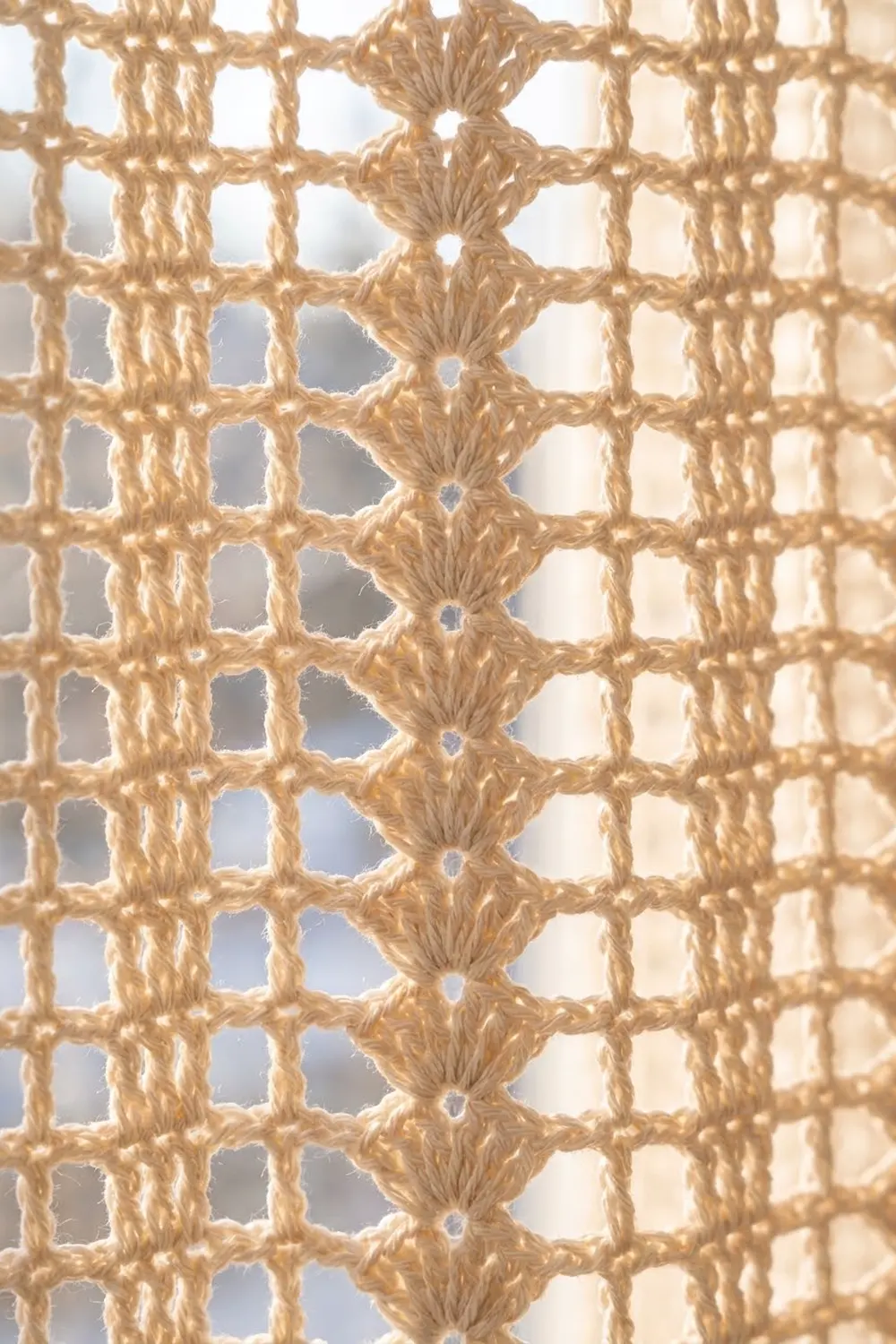
Curtain Panel
Foundation
Ch 178.
Row 1 (RS): Dc in 4th ch from hook (the skipped 3 ch count as the first dc) and in each ch across. (176 sts)
Check the width now: it should be 40 in (101.6 cm). This solid row keeps the bottom edge stable.
Pattern Set-Up
Row 2: Ch 3 (counts as dc), turn. M, *S, M, M, B, M, M; repeat from * 6 more times (7 repeats in all), S, M, working the final dc in the top of the turning ch. (176 sts)
Stitch check for Row 2: 1 (beginning ch 3) + 3 (first M) + 161 (7 repeats x 23 sts) + 8 (last S) + 3 (last M) = 176 sts.
Each 23-st repeat is S (8) + M (3) + M (3) + B (3) + M (3) + M (3) = 23 sts.
Place a marker in the center (4th) dc of each shell in Row 2. There are 8 shells across, and the markers make the next row easy to read.
Main Pattern
Row 3: Ch 3, turn. M, *S, M, M, B, M, M; repeat from * 6 more times, S, M, working the final dc in the top of the turning ch. (176 sts)
Work every unit directly over the same unit below:
- Mesh over mesh: ch 2, sk the ch-2 sp, dc in the next dc.
- Shell over shell: sk 3 dc, 7 dc in the center (4th) dc of the shell below, sk 3 dc, dc in the post dc.
- Block over block: dc in each of the 3 dc below.
The row is symmetrical, so it reads the same from both sides. You never need to reverse the instructions on WS rows.
Rows 4–179: Repeat Row 3. (176 sts in every row)
Each new shell sits in the center of the shell below, so the shells stack into straight columns that all fan upward. Move your markers up every 10 rows or so to make counting easier.
Top Edge
Row 180: Ch 3, turn. Dc in each dc and in each ch across. (176 sts)
Over a shell unit, work 1 dc in each of its 8 sts. Over a mesh, work 1 dc in each of the 2 chains and 1 dc in the post. This row matches Row 1, so the panel is balanced and the clips hold evenly.
Do not fasten off. The panel now measures 40 in x 80 in (101.6 cm x 203.2 cm).
Adjusting size: Add or remove rows to change the length; every 9 rows equal 4 in (10.2 cm). To change the width, add or remove one 23-st repeat (about 5.2 in / 13.2 cm) and change the foundation chain by 23.
Border
Border gauge: 22 sc = 5 in (12.7 cm) along the top and bottom. Along the sides, work 2 sc per dc row-end (9 rows x 2 sc = 18 sc per 4 in / 10.2 cm). In Rounds 1 and 3, corner stitches and spaces are counted separately from the sides.
Round 1
Ch 1, do not turn. Rotate the panel to work down the long side.
- Long side: 2 sc in each of the 180 row-ends. (360 sc)
- Corner: ch 2.
- Bottom: sc in the base of each of the 176 foundation chains. (176 sc)
- Corner: ch 2.
- Long side: 2 sc in each of the 180 row-ends. (360 sc)
- Corner: ch 2.
- Top: sc in each of the 176 sts of Row 180. (176 sc)
- Corner: ch 2. Join with sl st to the first sc.
Round 1 total: 176 + 360 + 176 + 360 = 1,072 sc, plus 4 corner ch-2 sps.
Round 2
Ch 1. Sc in each sc around, working (sc, ch 2, sc) in each corner ch-2 sp. Join.
Per side, including the 2 corner sc that belong to that side:
- Top and bottom: 1 + 176 + 1 = 178 sc each
- Long sides: 1 + 360 + 1 = 362 sc each
Round 2 total: 178 + 362 + 178 + 362 = 1,080 sc, plus 4 corner ch-2 sps.
Round 3
Ch 1. Work 1 rev sc in each sc around and 2 rev sc in each corner ch-2 sp. Join and fasten off.
- Top and bottom: 178 rev sc each
- Long sides: 362 rev sc each
- Corners: 4 x 2 = 8 rev sc
Round 3 total: 1,080 + 8 = 1,088 rev sc.
Why the Math Works
The body is 176 sts across at 4.4 sts per in, which is exactly 40 in (101.6 cm). The sides are 180 rows at 2.25 rows per in, which is 80 in (203.2 cm). Working 2 sc per row-end gives 360 sc over 80 in, or 4.5 sc per in. That is almost the same as the 4.4 sc per in along the top and bottom, so the edges lie flat without ruffling or pulling in. The corner ch-2 spaces and extra corner stitches let each round turn cleanly. The three rounds add 0.5 in (1.3 cm) per side, for a finished size of 41 in x 81 in (104.1 cm x 205.7 cm).
Final Blocking
- Weave in all ends along the solid bars or inside the shells, where they hide best.
- Lay the panel flat on blocking mats or a towel-covered floor.
- Spray it evenly with water until it is damp but not soaked.
- Pin the four corners first, at 41 in x 81 in (104.1 cm x 205.7 cm).
- Pin along each edge every 4–6 in (10.2–15.2 cm), keeping the border straight.
- Use a long ruler to check that each shell column runs straight from bottom to top.
- Gently open the mesh squares with your fingers so they look square.
- Let it dry completely before you unpin it, usually about 24 hours.
Final Quality-Control Checklist
- The panel measures 41 in x 81 in (104.1 cm x 205.7 cm).
- There are 8 shell columns and 7 solid bars, evenly spaced.
- Every shell has 7 dc and sits centered over the shell below.
- The mesh squares are even, with no extra or missing chains.
- Rows 1 and 180 are solid dc rows of 176 sts.
- Both long sides are the same length.
- The border lies flat, and the rev sc edge is evenly twisted.
- All ends are woven in securely and invisibly.
Troubleshooting
Shell columns lean to one side. You are working the shell into the 3rd or 5th dc instead of the 4th. Mark the center dc of each shell for a few rows.
The stitch count drifts. Usually a mesh was worked as ch 1 or ch 3, or the turning ch was skipped. Count every 10 rows; you should always have 176 sts.
Mesh squares look tall and narrow. Your dc are too tall for the chains. Pull each dc snug, or go down half a hook size.
The edges wave. There are too many sc on the sides. Keep strictly to 2 sc per row-end.
The edges pull in. There are too few sc on the sides, or the rev sc is too tight. Loosen the last round, or use a hook 0.5 mm larger for it.
The panel grows longer when hung. Cotton relaxes over time. Block it flat, and hang it with clips spaced every 4 in (10.2 cm) so the weight is shared.
Care
Hand wash, or machine wash on a gentle cold cycle in a mesh bag. Lay flat to dry and reshape; do not hang a wet panel, because it will stretch.
Final Notes
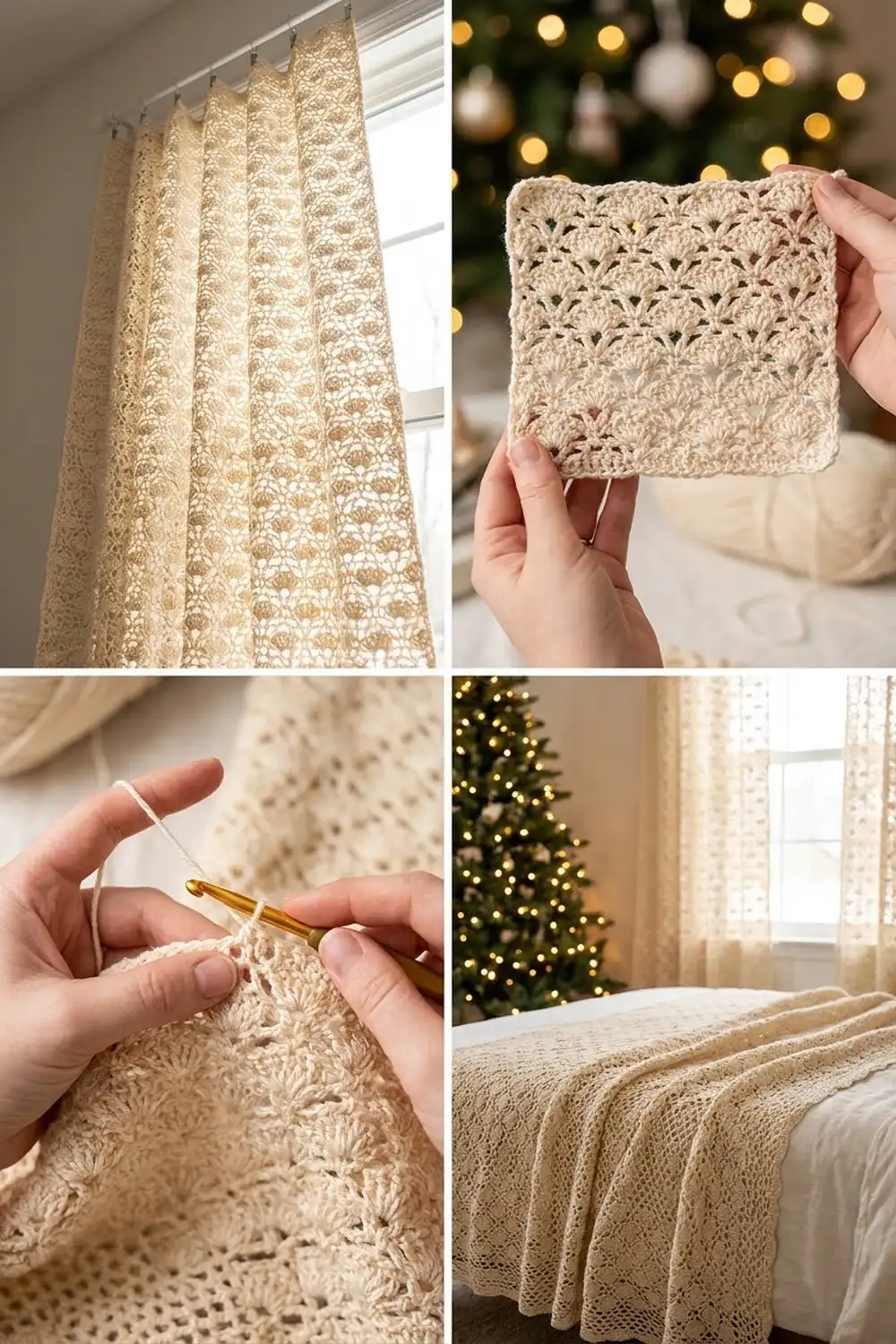
The measurement chain is simple. The foundation row sets the width at 176 sts, or 40 in (101.6 cm). Every pattern row keeps that count, and 180 rows give 80 in (203.2 cm). The border adds 0.5 in (1.3 cm) on every side, for a finished curtain panel of 41 in x 81 in (104.1 cm x 205.7 cm). Check your swatch, count often, and let the shells stack straight.
Happy crocheting!