

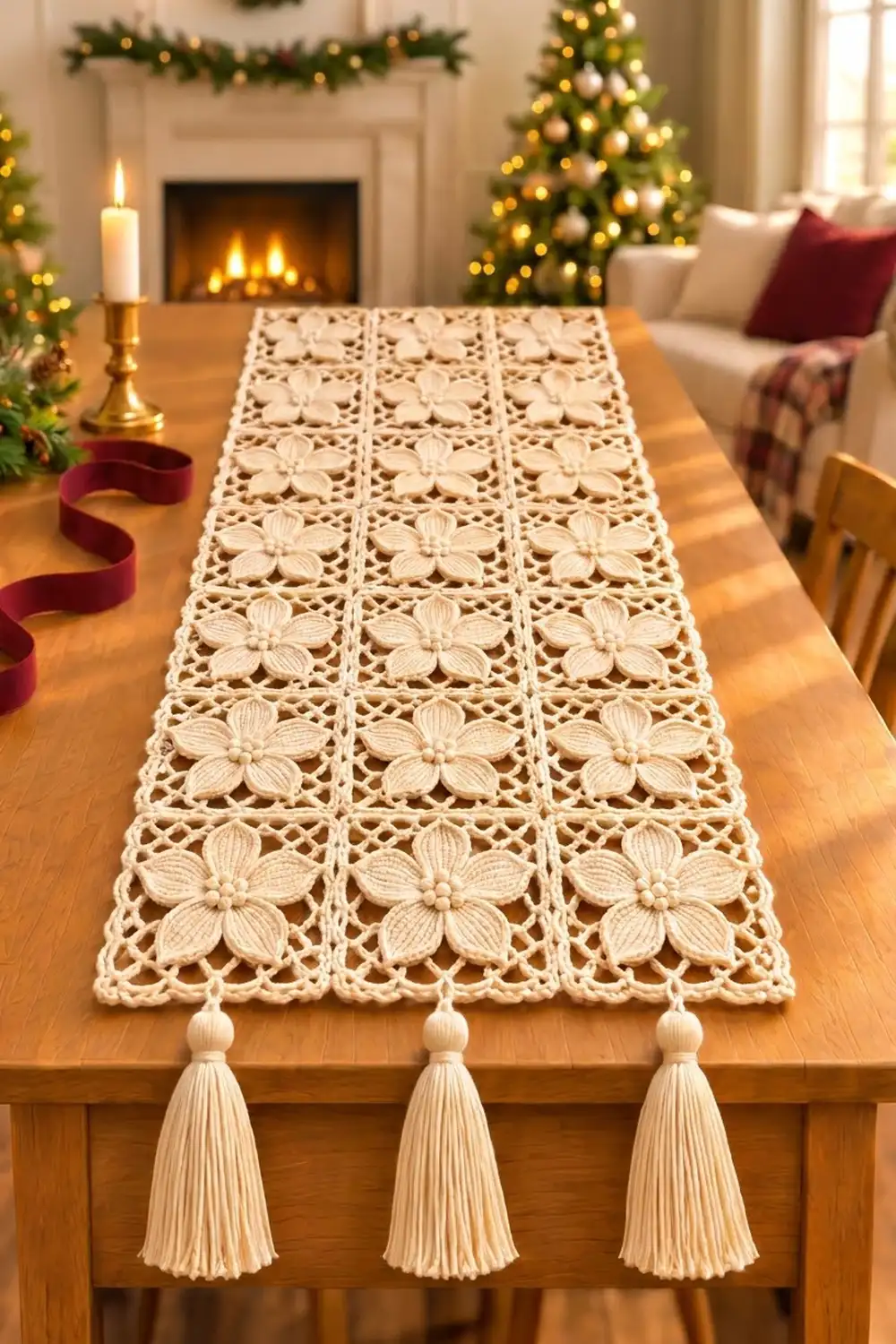
The Winter Lily Lattice Table Runner is made from 24 identical square motifs. Each one has a raised five-petal flower on an open diamond mesh, worked in a single shade of cream. The petals are pointed and ridged, and each flower has a small bobble cluster at its center.
The result is soft and textured, with a vintage feel. It suits a holiday table but works all year.
This pattern uses US crochet terms. The finished runner measures 19 in x 49 in (48.3 cm x 124.5 cm). Three tassels at each short end hang 5 in (12.7 cm) below the edge.
Each motif is worked in one piece from the center out. You make the bobble center first, then the petals, then a petal outline. Next, chain loops are anchored behind the flower, and the mesh rounds turn the circle into a square. Two solid rounds frame each square. You join the squares 3 across and 8 long, then add a three-round border and six tassels.
Finished Size and Construction
- Finished size: 19 in x 49 in (48.3 cm x 124.5 cm), not counting tassels
- Skill level: Intermediate
- Terminology: US crochet terms
- Yarn weight: DK (light worsted) cotton, weight 3
- Hook: 3.5 mm (E-4) for the motifs and border; 4.0 mm (G-6) for joining
- Number of pieces: 24 identical motifs, plus 6 tassels
- Layout: 3 motifs wide x 8 motifs long
- Motif size: 6 in x 6 in (15.2 cm x 15.2 cm), 30 sts per side (corners included)
- Size before border: 18 in x 48 in (45.7 cm x 121.9 cm)
- Border depth: 0.5 in (1.3 cm) per side
Materials
- Yarn: DK-weight cotton, about 124 yd (113 m) per 50 g. Cotton keeps the petal ridges and bobbles crisp, and it holds up to regular washing.
- Cream: 450 g, about 1,020 m (1,115 yd), or nine 50 g balls
- 3.5 mm (E-4) crochet hook
- 4.0 mm (G-6) crochet hook
- Tapestry needle
- 4 stitch markers
- A stiff card 5.5 in (14.0 cm) tall, for the tassels
- Blocking mats, rust-proof pins, and a spray bottle
- Measuring tape
The quantities include a margin of about 20%. The motifs use about 288 g, the joining about 9 g, the border about 22 g, and the tassels about 36 g.
Abbreviations (US Terms)
- ch: chain
- sl st: slip stitch
- sc: single crochet
- hdc: half double crochet
- dc: double crochet
- tr: treble crochet
- dtr: double treble crochet
- BLO: back loop only
- rev sc: reverse single crochet (crab stitch)
- sp: space
- st(s): stitch(es)
- RS / WS: right side / wrong side
Special stitches
- Bobble: *Yarn over, insert the hook in the st, yarn over and pull up a loop, then yarn over and pull through 2 loops. Repeat from * 3 more times in the same st (5 loops on hook). Yarn over and pull through all 5 loops. A bobble counts as 1 st.
- Picot: Ch 3, then sl st in the 3rd ch from the hook.
Gauge and Checkpoints
Gauge: 20 sc and 22 rows = 4 in (10.2 cm) in sc, using the 3.5 mm hook.
Make one full motif first, block it lightly, and measure it at each of these stages:
- After Rnd 6: The flower measures 4 in (10.2 cm) across.
- After Rnd 9: The mesh square measures about 5.25 in (13.3 cm) per side.
- After Rnd 11: The motif measures 6 in (15.2 cm) per side, with 30 sts per side.
If the motif is too big (for example, 6.25 in / 15.9 cm), go down half a hook size. If it is too small (for example, 5.75 in / 14.6 cm), go up half a hook size. Being off by 0.25 in (0.6 cm) per motif adds up to 2 in (5.1 cm) over 8 motifs.
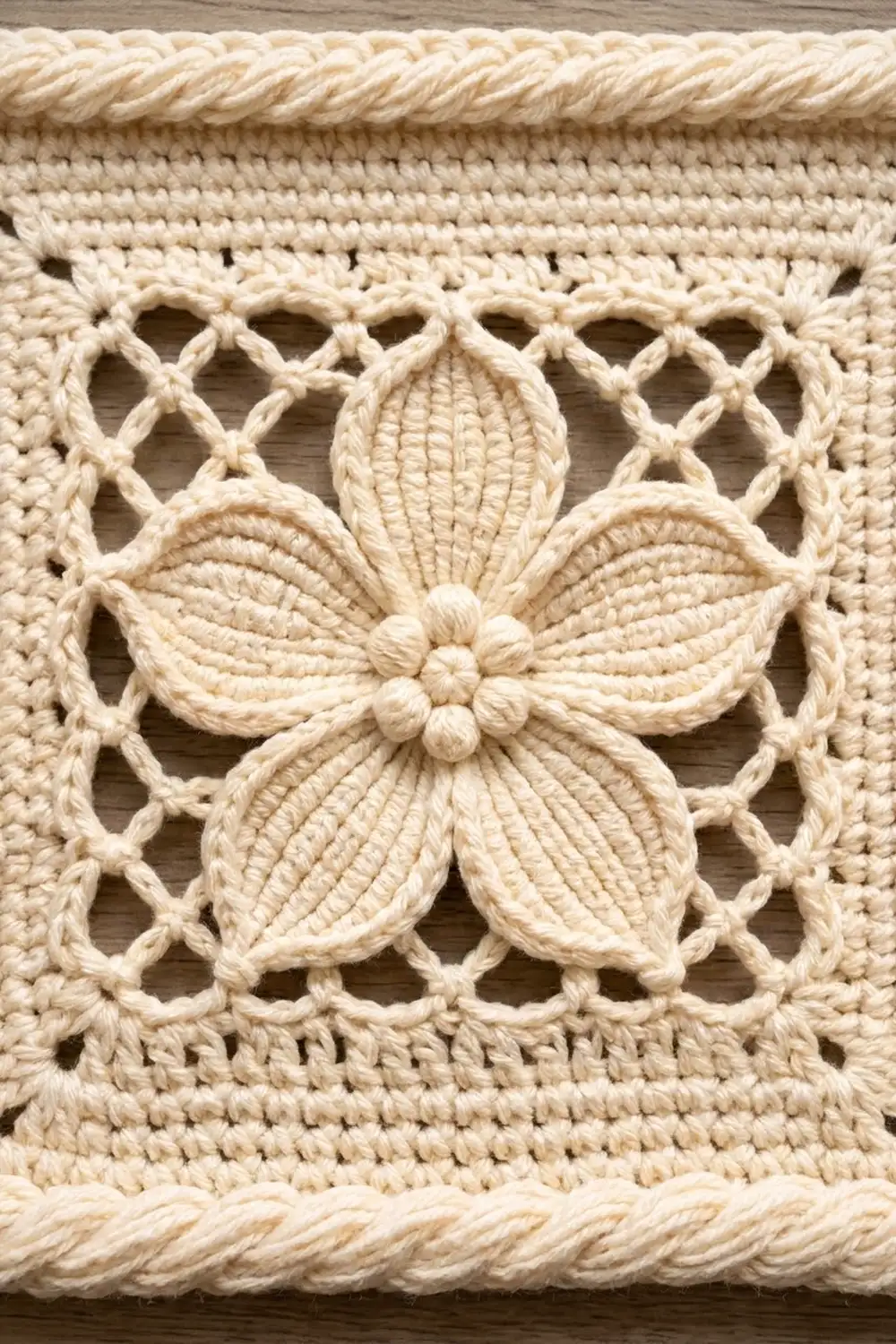
Motif (Make 24)
Use the 3.5 mm hook. Unless stated otherwise, join each round with a sl st to the first st.
Bobble Center
Rnd 1: In a magic ring, ch 1 and work 5 sc. Pull the ring tight and join. (5 sts)
Rnd 2: Ch 1, then work 2 sc in each st around. Join. (10 sts)
Rnd 3 (WS): Turn so the WS faces you. Ch 1, then work bobble in the next st, sc in the next st 5 times. Join, then turn back to the RS. (10 sts: 5 bobbles + 5 sc)
Because the bobbles are worked from the WS, they pop out on the RS. Together with the small domed center from Rnds 1–2, they form the raised cluster.
Petals
Rnd 4 (petal base): Ch 1. Sc in the next sc, ch 3, skip the bobble. Repeat 5 times. Join to the first sc. (5 sc + 5 ch-3 sps)
The ch-3s pass behind the bobbles, so the bobbles stay on top.
Rnd 5 (petals): In each ch-3 sp, work (hdc, dc, 2 tr, dtr, picot, dtr, 2 tr, dc, hdc), then sl st in the next sc. Repeat 5 times. (5 petals, each with 10 sts and a picot tip)
The tall stitches fan out from a narrow base. Their posts form the lengthwise ridges, and the picot makes the pointed tip.
Rnd 6 (petal outline): Work this round in BLO. For each petal: sc in each of the first 5 sts, work (sc, ch 2, sc) in the picot, then sc in each of the last 5 sts. Skip the sl st, then sl st around the Rnd 4 sc between petals. Repeat for all 5 petals. (60 sc + 5 ch-2 tips; 12 sc per petal)
The unworked front loops leave a raised outline around each petal.
Checkpoint: The flower measures 4 in (10.2 cm).
Mesh
Rnd 7 (anchor round): Join the yarn in any petal’s ch-2 tip. Ch 1, then work the following for each petal:
- Sc in the ch-2 tip, ch 4.
- Sc in the 4th sc after the tip, ch 4.
- Working behind the flower, sc around the Rnd 4 sc between petals, ch 4.
- Sc in the 3rd sc of the next petal, ch 4.
Repeat for all 5 petals, then join. (20 ch-4 loops)
Number the loops 1 to 20, starting from the first loop. Place markers in loops 3, 8, 13, and 18. These loops become the corners.
Rnd 8: Sl st into loop 1 and ch 1. Work (sc, ch 5) in each loop, but in each marked loop work (sc, ch 5, sc, ch 5) instead. Join. (24 ch-5 loops)
Move each marker to the first ch-5 inside its corner loop; this is now the corner sp. Each quarter now has 1 corner sp + 5 other loops.
Rnd 9: Sl st into the first loop and ch 1. Work (sc, ch 5) in each loop, but in each corner sp work (sc, ch 5, sc, ch 5) instead. Join. (28 ch-5 loops)
Move the markers to the new corner sps. There are now 6 side loops between corners.
Checkpoint: The square measures about 5.25 in (13.3 cm) per side.
Frame
Rnd 10 (conversion round): Ch 1. Work 4 sc in each side loop and 3 sc in each corner sp. Skip the sc from Rnd 9. Join.
Count: (24 side loops x 4 sc = 96) + (4 corner sps x 3 sc = 12) = 108 sts. Each side has 28 sts, including corners (1 corner + 1 + 24 + 1 + 1 corner). Mark the center sc of each corner group.
Rnd 11: Ch 1. Sc in each st, working 3 sc in each marked corner st. Join and fasten off.
Count: (108 sts worked 1 per st) + (4 corners x 2 extra) = 116 sts. Each side has 30 sts, including both corner sts.
Checkpoint: The motif measures 6 in (15.2 cm) square. Weave in the ends.
Make All Pieces
Make 24 cream motifs. Block each one to 6 in (15.2 cm) square.
Layout (3 across x 8 long):
Row 1:  M  M  M
Row 2:  M  M  M
Row 3:  M  M  M
Row 4:  M  M  M
Row 5:  M  M  M
Row 6:  M  M  M
Row 7:  M  M  M
Row 8:  M  M  M
Turn every motif so the same petal points toward the top short end.
Joining
Method: Slip stitch join through the back loops, using the 4.0 mm hook.
- Hold two motifs WS together, with the RS facing you.
- Start at a corner st. Insert the hook through the back loop of the matching st on each motif and sl st. Continue st for st.
- Join 30 sts to 30 sts, corner to corner. Don’t add or skip any sts.
- First join the motifs into 8 rows of 3 (2 short seams per row). Then join the rows with 7 long seams of 90 sts each (3 motifs x 30 sts).
This join leaves a raised chain line on the RS that matches the ridged frames. Keep each sl st as tall as a sc, because tight seams pull the runner in. Lay each seam flat to check it.
Checkpoint: The runner measures 18 in x 48 in (45.7 cm x 121.9 cm).
Border
Border gauge: 20 sts = 4 in (10.2 cm), the same as the motifs. The three rounds add 0.5 in (1.3 cm) per side.
Use the 3.5 mm hook. Each short end has 3 x 30 = 90 sts, and each long side has 8 x 30 = 240 sts, including the outer corners. At each seam, work 1 st into each motif’s corner st, with no extra sts.
Starting total: (2 x 90) + (2 x 240) − 4 shared outer corners = 656 sts.
Rnd 1: With the RS facing, join the yarn in any st. Ch 1, then sc in each st, working 3 sc in each of the 4 outer corner sts. Join.
Count: (656 worked 1 per st) + (4 corners x 2 extra) = 664 sts. Short ends have 92 sts and long sides have 242 sts, corners included.
Rnd 2: Ch 1, then sc in each st, working 3 sc in each center corner st. Join.
Count: (664 worked 1 per st) + 8 = 672 sts. Short ends have 94 sts and long sides have 244 sts, corners included.
Rnd 3: Ch 1, then rev sc in each st around. Join and fasten off. (672 sts)
Why the math works: At 5 sts per inch, 90 sts = 18 in (45.7 cm) and 240 sts = 48 in (121.9 cm), which matches the joined size. Adding 2 sts at each corner per round keeps the corners flat. The border adds 0.5 in (1.3 cm) per side, so the runner finishes at 19 in x 49 in (48.3 cm x 124.5 cm).
Tassels (Make 6)
- Wrap the yarn 40 times around the 5.5 in (14.0 cm) card.
- Tie the top with a 12 in (30.5 cm) strand, then cut the bottom loops.
- Wrap a strand tightly 0.75 in (1.9 cm) below the top to form a rounded head, and knot it.
- Trim the tassel to 5 in (12.7 cm).
- Attach 3 tassels to each short end, one at the center of each motif, 3 in (7.6 cm) from the seams or corners.
Final Blocking
- Spray the runner until it is evenly damp.
- Lay it RS up on the blocking mats.
- Pin the corners to 19 in x 49 in (48.3 cm x 124.5 cm).
- Pin along the seams every 6 in (15.2 cm) so the motifs stay square.
- Shape the petals with your fingers, lift the bobbles, and open the mesh loops.
- Let it dry completely before unpinning.
- Steam the tassels and comb them straight.
Final Quality-Control Checklist
- All 24 motifs measure 6 in (15.2 cm) and have 30 sts per side.
- The flowers all face the same direction.
- The bobbles sit on the RS.
- Each seam joins 30 sts to 30 sts, with the corners matched.
- The runner measures 18 in x 48 in (45.7 cm x 121.9 cm) before the border.
- The border counts are 664 sts after Rnd 1 and 672 sts after Rnds 2 and 3.
- The finished size is 19 in x 49 in (48.3 cm x 124.5 cm).
- The tassels are evenly spaced and 5 in (12.7 cm) long.
- All ends are secured.
Troubleshooting
- Bobbles sink to the back: Work Rnd 3 with the WS facing.
- Petals cup or ruffle: Tighten your yarn overs. Blocking fixes small cupping.
- The mesh twists: Check that the markers are in loops 3, 8, 13, and 18.
- The side count isn’t 30: Recount Rnd 10. It should have 4 sc per side loop and 3 sc per corner.
- Seams pucker: Rework them with the larger hook and looser sl sts.
- The border ripples: Go down a hook size.
- The border pulls in: Check that no corner sts were skipped at the seams.
Care
Hand wash or machine wash on a gentle cycle in cool water. Reshape and dry flat, and never hang the runner by its tassels while it’s wet.
Final Notes
The measurement chain is:
- Gauge: 20 sc = 4 in (10.2 cm)
- Flower: 4 in (10.2 cm)
- Mesh square: 5.25 in (13.3 cm)
- Motif: 6 in (15.2 cm), with 30 sts per side
- Joined runner: 18 in x 48 in (45.7 cm x 121.9 cm), with 90 and 240 sts per side
- Border: adds 0.5 in (1.3 cm) per side
- Finished runner: 19 in x 49 in (48.3 cm x 124.5 cm)
If each stage matches, the next one will too.
Happy crocheting!