

This curtain is made of vertical crochet strands. Each strand repeats teal butterflies, golden flowers and small striped beads, all linked with short chains. Each strand loops over a curtain rod at the top and ends in a teal-and-yellow tassel. The light shows through the gaps between strands, so the panels filter light without blocking it.
The palette has only two colors: deep teal and golden yellow. The butterflies are solid teal with a yellow outline of bumpy stitches and a raised yellow body. The flowers reverse the scheme, with a teal center and lacy yellow petals. The beads have teal caps and a yellow middle band, which ties the two motifs together.
The pattern uses US crochet terms. One finished panel measures about 29.5 in (74.9 cm) wide and 86 in (218.4 cm) long, from the top of the rod loop to the end of the tassel. The photo shows two panels, and the pattern makes both.
You crochet three small pieces (a butterfly, a flower and a bead), link them into strands with 5-chain links, then add a rod loop and a tassel to each strand. Every piece is small and easy to carry around, so the project works well in short sessions.
Finished Size and Construction
- Finished size (one panel): 29.5 in (74.9 cm) wide × 86 in (218.4 cm) long
- Skill level: Intermediate
- Terminology: US crochet terms
- Yarn weight: Worsted (#4) cotton
- Hook: 4.0 mm (US G-6)
- Pieces per panel: 36 butterflies, 36 flowers, 72 beads, 6 rod loops, 6 tassels
- Pieces for two panels: 72 butterflies, 72 flowers, 144 beads, 12 rod loops, 12 tassels
- Layout: 6 strands per panel, each with 6 repeats
- Piece sizes: butterfly 4.5 in × 3.5 in (11.4 × 8.9 cm); flower 3.5 in (8.9 cm); bead 1 in (2.5 cm)
- Strand length before rod loop and tassel: 79 in (200.7 cm)
- Border depth: rod loop about 2 in (5.1 cm) at the top; tassel 5 in (12.7 cm) at the bottom
Materials
Use a smooth, mercerized worsted-weight cotton, around 85 m per 50 g. Cotton holds the scallops and petal points crisply and doesn’t stretch much when it hangs. Avoid acrylic: over 86 in (218.4 cm), acrylic strands can stretch noticeably.
Yarn for two panels:
– Teal: 800 g / about 1,360 m (16 × 50 g balls)
– Golden yellow: 750 g / about 1,275 m (15 × 50 g balls)
These amounts include a margin of about 10% for gauge differences, tassels and a test strand.
Tools:
– 4.0 mm (US G-6) crochet hook
– Fiberfill stuffing, about 150 g in total for the beads
– Tapestry needle
– Stitch markers
– Scissors
– Blocking mat and rust-proof pins
– Measuring tape
– Curtain rod, up to 1.25 in (3.2 cm) in diameter
Abbreviations (US Terms)
- ch – chain
- sl st – slip stitch
- sc – single crochet
- hdc – half double crochet
- dc – double crochet
- tr – treble crochet
- sc2tog – single crochet 2 together
- MR – magic ring
- sp – space
- st(s) – stitch(es)
- Rnd – round
Special stitch – reverse sc (rev sc), also called crab stitch: Work single crochet from left to right (right to left if you crochet left-handed). Insert the hook into the next stitch to the right, yarn over, pull up a loop, yarn over and pull through both loops. This makes the beaded, rope-like edge on the butterflies.
Gauge and Checkpoints
Make one flower, one butterfly and one bead before anything else. Block them and measure.
- Flower: Rnd 1 = 1.5 in (3.8 cm); Rnd 2 = 2 in (5.1 cm); Rnd 3 = 3 in (7.6 cm); Rnd 4 = 3.5 in (8.9 cm)
- Butterfly: Rnd 1 = 0.75 in (1.9 cm); after Rnd 3 = 3.25 in × 2.5 in (8.3 × 6.4 cm); after Rnd 4 = 4 in × 3 in (10.2 × 7.6 cm); after Rnd 6 = 4.5 in × 3.5 in (11.4 × 8.9 cm)
- Bead: 1 in (2.5 cm) across
- Chains: 5 ch = 1 in (2.5 cm)
If your pieces are too big, go down to a 3.75 mm hook. If they’re too small, go up to a 4.5 mm hook. Pay the most attention to the chain gauge. A small error in each link adds up over 25 links per strand.
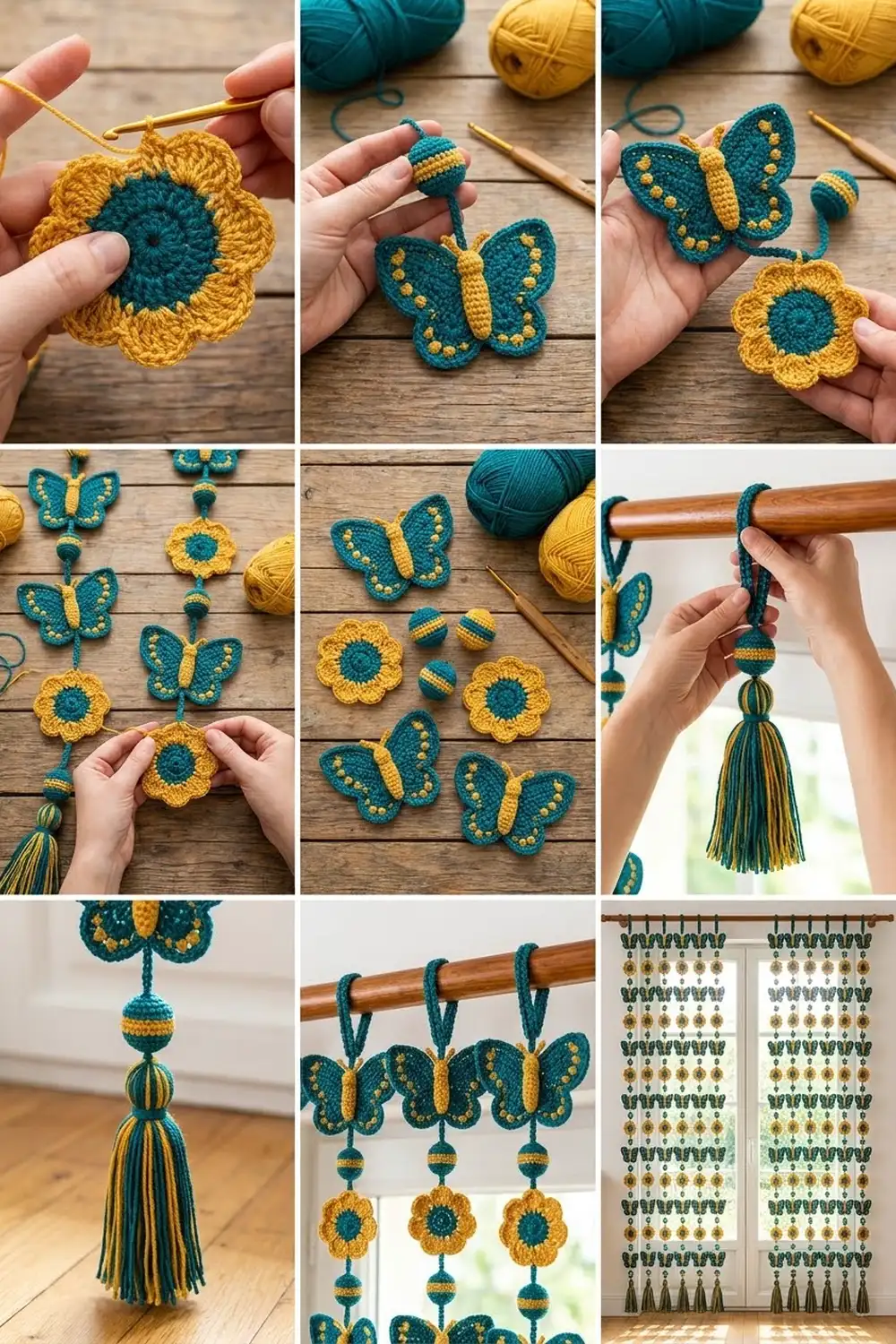
Butterfly (make 36 per panel)
The wings grow from four chain loops anchored on a small ring. The upper wings get longer loops and taller stitches, which gives them their larger shape.
Rnd 1 (teal): MR, ch 1, 12 sc in ring, sl st to the first sc. (12 sc)
Rnd 2: Ch 1, sc in the same st (this is st 1). Ch 8, skip 2 sts, sc in st 4. Ch 6, skip 2 sts, sc in st 7. Ch 6, skip 2 sts, sc in st 10. Ch 8, skip 2 sts, sl st to the first sc. (4 sc, two ch-8 loops, two ch-6 loops)
The four sc are the “valleys” between the wings. St 1 is the top of the butterfly and st 7 is the bottom.
Rnd 3:
– In the first ch-8 loop (upper wing): 3 dc, 5 tr, ch 3, 5 tr, 3 dc. Sl st in the next sc.
– In the ch-6 loop (lower wing): 2 hdc, 3 dc, ch 2, 3 dc, 2 hdc. Sl st in the next sc.
– Repeat the lower wing in the next ch-6 loop, then sl st in the next sc.
– Repeat the upper wing in the last ch-8 loop, then sl st in the first sc.
(16 sts per upper wing, 10 sts per lower wing, 4 sl sts = 56 sts, plus the tip spaces)
Rnd 4:
– Each upper wing: dc in the next 3 dc, 2 dc in each of the next 5 tr, (2 dc, ch 2, 2 dc) in the ch-3 tip, 2 dc in each of the next 5 tr, dc in the next 3 dc. (30 dc)
– Each lower wing: hdc in the next 2 hdc, 2 dc in each of the next 3 dc, (2 dc, ch 2, 2 dc) in the ch-2 tip, 2 dc in each of the next 3 dc, hdc in the next 2 hdc. (20 sts)
– Between wings: sl st in each valley sl st.
Round total: 30 + 20 + 20 + 30 + 4 = 104 sts. Fasten off teal.
Rnd 5 (yellow): Join with a sc in the first dc of an upper wing. Sc in each st and work 3 sc in each ch-2 tip. Skip every valley sl st, so the yarn pinches each valley inward. Sl st to the first sc. (33 sc per upper wing, 23 sc per lower wing = 112 sc)
Rnd 6: Ch 1, rev sc in each sc around, sl st to join. (112 rev sc) Fasten off.
Body (yellow): Ch 12. Hdc in the 3rd ch from the hook and in each ch across. (10 hdc) The body measures about 3 in (7.6 cm). Lay it vertically over the center of the butterfly, covering the top and bottom valleys, and sew it down along its full length.
Flower (make 36 per panel)
Rnd 1 (teal): MR, ch 3 (counts as dc), 15 dc in ring, sl st to the top of the ch-3. (16 dc) Fasten off.
Rnd 2 (yellow): Join in any dc. Ch 1, sc in the same st, ch 3, skip 1 st. Repeat (sc in the next st, ch 3, skip 1 st) around. Sl st to the first sc. (8 sc, 8 ch-3 sps)
Rnd 3: Sl st into the first ch-3 sp. Ch 3 (counts as dc), then (2 dc, ch 2, 3 dc) in the same sp. Work (3 dc, ch 2, 3 dc) in each remaining ch-3 sp. Sl st to the top of the ch-3. (8 shells: 48 dc, 8 ch-2 sps)
Rnd 4: Sl st in the gap between this shell and the previous one. Ch 1. Sc in the gap between shells, 7 dc in the next ch-2 sp. Repeat from * around. Sl st to the first sc. (8 sc + 56 dc = 64 sts, 8 scalloped petals) Fasten off.
Bead (make 72 per panel)
Work in a continuous spiral and use a stitch marker to mark the start of each round.
- Rnd 1 (teal): MR, 6 sc in ring. (6 sc)
- Rnd 2 (teal): 2 sc in each st. (12 sc)
- Rnds 3–4 (yellow): Sc in each st. (12 sc per round)
- Rnd 5 (teal): Sc in each st. (12 sc) Stuff the bead firmly.
- Rnd 6 (teal): Sc2tog 6 times. (6 sts) Fasten off, pull the hole closed and weave in the end.
The bead has teal caps at the top and bottom and a yellow band around the middle.
Make All Pieces
Per strand: 6 butterflies, 6 flowers, 12 beads.
Per panel: 36 butterflies, 36 flowers, 72 beads.
Color use per piece:
– Butterfly: teal for Rnds 1–4; yellow for Rnds 5–6 and the body
– Flower: teal for Rnd 1; yellow for Rnds 2–4
– Bead: teal for Rnds 1–2 and 5–6; yellow for Rnds 3–4
There are two strand types. Strand A starts with a butterfly and Strand B starts with a flower. Alternating them across the panel puts butterflies and flowers in a checkerboard pattern.
Panel layout
Read top to bottom. B = butterfly, F = flower, o = bead.
        S1  S2  S3  S4  S5  S6
        A   B   A   B   A   B
R1      B   F   B   F   B   F
        o   o   o   o   o   o
        F   B   F   B   F   B
        o   o   o   o   o   o
R2–R6   (repeat R1 five more times)
Joining
Each link is a 5-chain worked in teal, about 1 in (2.5 cm) long.
Attachment points:
– Butterfly: top = the top valley (under the upper end of the body); bottom = the bottom valley
– Flower: top = any Rnd 4 sc; bottom = the sc 4 petals away, directly opposite
– Bead: the closing points of Rnd 1 and Rnd 6
How to link: Sl st into the bottom point of the piece above, ch 5, then sl st into the top point of the next piece. Fasten off, rejoin at the bottom point of that piece, and repeat.
One repeat: link, motif, link, bead, link, motif, link, bead.
– The 4 links measure 4 in (10.2 cm).
– The pieces measure 3.5 + 1 + 3.5 + 1 = 9 in (22.9 cm).
– One repeat = 13 in (33.0 cm).
Six repeats measure 78 in (198.1 cm). Add one final link below the last bead for the tassel, and the strand measures 79 in (200.7 cm).
Tension: Keep the chains even and relaxed. Tight links make the strand pucker, and loose links let it sag. Count the chains in every link; don’t judge them by eye.
Size checkpoint: Hang the first finished strand overnight. If it measures 79 in (200.7 cm), plus or minus 1 in (2.5 cm), continue with the rest. If it has stretched, use ch 4 links on the remaining strands.
Border: Rod Loops and Tassel Fringe
This curtain has no closed edge. Instead, a rod loop finishes the top of each strand and a tassel finishes the bottom.
Rod loop (teal): Ch 22 and sl st to the first ch to form a ring, without twisting. Ch 5, then sl st into the top point of the first piece on the strand. This link is the first link of Repeat 1.
At 5 ch per inch, the 22-chain ring has a circumference of 4.4 in (11.2 cm). A 1.25 in (3.2 cm) rod has a circumference of about 3.9 in (9.9 cm), so the loop slides easily without being sloppy. The loop hangs about 2 in (5.1 cm) deep.
Tassel: Cut 10 teal and 10 yellow pieces, each 12 in (30.5 cm) long. Fold the bundle in half through the last link. Wrap it tightly with yellow 0.5 in (1.3 cm) below the fold and knot the wrap. Trim the ends to 5 in (12.7 cm).
Length check: 2 in rod loop + 79 in strand + 5 in tassel = 86 in (218.4 cm).
Width check: Space the strands 5 in (12.7 cm) apart, center to center. Five gaps × 5 in = 25 in (63.5 cm). Add half a butterfly’s width at each edge (2.25 in each) and the panel measures 29.5 in (74.9 cm). Neighboring motifs alternate, so they nest instead of overlapping.
Final Blocking
- Block the motifs before you link them. They’re easier to handle loose.
- Wet the butterflies and flowers and gently press out the water in a towel.
- Pin each butterfly to 4.5 in × 3.5 in (11.4 × 8.9 cm), with a pin at every wing tip and valley.
- Pin each flower to 3.5 in (8.9 cm), with a pin at the center of every petal.
- Let everything dry completely. Don’t wet or pin the beads.
- After linking, hang the strands and let them settle for 24 hours before trimming the tassels to their final length.
Final Quality-Control Checklist
- Every butterfly has 112 rev sc and a centered body.
- Every flower has 8 even petals of 7 dc each.
- The beads are firm and round, with the stripes level.
- Every link has exactly 5 ch.
- Each strand measures 79 in (200.7 cm) before the rod loop and tassel.
- Strand A and Strand B alternate across the panel.
- All ends are woven in securely.
- The tassels are trimmed level, 5 in (12.7 cm) long.
Troubleshooting
- Upper wings cup: Your Rnd 4 tension is tight. Loosen up or use a larger hook for Rnd 4.
- Flower ruffles: Your Rnd 3 shells are crowding. Check that Rnd 2 has exactly 8 loops.
- Lumpy beads: Overstuffed. Remove a little fiberfill before Rnd 6.
- Motifs twist on the strand: You attached at points that aren’t directly opposite each other. Re-link through the exact top and bottom points.
- Strands are different lengths: Count the chains in each link again.
- Rod loop too tight: Add 2 ch to the ring.
Care
Hand wash in cool water, roll in a towel to remove water, and dry the strands flat. Re-pin the butterfly wing tips if needed, then rehang.
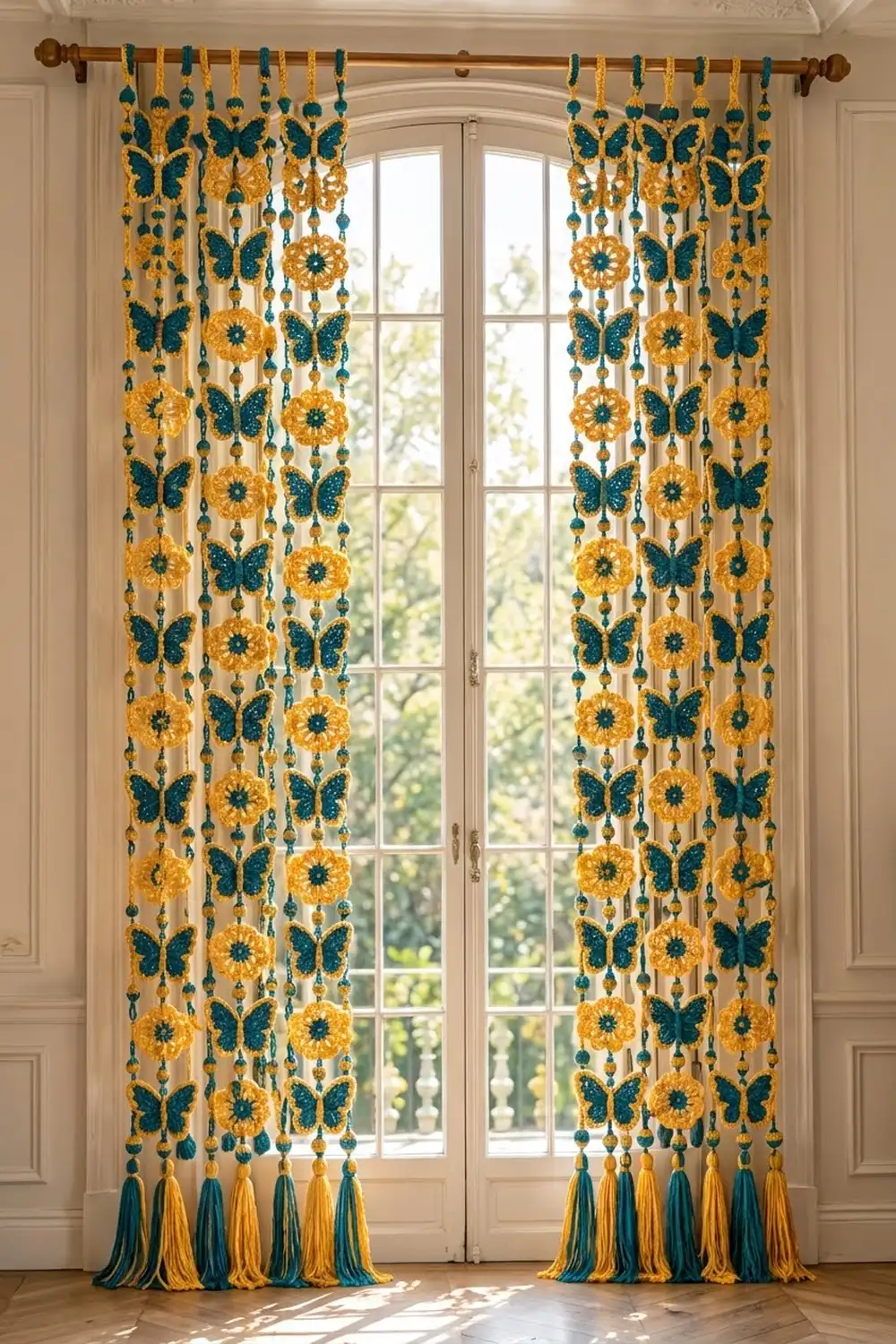
Final Notes
Everything depends on one measurement leading to the next. Correct gauge gives 3.5 in (8.9 cm) motifs and 1 in (2.5 cm) beads and links. Those give a 13 in (33.0 cm) repeat. Six repeats plus the final link give a 79 in (200.7 cm) strand. The rod loop and tassel bring each strand to 86 in (218.4 cm), and six strands spaced 5 in (12.7 cm) apart make a 29.5 in (74.9 cm) panel. Check each step before moving on and the two panels will hang evenly.
Happy crocheting!