

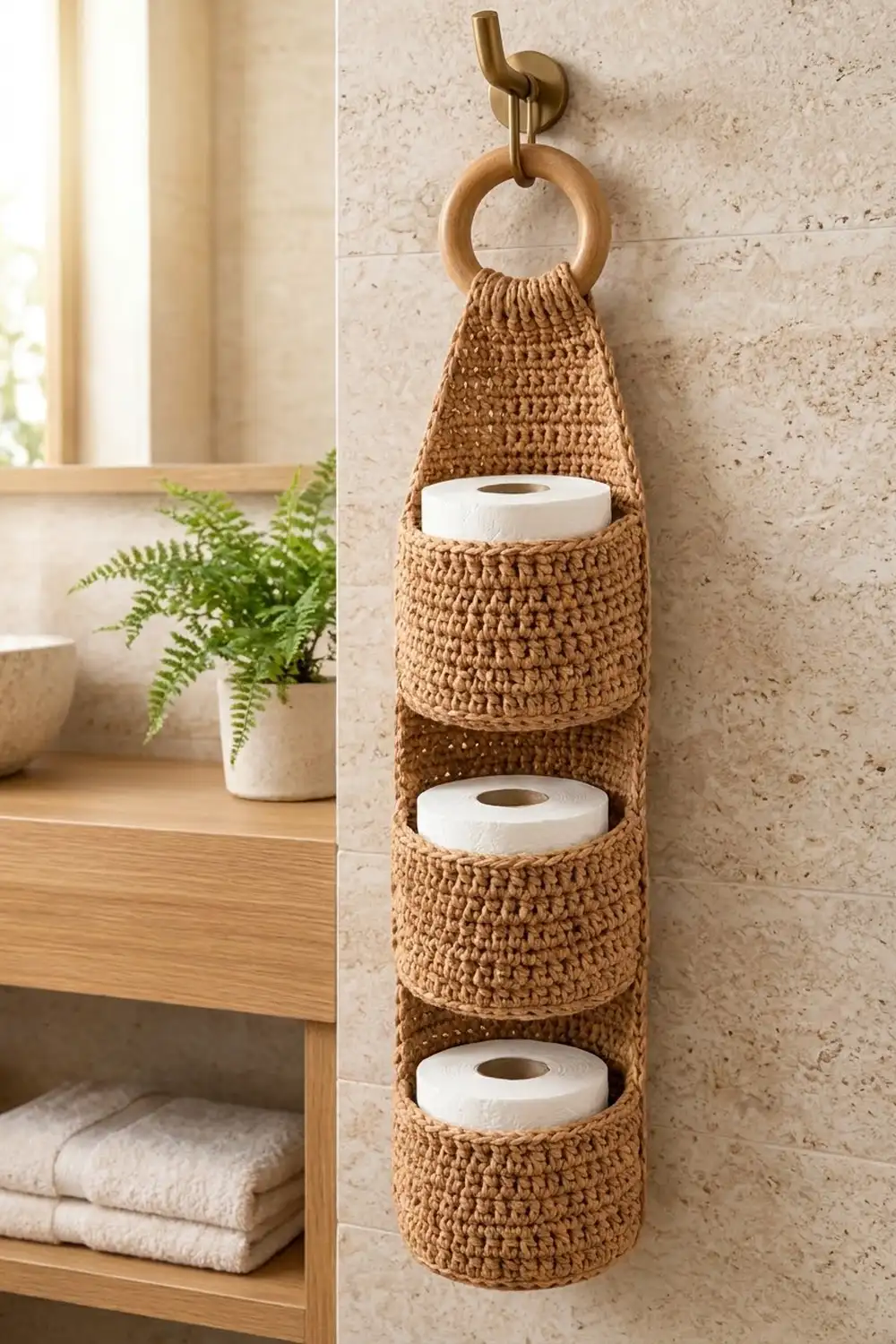
This hanging toilet paper holder is a tall, slim organizer. One long back panel tapers into a narrow strap that loops over a wooden ring. Three round pockets are stitched to the front of the panel, one above the other, and each holds a standard roll upright.
The sample uses a single warm caramel-tan cotton. Dense half double crochet gives the back panel a firm, woven look. The pockets are tight single crochet baskets with a rolled crab-stitch rim. It’s a calm, natural design that suits a spa-style bathroom.
The pattern uses US crochet terms. The finished holder is about 5.4 in (13.7 cm) wide and hangs about 24 in (61.0 cm) from the top of the ring to the bottom edge. Each pocket is about 4.9 in (12.4 cm) across and 3.75 in (9.5 cm) tall.
Construction is simple:
- Crochet the back panel flat in rows.
- Crochet three pockets in joined rounds.
- Sew the pockets to the panel stitch-to-stitch.
- Add a two-round border.
- Fold the strap over the ring and sew it down.
Finished Size and Construction
- Finished size: 5.4 in (13.7 cm) wide x about 24 in (61.0 cm) long, ring included
- Skill level: Easy / advanced beginner
- Terminology: US crochet terms
- Yarn weight: Worsted weight (#4) cotton
- Hook: 5.0 mm (H-8)
- Number of pieces: 4 (1 back panel, 3 pockets)
- Layout: 3 pockets stacked vertically on 1 panel
- Pocket size: 4.9 in (12.4 cm) diameter x 3.75 in (9.5 cm) tall
- Panel size before border: 4.9 in (12.4 cm) wide x 19.6 in (49.8 cm) long, plus a 3.6 in (9.1 cm) strap
- Border depth: 0.25 in (0.6 cm) per side
Materials
Choose a smooth, firm worsted weight cotton or cotton blend. Cotton holds its shape under the weight of the rolls and copes well with bathroom humidity. Avoid fluffy or very stretchy acrylic, because the pockets will sag.
- Caramel tan (only color): 130 g / 220 m
This amount includes a margin of about 40 percent, so you have yarn left for a gauge test and for sewing.
Tools:
- 5.0 mm (H-8) crochet hook
- 3 in (7.6 cm) wooden ring
- Tapestry needle
- 6 locking stitch markers
- Scissors and measuring tape
- Pins and a blocking mat
Abbreviations (US Terms)
- ch: chain
- sl st: slip stitch
- sc: single crochet
- hdc: half double crochet
- hdc2tog: half double crochet 2 together
- BLO: back loop only
- st(s): stitch(es)
- rep: repeat
Special stitches:
- hdc2tog: Yarn over, insert the hook in the next st, yarn over and pull up a loop. Yarn over, insert the hook in the following st, yarn over and pull up a loop (5 loops on hook). Yarn over and pull through all 5 loops. This removes 1 st.
- Crab stitch (reverse sc): Work from left to right (if you’re right-handed). Insert the hook in the next st to the right, pull up a loop, yarn over and pull through both loops. This makes a rolled, corded edge.
Gauge and Checkpoints
- sc in rounds: 14 sts and 16 rounds = 4 in (10.2 cm)
- hdc in rows: 14 sts and 11 rows = 4 in (10.2 cm)
Make one pocket first and use it as your gauge test. Size matters most on the pockets, because a roll has to slide in easily.
Checkpoints:
- Pocket base after Round 5: about 2.7 in (6.9 cm) across
- Pocket base after Round 9: about 4.9 in (12.4 cm) across
- Finished pocket: 3.75 in (9.5 cm) tall, 15.4 in (39.1 cm) around
- Panel after Row 11: 4.9 in (12.4 cm) wide x 4 in (10.2 cm) long
- Panel after Row 44: 16 in (40.6 cm) long
- Panel after Row 54: 19.6 in (49.8 cm) long
If the pocket is too small and a roll won’t fit, change to a 5.5 mm (I-9) hook. If the pocket is too big and floppy, change to a 4.5 mm (7) hook. Don’t add or remove stitches, because the counts are tied to the panel width and to the sewing.
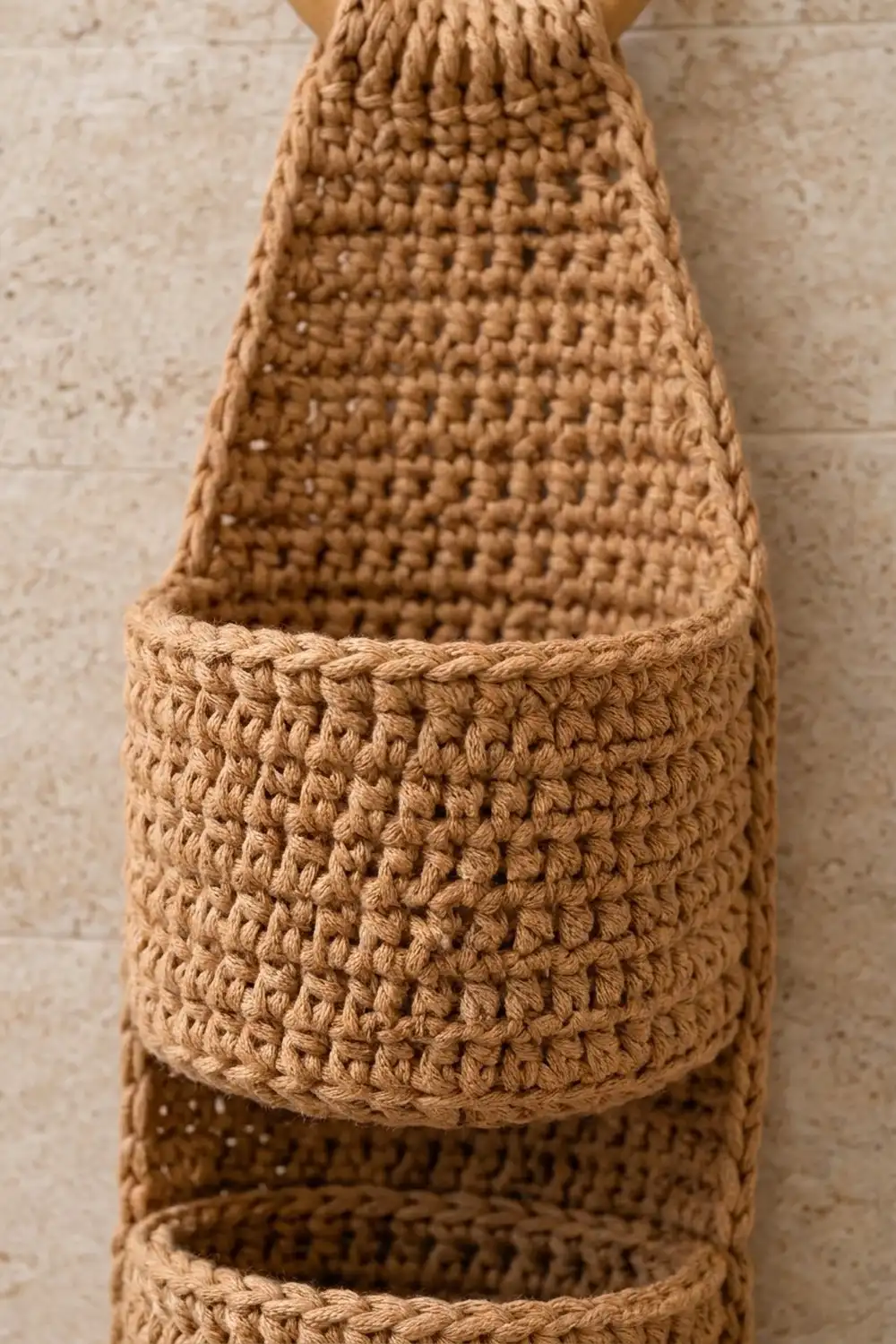
Back Panel
Work in rows. The ch 2 at the start of each row does not count as a stitch.
Ch 19.
Row 1: Hdc in 3rd ch from hook and in each ch across. (17 hdc)
Rows 2–44: Ch 2, turn, hdc in each st across. (17 hdc)
Checkpoint: 4.9 in (12.4 cm) wide x 16 in (40.6 cm) long.
Taper:
Row 45: Ch 2, turn, hdc2tog, hdc in next 13 sts, hdc2tog. (15 hdc)
Row 46: Ch 2, turn, hdc in each st across. (15 hdc)
Row 47: Ch 2, turn, hdc2tog, hdc in next 11 sts, hdc2tog. (13 hdc)
Row 48: Ch 2, turn, hdc in each st across. (13 hdc)
Row 49: Ch 2, turn, hdc2tog, hdc in next 9 sts, hdc2tog. (11 hdc)
Row 50: Ch 2, turn, hdc in each st across. (11 hdc)
Row 51: Ch 2, turn, hdc2tog, hdc in next 7 sts, hdc2tog. (9 hdc)
Row 52: Ch 2, turn, hdc in each st across. (9 hdc)
Row 53: Ch 2, turn, hdc2tog, hdc in next 5 sts, hdc2tog. (7 hdc)
Row 54: Ch 2, turn, hdc in each st across. (7 hdc)
The taper is 10 rows, about 3.6 in (9.1 cm) long. The panel now measures 19.6 in (49.8 cm).
Strap:
Rows 55–64: Ch 2, turn, hdc in each st across. (7 hdc)
The strap is 2 in (5.1 cm) wide and 3.6 in (9.1 cm) long. Fasten off and weave in the tail. The panel has 64 rows in total.
Pockets (Make 3)
Work in joined rounds with the right side facing. The ch 1 at the start of each round does not count as a stitch. Join each round with a sl st to the first sc.
Base:
Round 1: Make a magic ring, ch 1, 6 sc in ring, join. (6 sc)
Round 2: Ch 1, 2 sc in each st around, join. (12 sc)
Round 3: Ch 1, *sc in next st, 2 sc in next st; rep from * 6 times, join. (18 sc)
Round 4: Ch 1, *sc in next 2 sts, 2 sc in next st; rep from * 6 times, join. (24 sc)
Round 5: Ch 1, *sc in next 3 sts, 2 sc in next st; rep from * 6 times, join. (30 sc)
Checkpoint: about 2.7 in (6.9 cm) across.
Round 6: Ch 1, *sc in next 4 sts, 2 sc in next st; rep from * 6 times, join. (36 sc)
Round 7: Ch 1, *sc in next 5 sts, 2 sc in next st; rep from * 6 times, join. (42 sc)
Round 8: Ch 1, *sc in next 6 sts, 2 sc in next st; rep from * 6 times, join. (48 sc)
Round 9: Ch 1, *sc in next 7 sts, 2 sc in next st; rep from * 6 times, join. (54 sc)
Checkpoint: the base lies flat and measures about 4.9 in (12.4 cm) across.
Walls:
Round 10: Ch 1, sc in BLO of each st around, join. (54 sc)
This round leaves a ridge of unused front loops, which makes a crisp fold between the base and the walls.
Rounds 11–23: Ch 1, sc in each st around, join. (54 sc)
The walls (Rounds 10–23) are 14 rounds, or 3.5 in (8.9 cm).
Round 24 (rim): Ch 1, crab stitch in each st around, join. (54 crab sts)
Fasten off and leave a 40 in (101.6 cm) tail for sewing. The pocket is now 3.75 in (9.5 cm) tall.
Make All Pieces
- Back panel: 1, caramel tan
- Pockets: 3, caramel tan
Layout (front view, top to bottom):
        [ wooden ring ]
        [ strap R55–64 ]
       /  taper R45–54  \
      |  plain R39–44    |
      |  POCKET 3 R29–38 |
      |  gap R25–28      |
      |  POCKET 2 R15–24 |
      |  gap R11–14      |
      |  POCKET 1 R1–10  |
      +------------------+
Each pocket covers 10 panel rows. Each gap is 4 rows, about 1.5 in (3.8 cm).
Joining
Lay the panel right side up and place each pocket on its front. Sew the pockets on with whipstitch, using their long tails.
Stitch-to-stitch logic: Each pocket has 54 rim stitches. Mark 17 stitches in a row as the back of the pocket. These 17 stitches match the 17 hdc of the panel one-to-one, so the back of the pocket lies flat across the full width of the panel. The other 37 stitches curve forward to form the open front.
For each pocket:
- Put a marker on the first and last of the 17 back rim stitches.
- Line up the rim with the top of the pocket’s highest row: Row 10 for Pocket 1, Row 24 for Pocket 2, Row 38 for Pocket 3.
- Whipstitch the 17 back rim stitches to the 17 hdc of that row, 1 rim st to 1 hdc.
- Sew down both sides of the flattened back. Follow the wall column below each marker and sew it to the matching panel column (hdc 1 and hdc 17), through all 14 wall rounds.
- Sew the 17 matching front loops of the base ridge to the panel. For Pocket 1, sew along the bottom of Row 1. For Pocket 2, sew to the tops of Row 14. For Pocket 3, sew to the tops of Row 28.
Tension: Sew snugly, but don’t pull so hard that the panel puckers. Check that the panel still lies flat after each seam.
Size checkpoint: The top of Pocket 3 should sit about 13.8 in (35.1 cm) above the bottom edge. Above it, about 5.8 in (14.7 cm) of plain panel and taper should show before the strap.
Border
Work the border around the whole panel, strap included. The pockets sit inside the side edges, so they don’t get in the way.
Border gauge: 5 sc for every 4 hdc row ends.
Round 1: With the right side facing, join yarn in the first foundation st at the bottom right corner.
- Bottom edge: Ch 1, 3 sc in first st (corner), sc in next 15 sts, 3 sc in last st (corner). (21 sc, both corners included)
- First long side: *Sc in next 3 row ends, 2 sc in next row end; rep from * 16 times. (80 sc)
- Strap top: 3 sc in first st (corner), sc in next 5 sts, 3 sc in last st (corner). (11 sc, both corners included)
- Second long side: *Sc in next 3 row ends, 2 sc in next row end; rep from * 16 times. (80 sc)
- Join to the first sc. (192 sc)
The long-side counts do not include corners. All 4 corner groups are counted with the short edges.
Round 2: Ch 1, crab stitch in each st around, join. (192 crab sts)
Fasten off.
Why the math works:
- Long sides: Each side has 64 rows. 64 ÷ 4 = 16 repeats, and 16 x 5 = 80 sc.
- Gauge match: The panel has 2.75 hdc rows per inch. At 1.25 sc per row, that’s about 3.44 sc per inch, very close to the 3.5 sc-per-inch gauge, so the edges won’t ruffle or pull in.
- Short edges: 1 sc per stitch plus 2 extra at each corner. Bottom: 17 + 4 = 21. Top: 7 + 4 = 11.
- Total: 21 + 80 + 11 + 80 = 192.
Attaching the ring:
- Slide the strap through the 3 in (7.6 cm) ring from front to back.
- Fold the strap down behind the panel so its top edge sits against the back of Row 52.
- Whipstitch the 7 strap stitches across, then sew down both sides of the strap.
The strap gathers slightly at the ring.
Final Blocking
- Mist the whole holder until it’s damp but not soaked.
- Pin the panel flat to 5.4 in (13.7 cm) wide, keeping both sides straight.
- Check that the panel body is 19.9 in (50.5 cm) long, from the bottom border to the top of Row 54.
- Put a toilet roll or a rolled towel in each pocket so the walls dry round.
- Smooth the crab-stitch rims so they roll outward evenly.
- Let it dry completely, at least 24 hours.
Final Quality-Control Checklist
- Panel is 5.4 in (13.7 cm) wide along its full straight length
- Taper is symmetrical and decreases evenly to 7 sts
- Each pocket has 54 sts in every wall round
- Each pocket is 4.9 in (12.4 cm) across and 3.75 in (9.5 cm) tall
- The back of each pocket is sewn across all 17 panel stitches
- Gaps between pockets are even, about 1.5 in (3.8 cm)
- Border has 192 sts in both rounds
- Ring is sewn on securely and the holder hangs straight
- All tails are woven in on the back
Troubleshooting
Roll won’t fit: Your gauge is tight. Remake the pocket with a larger hook.
Pocket sags forward: The side seams are too short, or the yarn is too soft. Sew the side seams through all 14 wall rounds.
Panel edges wave: There are too many border stitches. Make sure you add only 1 extra sc for every 4 row ends.
Panel edges pull in: Your border tension is too tight. Loosen up, or use a 5.5 mm (I-9) hook for the border only.
Holder leans to one side: The pockets are sewn off-center. Unpick them and line up the markers with hdc 1 and hdc 17.
Base won’t lie flat: Recount the increase rounds. Each one should add exactly 6 stitches.
Care
Hand wash in cool water with mild soap. Press out the water, reshape, and dry flat with a roll in each pocket.
Final Notes
Everything follows one chain of measurements:
- The 54-stitch pocket gives a 4.9 in (12.4 cm) base.
- Its 17 back stitches match the 17-stitch, 4.9 in (12.4 cm) panel.
- Each pocket covers 10 panel rows, with 4-row gaps between them.
- The 64-row panel takes 80 border stitches per side, which brings the width to 5.4 in (13.7 cm).
- The strap and ring bring the holder to about 24 in (61.0 cm) long.
Check your pocket gauge first and the rest will fall into place.
Happy crocheting!