

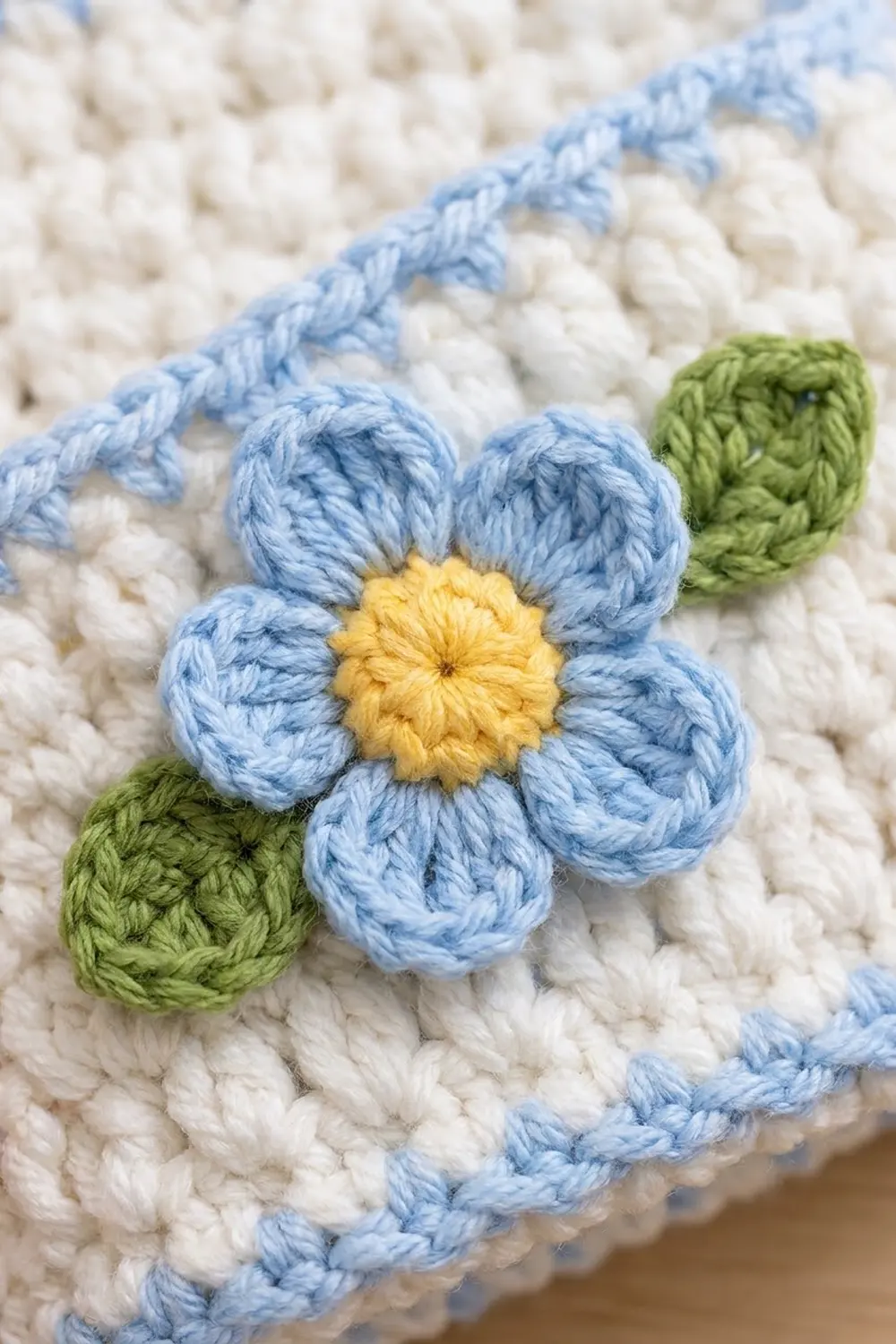
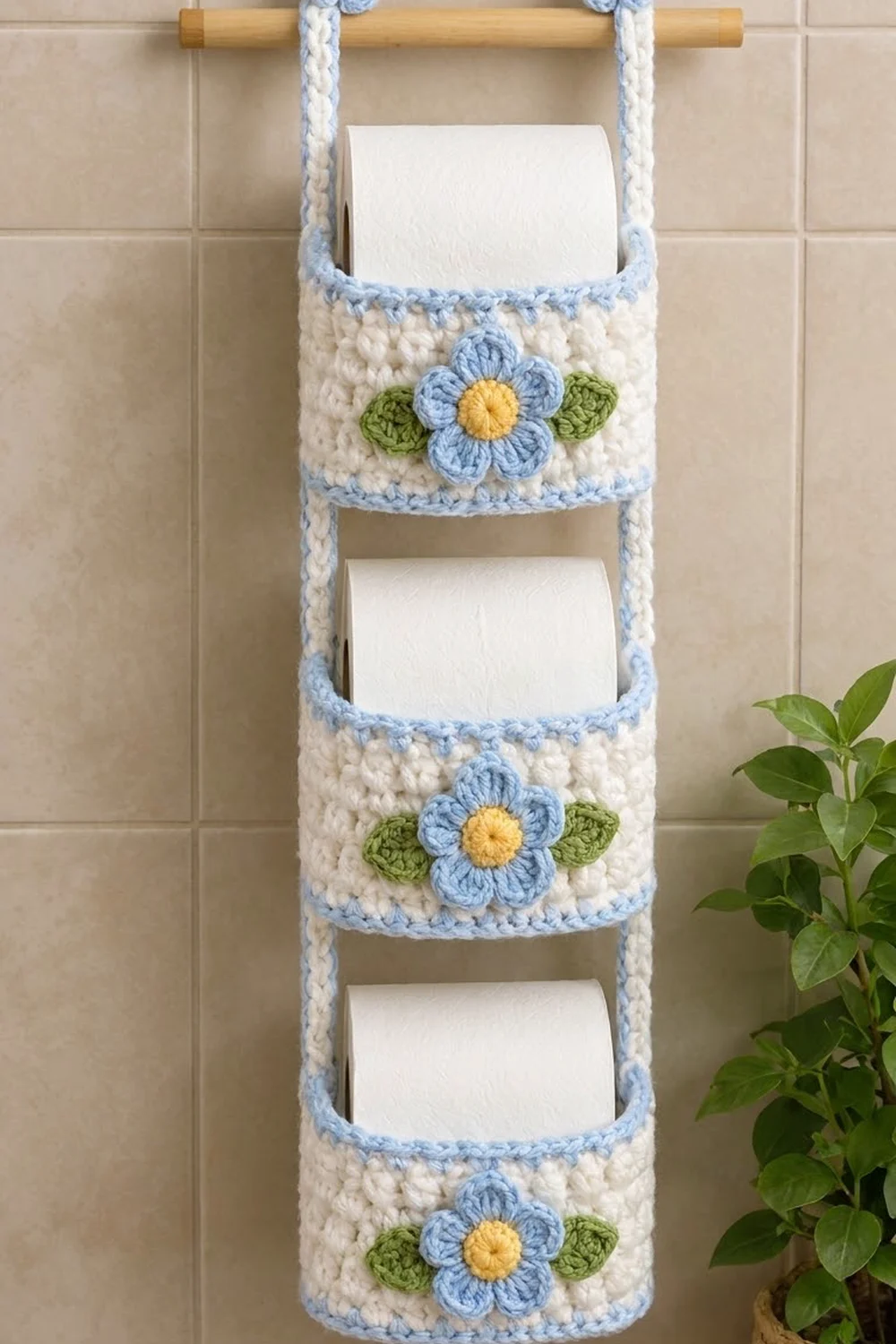
This hanging holder keeps three spare rolls neatly within reach. It has three soft pockets stacked on two slim straps, and each strap loops over a short wooden dowel. Every pocket has a bumpy white body, crisp light blue rims, and a blue flower with a sunny yellow center and two green leaves.
The palette is white, light blue, yellow, and green. The style is cheerful and cottage-like, and it suits a bathroom with natural wood and plants. The bumpy texture comes from griddle stitch, which alternates single and double crochet. Short blue spike stitches give the top rim a neat finish.
This pattern uses US crochet terms. Each pocket finishes at about 5.5 in (14.0 cm) wide, 4.5 in (11.4 cm) deep, and 3.5 in (8.9 cm) tall. The holder hangs about 18 in (45.7 cm) from the top of the strap loops to the bottom of the lowest pocket.
For each pocket, you crochet a flat base and a flat wall strip. You seam the strip into a ring, join it to the base with a blue round, and add a blue border at the top. Then you make the straps and appliqués, sew the pockets to the straps, and slide the dowel through the loops.
Finished Size and Construction
- Finished size: about 6 in (15.2 cm) wide x 18 in (45.7 cm) tall, hanging
- Skill level: Easy+ / Intermediate
- Terminology: US crochet terms
- Yarn weight: Worsted (#4) cotton or cotton blend
- Hook: 5.0 mm (H-8)
- Number of pieces: 19 (3 bases, 3 walls, 2 straps, 3 large flowers, 6 leaves, 2 small flowers)
- Layout: 1 column of 3 pockets with 1.5 in (3.8 cm) gaps
- Piece size (one pocket): 5.5 in (14.0 cm) wide x 4.5 in (11.4 cm) deep x 3.5 in (8.9 cm) tall
- Size before border: about 3 in (7.6 cm) wall height
- Border depth: about 0.25 in (0.6 cm)
Materials
Choose a smooth worsted-weight cotton or cotton blend. Cotton holds its shape, handles bathroom humidity, and washes well. The amounts below assume about 190 m per 100 g.
- White (main color): 100 g / 190 m
- Light blue: 40 g / 76 m
- Yellow: 10 g / 19 m
- Green: 10 g / 19 m
These amounts include a margin of about 25% for swatching and differences in tension.
Tools:
- 5.0 mm (H-8) crochet hook
- Tapestry needle
- 8 stitch markers
- Scissors and tape measure
- Wooden dowel, 9 in (22.9 cm) long, 3/8 in (1.0 cm) in diameter
- Rust-proof pins and a blocking mat
Abbreviations (US Terms)
- ch – chain
- sl st – slip stitch
- sc – single crochet
- hdc – half double crochet
- dc – double crochet
- st(s) – stitch(es)
- rep – repeat
- RS / WS – right side / wrong side
Long sc (spike): Insert the hook into the stitch directly below the next stitch, 2 rows down. Yarn over and pull up a loop to the height of the current row. Yarn over and pull through both loops. Skip the stitch behind the spike.
Griddle stitch: Alternate sc and dc across the row. On the next row, work sc into each dc and dc into each sc.
Gauge and Checkpoints
- Sc: 16 sts x 18 rows = 4 in (10.2 cm)
- Griddle stitch: 16 sts x 16 rows = 4 in (10.2 cm)
Make one complete pocket first. It works as both your gauge swatch and your fit test. Check it at each stage:
- Base after Row 20: 5.5 in (14.0 cm) x 4.5 in (11.4 cm).
- Base edge round: 80 sts.
- Wall after Row 1: 20 in (50.8 cm) long.
- Wall after Row 12: about 3 in (7.6 cm) tall.
- Seamed wall ring: 20 in (50.8 cm) around.
- Finished pocket: 3.5 in (8.9 cm) tall, and a roll lying on its side fits snugly.
Too big: Change to a 4.5 mm (US 7) hook. Too small: Change to a 5.5 mm (I-9) hook. Keep all stitch counts the same. The base edge and the wall ring must match, because their 80 stitches are joined one to one.
Pocket Base (make 3)
Work in rows with white.
Row 1: Ch 23, sc in 2nd ch from hook and in each ch across. (22 sc)
Rows 2–20: Ch 1, turn, sc in each st across. (22 sc)
Checkpoint: 5.5 in (14.0 cm) x 4.5 in (11.4 cm).
Edge Round: Ch 1, do not turn. Work 18 sc down the 20 row ends by working 1 sc in each row end except Rows 7 and 14. Work 22 sc across the free loops of the foundation chain. Work 18 sc up the other 20 row ends, again skipping Rows 7 and 14. Work 22 sc across the tops of Row 20. Sl st to the first sc. (80 sc: 22 + 18 + 22 + 18)
Do not add extra stitches at the corners. This lets the corners round off softly, like the curved pocket shape. Place markers in the first and last st of each long side. Fasten off.
Pocket Wall (make 3)
Work flat in rows, then seam the wall into a ring.
Row 1 (blue): Ch 81, sc in 2nd ch from hook and in each ch across. (80 sc) Fasten off.
Row 2 (white): Turn and join white in the first st. Ch 1, *sc in next st, dc in next st; rep from * across. (80 sts: 40 sc + 40 dc)
Rows 3–11 (white): Ch 1, turn, *sc in next dc, dc in next sc; rep from * across. (80 sts) Fasten off after Row 11.
Checkpoint: about 2.75 in (7.0 cm) tall.
Row 12 (blue, spike row): Turn and join blue in the first st. Ch 1, *sc in next st, long sc in next st of Row 10; rep from * across. (80 sts: 40 sc + 40 long sc)
This row makes the blue spikes that dip into the white. Checkpoint: the wall is about 3 in (7.6 cm) tall and 20 in (50.8 cm) long.
Seam: Fold the wall with RS together and match the short ends. Whipstitch the 12 row ends with matching colors. Turn the ring RS out. It should measure 20 in (50.8 cm) around.
Large Flower (make 3)
Rnd 1 (yellow): Make a magic ring and work 10 sc in the ring. Sl st to the first sc. (10 sc)
Rnd 2 (yellow): Ch 1, work 2 sc in each st around. Sl st to the first sc. (20 sc) Fasten off. The center is about 1 in (2.5 cm) across.
Rnd 3 (blue): Join blue in any st. *Sl st in next st, (hdc, 2 dc) in next st, (2 dc, hdc) in next st, sl st in next st; rep from * 4 more times. (5 petals, 4 sts each; 20 sts used)
Leave a 12 in (30.5 cm) tail. The flower is about 2.75 in (7.0 cm) across. Push the yellow center forward so it stands slightly raised.
Leaf (make 6)
Rnd 1 (green): Ch 7. Starting in the 2nd ch from hook, work sc, hdc, dc, dc, hdc in the next 5 ch, then 3 sc in the last ch. Working along the other side of the chain, work hdc, dc, dc, hdc, sc in the next 5 ch. Sl st to the first sc. (13 sts)
The 3 sc in the last chain form the pointed tip. Each leaf is about 1.5 in (3.8 cm) long. Leave a 10 in (25.4 cm) tail.
Small Flower (make 2)
Rnd 1 (yellow): Make a magic ring and work 5 sc in the ring. Sl st to the first sc. (5 sc) Fasten off.
Rnd 2 (blue): Join blue. In each st around, work (sl st, ch 2, 2 dc, ch 2, sl st). (5 petals)
Each small flower is about 1.25 in (3.2 cm) across.
Strap (make 2)
Row 1 (white): Ch 81, sc in 2nd ch from hook and in each ch across. (80 sc)
Row 2: Ch 1, turn, sl st loosely in each st across. (80 sl sts) Fasten off.
The slip stitch row gives a firm, braid-like edge. Each strap is 20 in (50.8 cm) long and about 0.5 in (1.3 cm) wide. Counting from one end, place markers after sts 12, 24, 38, 44, 58, 64, and 78.
Make All Pieces
- White: 3 bases, wall Rows 2–11 (x3), 2 straps
- Light blue: wall Rows 1 and 12, joining rounds, borders, all petals
- Yellow: 3 large flower centers and 2 small flower centers
- Green: 6 leaves
Strap layout from the top end (1 st = 0.25 in / 0.6 cm):
Sts  1–12   dowel loop ............... 3 in   (7.6 cm)
Sts 13–24   free drop ................ 3 in   (7.6 cm)
Sts 25–38   POCKET 1 ................. 3.5 in (8.9 cm)
Sts 39–44   gap ...................... 1.5 in (3.8 cm)
Sts 45–58   POCKET 2 ................. 3.5 in (8.9 cm)
Sts 59–64   gap ...................... 1.5 in (3.8 cm)
Sts 65–78   POCKET 3 ................. 3.5 in (8.9 cm)
Sts 79–80   tail under base .......... 0.5 in (1.3 cm)
Total: 80 sts = 20 in (50.8 cm)
Joining
Wall to base: Hold the wall ring and base with WS together, with wall Row 1 at the bottom. Place the wall seam at the center of one long side of the base. This side is the back. Starting from the seam, the 80 Row 1 sts divide into back 11, side 18, front 22, side 18, and back 11. These match the marked base sides of 22, 18, 22, and 18 exactly.
Joining Round (blue): Join blue at the seam. Work through the free foundation loop of wall Row 1 and the matching base edge st at the same time. Sc in each st around and sl st to the first sc. (80 sc) Fasten off.
The ridge sits on the outside and forms the blue bottom rim. Use your normal tension. If the round is too tight, the base cups. If it’s too loose, the bottom ripples.
Appliqué: Center a large flower on the front 22 sts, halfway up the white section. Tuck a leaf behind each side so the tips angle outward and slightly upward. Sew the leaves first, then sew the flower around its center and the base of each petal. Leave the petal tips free.
Pockets to straps: On each strap, fold sts 1–12 to the back and sew st 1 to st 12. This makes a 3 in (7.6 cm) loop. Place one strap at each back corner of the pockets so the straps show at the sides. Sew strap sts 25–38 to Pocket 1, sts 45–58 to Pocket 2, and sts 65–78 to Pocket 3. Each section runs from the border down to the joining ridge, 14 sts = 3.5 in (8.9 cm). Tuck sts 79–80 under the bottom pocket and sew them in place.
Size checkpoint: The gaps should measure 1.5 in (3.8 cm), and the total length should be about 18 in (45.7 cm). Sew a small flower to the front of each loop, at the top.
Border
Work the border around the top rim of each pocket. Border gauge matches sc gauge: 16 sts = 4 in (10.2 cm).
Rnd 1 (blue): Join at the back seam in Row 12. Ch 1, sc in each st around, sl st to the first sc. (80 sc: back 11, side 18, front 22, side 18, back 11)
Rnd 2 (blue): Sl st loosely in each st around. (80 sl sts) Fasten off.
Why the math works: The base edge has 80 sts (22 + 18 + 22 + 18), and every wall row has 80. The border keeps the same 80, so the rim measures 20 in (50.8 cm), just like the base. Because the counts match, the rim won’t flare or pull in. The slip stitch round firms up the opening so the pocket keeps its shape when you remove a roll.
Final Blocking
- Weave in all remaining ends.
- Mist each pocket lightly with water.
- Put a roll, or a rolled towel the same size, inside each pocket.
- Shape the walls upright and square them against the base.
- Pin the straps flat and straight.
- Press the petals flat, but leave the yellow centers raised.
- Let everything dry completely before hanging.
Final Quality-Control Checklist
- Each base edge and every wall row has 80 sts.
- Each wall seam is at the center back.
- Each pocket is 5.5 in (14.0 cm) wide and 3.5 in (8.9 cm) tall.
- The blue spikes are even on all three pockets.
- The flowers are centered, and the leaves are placed symmetrically.
- The pockets hang level at matching strap heights.
- The loops slide easily over the dowel.
- All ends are secure and hidden.
Troubleshooting
Wall ring is longer than the base edge: Your griddle stitch is looser than your sc. Work the wall with a hook 0.5 mm smaller.
Front of the pocket sags: Make sure you worked border Rnd 2. If you did, add a second slip stitch round.
Spikes pucker: Pull each spike loop up to the full height of the row.
Pockets hang crooked: Re-check the strap markers, then re-sew each pocket over exactly 14 sts.
Petals curl: Steam-block them flat.
Roll doesn’t fit: Add 2 rows to the base and keep 18 sts on each short side of the edge round.
Care
Hand wash in cool water with mild soap. Reshape the pockets around a roll and dry flat.
Final Notes
The whole design depends on one measurement chain. At 4 sts per inch, the 80-stitch base edge, wall, and border each measure 20 in (50.8 cm). That gives each pocket a 5.5 in (14.0 cm) front, 4.5 in (11.4 cm) sides, and a 3.5 in (8.9 cm) height. The 80-stitch straps are 20 in (50.8 cm) long and hold the three pockets with 1.5 in (3.8 cm) gaps, for a finished hanging length of about 18 in (45.7 cm). If your first pocket matches these numbers, the other two will match too.
Happy crocheting!