

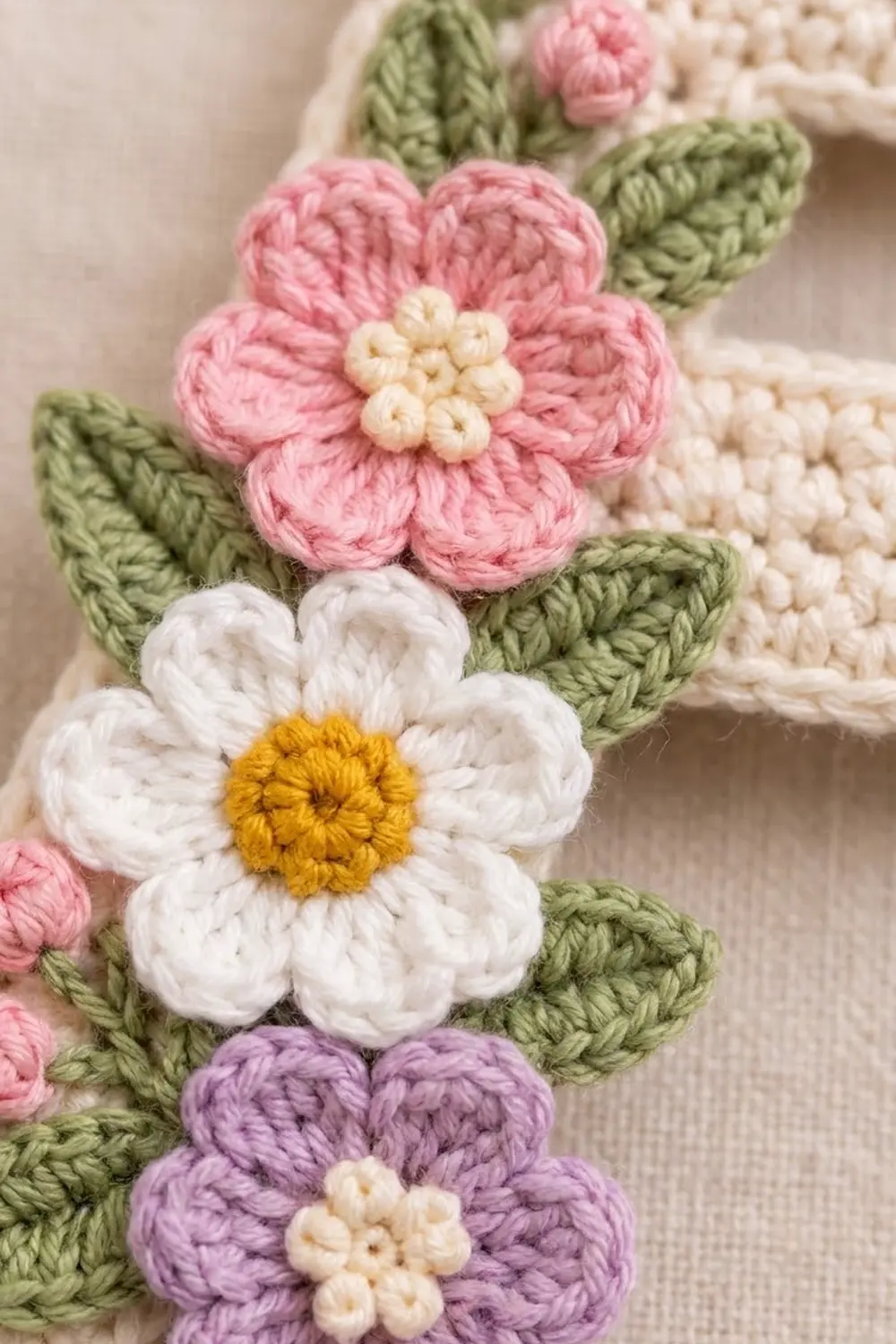
This little keychain is a flat, cream letter F with a tiny spring bouquet climbing up its stem. A pink flower, a white flower with a mustard center and a lilac flower sit stacked down the upright, tucked between sage green leaves and small pink buds. A neat raised outline frames the whole letter, so it looks crisp clipped to a bag handle or a set of keys.
The base is worked in dense single crochet, which gives a firm, slightly pebbled fabric that holds its shape. The flowers are worked separately and sewn on, so you can swap colors or rearrange the bouquet without touching the letter itself.
This pattern uses US crochet terms throughout. The finished letter measures 3 in (7.6 cm) wide and 4 in (10.2 cm) tall, not counting the hardware.
Construction is simple. You crochet the F in rows from the bottom up, adding chains to build the two arms. Then one round of single crochet and one round of slip stitch outline the letter. Finally, you make three flowers, seven leaves and four buds, sew them along the stem, and attach a gold chain and split ring.
Finished Size and Construction
- Finished size: 3 in (7.6 cm) wide x 4 in (10.2 cm) tall
- Skill level: Easy to intermediate
- Terminology: US crochet terms
- Yarn weight: Sport / 4-ply cotton (#2 fine)
- Hook: 2.75 mm (US C-2)
- Number of pieces: 1 letter base, plus 3 flowers, 7 leaves and 4 buds sewn on as appliqué
- Layout: A single letter F, with the flowers stacked vertically along the stem
- Base size before border: 2.5 in (6.4 cm) wide x 3.5 in (8.9 cm) tall
- Stem width before border: 1 in (2.5 cm)
- Border depth: about 0.25 in (0.6 cm) per side
Materials
Use a smooth mercerized or combed cotton in sport weight. Cotton gives clean stitch definition and resists stretching on a keychain that gets handled every day. Avoid fuzzy or very splitty yarns, because the appliqués are small and need sharp edges.
- Cream (letter base, pink and lilac flower centers): 4 g / 12 m
- Pink (large flower and buds): 2 g / 6 m
- Sage green (leaves): 2 g / 6 m
- Lilac (flower): 1 g / 3 m
- White (flower): 1 g / 3 m
- Mustard yellow (white flower center): 1 g / 3 m
These quantities include a margin of about 30% for swatching and weaving in. Scraps work for every color except cream.
Tools:
- 2.75 mm (US C-2) crochet hook
- Sharp-pointed tapestry needle for sewing the appliqués
- Stitch markers
- Gold split key ring, 1 in (2.5 cm) diameter
- Gold curb chain, about 1.5 in (3.8 cm)
- Two 6 mm gold jump rings and two pairs of flat-nose pliers
- Blocking mat, rust-proof pins and a spray bottle
- Ruler or tape measure
- Optional: fabric glue to secure the knots behind the appliqués
Abbreviations (US Terms)
- ch: chain
- sl st: slip stitch
- sc: single crochet
- hdc: half double crochet
- dc: double crochet
- sc2tog: single crochet 2 together
- st(s): stitch(es)
- BLO: back loop only
- MR: magic ring
- RS: right side
- 4-dc cluster: (yo, insert hook, yo, pull up a loop, yo, draw through 2 loops) 4 times in the same place, then yo and draw through all 5 loops on the hook.
- Standing sc: with a slip knot on the hook, insert hook into the stitch, yo, pull up a loop, yo, draw through both loops.
Gauge and Checkpoints
Gauge: 6 sc and 6 rows = 1 in (2.5 cm) in sc worked in rows.
Gauge matters here because the border math depends on stitches and rows being the same size. Before you start, crochet a test square: ch 13, sc in the 2nd ch from the hook and across (12 sc), then work 11 more rows. It should measure 2 in (5.1 cm) square.
If your square is too big, go down one hook size. If it is too small, go up one size. If your stitches match but your rows do not, change how high you pull up your loops rather than changing the hook.
Checkpoints during the base:
- After Row 1: 6 sc = 1 in (2.5 cm) wide
- After Row 6: the stem is 1 in (2.5 cm) tall
- After Row 8: the middle bar is 2 in (5.1 cm) wide
- After Row 15: the piece is 2.5 in (6.4 cm) tall
- After Row 16: the top bar is 2.5 in (6.4 cm) wide
- After Row 21: the piece is 2.5 in (6.4 cm) wide x 3.5 in (8.9 cm) tall
- After the border: the piece is 3 in (7.6 cm) wide x 4 in (10.2 cm) tall
Letter F Base
The F is worked flat in rows from the bottom of the stem upward. The ch 1 at the start of each row does not count as a stitch.
The arms always grow from the edge where the odd-numbered rows end, which is the same edge as the foundation tail. Lay the piece with that edge on the right, and the face toward you is the RS. Single crochet looks nearly the same on both faces, so the RS is mainly your reference for placing the appliqués later.
Stem
With cream, ch 7.
Row 1: Sc in 2nd ch from hook and in each ch across, turn. (6 sc)
Rows 2–7: Ch 1, sc in each st across, turn. (6 sc)
At the end of Row 7, the working yarn sits on the arm edge. Do not turn yet.
Middle Bar
Row 8: Ch 7. Turn. Sc in 2nd ch from hook and in next 5 ch, then sc in each of the 6 stem sts. (12 sc: 6 arm + 6 stem)
Rows 9–10: Ch 1, turn, sc in each st across. (12 sc)
Row 10 ends on the outer edge of the stem. The middle bar is 3 rows tall, which is 0.5 in (1.3 cm), and extends 1 in (2.5 cm) beyond the stem.
Gap Section
Row 11: Ch 1, turn, sc in the first 6 sts only, leaving the 6 arm sts unworked. (6 sc)
Rows 12–15: Ch 1, turn, sc in each st across. (6 sc)
Row 15 ends on the arm edge again. Do not turn.
Top Bar
Row 16: Ch 10. Turn. Sc in 2nd ch from hook and in next 8 ch, then sc in each of the 6 stem sts. (15 sc: 9 arm + 6 stem)
Rows 17–21: Ch 1, turn, sc in each st across. (15 sc)
The top bar is 6 rows tall, which is 1 in (2.5 cm), and extends 1.5 in (3.8 cm) beyond the stem. Fasten off and weave in all tails.
Stitch check: The stem is 6 sc x 21 rows, the middle arm is 6 sc x 3 rows and the top arm is 9 sc x 6 rows. The width is 15 sc = 2.5 in (6.4 cm), and the height is 21 rows = 3.5 in (8.9 cm).
Flower Appliqués (make 3)
All three flowers use the same pattern. Each one finishes about 1 in (2.5 cm) across.
- Pink flower: cream center, pink petals
- White flower: mustard center, white petals
- Lilac flower: cream center, lilac petals
Round 1 (center color): MR, ch 1, 10 sc in ring, pull the ring closed, sl st to first sc. (10 sc) Fasten off.
Round 2 (petal color): Join with a sl st in any st. (Hdc, 3 dc, hdc) in next st, sl st in next st; repeat from * 4 more times, placing the last sl st in the joining st. (5 petals; 25 petal sts + 5 sl sts) Fasten off, leaving a 10 in (25.4 cm) tail for sewing.
On the two cream centers, embroider three tiny cream French knots over Round 1 to give a dotted, beaded look. The mustard center stays plain and slightly domed.
Leaf Appliqués (make 7)
With sage green, ch 6.
Side 1: Sc in 2nd ch from hook, hdc in next ch, dc in next ch, hdc in next ch, (sc, ch 2, sc) in last ch for the tip.
Side 2: Rotate and work along the opposite side of the foundation chain: hdc in next ch, dc in next ch, hdc in next ch, sc in the same ch as the first sc. Sl st to first sc. (10 sts plus ch-2 tip)
Each leaf is about 0.75 in (1.9 cm) long. Fasten off, leaving an 8 in (20.3 cm) tail. If you like, embroider a center vein with one long straight stitch in a slightly lighter green.
Bud Appliqués (make 4)
With pink: MR, ch 2, 4-dc cluster into ring, ch 1 to lock. Pull the ring tightly closed. (1 bud) Fasten off, leaving a 6 in (15.2 cm) tail.
Each bud is about 0.3 in (0.8 cm) wide.
Assembly and Hardware
Do this step after the border and blocking below are finished. Arrange the appliqués on the RS of the stem before sewing anything:
- Lilac flower: on the lower stem, about 0.75 in (1.9 cm) above the bottom edge, slightly overlapping the arm side
- White flower: directly above the lilac flower, just below the middle bar
- Pink flower: above the white flower, overlapping the place where the stem meets the middle bar
- Leaves: one on each side of the pink and white flowers, and one on the outer side of the lilac flower
- Buds: two near the top-left of the stem, stacked one above the other, and two on the outer edge beside the lilac flower
The flowers should touch or slightly overlap so the bouquet reads as one continuous spray. Tuck the leaf bases under the petals.
Sew the leaves first, then the buds, then the flowers on top. Use the tails and small whipstitches through the outer stitches of each appliqué. Catch only the front layer of the base so nothing shows on the back. Add short green straight stitches under the top buds for stems.
To attach the hardware, open a jump ring, pass it through the border at the top-left corner, and close it around the last link of the chain. Use the second jump ring to join the other end of the chain to the split ring.
Border
The border has two rounds. A single crochet round smooths the edges and squares the corners. A back-loop slip stitch round then creates the raised outline.
Border gauge: The border uses the same gauge as the base, 6 sc = 1 in (2.5 cm). Along the row edges, work 1 sc per row end.
Corners: The letter has 7 outer corners and 3 inner corners. At each outer corner, work 3 sc in the corner stitch (+2 sts). At each inner corner, sc2tog over the last stitch of one edge and the first stitch of the next (−1 st).
Round 1: With RS facing, join cream with a standing sc in the last st of Row 21 (the top-right corner of the top bar), then work 2 more sc in the same st. Continue counterclockwise:
| Edge | Worked into | Border sts |
|---|---|---|
| Top edge | 15 sts of Row 21 | 3 sc in first, 13 sc, 3 sc in last = 19 |
| Left side of stem | 21 row ends | 21 sc = 21 |
| Bottom of stem | 6 foundation sts | 3 sc in first, 4 sc, 3 sc in last = 10 |
| Lower stem, arm side | 7 row ends + 1st ch of middle arm | 6 sc, sc2tog = 7 |
| Underside of middle arm | remaining 5 ch | 4 sc, 3 sc in last = 7 |
| End of middle arm | 3 row ends | 3 sc = 3 |
| Top of middle arm | 6 unworked sts of Row 10 + 1st row end of Row 11 | 3 sc in first, 4 sc, sc2tog = 8 |
| Gap section, arm side | remaining 4 row ends + 1st ch of top arm | 3 sc, sc2tog = 4 |
| Underside of top arm | remaining 8 ch | 7 sc, 3 sc in last = 10 |
| End of top arm | 6 row ends | 6 sc = 6 |
Sl st to the first sc. (95 sc)
Why the math works: The raw edges give 84 places to work: 6 + 7 + 6 + 3 + 6 + 5 + 9 + 6 + 15 + 21. The seven outer corners add 2 sts each (+14), and the three inner corners take away 1 each (−3). That gives 84 + 14 − 3 = 95. Because stitch gauge and row gauge are equal, 1 sc per row end lies flat without ruffling or pulling.
Round 2: Ch 1, sl st in the BLO of each st around, keeping your tension relaxed. Sl st to the first sl st. (95 sl sts) Fasten off and weave in the tails.
Checkpoint: The letter now measures 3 in (7.6 cm) x 4 in (10.2 cm), and the gap between the two arms is still clearly open.
Final Blocking
- Lightly mist the base with water until it is damp, not soaked.
- Pin it flat on the blocking mat, RS up, with the arms pointing right.
- Pin all 7 outer corners so each one is sharp and square.
- Check the width at 3 in (7.6 cm) across the top bar and the height at 4 in (10.2 cm).
- Check that the stem is straight and both arms are parallel.
- Let it dry completely, for at least 4 hours.
- Block the flowers and leaves separately: pin each petal tip and leaf point, mist, and let dry.
- Unpin everything and complete the Assembly and Hardware section.
Final Quality-Control Checklist
- The base measures 3 in (7.6 cm) x 4 in (10.2 cm).
- The border round has 95 sts with no gaps at the inner corners.
- All 7 outer corners are sharp.
- The gap between the arms is open and even.
- All 3 flowers, 7 leaves and 4 buds are securely sewn.
- No stitching shows on the back.
- The jump rings are fully closed with no gap.
- All tails are woven in and trimmed.
Troubleshooting
The arms grew from the wrong side. You turned before chaining. Rip back to the end of Row 7 or Row 15 and make the chain before turning.
The border ruffles along the stem. Your rows are taller than your stitches are wide. Skip 1 row end every 8 rows on the long edges, and write down your new total.
The inner corners have holes. Work the sc2tog more tightly, or close the gap with a stitch from a tail.
The petals cup instead of lying flat. Pin them open while blocking, or work Round 1 with 11 sc.
The leaf tips are rounded. Pull the ch-2 tip snug and pin it to a point while blocking.
The keychain twists on its chain. Pass the jump ring through both loops of the border, not just one.
Care
Hand wash gently in cool water with mild soap, press the water out in a towel, and dry flat. Keep it away from high heat, especially if you used glue.

Final Notes
Every size in this keychain follows from your gauge. At 6 sc and 6 rows per 1 in (2.5 cm), the stem is 1 in (2.5 cm) wide. The 15-stitch top bar and 21 rows make a base of 2.5 in (6.4 cm) x 3.5 in (8.9 cm). The 95-stitch border adds about 0.25 in (0.6 cm) per side, for a finished letter of 3 in (7.6 cm) x 4 in (10.2 cm). The three 1 in (2.5 cm) flowers fit neatly along the stem.
Check your gauge first and count at each checkpoint, and the letter will come out as planned. The same method works for other initials if you map them in 6-stitch strokes.
Happy crocheting!