

The Sage Meadow Butterfly is a lacy butterfly appliqué in soft sage green. Each of the four wings has an open teardrop window ringed with solid stitches. Around that window is a fan of tall spokes, then a firm single crochet edge. The two upper wings end in three soft scallops, and the two lower wings have a smooth rounded edge.
A raised, ridged body runs down the center. Two slip-stitch antennae end in small bobble knobs. The look is light, airy, and botanical. Use it as a curtain tie-back accent, a wall decoration, or a bag embellishment.
This pattern uses US crochet terms. The finished butterfly measures 6 in (15.2 cm) across the wings and 5 in (12.7 cm) tall, not counting the antennae.
You make the four wings separately, each in four short rounds. Next you crochet a small stuffed body in a spiral and add the antennae directly to the head. Finally, you sew the wing tips together and stitch the body on top.
Finished Size and Construction
- Finished size: 6 in (15.2 cm) wide x 5 in (12.7 cm) tall
- Skill level: Easy-intermediate
- Terminology: US
- Yarn weight: DK (#3) cotton or cotton blend
- Hook: 3.5 mm (E-4)
- Number of pieces: 5 (2 upper wings, 2 lower wings, 1 body with antennae)
- Layout: upper wings angled up and out, lower wings angled down and out, body centered on top
- Upper wing size: 3 in (7.6 cm) long x 2.25 in (5.7 cm) wide
- Lower wing size: 2.5 in (6.4 cm) long x 1.75 in (4.4 cm) wide
- Size before border: upper wing 2.25 in (5.7 cm) x 1.5 in (3.8 cm); lower wing 1.75 in (4.4 cm) x 1 in (2.5 cm)
- Border depth: about 0.375 in (1.0 cm) per edge (2 rounds)
- Body: 3.5 in (8.9 cm) long, about 0.75 in (1.9 cm) across
Materials
Mercerized or matte cotton in DK weight gives the crisp stitch definition shown here. The spokes stand up cleanly and the piece blocks flat. Avoid fuzzy or very stretchy yarns, which blur the openwork.
- Sage green DK cotton: 15 g (about 35 m / 38 yd)
- 3.5 mm (E-4) crochet hook
- Tapestry needle
- Scissors
- Stitch marker
- A small pinch of fiberfill or matching yarn scraps
- Rustproof pins and a blocking mat
- Spray bottle
The yarn quantity includes a margin of about 20 percent for swatching and sewing tails.
Abbreviations (US Terms)
- ch: chain
- sl st: slip stitch
- sc: single crochet
- hdc: half double crochet
- dc: double crochet
- tr: treble crochet
- sc2tog: single crochet 2 together
- BLO: back loop only
- sp: space
- st(s): stitch(es)
Special stitch: 5-dc bobble. [Yo, insert hook in indicated st, yo and pull up a loop, yo and draw through 2 loops] 5 times in the same st. Then yo and draw through all 6 loops on the hook.
Gauge and Checkpoints
Gauge: 20 sc and 22 rows = 4 in (10.2 cm) with a 3.5 mm hook.
Make one lower wing first and measure it at each stage:
- Lower wing after Round 1: 1.25 in (3.2 cm) long x 0.5 in (1.3 cm) wide
- Lower wing after Round 2: 1.75 in (4.4 cm) x 1 in (2.5 cm)
- Lower wing after Round 4: 2.5 in (6.4 cm) x 1.75 in (4.4 cm)
- Upper wing after Round 1: 1.5 in (3.8 cm) x 0.75 in (1.9 cm)
- Upper wing after Round 2: 2.25 in (5.7 cm) x 1.5 in (3.8 cm)
- Upper wing after Round 4: 3 in (7.6 cm) x 2.25 in (5.7 cm)
If a wing is more than 0.25 in (0.6 cm) too big, switch to a 3.25 mm hook. If it is too small, switch to a 3.75 mm hook. Always measure after blocking, because damp cotton relaxes and the spokes lengthen slightly.
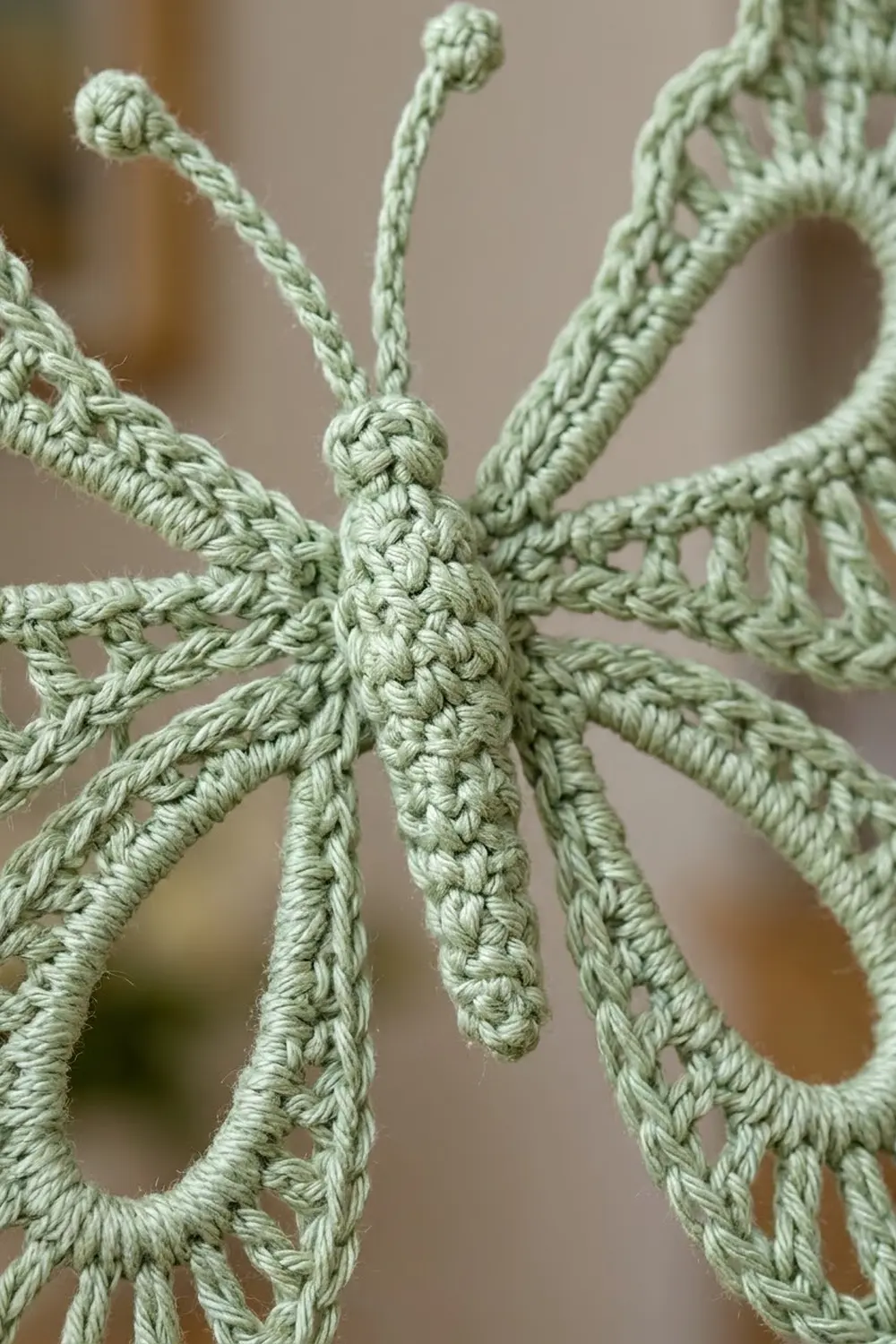
Lower Wing (Make 2)
The lower wing is a teardrop. Its narrow tip points toward the body, and the spokes sit around its rounded end.
Foundation: Ch 22, sl st in first ch to form a ring.
Round 1: Ch 1, work 30 sc into the ring, working over the chain. Sl st to first sc. (30 sts)
Packing 30 sc over 22 chains creates the thick, solid rim around the opening. Spread the stitches evenly around the loop. The sl st join marks the wing tip.
Round 2: Ch 1, sc in same st and next 4 sts, hdc in next st, [tr in next st, ch 1] 17 times, tr in next st, hdc in next st, sc in last 5 sts. Sl st to first sc. (47 sts: 10 sc, 2 hdc, 18 tr, 17 ch)
The short stitches at the tip and the tall trebles at the rounded end give the teardrop its shape, and the ch-1 gaps create the lacy fan. As a check, the stitches you worked into should add up to the full round: 5 + 1 + 18 + 1 + 5 = 30.
Don’t fasten off. Go straight to the Lower Wing Border.
Upper Wing (Make 2)
The upper wing is a larger teardrop with a scalloped outer edge.
Foundation: Ch 26, sl st in first ch to form a ring.
Round 1: Ch 1, work 36 sc into the ring, working over the chain. Sl st to first sc. (36 sts)
Round 2: Ch 1, sc in same st and next 5 sts, hdc in next st, [tr in next st, ch 1] 21 times, tr in next st, hdc in next st, sc in last 6 sts. Sl st to first sc. (57 sts: 12 sc, 2 hdc, 22 tr, 21 ch)
Check: 6 + 1 + 22 + 1 + 6 = 36 stitches worked into.
Don’t fasten off. Go straight to the Upper Wing Border.
Body with Antennae (Make 1)
The body is worked in a continuous spiral from head to tail. Mark the first st of each round with the stitch marker.
Head
Round 1: Ch 2, 6 sc in 2nd ch from hook. (6 sts)
Round 2: 2 sc in each st. (12 sts)
Round 3: Sc in each st. (12 sts)
Round 4: [Sc in next st, sc2tog] 4 times. (8 sts)
Thorax
Round 5: [Sc in next st, 2 sc in next st] 4 times. (12 sts)
Rounds 6–7: Sc in each st. (12 sts)
Round 8: [Sc in next st, sc2tog] 4 times. (8 sts)
Stuff the head and thorax lightly. They should feel firm but stay oval.
Abdomen
Rounds 9, 11, 13, 15: Sc in BLO of each st. (8 sts)
Rounds 10, 12, 14, 16: Sc in both loops of each st. (8 sts)
Each BLO round leaves a ring of unused front loops on the surface. Those rings form the ridges across the abdomen.
Round 17: [Sc in next 2 sts, sc2tog] 2 times. (6 sts)
Round 18: Sc in each st. (6 sts)
Add a little stuffing to the abdomen.
Round 19: Sc2tog 3 times. (3 sts)
Fasten off, leaving a 12 in (30.5 cm) tail. Weave the tail through the last 3 sts and pull closed. Keep the rest of the tail for sewing.
Body checkpoint: 3.5 in (8.9 cm) long and about 0.75 in (1.9 cm) across the thorax.
Antennae
Join yarn with a sl st in a Round 2 st at the top of the head, just left of center. Ch 15, work a 5-dc bobble in 4th ch from hook, then sl st in each of the remaining 11 ch. Sl st back into the head and fasten off.
Make the second antenna the same way in a Round 2 st just right of center, with 2 sts between the antennae. Each antenna is about 1.5 in (3.8 cm) long. The ch-3 and the bobble together form the round knob at the tip.
Make All Pieces
Every piece uses the same sage green yarn:
- Upper wings: 2 (about 4 g each)
- Lower wings: 2 (about 2.5 g each)
- Body with antennae: 1 (about 2 g)
Order of work: crochet each wing through Round 2, add its two border rounds (see Border), block all four wings, then join.
Layout, seen from the front:
[Upper L]   head   [Upper R]
            body
            body
[Lower L]   tail   [Lower R]
Every wing tip (the Round 1 join point) points toward the center. The rounded, spoked ends point outward.
Joining
Method: Whipstitch the wings together with the yarn tails, then sew the body on top.
Stitch-to-stitch logic: Each wing’s tip zone is 6 sts centered on the join: the last 3 and first 3 sts of Round 4.
- Lay the left upper wing over the left lower wing so their tips overlap by about 0.5 in (1.3 cm). Whipstitch the 6 tip-zone sts of one wing to the 6 tip-zone sts of the other, matching them one to one. Repeat on the right side.
- Lay both wing pairs right side up with their tips touching at the center. Whipstitch the two innermost sts of each pair together.
- Center the body over the join, with the head just above the upper wing tips. Using the body tail, sew through the underside of Rounds 5–12 into the wing tip zones below. Make one stitch per body round on each side.
Tension: Pull each stitch just snug enough to close the gap. If you pull too tight, the tips pucker and the wings tilt forward.
Size checkpoint: The assembled butterfly should measure 6 in (15.2 cm) across the upper wings and 5 in (12.7 cm) from the top of the upper wings to the bottom of the lower wings.
Border
Work these border rounds on each wing right after its Round 2, before joining. They are grouped here so all the edge math is in one place.
Border gauge: Each sc round adds about 0.1875 in (0.5 cm), so the two rounds add about 0.375 in (1.0 cm) per edge.
Lower Wing Border
Round 3: Ch 1, sc in first 6 sts (5 sc + hdc), [sc in next tr, sc in next ch-1 sp] 17 times, sc in last tr, sc in hdc, sc in last 5 sc. Sl st to first sc. (47 sts = 47 worked 1-per-existing-st + 0 added)
By zone: 12 sc at the tip (6 on each side) and 35 sc around the spokes.
Round 4: Ch 1, sc in first 11 sts, [sc in next 2 sts, 2 sc in next st, sc in next 2 sts] 5 times, sc in last 11 sts. Sl st to first sc. (52 sts = 47 worked 1-per-existing-st + 5 added)
By zone: 11 sc on each straight side and 30 sc around the curve. Fasten off, leaving a 10 in (25.4 cm) tail.
Upper Wing Border
Round 3: Ch 1, sc in first 7 sts, [sc in next tr, sc in next ch-1 sp] 21 times, sc in last tr, sc in hdc, sc in last 6 sc. Sl st to first sc. (57 sts = 57 worked 1-per-existing-st + 0 added)
Round 4 (scallops): Ch 1, sc in first 8 sts.
Lobe: sc in next st, hdc in next st, dc in next 2 sts, 2 dc in each of next 5 sts, dc in next 2 sts, hdc in next st, sc in next st.
Sl st in next st, work a second Lobe, sl st in next st, then work a third Lobe. Sc in last 8 sts. Sl st to first sc. (72 sts = 57 worked 1-per-existing-st + 15 added)
Each lobe is worked over 13 sts and makes 18 sts. Fasten off, leaving a 10 in (25.4 cm) tail.
Why the math works: On the upper wing, Round 3 has 7 sts at the start and 7 at the end, so its curved edge holds 57 − 14 = 43 sts. Round 4 adds 1 extra sc at each end of the curve, which leaves 41 sts for 3 lobes (39 sts) and 2 sl st valleys (2 sts). That gives 8 + 41 + 8 = 57 sts worked into. Each lobe adds 5 sts, so 57 + 15 = 72.
On the lower wing, the 5 increases fall on sts 14, 19, 24, 29, and 34. Stitch 24 is the center of the rounded end, so the increases are centered and the edge lies flat without ruffling.
Final Blocking
- Weave in all remaining ends.
- Spritz the butterfly until it is evenly damp but not dripping.
- Lay it right side up on the blocking mat.
- Pin the upper wings to 3 in (7.6 cm) x 2.25 in (5.7 cm) and the lower wings to 2.5 in (6.4 cm) x 1.75 in (4.4 cm).
- Pin each scallop valley so the three lobes stay distinct.
- Open each teardrop window with a fingertip, and straighten every spoke so it points outward from the opening.
- Arrange the antennae in a slight V.
- Let the butterfly dry completely before unpinning.
Final Quality-Control Checklist
- Wingspan is 6 in (15.2 cm) and height is 5 in (12.7 cm)
- Lower wings have 52 sts and upper wings have 72 sts in Round 4
- Each upper wing has three even lobes
- All teardrop windows are open and about the same size
- Spokes are evenly spaced, with no skipped ch-1 spaces
- The abdomen shows 4 clear ridges
- The antennae are the same length and both knobs are round
- No sewing stitches show on the front
Troubleshooting
Round 1 ruffles. Spread the stitches more evenly along the chain, or make the foundation chain with a larger hook.
Teardrop looks round instead of pointed. Make sure the sc and hdc stitches sit at the sl st join.
Spoke edge cups. Your trebles are too short. Pull each loop up a little taller.
Scallops look flat. Check that each lobe has exactly 5 increases, then pin the valleys firmly when blocking.
Body twists. A spiral naturally twists. Rotate the body so the ridges sit straight before you sew it down.
Wings droop when hung. Add a tacking stitch from each tip zone into the body.
Care
Hand wash in cool water with mild soap, roll in a towel to remove water, and dry flat. Don’t tumble dry, because it distorts the spokes and scallops.
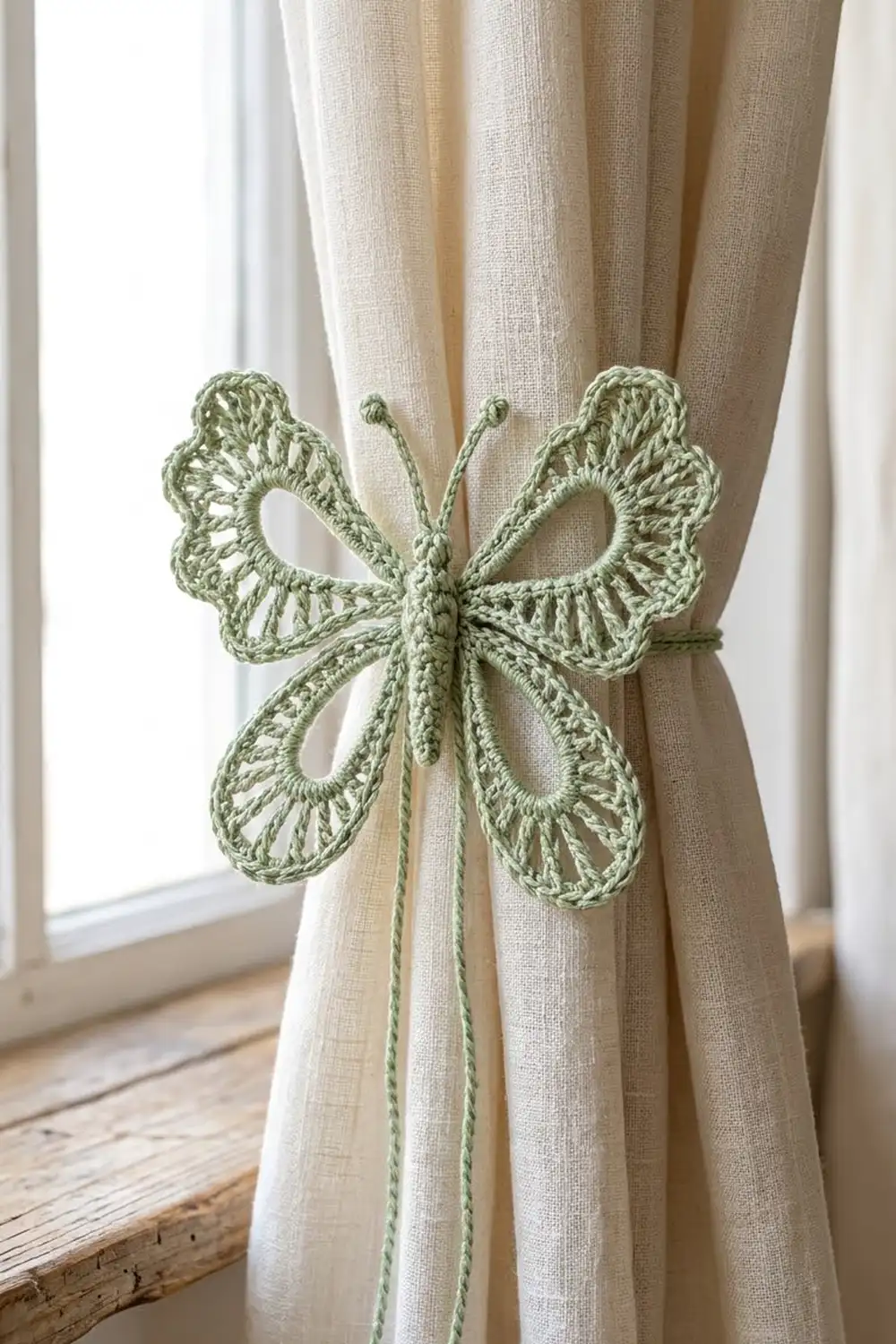
Final Notes
At 20 sc per 4 in (10.2 cm), the wing cores measure 1.75 in (4.4 cm) x 1 in (2.5 cm) for the lower wings and 2.25 in (5.7 cm) x 1.5 in (3.8 cm) for the upper wings. Two border rounds add 0.375 in (1.0 cm) per edge, so the finished wings are 2.5 in (6.4 cm) and 3 in (7.6 cm) long. Joined around the 3.5 in (8.9 cm) body, they make a butterfly 6 in (15.2 cm) wide by 5 in (12.7 cm) tall. Check each measurement as you go, and the finished piece will come out at the right size.
Happy crocheting!