

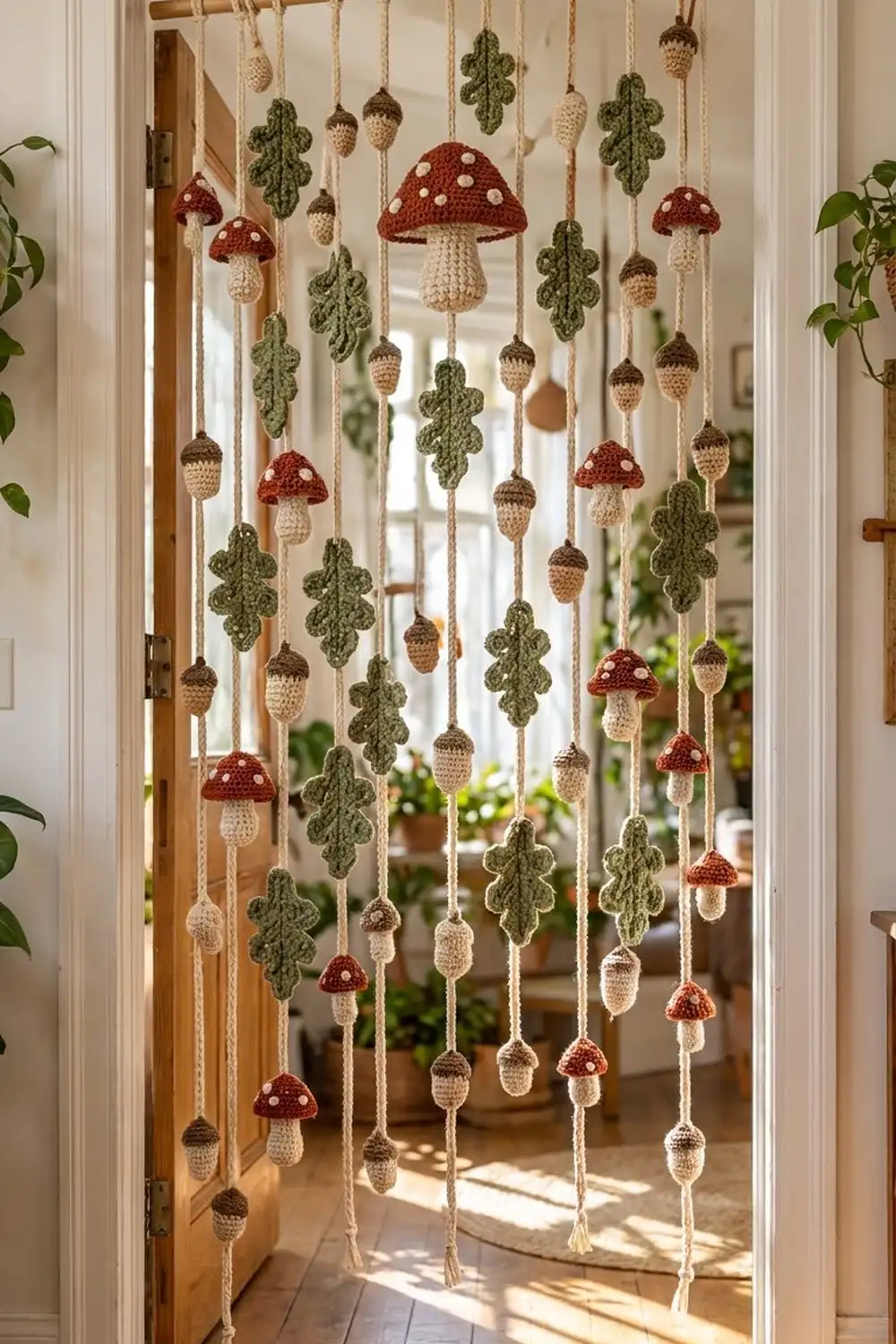
The Forest Floor Door Curtain turns a plain doorway into a woodland walk. Rust-red toadstools with cream spots, small cream-and-brown acorns, and lobed sage-green oak leaves hang on thick cream cords from a wooden dowel. Light passes between the strands, and the motifs sway when someone walks through.
The palette is warm and earthy: rust, cream, chocolate brown and sage green. The style is cottagecore amigurumi: firm single crochet, light stuffing and simple shapes that look good from both sides.
This pattern uses US crochet terms. The finished curtain is 32.5 in (82.6 cm) wide across the strands and hangs 72 in (182.9 cm) from the dowel to the cord ends, on a 36 in (91.4 cm) dowel.
For construction, you crochet each motif separately, make 14 slip-stitch cords, sew the motifs to the cords at measured stitch positions, then tie each cord onto the dowel. Because every motif position is counted in stitches, all the strands line up.
Finished Size and Construction
- Finished size: 32.5 in (82.6 cm) wide × 72 in (182.9 cm) drop
- Skill level: Intermediate (lots of repetition, small 3D shaping)
- Terminology: US
- Yarn weight: Worsted (#4), cotton or cotton blend
- Hooks: 3.5 mm (E-4) for motifs; 5.0 mm (H-8) for cords
- Number of pieces: 196 motifs (98 leaves, 49 acorns, 49 toadstools) + 294 spots + 14 cords
- Layout: 14 strands × 14 motifs per strand
- Piece sizes: Toadstool 2.5 in (6.4 cm) tall, cap 2 in (5.1 cm) wide; acorn 1.5 in (3.8 cm) tall × 1.1 in (2.8 cm) wide; leaf 3.5 in (8.9 cm) including the stem
- Size before border: Not applicable. The curtain has no crocheted border, and the header spacing sets its width.
- Border depth: 0 in (0 cm). The dowel and cord knots finish the edges.
Materials
Choose a smooth, firm worsted-weight cotton or cotton blend. Cotton keeps its shape, shows stitch definition, and stretches less than acrylic under hanging weight. The amounts below assume about 95 m per 50 g.
- Cream (cords, stems, spots, acorn bodies): 575 g / 1,093 m
- Rust (toadstool caps): 225 g / 428 m
- Sage green (oak leaves): 200 g / 380 m
- Chocolate brown (acorn caps): 75 g / 143 m
All quantities include a margin of about 15% for gauge differences and sewing tails.
Tools:
– 3.5 mm (E-4) and 5.0 mm (H-8) crochet hooks
– About 200 g polyester fiberfill
– Tapestry needle
– 14+ removable stitch markers
– Wooden dowel, 36 in (91.4 cm) long and 1 in (2.5 cm) in diameter, plus two cup hooks or brackets
– Tape measure, scissors, pins and a spray bottle
Abbreviations (US Terms)
- ch – chain
- sl st – slip stitch
- sc – single crochet
- hdc – half double crochet
- dc – double crochet
- inc – 2 sc in the same stitch
- dec – single crochet 2 together (invisible decrease recommended)
- MR – magic ring
- BLO / FLO – back loop only / front loop only
- st(s) – stitch(es)
Special stitch – Slip-stitch cord: Chain the required length. Then sl st into the back bump of each chain. This makes a firm, round cord that resists twisting.
Gauge and Checkpoints
Motif gauge: 20 sc and 22 rounds = 4 in (10.2 cm) with a 3.5 mm hook, worked in continuous rounds.
Cord gauge: 12 sl st = 4 in (10.2 cm) with yarn held double and a 5.0 mm hook.
Make one of each motif and one cord before you start the batch, then check these points:
- Toadstool cap after Rnd 5: a flat circle 1.9 in (4.8 cm) across
- Finished toadstool: 2.5 in (6.4 cm) tall
- Leaf after Rnd 1: 2.5 in (6.4 cm) long × 0.6 in (1.5 cm) wide
- Leaf after Rnd 2: 2.75 in (7.0 cm) long × 1.75 in (4.4 cm) wide, not counting the stem
- Acorn: 1.5 in (3.8 cm) tall
- Cord: 246 sl st = 82 in (208.3 cm)
If your motifs are too big, use a 3.25 mm hook. If they’re too small, use a 3.75 mm hook. Motif size can vary by about 0.25 in (0.6 cm) without hurting the design.
Cord gauge matters more, because it controls where the motifs sit. If 12 sl st measure more than 4 in (10.2 cm), use a 4.5 mm hook. If they measure less, use a 5.5 mm hook.
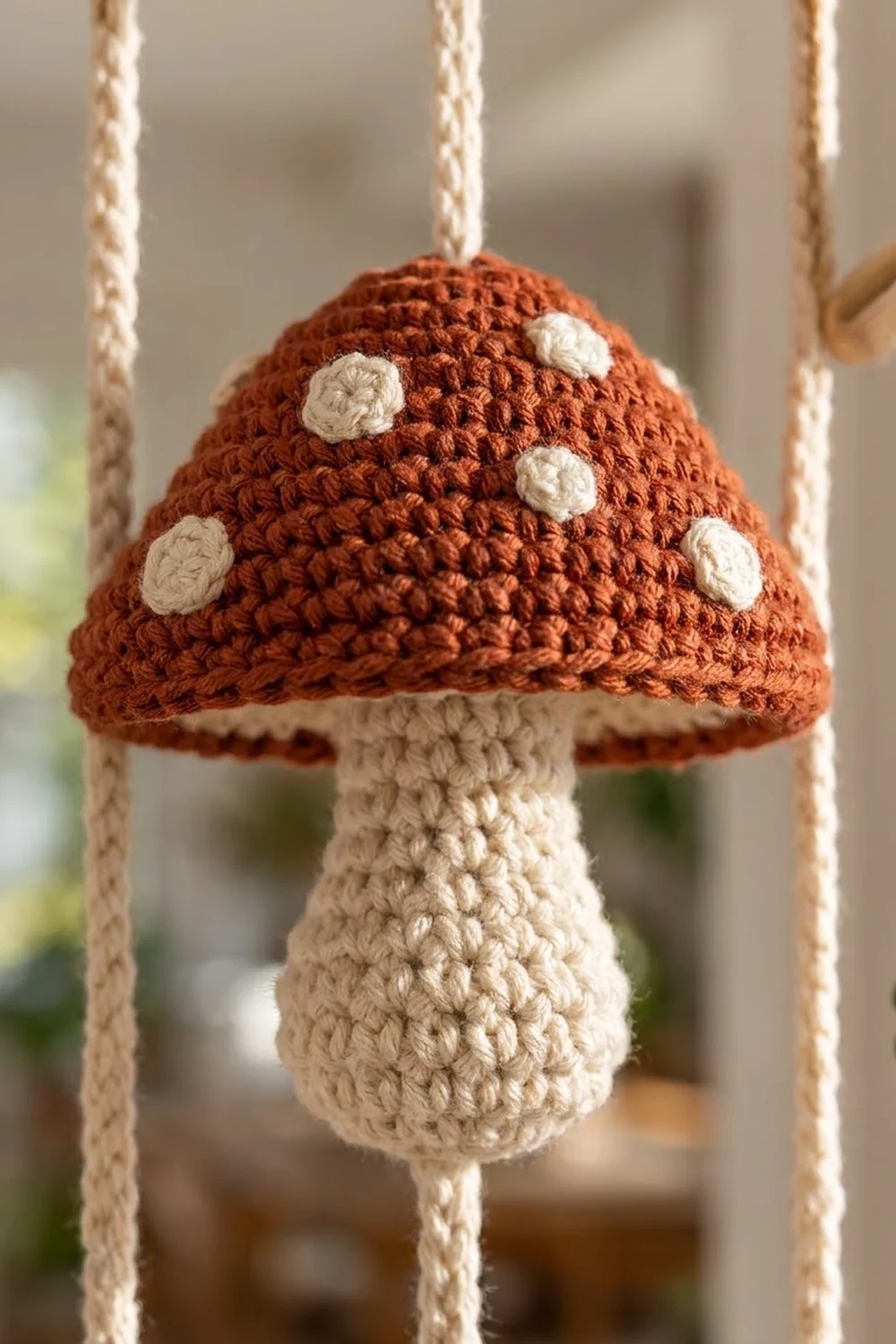
Toadstool (Make 49)
Cap (Rust, 3.5 mm hook)
Work in continuous rounds without joining. Mark the first stitch of each round.
- Rnd 1: 6 sc in MR. (6)
- Rnd 2: inc in each st around. (12)
- Rnd 3: (sc, inc) 6 times. (18)
- Rnd 4: (2 sc, inc) 6 times. (24)
- Rnd 5: (3 sc, inc) 6 times. (30)
Checkpoint: the piece is 1.9 in (4.8 cm) across.
- Rnds 6–9: sc in each st around. (30 per round) This straight section forms the dome.
- Rnd 10: working in BLO, (3 sc, dec) 6 times. (24) The unused front loops of Rnd 9 form the lip under the cap.
- Rnd 11: (2 sc, dec) 6 times. (18)
- Rnd 12: (sc, dec) 6 times. (12)
Stuff the dome lightly so it stays rounded but doesn’t bulge. Fasten off and leave a 12 in (30.5 cm) tail.
Spots (Cream, 3.5 mm hook, make 6 per toadstool)
- Rnd 1: 5 sc in MR, pull the ring tight, sl st to the first sc. (5)
Fasten off and leave a 6 in (15.2 cm) tail. Each spot is about 0.4 in (1.0 cm) across.
Sew 6 spots onto each cap: 1 near the top center and 5 spaced evenly around Rnds 5–8. Use both tails to stitch around the edge of each spot, then knot the tails inside the cap.
Stem (Cream, 3.5 mm hook)
- Rnd 1: 6 sc in MR. (6)
- Rnd 2: inc in each st around. (12)
- Rnd 3: (sc, inc) 6 times. (18)
- Rnd 4: working in BLO, sc in each st around. (18) This makes a flat base.
- Rnds 5–6: sc in each st around. (18 per round)
- Rnd 7: (4 sc, dec) 3 times. (15)
- Rnds 8–9: sc in each st around. (15 per round)
- Rnd 10: (3 sc, dec) 3 times. (12)
- Rnds 11–12: sc in each st around. (12 per round)
Stuff firmly and fasten off.
Assembly: Push the top of the stem into the cap opening. Whipstitch stem Rnd 12 (12 sts) to cap Rnd 12 (12 sts), one stitch to one stitch, using the cap tail. Keep the rest of the tail for sewing the toadstool to its cord.
Checkpoint: 2.5 in (6.4 cm) tall, cap 2 in (5.1 cm) wide, cap 1.25 in (3.2 cm) deep, stem base 1.1 in (2.8 cm) wide.
Acorn (Make 49)
Body (Cream, 3.5 mm hook)
- Rnd 1: 6 sc in MR. (6) This is the bottom tip.
- Rnd 2: inc in each st around. (12)
- Rnd 3: (sc, inc) 6 times. (18)
- Rnds 4–7: sc in each st around. (18 per round)
- Rnd 8: (sc, dec) 6 times. (12) Stuff.
- Rnd 9: dec 6 times. (6)
Close the top and fasten off.
Cap (Brown, 3.5 mm hook)
- Rnd 1: 6 sc in MR. (6)
- Rnd 2: inc in each st around. (12)
- Rnd 3: (sc, inc) 6 times. (18)
- Rnds 4–5: sc in each st around. (18 per round)
Fasten off and leave a 12 in (30.5 cm) tail.
Assembly: Place the cap over the closed top of the body. Whipstitch the cap edge (18 sts) to body Rnd 6 (18 sts), one stitch to one stitch. Keep the tail for sewing the acorn to its cord.
Checkpoint: 1.5 in (3.8 cm) tall × 1.1 in (2.8 cm) wide.
Oak Leaf (Make 98)
Sage Green, 3.5 mm hook
Ch 13.
Rnd 1:
1. Sc in the 2nd ch from the hook and in the next 10 ch. (11 sc)
2. Work 3 sc in the last ch. This is the tip.
3. Rotate and work along the other side of the foundation: sc in the next 10 ch.
4. Work 2 sc in the last ch. This ch already holds the first sc, so it now has 3 sc in total.
5. Join with a sl st to the first sc.
Count: 11 + 3 + 10 + 2 = 26 sts. For reference, st 1 is at the base, sts 2–11 run up side A, sts 12–14 form the tip, sts 15–24 run down side B, and sts 25–26 finish the base.
Checkpoint: 2.5 in (6.4 cm) long × 0.6 in (1.5 cm) wide.
Rnd 2 (lobes):
1. Ch 1 (does not count as a stitch). Sl st in the same st (st 1).
2. Side A: [sl st in next st, (hdc, 2 dc) in next st, (2 dc, hdc) in next st] 3 times, sl st in next st. This uses 10 sts and makes 3 lobes. (22 sts)
3. Tip: sc in next st, (hdc, dc, hdc) in next st, sc in next st. (5 sts)
4. Side B: repeat the Side A instructions. (22 sts)
5. Base and stem: sl st in each of the next 2 sts (2 sts). Ch 5, then sl st in the 2nd ch from the hook and in the next 3 ch to make the stem.
6. Join with a sl st to the first sl st of the round.
Rnd 2 total: 1 + 22 + 5 + 22 + 2 = 52 edge sts, plus the stem.
Each lobe is 6 sts worked into 2 Rnd 1 stitches. The sl sts between lobes pull in tightly, which makes the rounded oak-leaf scallops.
Fasten off and leave a 12 in (30.5 cm) tail at the stem.
Checkpoint: 2.75 in (7.0 cm) long × 1.75 in (4.4 cm) wide, plus a 0.75 in (1.9 cm) stem. Total length is 3.5 in (8.9 cm).
Cords (Make 14)
Use cream yarn held double and the 5.0 mm hook.
- Ch 247.
- Sl st in the back bump of the 2nd ch from the hook and of each ch across. (246 sl st)
- Fasten off and weave in the ends.
Checkpoint: 82 in (208.3 cm) long.
The length breaks down as follows:
– Sts 1–24: tie allowance, 8 in (20.3 cm)
– Sts 25–240: the 72 in (182.9 cm) drop
– Sts 241–246: end knot allowance, 2 in (5.1 cm)
Make All Pieces
Each strand holds 14 motifs. There are two strand types, and they alternate across the dowel.
- Odd strands (1, 3, 5, 7, 9, 11, 13): L A L M L A L M L A L M L A. That’s 7 leaves, 4 acorns and 3 toadstools per strand.
- Even strands (2, 4, 6, 8, 10, 12, 14): L M L A L M L A L M L A L M. That’s 7 leaves, 3 acorns and 4 toadstools per strand.
Totals:
– Leaves: 14 × 7 = 98
– Acorns: (7 × 4) + (7 × 3) = 49
– Toadstools: (7 × 3) + (7 × 4) = 49
– Spots: 49 × 6 = 294
Layout grid (columns are strands 1–14; rows are motif positions 1–14 from the top):
Pos  1:  L L L L L L L L L L L L L L
Pos  2:  A M A M A M A M A M A M A M
Pos  3:  L L L L L L L L L L L L L L
Pos  4:  M A M A M A M A M A M A M A
Pos  5:  L L L L L L L L L L L L L L
Pos  6:  A M A M A M A M A M A M A M
Pos  7:  L L L L L L L L L L L L L L
Pos  8:  M A M A M A M A M A M A M A
Pos  9:  L L L L L L L L L L L L L L
Pos 10:  A M A M A M A M A M A M A M
Pos 11:  L L L L L L L L L L L L L L
Pos 12:  M A M A M A M A M A M A M A
Pos 13:  L L L L L L L L L L L L L L
Pos 14:  A M A M A M A M A M A M A M
The rows of leaves keep the curtain green. Between them, toadstools and acorns alternate in a checkerboard, so no two toadstools sit side by side.
Joining (Attaching Motifs to Cords)
Method: Sew each motif to the center of the cord with its own long tail. Pass the needle through the sl-st ridge of the cord and then through the motif several times. Knot the tail inside the motif and bury the end.
Stitch-to-stitch logic: St 24 sits at the underside of the dowel. Motif 1 starts 4 in (10.2 cm) below the dowel, at 3 sts per inch, so its marker goes at st 24 + 12 = st 36. After that, the motifs are 5 in (12.7 cm) apart, which is 15 sts.
Place markers counting from the beginning tail end of the cord: 36, 51, 66, 81, 96, 111, 126, 141, 156, 171, 186, 201, 216, 231. That’s 14 markers.
The last marker is 69 in (175.3 cm) below the dowel. The marker shows the top of each motif:
- Toadstool: stitch the top center of the cap to the marker, then tack the back of the stem to the cord.
- Acorn: stitch the top of the cap to the marker, then tack the back of the body to the cord.
- Leaf: stitch the stem tip to the marker, then sew along the back of the center spine so the leaf lies flat against the cord.
Tension: Pull the sewing stitches snug but not tight. If the cord puckers, the spacing will shrink.
Size checkpoint: Hang one finished strand from a hook at st 24. Tie an overhand knot so its top sits at st 240, and leave the extra cord below as a short tail.
The strand should measure 72 in (182.9 cm) from the hook to the knot. Cotton can relax by up to 1 in (2.5 cm). If yours stretches more than that, retie the knot higher on all the strands to match.
Border (Header and Edge Finish)
This curtain has no crocheted border. The dowel header sets its width, and the end knots finish the bottom edge.
Header gauge: The cords are spaced 2.5 in (6.4 cm) apart, center to center.
- Mark the dowel 1.75 in (4.4 cm) in from the left end.
- Mark 13 more points, 2.5 in (6.4 cm) apart. The 14th mark sits 1.75 in (4.4 cm) from the right end.
- Wrap the tie allowance (sts 1–24) of each cord once around the dowel at its mark.
- Knot the tail around the hanging cord just below the dowel. Adjust the knot so st 24 sits at the dowel’s underside.
Why the math works: 14 strands create 13 gaps, and 13 × 2.5 in = 32.5 in (82.6 cm). Adding the two margins gives 32.5 + 1.75 + 1.75 = 36 in (91.4 cm), which is exactly the length of the dowel.
The widest motif, the toadstool cap at 2 in (5.1 cm), is narrower than the 2.5 in (6.4 cm) spacing. That leaves at least 0.5 in (1.3 cm) of clearance, so neighboring motifs don’t tangle.
Final Blocking
- Mist the leaves lightly before or after you sew them on.
- Pin each leaf flat and open each lobe with your fingers. Let them dry.
- Don’t wet the toadstools or acorns. Reshape caps and stems by hand.
- Hang the finished curtain for 24 hours so the cords relax and straighten.
- Measure all 14 strands and retie any end knot that is more than 0.5 in (1.3 cm) off the 72 in (182.9 cm) drop.
Final Quality-Control Checklist
- All 14 cords are 246 sl st and 82 in (208.3 cm) long before tying.
- Each strand has 14 motifs at sts 36 through 231, in the correct odd or even sequence.
- Every toadstool has 6 spots, and each stem is sewn 12 sts to 12 sts.
- Every acorn cap is sewn 18 sts to 18 sts.
- Every leaf has 3 lobes on each side, a rounded tip and a stem.
- The cords are 2.5 in (6.4 cm) apart, with 1.75 in (4.4 cm) margins.
- All end knots sit 72 in (182.9 cm) below the dowel.
- All tails are knotted and buried inside the motifs.
Troubleshooting
- Cap is flat, not domed: Your tension may be loose in Rnds 6–9. Go down a hook size or add one more straight round.
- Stuffing shows through: Use invisible decreases, go down a hook size and stuff a little less.
- Leaf lobes are blurred: Pull the sl sts between the lobes firmly.
- Leaves curl: Mist and pin them flat, or press them with a warm iron through a cloth (cotton only).
- Cords twist: Hang the cords and let them untwist before you sew on the motifs. Always sew motifs to the same side of the cord.
- Strands are different lengths: Count the cord stitches again and retie the knots at st 240.
- Motifs flip sideways: Add a second tack stitch lower on the back of the motif.
Care
Dust the curtain with a cool hair dryer or a gentle shake. If it needs cleaning, spot clean the motifs by hand with mild soap and let the curtain dry while it hangs.
Final Notes
The measurement chain is straightforward. Gauge sets the motif sizes, and the cord gauge of 12 sl st per 4 in (10.2 cm) turns every position into a stitch count. Motifs start at st 36 and repeat every 15 sts, and the 14 strands sit 2.5 in (6.4 cm) apart for a 32.5 in (82.6 cm) × 72 in (182.9 cm) curtain on a 36 in (91.4 cm) dowel. Check each stage and your forest floor will hang evenly from the first strand to the last.
Happy crocheting!