

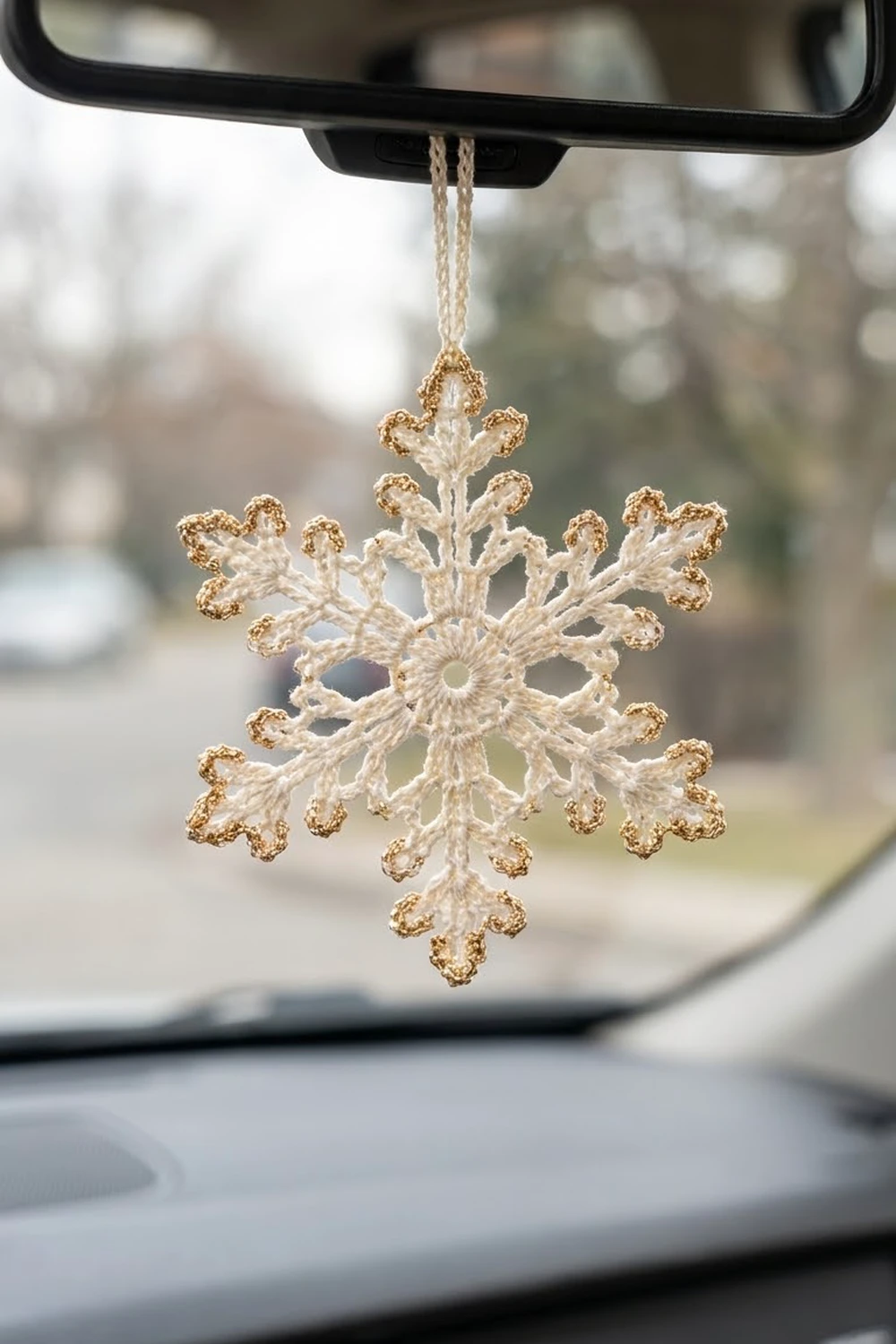
The Gilded Frost Snowflake is a lacy six-point ornament in soft cream thread. Every branch tip and point ends in a small gold-edged picot. It looks sharp hanging from a rearview mirror, a tree branch, or a window latch, and it catches the light in a subtle way.
The palette is simple: ivory cotton thread for the body and fine metallic gold thread for the edging. The style is classic thread lace. It has a small open center, a sturdy stitched spine down each arm, and V-shaped side branches.
This pattern uses US crochet terms. The finished snowflake measures 4 in (10.2 cm) from point to point after blocking. The hanging loop adds about 3.75 in (9.5 cm) above the top point.
You build the snowflake in one piece. Two short rounds form the center. In Round 3, each arm is chained out and worked back down with its branches and picots, all in one pass. Round 4 adds the gold edging around every picot. You finish by stiffening the piece, blocking it, and attaching the hanging loop.
Finished Size and Construction
- Finished size: 4 in (10.2 cm) point to point
- Skill level: Intermediate (fine thread, chain-based lace)
- Terminology: US crochet terms
- Yarn weight: Size 10 crochet thread (Lace, weight 0)
- Hook: 1.75 mm steel hook
- Number of pieces: 1 (single motif)
- Layout: One six-point snowflake with one hanging loop
- Piece size: 4 in (10.2 cm) across
- Size before border: 3.75 in (9.5 cm) across after Round 3
- Border depth: 0.125 in (0.3 cm) added at each tip by the gold edging round
Materials
Use a mercerized cotton thread, size 10. Mercerized cotton has a light sheen, keeps its stitch definition, and takes stiffener well. For the gold, choose a metallic thread close to size 10 that is soft enough to crochet with, not a stiff tinsel cord.
- Cream/ivory size 10 cotton thread: 4 g, about 13 m
- Metallic gold size 10 thread: 2 g, about 7 m
These amounts include a margin for the gauge swatch, weaving in ends, and the hanging loop.
Tools:
– 1.75 mm steel crochet hook
– Fine tapestry needle
– Small sharp scissors
– Fabric stiffener or heavy starch
– Foam blocking board or a piece of craft foam at least 6 in x 6 in (15.2 cm x 15.2 cm)
– Rustproof pins (about 50)
– Plastic wrap
– Ruler or tape measure
Abbreviations (US Terms)
- ch – chain
- sl st – slip stitch
- sc – single crochet
- hdc – half double crochet
- dc – double crochet
- sp – space
- st(s) – stitch(es)
- RS – right side
- WS – wrong side
- rep – repeat
Special stitches:
- Picot: Ch 3, sl st in 3rd ch from hook.
- Trefoil tip: [Ch 3, sl st in 3rd ch from hook] 3 times, then sl st in the top spine chain to gather the 3 picots into a cluster.
- Gold lobe: (Sc, hdc, sc) worked into one picot loop.
- Travel sl st: A loose sl st worked through the back strand only of a cream stitch or chain, so the gold sits on the WS.
Gauge and Checkpoints
Gauge matters for fit and proportion, not for wearability. Make one complete snowflake as your test piece before you make a set.
- Chain gauge: 8 ch = 1 in (2.5 cm)
- After Round 1: the center measures 0.6 in (1.5 cm) across
- After Round 2: the center measures 1 in (2.5 cm) across
- After Round 3: each arm is 1.375 in (3.5 cm) from the edge of Round 2 to the tip of the trefoil, and the piece is 3.75 in (9.5 cm) across
- After Round 4 and blocking: 4 in (10.2 cm) point to point
If your snowflake is too big: go down to a 1.5 mm hook, or chain more firmly. Long, loose spine chains are the most common cause.
If your snowflake is too small: go up to a 2.0 mm hook. Also check that you are not pulling the branch sl sts tight, because that makes the stems pucker.
Measure the arms gently relaxed before stiffening. Blocking will open the lace by about 0.125 in (0.3 cm) per arm, and the target numbers above already allow for that.

Round 1 – Center Ring
Use cream thread.
Ch 6, sl st in the first ch to form a ring.
Rnd 1: Ch 3 (counts as first dc), work 17 dc in the ring, then sl st in the top of the beginning ch-3.
Count: 18 dc.
The open center should be about 0.25 in (0.6 cm) wide, with the dc packed snugly around it. Checkpoint: 0.6 in (1.5 cm) across.
Round 2 – Arm Bases
Rnd 2: Ch 3 (counts as dc), dc in the next 2 dc, ch 3. Dc in the next 3 dc, ch 3. Rep from * 4 more times. Sl st in the top of the beginning ch-3.
Count: 18 dc and 6 ch-3 sps (6 groups of 3 dc).
This is a spacing round. It does not add any dc. Each ch-3 sp becomes the base of one arm, and each 3-dc group becomes the gap between two arms. Checkpoint: 1 in (2.5 cm) across.
Round 3 – Six Arms
Keep using cream. Sl st in the next 2 dc and in the next ch-3 sp. Ch 1.
Each arm is worked as follows:
- Base: Sc in the ch-3 sp.
- Spine: Ch 10. Number these chains 1 (at the base) to 10 (at the top).
- Tip: Work a trefoil tip, finishing with a sl st in ch 10.
- Upper spine: Sc in ch 9, 8, and 7 (3 sc).
- Outer branch pair: [Ch 7, sl st in 3rd ch from hook to make the picot, sl st in each of the next 4 ch back to the spine] twice. This makes 2 branches with a 4-ch stem each.
- Middle spine: Sc in ch 6, 5, and 4 (3 sc).
- Inner branch pair: [Ch 9, sl st in 3rd ch from hook to make the picot, sl st in each of the next 6 ch back to the spine] twice. This makes 2 branches with a 6-ch stem each.
- Lower spine: Sc in ch 3, 2, and 1 (3 sc).
- Close arm: Sc again in the same ch-3 sp.
Between arms: Ch 2, skip the next dc, sc in the next dc (the center dc of the group), ch 2, skip the next dc. You are now at the next ch-3 sp.
Rep the arm and the between-arm section 5 more times. On the last repeat, end with the final ch 2, then sl st in the first sc of the round. Fasten off and weave in the ends.
Count per arm: 2 base sc, 9 spine sc, 1 trefoil (3 picots), and 4 branches (4 picots).
Round totals:
– 72 sc (12 base sc + 54 spine sc + 6 between-arm sc)
– 6 trefoil tips with 18 picots
– 24 branches with 24 picots
– 12 ch-2 sps
Total picots: 18 + 24 = 42.
Shaping note: The branches lean in random directions while you work. That is normal. In each pair, the first branch is pinned to the left and the second to the right during blocking, which gives the V shape.
Checkpoint: 3.75 in (9.5 cm) across, measured gently relaxed.
Border – Gold Edging (Round 4)
The border is the gold edging. It covers all 42 picots and leaves the spine and stems cream on the RS.
Border gauge: One gold lobe (sc, hdc, sc) wraps a ch-3 picot and adds about 0.125 in (0.3 cm) to it. That brings the 3.75 in (9.5 cm) piece to 4 in (10.2 cm) across.
Hold the snowflake with the RS facing and one arm pointing up. Join gold with a sl st through the back strand of the first base sc of that arm. All travel sl sts are worked loosely through back strands so the gold stays on the WS.
Each arm (moving up the right edge, around the tip, and down the left edge):
- Travel sl st through the back strands of the lower 3 spine sc.
- Inner right branch: 6 travel sl sts up the stem, gold lobe in the picot, 6 travel sl sts back down.
- Travel sl st through the next 3 spine sc.
- Outer right branch: 4 travel sl sts up, gold lobe, 4 travel sl sts down.
- Travel sl st through the top 3 spine sc.
- Tip: Gold lobe in each of the 3 trefoil picots (9 sts).
- Travel down the left edge through the free loops of the spine chain: 3 sl sts, then the outer left branch (4 up, lobe, 4 down), then 3 sl sts, then the inner left branch (6 up, lobe, 6 down), then 3 sl sts.
- Travel sl st in the second base sc.
- Bridge to the next arm: 2 travel sl sts in the ch-2 sp, 1 in the center sc, and 2 in the next ch-2 sp. Then sl st in the first base sc of the next arm.
Rep for all 6 arms. On the last arm, the final sl st lands in the joining sl st. Fasten off and weave the end into the WS of a spine.
Count per arm (“per side”):
– Gold lobe sts: 7 picots x 3 sts = 21 (14 sc + 7 hdc)
– Travel sl sts: 65, made up of 1 base sc, 9 spine sts going up, 40 stem sts (2 x 12 inner + 2 x 8 outer), 9 spine sts going down, 1 second base sc, and 5 bridge sts
– Total per arm: 86 sts
Round totals:
– 126 lobe sts (84 sc + 42 hdc)
– 390 travel sl sts
– 516 sts in all
Why the math works: Each arm has exactly 7 picots (3 at the tip and 4 on the branches). 7 x 3 = 21 lobe sts per arm, and 21 x 6 = 126. That matches 42 picots x 3. The travel counts mirror Round 3 exactly: 9 spine stitches on each edge, and stems of 6 and 4 chains walked up and back. You never invent extra stitches.
Final Blocking
- Prepare the board. Cover the foam with plastic wrap. Draw a 4 in (10.2 cm) circle underneath, with 6 lines through the center spaced 60 degrees apart.
- Stiffen. Soak the snowflake in fabric stiffener or heavy starch. Squeeze out the excess gently and blot it with a paper towel.
- Pin the center. Center the ring on the drawing and pin through the open center.
- Pin the tips. Pin each trefoil tip on a line, right at the circle edge.
- Shape the branches. In each pair, pin the first branch to the left and the second to the right, angled about 45 degrees outward. Pin the inner pairs first, then the outer pairs.
- Open the trefoils. Pin or nudge the 3 picots of each tip into a small fan.
- Check the size. Opposite points should measure 4 in (10.2 cm) apart on all 3 axes.
- Dry. Let it dry completely, usually 12 to 24 hours, before you unpin it.
Hanging Loop
Work this after blocking so the loop stays soft. Join cream with a sl st at the base of one trefoil tip. Ch 60 (about 7.5 in / 19.1 cm), then sl st back in the same place. This forms a doubled loop about 3.75 in (9.5 cm) long. Fasten off and weave the end into the spine.
Final Quality-Control Checklist
- 6 arms with equal spacing
- Each arm has 9 spine sc, 2 branch pairs, and a 3-picot trefoil
- 42 picots, each with a gold lobe of 3 sts
- No gold showing on the RS between the lobes
- 4 in (10.2 cm) point to point on all 3 axes
- Arms 1.375 in (3.5 cm) long, plus 0.125 in (0.3 cm) of gold at the tip
- Piece is fully dry, flat, and stiff
- Hanging loop is secure and about 3.75 in (9.5 cm) long
- All ends woven into the cream spines
Troubleshooting
Arms are different lengths. Your spine chains are uneven. Count to exactly 10 and keep the chain tension even.
Branches twist or curl. The travel sl sts are too tight. Rip back and work them looser, or let blocking flatten them.
Gold shows on the front. You are catching both strands. Work through the back strand only.
Metallic thread frays or splits. Use shorter lengths, about 24 in (61.0 cm), and pull through gently.
Snowflake droops when hanging. Add another coat of stiffener and dry it pinned flat.
Center ring cups. Rnd 1 is too crowded. Use a slightly looser ch-6 ring or a larger hook for Rnd 1 only.
Care
Dust gently with a soft brush. If it softens, rinse in cool water and re-stiffen and re-block it on the template.
Final Notes
The measurement chain is short and easy to check:
- Round 1: 0.6 in (1.5 cm)
- Round 2: 1 in (2.5 cm)
- Round 3: 3.75 in (9.5 cm), with arms of 1.375 in (3.5 cm)
- Round 4 gold edging: 0.125 in (0.3 cm) added at each tip, for 4 in (10.2 cm) point to point after blocking
- Hanging loop: 3.75 in (9.5 cm) on top
If each checkpoint is right, the finished snowflake will be right too. Make one, enjoy watching the gold catch the light, and then make a few more for gifts.
Happy crocheting!