

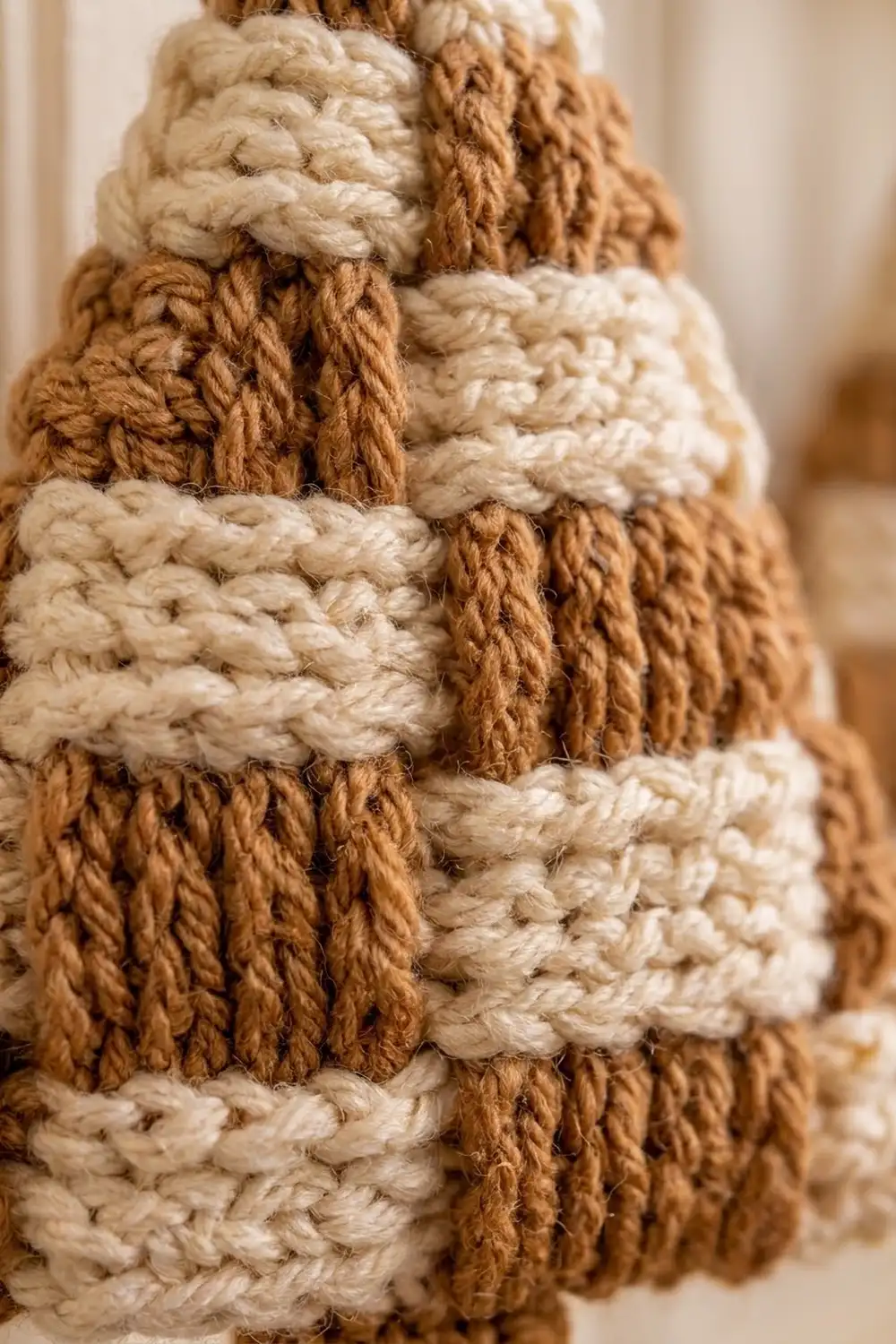
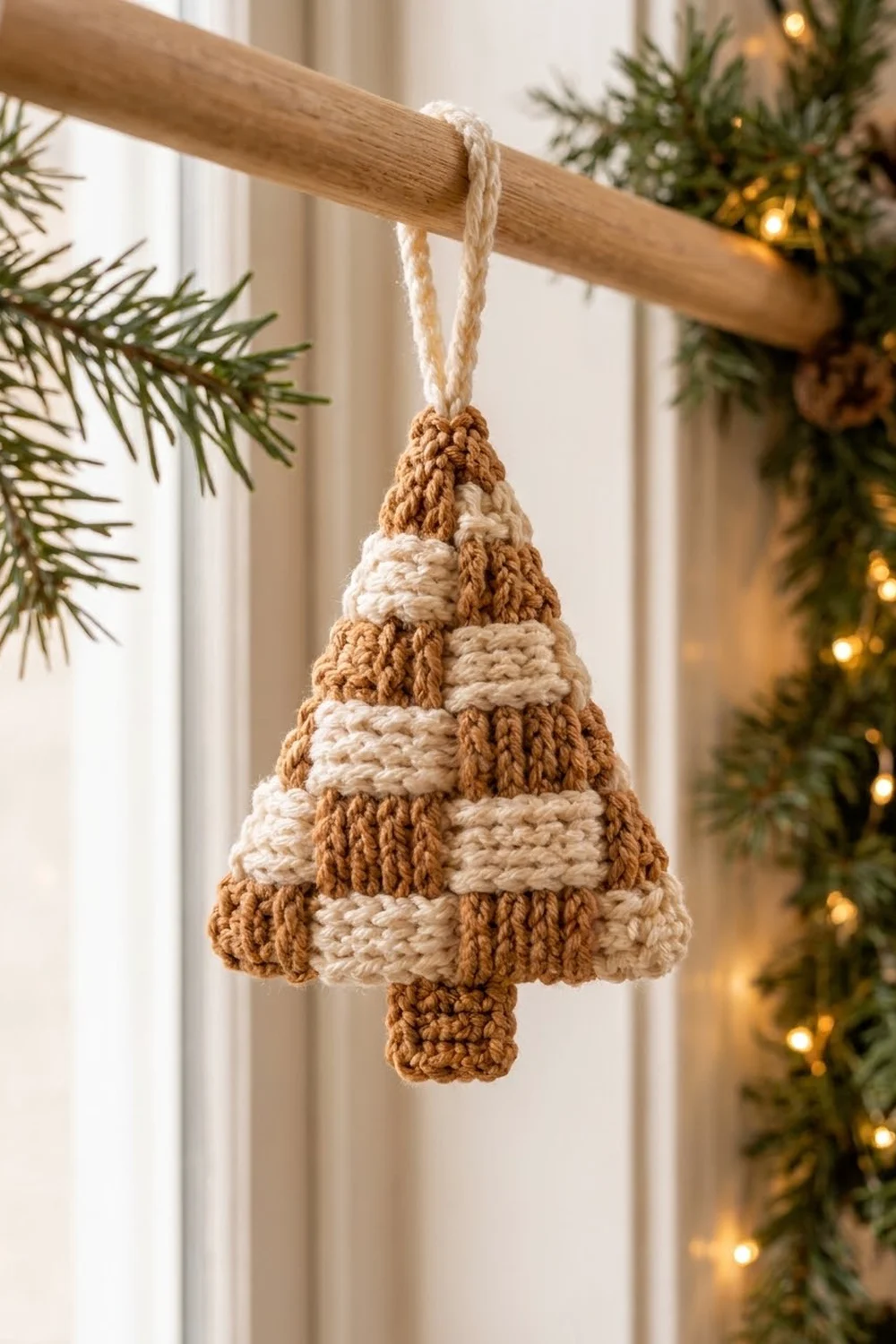
This little tree ornament is a single flat triangle worked in a two-color checkerboard of warm caramel and soft cream. The blocks shift with every band, so the tree reads as a neat woven grid from tip to base. It is finished with a short caramel trunk and a cream hanging loop.
The look is cozy and Scandinavian-simple: no beads, no bobbles, just tidy columns of tapestry single crochet that stack almost like knit stitches. It looks lovely hung from a dowel, a doorknob, or a tree branch, and it also works well on top of a wrapped gift.
The pattern uses US crochet terms. The finished tree measures 4.2 in (10.7 cm) wide at the base and 4.8 in (12.2 cm) tall from trunk to tip, not counting the loop.
You will work the triangle flat from the base up, decreasing at both ends of every even row. Then you add the trunk into the underside of the foundation chain and finish with a slip-stitch cord loop at the tip.
Finished Size and Construction
- Finished size: 4.2 in (10.7 cm) wide x 4.8 in (12.2 cm) tall, plus a 1.6 in (4.1 cm) loop
- Skill level: Easy-intermediate (basic tapestry color changes)
- Terminology: US crochet terms
- Yarn weight: DK (#3)
- Hook: 3.5 mm (E-4)
- Number of pieces: 1 (single flat piece; trunk and loop are worked onto it)
- Layout: Single triangle; checkerboard of 3-stitch x 4-row blocks in 5 bands
- Piece size: Triangle 4.2 in (10.7 cm) wide x 4 in (10.2 cm) tall; trunk 1 in (2.5 cm) wide x 0.8 in (2.0 cm) tall
- Size before border: 4.2 in x 4.8 in (10.7 cm x 12.2 cm)
- Border depth: 0 in (0 cm); no border is added, the edge stitches form the finished outline
Materials
Choose a smooth DK yarn with good stitch definition. Cotton or a cotton-acrylic blend shows the checkerboard best. Fuzzy or loosely plied yarns blur the block edges.
- Color A, Caramel: 12 g / about 30 m
- Color B, Cream: 8 g / about 20 m
Both colors are carried through most rows, so each ornament uses more yarn than a one-color version would. The quantities above include a margin of roughly 25 percent for swatching and tails.
Tools:
- 3.5 mm (E-4) crochet hook
- Tapestry needle
- Scissors
- Stitch markers (2)
- Ruler or tape measure
- Spray bottle and pins for blocking
Abbreviations (US Terms)
- ch: chain
- sc: single crochet
- sc2tog: single crochet 2 together (decrease)
- sc3tog: single crochet 3 together (decrease)
- sl st: slip stitch
- st(s): stitch(es)
- A / B: Color A (caramel) / Color B (cream)
- RS / WS: right side / wrong side
Tapestry single crochet: Lay the unused color along the top of the row and work each sc over it, so the carried strand is hidden inside the stitches. To change color, work the last sc of the old color until 2 loops remain. Then yarn over with the new color and pull through. The next stitch is now in the new color.
Decreases in color: Work every sc2tog and sc3tog entirely in the color named in the row. Pull up each loop and finish the stitch with that color, and carry the other color inside it as usual.
Gauge and Checkpoints
Gauge: 20 sts and 20 rows = 4 in (10.2 cm) in tapestry sc, carrying the second color. That is 5 sts and 5 rows per 1 in (2.5 cm).
Each checkerboard block is 3 sts wide and 4 rows tall, so one block measures 0.6 in (1.5 cm) wide x 0.8 in (2.0 cm) tall.
Make one test tree before making a batch. It doubles as your gauge swatch and takes well under an hour.
Checkpoints (measure flat, before blocking):
- After Row 1: 21 sts, 4.2 in (10.7 cm) wide.
- After Row 4: 17 sts; height 0.8 in (2.0 cm).
- After Row 8: 13 sts, 2.6 in (6.6 cm) wide; height 1.6 in (4.1 cm).
- After Row 12: 9 sts, 1.8 in (4.6 cm) wide; height 2.4 in (6.1 cm).
- After Row 16: 5 sts, 1 in (2.5 cm) wide; height 3.2 in (8.1 cm).
- After Row 20: 1 st; height 4 in (10.2 cm).
- After trunk: total height 4.8 in (12.2 cm).
For an ornament, being up to 0.2 in (0.5 cm) over or under is fine.
If your tree is too big: Go down to a 3.25 mm (D-3) hook, or carry the unused strand a little more snugly.
If your tree is too small: Go up to a 3.75 mm (F-5) hook. Also check that you are not pulling the carried strand so tight that the row puckers.
If the width matches but the height does not, adjust how far you pull up each loop. The blocks should look almost square, not like flat bricks.
Tree Body
The body is worked flat in rows, from the base up to the tip. The ch 1 at the start of each row does not count as a stitch.
Every row is symmetrical, so its color sequence reads the same from either end. You can follow it on both RS and WS rows without reversing anything.
At each row end, bring the unused color up alongside the edge and keep carrying it. Do not cut either color between bands.
Color layout: The tree has 5 bands of 4 rows each. Within a band, the blocks alternate A and B across the row. At each new band the colors swap, which creates the checkerboard. The edge blocks get narrower as the decreases eat into them.
Band 1 (Rows 1–4): cream blocks at both edges
Foundation: With A, ch 22.
Row 1 (RS): Join B and carry A. Starting in the 2nd ch from the hook, work: 3 sc in B, 3 sc in A, 3 sc in B, 3 sc in A, 3 sc in B, 3 sc in A, 3 sc in B. (21 sts)
Row 2: Ch 1, turn. Sc2tog in B, 1 sc in B, 3 sc in A, 3 sc in B, 3 sc in A, 3 sc in B, 3 sc in A, 1 sc in B, sc2tog in B. (19 sts: 2B, 3A, 3B, 3A, 3B, 3A, 2B)
Row 3: Ch 1, turn. 2 sc in B, 3 sc in A, 3 sc in B, 3 sc in A, 3 sc in B, 3 sc in A, 2 sc in B. (19 sts)
Row 4: Ch 1, turn. Sc2tog in B, 3 sc in A, 3 sc in B, 3 sc in A, 3 sc in B, 3 sc in A, sc2tog in B. (17 sts: 1B, 3A, 3B, 3A, 3B, 3A, 1B)
Band 2 (Rows 5–8): colors swap
Row 5: Ch 1, turn. 1 sc in A, 3 sc in B, 3 sc in A, 3 sc in B, 3 sc in A, 3 sc in B, 1 sc in A. (17 sts)
Row 6: Ch 1, turn. Sc2tog in B (over the edge A st and the first B st), 2 sc in B, 3 sc in A, 3 sc in B, 3 sc in A, 2 sc in B, sc2tog in B. (15 sts: 3B, 3A, 3B, 3A, 3B)
The single A edge stitch is absorbed into the decrease, which keeps the side edges clean.
Row 7: Ch 1, turn. 3 sc in B, 3 sc in A, 3 sc in B, 3 sc in A, 3 sc in B. (15 sts)
Row 8: Ch 1, turn. Sc2tog in B, 1 sc in B, 3 sc in A, 3 sc in B, 3 sc in A, 1 sc in B, sc2tog in B. (13 sts: 2B, 3A, 3B, 3A, 2B)
Band 3 (Rows 9–12): colors swap
Row 9: Ch 1, turn. 2 sc in A, 3 sc in B, 3 sc in A, 3 sc in B, 2 sc in A. (13 sts)
Row 10: Ch 1, turn. Sc2tog in A, 3 sc in B, 3 sc in A, 3 sc in B, sc2tog in A. (11 sts: 1A, 3B, 3A, 3B, 1A)
Row 11: Ch 1, turn. 1 sc in A, 3 sc in B, 3 sc in A, 3 sc in B, 1 sc in A. (11 sts)
Row 12: Ch 1, turn. Sc2tog in B (over the edge A st and the first B st), 2 sc in B, 3 sc in A, 2 sc in B, sc2tog in B. (9 sts: 3B, 3A, 3B)
Band 4 (Rows 13–16): colors swap
Row 13: Ch 1, turn. 3 sc in A, 3 sc in B, 3 sc in A. (9 sts)
Row 14: Ch 1, turn. Sc2tog in A, 1 sc in A, 3 sc in B, 1 sc in A, sc2tog in A. (7 sts: 2A, 3B, 2A)
Row 15: Ch 1, turn. 2 sc in A, 3 sc in B, 2 sc in A. (7 sts)
Row 16: Ch 1, turn. Sc2tog in A, 3 sc in B, sc2tog in A. (5 sts: 1A, 3B, 1A)
Band 5 (Rows 17–20): caramel tip
Row 17: Ch 1, turn. 1 sc in B, 3 sc in A, 1 sc in B. (5 sts)
Row 18: Ch 1, turn. Sc2tog in A (over the edge B st and the first A st), 1 sc in A, sc2tog in A. (3 sts, all A)
Cut B after Row 18, leaving a 4 in (10.2 cm) tail to weave in. Continue with A only.
Row 19: Ch 1, turn. 3 sc in A. (3 sts)
Row 20: Ch 1, turn. Sc3tog in A. (1 st)
Fasten off A. The cream loop is added in the Border section.
Body check: The triangle should measure 4.2 in (10.7 cm) across the base and 4 in (10.2 cm) tall. Each band should be 0.8 in (2.0 cm) tall.
Trunk
The trunk is worked into the free loops on the underside of the foundation chain, centered on the base.
Count the 21 stitches along the base of Row 1 and place markers in stitches 9 and 13. These 5 stitches (9 through 13) are the center caramel block plus one stitch on each side, so the trunk sits exactly under the middle of the tree.
Row 1: With the base of the tree facing up, join A in the free loop of st 9. Ch 1, then sc in the same st and in each of the next 4 sts. (5 sts)
Rows 2–4: Ch 1, turn. Sc in each st across. (5 sts)
Fasten off. The trunk measures 1 in (2.5 cm) wide x 0.8 in (2.0 cm) tall.
There are 8 free base stitches on each side of the trunk: 8 + 5 + 8 = 21, matching Row 1.
Border
This design has no added border round. The outer stitches of each row form the finished edge, and the checkerboard blocks run right out to the sides. Border depth is 0 in (0 cm), so the size is the same before and after this section.
Edge gauge: Each sloped side has 1 row-end per row, so it carries 20 row-ends over 4 in (10.2 cm) of vertical height. The base has 21 stitches over 4.2 in (10.7 cm).
Edge counts per side:
- Left slope: 20 row-ends (Rows 1–20).
- Right slope: 20 row-ends (Rows 1–20).
- Base: 21 sts total: 8 free sts, 5 sts under the trunk, 8 free sts.
- Trunk: 4 row-ends on each side and 5 sts across the bottom.
Why the math works: Rows 2, 4, 6, 8, 10, 12, 14, 16, and 18 each remove 2 stitches, one at each end. That is 9 decrease rows x 2 = 18 stitches, so 21 − 18 = 3 stitches remain for Row 19. Row 20 combines those 3 into 1 with sc3tog, giving a single centered point. Because the decreases are always paired, the triangle stays symmetrical and every band stays centered over the trunk.
Hanging loop: Join B with a sl st in the top st of Row 20. Ch 16, then sl st into the same top st to form a loop. Work a sl st into the back bump of each of the 16 ch, working back toward the tree. (16 sl sts)
Sl st into the tip once more and fasten off. The slip stitches turn the chain into a firm, rounded cord. The loop stands about 1.6 in (4.1 cm) tall when folded.
Final Blocking
- Weave in all tails through same-color stitches on the WS: cream tails into cream blocks, caramel tails into caramel blocks.
- Lay the tree WS up on a blocking mat or folded towel.
- Mist it lightly with water until just damp.
- Pin the two base corners 4.2 in (10.7 cm) apart.
- Pin the tip so the triangle is 4 in (10.2 cm) tall above the base.
- Pin the trunk straight down so it is 0.8 in (2.0 cm) long.
- Run a finger down each slope to straighten it. The bands of blocks should run straight across the tree.
- Let it dry completely, then unpin.
For acrylic yarn, steam lightly from above without touching the fabric.
Final Quality-Control Checklist
- The base measures 4.2 in (10.7 cm) and the triangle is 4 in (10.2 cm) tall.
- Total height with the trunk is 4.8 in (12.2 cm).
- Five bands are visible, each 4 rows tall.
- Colors alternate across every band and swap between bands.
- The bottom band has cream at both corners, and the tip is solid caramel.
- Both slopes have 20 row-ends and mirror each other.
- The trunk is 5 sts wide and centered under the middle caramel block.
- No carried strands show on the RS.
- The loop is firm, centered, and about 1.6 in (4.1 cm) tall.
Troubleshooting
The carried color shows through the stitches. Keep the carried strand flat on top of the row and work snugly over it. A smaller hook can help.
The tree curls or puckers. The carried strand is too tight. Tug it gently only every few stitches, and spread the stitches out along the hook before each color change.
The block edges look jagged. Change color on the final yarn over of the previous stitch, not at the start of the new one.
One slope is longer than the other. A decrease was missed or an extra one was worked. Check each row against the bold stitch counts.
The trunk is off-center. Recount the base stitches and make sure the trunk starts in stitch 9 and ends in stitch 13.
The blocks look short and wide. Your rows are too short. Pull up each loop slightly taller, or block with a little extra vertical stretch.
Care
Hand wash in cool water with mild soap, press out the water in a towel, and dry flat. Store the ornament flat or hanging so the loop and tip keep their shape.
Final Notes
The whole ornament follows one simple measurement chain. Gauge is 5 sts and 5 rows per 1 in (2.5 cm), so each 3-stitch x 4-row block is 0.6 in x 0.8 in (1.5 cm x 2.0 cm).
Twenty-one stitches set the base at 4.2 in (10.7 cm). Twenty rows in five bands build a 4 in (10.2 cm) triangle. A 4-row trunk adds 0.8 in (2.0 cm), for a total of 4.8 in (12.2 cm), and the cord loop adds about 1.6 in (4.1 cm) for hanging.
Check your size after Row 1 and after each band, and every tree in your batch will match. Make a few and hang them together on a dowel for an easy, warm holiday display.
Happy crocheting!