

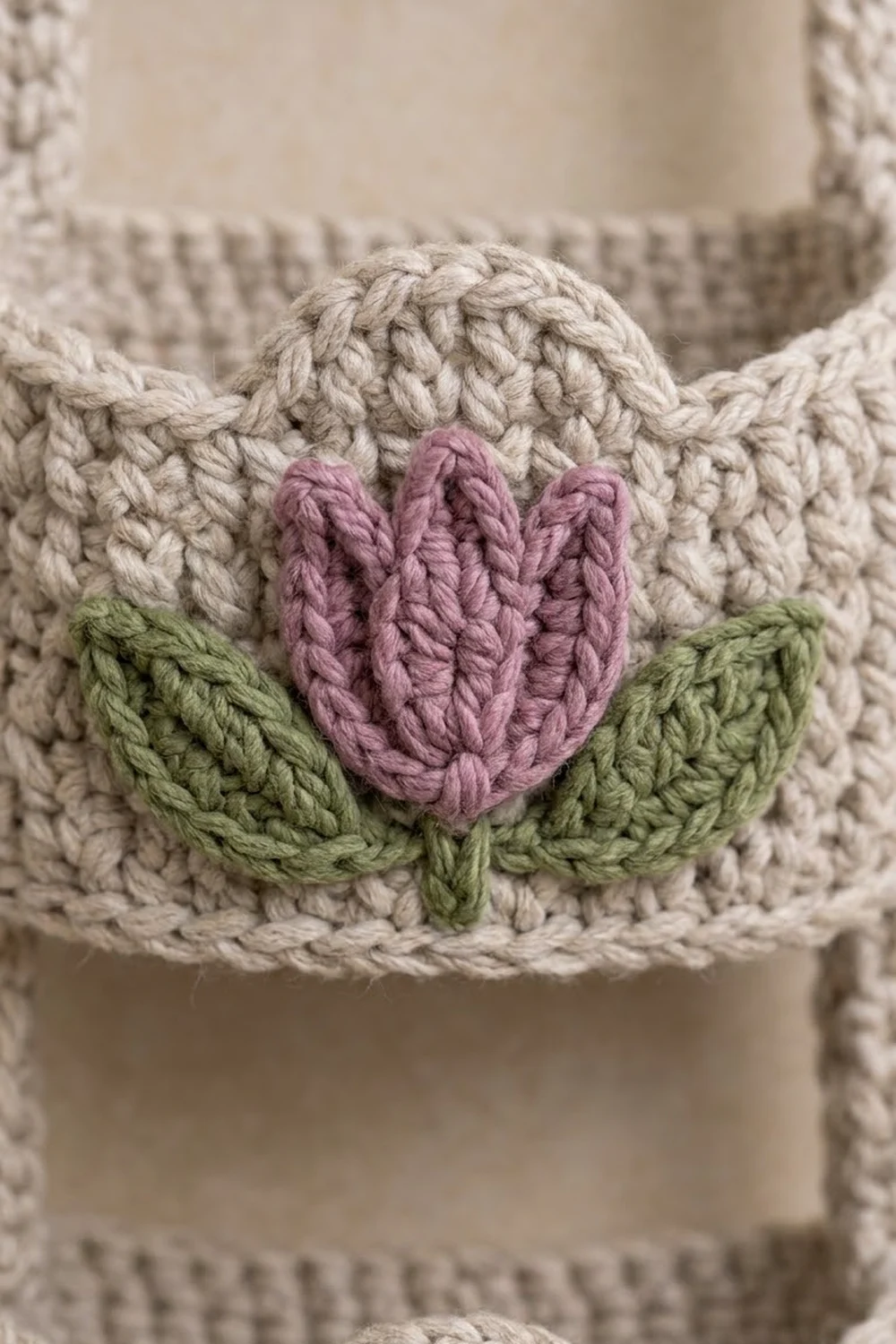
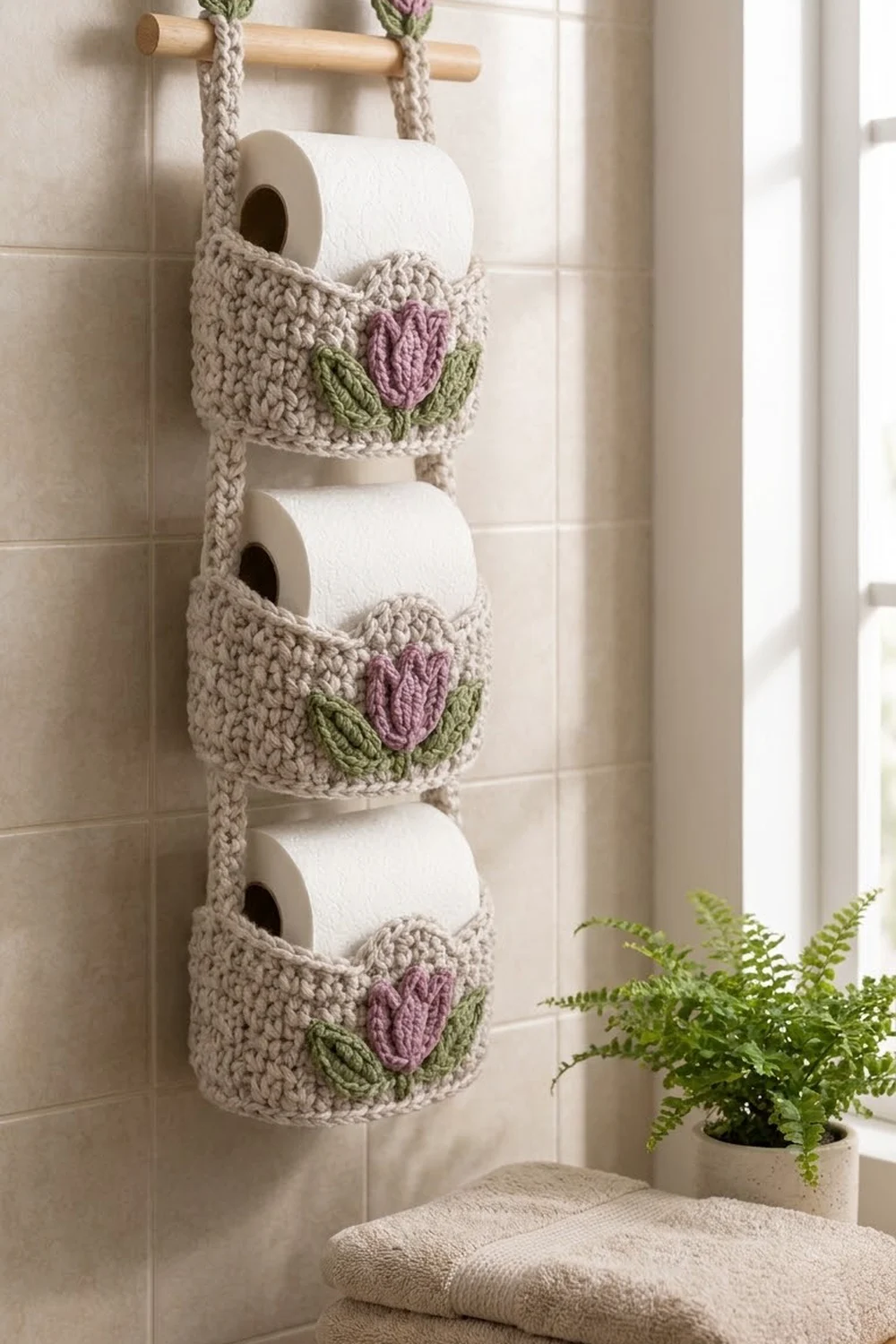
This hanging holder keeps three spare toilet rolls in a neat vertical stack. Three soft pockets hang one above the other from two crocheted straps, and the straps loop over a short wooden dowel. Each pocket has a rounded arch at the center front, with a raised tulip appliqué on it.
The colors are soft and calm, which suits a bathroom: oatmeal greige for the pockets and straps, dusty lilac for the tulips, and sage green for the leaves and stems. A mini tulip sits at the top of each strap, just above the dowel.
The pattern uses US crochet terms. Each pocket is 5.33 in (13.5 cm) wide and 4.67 in (11.9 cm) deep at the base. The walls are 4 in (10.2 cm) tall, and the arch rises to 5 in (12.7 cm). The holder measures 17.67 in (44.9 cm) from the dowel to the bottom of the lowest pocket.
Each pocket starts as a flat single crochet rectangle. You then work rounds up from it to make the walls, add a short arch in rows, and finish with a rim border. The straps are two-row strips. The appliqués are sewn on, and then the pockets are whipstitched to the straps.
Finished Size and Construction
- Pocket size: 5.33 in (13.5 cm) wide x 4.67 in (11.9 cm) deep x 4 in (10.2 cm) tall; 5 in (12.7 cm) at the arch
- Hanging length: 17.67 in (44.9 cm), from the dowel to the bottom
- Skill level: Easy-intermediate
- Terminology: US
- Yarn weight: Bulky (#5)
- Hooks: 6.0 mm for the body, 5.0 mm for the appliqués
- Number of pieces: 3 pockets, 2 straps, 3 large tulips, 2 mini tulips
- Layout: 1 column of 3 pockets, spaced 5.33 in (13.5 cm) apart from base to base
- Size before border: walls 3.67 in (9.3 cm) tall; arch 1 in (2.5 cm) tall
- Border depth: 0.33 in (0.8 cm); one sc round plus one sl st round
Materials
Choose a smooth bulky acrylic or cotton blend. It keeps the pockets firm and copes well with bathroom humidity. Loosely spun yarns tend to sag once a roll is inside.
- Main color (oatmeal greige): 300 g / 300 m (328 yd)
- Lilac: 30 g / 30 m (33 yd)
- Sage green: 25 g / 25 m (27 yd)
These amounts assume yarn with 100 m per 100 g. They include about a 15% margin for your gauge swatch and sewing tails.
Tools:
– 6.0 mm and 5.0 mm crochet hooks
– Wooden dowel, 8 in (20.3 cm) long and 5/8 in (1.6 cm) in diameter
– Tapestry needle
– 6 stitch markers
– Measuring tape
– Blocking pins and a spray bottle
Abbreviations (US Terms)
- ch – chain
- sl st – slip stitch
- sc – single crochet
- hdc – half double crochet
- dc – double crochet
- sc2tog – single crochet 2 together
- BLO – back loop only
- st(s) – stitch(es)
- rnd – round
Special technique: working both sides of a chain. Work along the chain, put the stated stitches in the last ch, then turn the piece and work into the free loops on the other side of the same chain. This makes an oval with a center line, which you will use for the petals and leaves.
Gauge and Checkpoints
Body gauge (6.0 mm hook): 12 sc x 12 rows or rnds = 4 in (10.2 cm). That works out to 3 stitches and 3 rounds per inch.
Make one complete pocket first and check it at each stage:
- After base Row 12: 4.67 in (11.9 cm) x 4 in (10.2 cm)
- After Rnd 1: 5.33 in (13.5 cm) x 4.67 in (11.9 cm); 60 sts around a 20 in (50.8 cm) perimeter
- After Rnd 12: walls 3.67 in (9.3 cm) tall
- After the arch: 1 in (2.5 cm) tall and 3.33 in (8.5 cm) wide at its base
- After the border: rim 4 in (10.2 cm) tall; arch top 5 in (12.7 cm) tall
Too big: The roll slides around and the walls flop over. Switch to a 5.5 mm hook.
Too small: A standard roll, about 4.5 in (11.4 cm) wide and 4.25 in (10.8 cm) across, won’t fit. Switch to a 6.5 mm hook.
Pocket (Make 3)
Use the main color and the 6.0 mm hook.
Base
Ch 15.
Row 1: Sc in 2nd ch from hook and in each ch across, turn. (14 sts)
Rows 2–12: Ch 1, sc in each st across, turn. (14 sts per row)
The base is now 4.67 in (11.9 cm) x 4 in (10.2 cm). Do not fasten off.
Rnd 1 (base edge): Ch 1. Along the last row: 3 sc in first st, sc in next 12 sts, 3 sc in last st (18). Down the row ends: sc in each of 12 row ends (12). Along the free loops of the foundation chain: 3 sc in first loop, sc in next 12, 3 sc in last (18). Up the other row ends: sc in each of 12 row ends (12). Join with sl st to first sc. (60 sts: 18 + 12 + 18 + 12)
The base now measures 5.33 in (13.5 cm) x 4.67 in (11.9 cm). From this point on, the front and back are 18 sts each, counted from the start of one corner group to the end of the next. Each side is 12 sts. Mark the side boundaries.
Walls
Rnd 2: Ch 1, sc in BLO of each st around, join. (60 sts) The unworked loops form a crisp ridge where the base turns up into the wall.
Rnds 3–12: Ch 1, sc in each st around, join. (60 sts per rnd)
Rnds 2–12 make 11 rounds of wall, which is 3.67 in (9.3 cm) tall. Fasten off.
Front Arch
Skip the first 4 front sts and join yarn in the 5th.
Row 1: Ch 1, sc in same st and next 9 sts, turn. (10 sts)
Row 2: Ch 1, sc2tog, sc in next 6 sts, sc2tog, turn. (8 sts)
Row 3: Ch 1, sc2tog, sc in next 4 sts, sc2tog. (6 sts)
Fasten off. The arch is 1 in (2.5 cm) tall and sits on 10 sts, or 3.33 in (8.5 cm), with 4 plain front sts on each side. The border will round off its top corners.
Work order: Do the border on every pocket first (see Border below), then sew on the appliqués, then join.
Large Tulip Appliqué (Make 3)
Use the 5.0 mm hook. Leave a 10 in (25.4 cm) tail on each piece for sewing.
Large petal (3 per tulip, 9 total), lilac:
Ch 7. Sl st in 2nd ch from hook, sc in next, hdc in next, dc in next 2, 5 dc in last ch. Turn and work along the free loops: dc in next 2, hdc in next, sc in next, sl st in next. Work (sl st, ch 2, sl st) in the tip ch. (5 + 5 + 5 = 15 sts plus ch-2 tip)
The petal has a rounded base and a pointed tip. It is about 1.75 in (4.4 cm) tall and 1 in (2.5 cm) wide, and the dc columns give it a ridged texture.
Leaf (2 per tulip, 6 total), sage:
Ch 9. Sl st in 2nd ch from hook, sc in next, hdc in next, dc in next 2, hdc in next, sc in next, 3 sc in last ch. Turn and work along the free loops: sc in next, hdc in next, dc in next 2, hdc in next, sc in next, sl st in next. Sl st in the tip ch. (7 + 3 + 7 + 1 = 18 sts)
The leaf is a pointed oval about 2 in (5.1 cm) long and 0.75 in (1.9 cm) wide. The chain at its center looks like a vein.
Stem (1 per tulip, 3 total), sage:
Ch 5. Sl st in the back bump of the 2nd ch from hook and the next 3 ch. (4 sl sts) The stem is about 1 in (2.5 cm) long.
Assemble the head: Place one petal in the center. Tuck the other two behind it so their bases overlap by 0.5 in (1.3 cm), and tilt each tip outward. The finished head is about 2 in (5.1 cm) wide. Tack the petals together from behind.
Mini Tulip Topper (Make 2)
Use the 5.0 mm hook.
Mini petal (3 per topper, 6 total), lilac:
Ch 5. Sl st in 2nd ch from hook, sc in next, hdc in next, 5 hdc in last ch. Work along the free loops: hdc, sc, sl st. Work (sl st, ch 1, sl st) in the tip ch. (3 + 5 + 3 = 11 sts) The petal is about 1 in (2.5 cm) tall.
Mini leaf (2 per topper, 4 total), sage:
Ch 6. Sl st in 2nd ch from hook, sc, hdc, sc, 3 sc in last ch. Work along the free loops: sc, hdc, sc, sl st. Sl st in the tip ch. (4 + 3 + 4 + 1 = 12 sts) The leaf is about 1.25 in (3.2 cm) long.
Put the petals together the same way as the large tulip. Sew one mini leaf on each side below the head, angled outward.
Strap (Make 2)
Use the main color and the 6.0 mm hook. Ch 64.
Row 1: Sc in 2nd ch from hook and in each ch across, turn. (63 sts)
Row 2: Ch 1, sc in each st across. (63 sts)
Fasten off. Each strap is 21 in (53.3 cm) long and 0.67 in (1.7 cm) wide. Measure it flat without pulling, because long strips stretch easily.
Make All Pieces
- Main color: 3 pockets, 2 straps
- Lilac: 9 large petals, 6 mini petals
- Sage: 6 leaves, 3 stems, 4 mini leaves
Layout (front view):
  [mini tulip]                 [mini tulip]
  ====|========= dowel =========|====
      |   [ Pocket 1 + tulip ]  |   strap sts 33–44
      |                         |   gap: sts 29–32
      |   [ Pocket 2 + tulip ]  |   strap sts 17–28
      |                         |   gap: sts 13–16
      |   [ Pocket 3 + tulip ]  |   strap sts 1–12
Placing the appliqués: Center each tulip head on its arch, with the tip of the center petal 0.33 in (0.8 cm) below the arch edge. Run the stem straight down from the head. Sew one leaf on each side of the stem base, angled up and out in a V. The lowest leaf points should sit about 1 in (2.5 cm) above the base ridge. Sew through the outer layer of the pocket only.
Joining
Method: Whipstitch with the main color.
Stitch-to-stitch logic: Each pocket side wall has 12 row ends: Rnds 2–12 plus border Rnd 1. Sew those 12 row ends to 12 strap sts, one to one, so nothing gathers or stretches.
Number the strap stitches from the bottom end:
- Sts 1–12: Pocket 3 (bottom)
- Sts 13–16: gap of 1.33 in (3.4 cm)
- Sts 17–28: Pocket 2
- Sts 29–32: gap
- Sts 33–44: Pocket 1 (top)
- Sts 45–53: 3 in (7.6 cm) up to the dowel
- Sts 54–63: 3.33 in (8.5 cm) for the dowel loop
Center the strap on the side wall, over side sts 6 and 7. Line up strap st 1 with the base ridge from Rnd 2. Sew along both long edges of the strap.
Tension: Sew snugly but not tightly. Seams pulled too tight make the wall pucker. Keep a roll inside the pocket while you sew.
Dowel loop: Fold sts 54–63 over the dowel from front to back. Sew the end to the back of the strap just below the dowel. Then sew a mini tulip over the front of each fold. Leave 1.33 in (3.4 cm) of dowel beyond each strap, so the straps hang 5.33 in (13.5 cm) apart.
Size checkpoint: The pockets should sit 5.33 in (13.5 cm) apart from base to base. From the dowel to the bottom should be 53 strap sts, or 17.67 in (44.9 cm).
Border
Work the border on each pocket after the arch and before the appliqués. Use the main color and the 6.0 mm hook.
Border gauge: Same as the body gauge, 3 sc per inch. One sc round adds 0.33 in (0.8 cm) of height.
Rnd 1: Join yarn in the first back st. Sc in each of the 18 back sts, the 12 left side sts and the 4 front sts before the arch. On the arch: sc in each of the 3 row ends going up, 2 sc in the first top st, sc in the next 4 sts, 2 sc in the last top st, then sc in each of the 3 row ends going down. Finish with sc in the last 4 front sts and the 12 right side sts. Join.
Stitches per side:
– Back: 18
– Left side: 12
– Front: 4 + (3 + 8 + 3) + 4 = 22
– Right side: 12
– Total: 64 sts
Rnd 2: Ch 1, sl st loosely in each st around. (64 sl sts) Fasten off.
Why the math works: The rim has 60 sts. The arch covers 10 of them, which leaves 50 to work one to one. The arch adds 14 border stitches of its own: 3 row ends on each side, plus its 6 top sts worked as 8. That gives 50 + 14 = 64. The two corner increases round off the arch without making it cup. Working the rest of the rim one to one keeps the walls straight.
Final Blocking
- Mist each pocket until it is evenly damp.
- Put a plastic-wrapped roll inside each pocket.
- Stand each arch upright and pin it flat.
- Smooth the tulips flat and ease the petal tips into points.
- Lay the straps out straight without stretching them. They should measure 21 in (53.3 cm).
- Let everything dry for at least 12 hours before hanging.
Final Quality-Control Checklist
- Each base is 5.33 x 4.67 in (13.5 x 11.9 cm)
- Rnds 2–12 have 60 sts each; the arch rows have 10, 8 and 6 sts
- Border Rnd 1 has 64 sts (18 / 12 / 22 / 12)
- Each rim is 4 in (10.2 cm) tall and each arch is 5 in (12.7 cm) tall
- Each pocket is sewn to 12 strap sts, with 4-st gaps between pockets
- The tulips are centered and the leaves are symmetrical
- All tails are woven in on the wrong side
Troubleshooting
- Walls lean outward: Rnd 2 probably wasn’t worked in BLO, or your gauge is loose. Redo Rnd 2 or go down a hook size.
- Arch looks pointed: Check that you made both 2-sc corner increases in border Rnd 1.
- Arch flares: Work the sc2tog stitches more firmly.
- Pockets tip forward: The strap is off-center. Re-sew it over side sts 6 and 7.
- Straps have stretched: Shorten the dowel loop. Don’t change the spacing between pockets.
- Petals curl: Steam them lightly and pin them flat to dry.
Care
Remove the dowel, hand wash in cool water and press out the water with a towel. Dry flat, with a roll inside each pocket to hold its shape.
Final Notes
Every measurement follows from the gauge. A gauge of 12 sc x 12 rnds = 4 in (10.2 cm) gives a 14 x 12 base. Rnd 1 turns that into a 60-st base measuring 5.33 x 4.67 in (13.5 x 11.9 cm). Eleven wall rounds make 3.67 in (9.3 cm), and the 64-st border brings the rim to 4 in (10.2 cm). The 63-st strap holds each pocket on 12 sts with 4-st gaps between them, for a total of 17.67 in (44.9 cm) below the dowel. If your gauge matches, everything else will fit.
Happy crocheting!