

This hanging bag holder is a tall cream tube covered in small hexagons. Each hexagon has a cornflower-blue six-petal puff flower in the middle and a thick cream frame around it. The hexagons sit in a honeycomb layout, so every other column is shifted down by half a motif. A crocheted ring at the top hangs it from a hook. You push bags in at the top and pull them out of the narrow opening at the bottom.
There are only two colors: cream for the frames, bands and hanger, and medium blue for the flowers. The look is cottagey and tidy, and it suits a kitchen or laundry wall. Mustard frames with cream flowers work just as well for a second holder.
The pattern uses US crochet terms. The finished tube is 15.6 in (39.6 cm) around, about 5 in (12.7 cm) across, and 20.5 in (52.1 cm) long, or 24.25 in (61.6 cm) with the hanger.
You make 33 full flower hexagons and 6 plain cream half hexagons, join them in six columns, and close the columns into a tube. Then you add a straight sc band at the top, a decreasing band at the bottom, and a strap with a covered ring.
Finished Size and Construction
- Finished size: 15.6 in (39.6 cm) circumference x 20.5 in (52.1 cm) long; 24.25 in (61.6 cm) including the hanger
- Skill level: Intermediate
- Terminology: US
- Yarn weight: Medium worsted (#4), cotton or cotton blend
- Hook: 4.5 mm (US 7)
- Number of pieces: 33 full hexagons + 6 half hexagons, plus a ring cover and a strap worked onto the top band
- Layout: 6 columns in a honeycomb. Columns 1, 3 and 5 have 6 full hexagons. Columns 2, 4 and 6 have 5 full hexagons with a half hexagon at the top and bottom.
- Piece size: each hexagon is 3 in (7.6 cm) flat edge to flat edge, about 3.5 in (8.9 cm) point to point, with sides of about 1.75 in (4.4 cm)
- Size before border: 15.6 in (39.6 cm) around x 18 in (45.7 cm) long
- Border depth: top band 1.25 in (3.2 cm); bottom band 1.25 in (3.2 cm)
Materials
Pick a smooth worsted cotton or cotton blend at about 170 m per 100 g. Cotton keeps its shape when the holder is full of bags. A slightly firm fabric works better than a soft, drapey one here.
- Cream: 200 g (about 340 m)
- Cornflower blue: 80 g (about 136 m)
These amounts include a margin of roughly 15 percent.
Tools:
- 4.5 mm (US 7) crochet hook
- Plastic or wooden ring, 2.5 in (6.4 cm) outside diameter
- Tapestry needle
- Stitch markers
- Measuring tape and scissors
- Blocking mat, rust-proof pins and spray bottle
Abbreviations (US Terms)
- ch – chain
- sl st – slip stitch
- sc – single crochet
- dc – double crochet
- sc2tog – single crochet 2 together
- sk – skip
- sp – space
- st(s) – stitch(es)
- RS / WS – right side / wrong side
- rnd – round
Puff stitch (puff): [yo, insert hook in st, yo, pull up a loop to dc height] 3 times, yo, draw through all 7 loops on hook.
Reverse sc: Working from left to right, insert hook in the next st to the right, pull up a loop, yo, and draw through both loops.
Gauge and Checkpoints
Make one full hexagon first and measure it after blocking.
- Sc gauge: 23 sc = 5 in (12.7 cm); 4 sc rnds = 1 in (2.5 cm)
- After Rnd 1: about 1.1 in (2.8 cm) across
- After Rnd 2: about 1.9 in (4.8 cm) across
- After Rnd 3: about 2.6 in (6.6 cm) flat to flat
- After Rnd 4: 3 in (7.6 cm) flat to flat; each side about 1.75 in (4.4 cm)
If your hexagon is larger than 3 in (7.6 cm), go down half a hook size. If it is smaller, go up half a size. A difference of only 0.25 in (0.6 cm) per hexagon adds up to 1.5 in (3.8 cm) in both the circumference and the length.
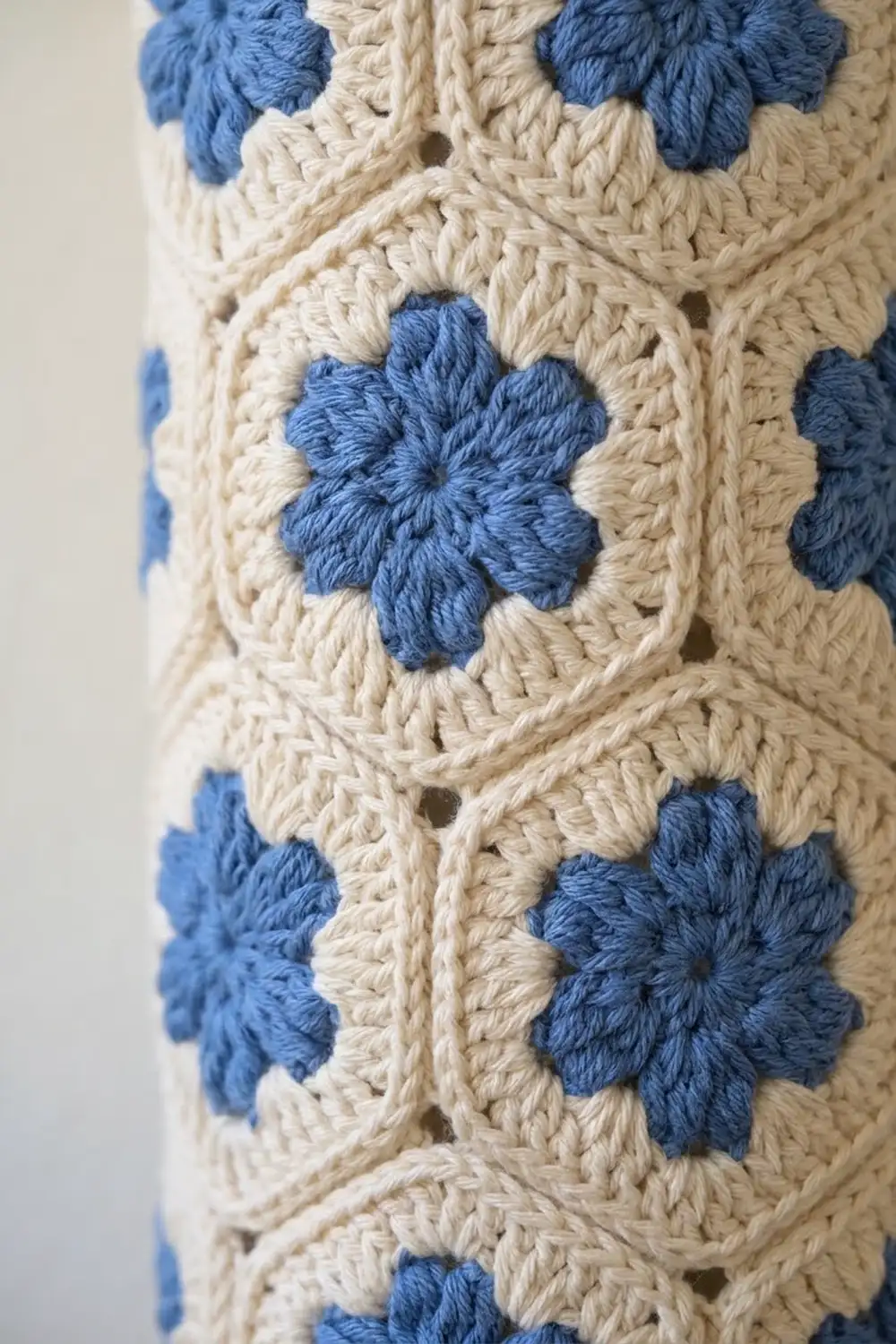
Full Hexagon (make 33)
Worked in rounds with the RS facing. Do not turn.
Rnd 1 (blue): Make a magic ring. Ch 3 (counts as dc), 11 dc in ring, sl st to top of ch-3. Pull the ring closed. (12 dc)
Rnd 2 (blue): Ch 1, puff in same st as join, ch 3, sk next st, puff in next st, ch 3, sk next st 5 times, sl st to top of first puff. (6 puffs, 6 ch-3 sps) Fasten off blue. The six puffs are the flower petals.
Rnd 3 (cream): Join cream in any ch-3 sp. Ch 3 (counts as dc), (2 dc, ch 2, 3 dc) in same sp, (3 dc, ch 2, 3 dc) in each of next 5 ch-3 sps, sl st to top of ch-3. (36 dc, 6 ch-2 corners)
Skip the puffs as you go. Each side now has 6 dc: the last 3 dc of one corner group and the first 3 dc of the next.
Rnd 4 (cream): Ch 1, sc in each of first 3 dc, (sc, ch 2, sc) in ch-2 sp, sc in each of next 6 dc, (sc, ch 2, sc) in next ch-2 sp 5 times, sc in each of last 3 dc, sl st to first sc. (48 sc, 6 ch-2 corners)
Each side has 8 sc: 6 sc along the side plus the 2 corner sc. Fasten off and leave a 6 in (15.2 cm) tail.
Half Hexagon (make 6)
All in cream, worked in rows. Turn at the end of each row. The rounded side becomes three hexagon edges, and the row ends form one straight edge.
Row 1: Make a magic ring. Ch 3 (counts as dc), 6 dc in ring. Turn. (7 dc)
Row 2: Ch 3 (counts as dc), puff in next st, ch 3, sk next st, puff in next st, ch 3, sk next st, puff in next st, dc in top of turning ch. Turn. (2 dc, 3 puffs, 2 ch-3 sps)
Row 3: Ch 3 (counts as dc), 2 dc in first st, sk puff, (3 dc, ch 2, 3 dc) in ch-3 sp, sk puff, (3 dc, ch 2, 3 dc) in next ch-3 sp, sk puff, 3 dc in top of turning ch. Turn. (18 dc, 2 ch-2 corners)
That gives 6 dc on each of the three edges, the same as Rnd 3 of the full hexagon.
Row 4: Ch 1, 2 sc in first dc, sc in next 5 dc, (sc, ch 2, sc) in ch-2 sp, sc in next 6 dc, (sc, ch 2, sc) in ch-2 sp, sc in next 5 dc, 2 sc in last dc. (24 sc, 2 ch-2 corners)
Each edge has 8 sc to match a full hexagon side. The doubled sc at each end stands in for the corner sc a full hexagon has at that point. The half hexagon is about 3.5 in (8.9 cm) along the straight edge and 1.5 in (3.8 cm) deep.
Make All Pieces
- Full hexagons: 33, with blue Rnds 1–2 and cream Rnds 3–4
- Half hexagons: 6, all cream
Lay everything out flat before joining. Read each column from top to bottom:
Col 1:  F F F F F F
Col 2:  h F F F F F h
Col 3:  F F F F F F
Col 4:  h F F F F F h
Col 5:  F F F F F F
Col 6:  h F F F F F h   (joins back to Col 1)
F = full hexagon and h = half hexagon. That makes 18 F in the odd columns, 15 F in the even columns, and 6 h. The even columns sit half a hexagon lower than the odd ones. Place each half hexagon straight edge up at the top and straight edge down at the bottom.
Joining
Use a flat whipstitch in cream. Hold two pieces RS up and edge to edge, and stitch through the back loops only. The front loops stay on the outside as a neat cream ridge.
Stitch-to-stitch logic: Every seam joins 8 sc to 8 sc, corner sc to corner sc. At each point where three pieces meet, pass the needle through all three ch-2 corner sps so no hole is left.
- Columns: Join the pieces in each column top edge to bottom edge. Odd columns have 5 seams each and even columns have 6.
- Column to column: Join Column 1 to Column 2 along the zigzag. Each Column 1 hexagon joins with its upper-right and lower-right edges, which makes 12 diagonal seams. Join Columns 2–3, 3–4, 4–5 and 5–6 the same way.
- Close the tube: Join Column 6 to Column 1 with 12 more diagonal seams.
Tension: Pull each stitch only until the edges meet. If you pull harder, the seams pucker and the tube gets shorter. Weave in ends along the seams as you go.
Checkpoint: Flattened, the tube measures 7.8 in (19.8 cm) wide and 18 in (45.7 cm) long. Each column pitch is 2.6 in (6.6 cm), and six of them make the 15.6 in (39.6 cm) circumference.
Border: Top Band, Bottom Taper and Hanger
Border gauge: 23 sc = 5 in (12.7 cm), or about 4.6 sc per in.
Top Band
Rnd 1: With RS facing, join cream at the top of Column 1. Work across each pair of columns like this:
– Full hexagon top edge: sc in each of 8 sc, skipping the ch-2 corner sps (8)
– Half hexagon straight edge: on each side, 2 sc in each of the 3 dc row ends and 1 sc in the sc row end, plus 2 sc at the magic ring center (16)
That makes 24 sc per pair of columns. Repeat around and sl st to first sc. (72 sc)
Rnds 2–4: Ch 1, sc in each st around, sl st to first sc. (72 sc)
Rnd 5: Ch 1, reverse sc in each st around, sl st to first st. (72 sts)
Bottom Taper
Rnd 1: Work across the bottom edge exactly as for Top Band Rnd 1. (72 sc)
Rnd 2: Ch 1, sc in next 4 sts, sc2tog 12 times, sl st to first sc. (60 sc)
Rnd 3: Ch 1, sc in next 3 sts, sc2tog 12 times, sl st to first sc. (48 sc)
Rnd 4: Ch 1, sc in next 2 sts, sc2tog 12 times, sl st to first sc. (36 sc)
Rnd 5: Ch 1, reverse sc in each st around, sl st to first st. (36 sts)
The opening is 7.8 in (19.8 cm) around, about 2.5 in (6.4 cm) across. That holds the bags in but still lets you pull one out easily.
Hanger
Ring cover: Join cream to the ring and work 44 sc around it so the ring is completely hidden. Sl st to first sc and fasten off.
Strap: Find the 8 sts of Top Band Rnd 4 centered over Column 4, at the back. Join cream in the back loop of the first of these sts.
– Row 1: Ch 1, sc in back loop of each of the 8 sts. Turn. (8 sc)
– Rows 2–10: Ch 1, sc in each st. Turn. (8 sc)
Fold Rows 7–10 around the bottom of the covered ring toward the inside, and whipstitch Row 10 to Row 6. The visible strap is about 1.75 in (4.4 cm) wide and 1.5 in (3.8 cm) tall. With the ring, it adds 3.75 in (9.5 cm) to the length.
Why the math works: A hexagon side holds 8 sc over 1.75 in (4.4 cm). A half hexagon’s straight edge is two sides long, so it holds 16 sc. One top edge plus one straight edge spans two column pitches, 5.2 in (13.2 cm), with 24 sc, which is 4.6 sc per in. Three pairs give 72 sc over 15.6 in (39.6 cm). This matches the border gauge, so the bands lie flat without ruffling or pulling in. The taper takes away 12 sts per round, which is 2 per column.
Final Blocking
- Weave in all remaining ends along the seams.
- Spray the holder until it is evenly damp but not soaked.
- Slide a rolled towel inside so the tube is 5 in (12.7 cm) across.
- Straighten the columns so they run vertically, and shape the edges of each hexagon so they are crisp.
- Lay the holder flat and pin it to 7.8 in (19.8 cm) wide and 20.5 in (52.1 cm) long, not counting the hanger.
- Ease the bottom taper so it curves inward evenly.
- Let it dry completely, then remove the towel.
Final Quality-Control Checklist
- Every hexagon is 3 in (7.6 cm) flat to flat.
- Each flower has 6 even puffs.
- Every seam is 8 sc to 8 sc, with no gaps where three pieces meet.
- The columns run straight and do not spiral.
- The top band has 72 sts and the bottom opening has 36 sts.
- The holder is 15.6 in (39.6 cm) around and 20.5 in (52.1 cm) long.
- The strap is centered at the back and the ring is fully covered.
- All ends are secure.
Troubleshooting
- Hexagons cup: Your Rnd 3 is too tight. Use a hook half a size larger for the cream rounds.
- Hexagons ruffle: Your puffs are too tall. Pull the loops up to dc height only.
- Holes at corners: Stitch through all three ch-2 sps at each meeting point, with a second pass if needed.
- Tube spirals: A column was joined out of order. Check it against the layout grid.
- Top band flares: Rework Rnd 1 with a 4 mm (US G/6) hook.
- Opening too loose: Add a round of sc 4, sc2tog to bring it down to 30 sts.
- Holder sags: Remake the strap with a smaller hook so it is firmer.
Care
Hand wash in cool water and lay flat to dry, reshaping the tube while it is damp. Don’t hang it while it’s wet, because the weight will stretch the strap.
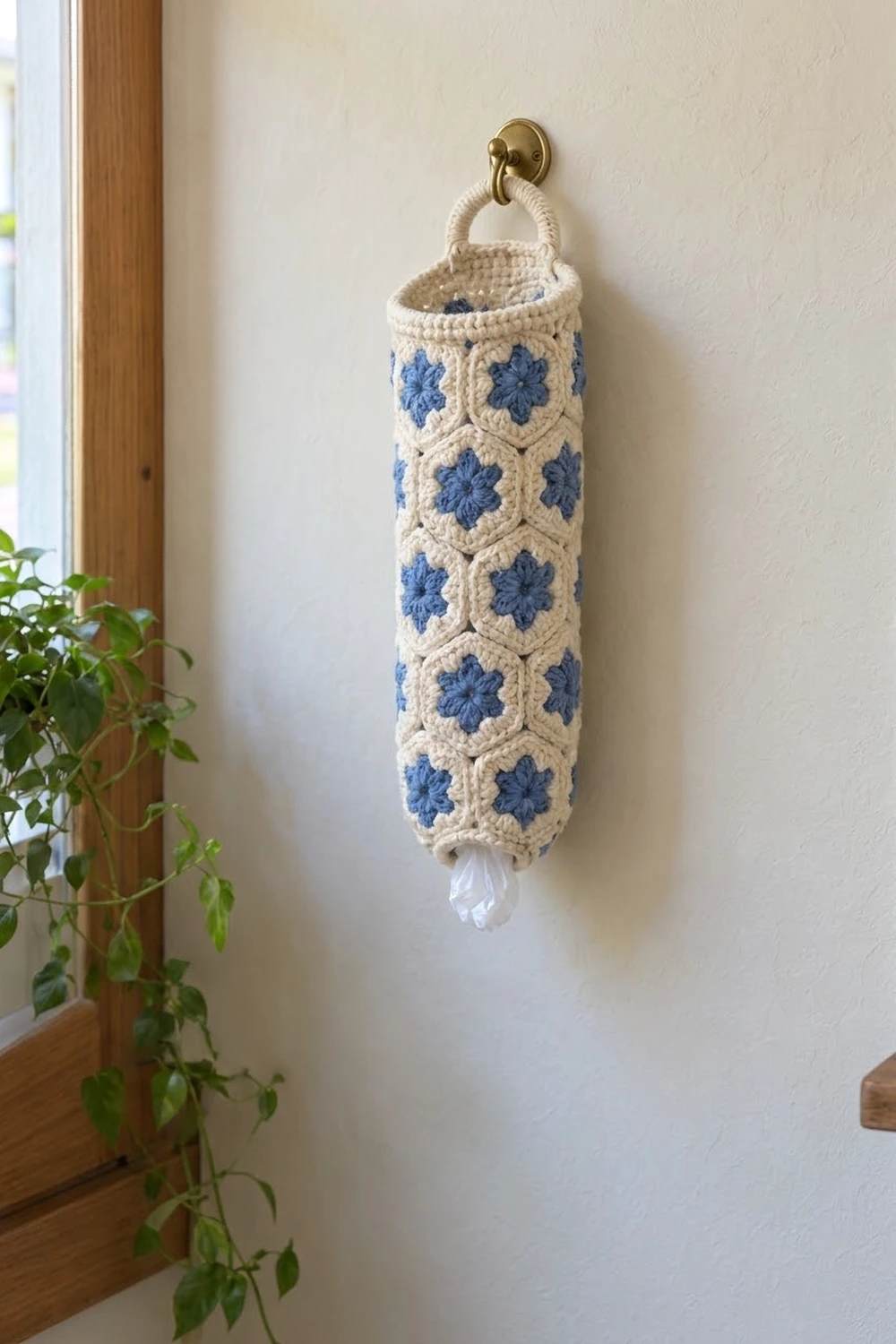
Final Notes
Here is the measurement chain. Each hexagon is 3 in (7.6 cm) flat to flat with 8 sc per side. Six columns at 2.6 in (6.6 cm) each make a 15.6 in (39.6 cm) tube. Both bands start with 72 sc at 4.6 sc per in, and the bottom narrows to a 36-stitch opening. The body is 20.5 in (52.1 cm) long, or 24.25 in (61.6 cm) with the hanger. If your first hexagon matches its checkpoints, everything after it will fit.
Happy crocheting!