

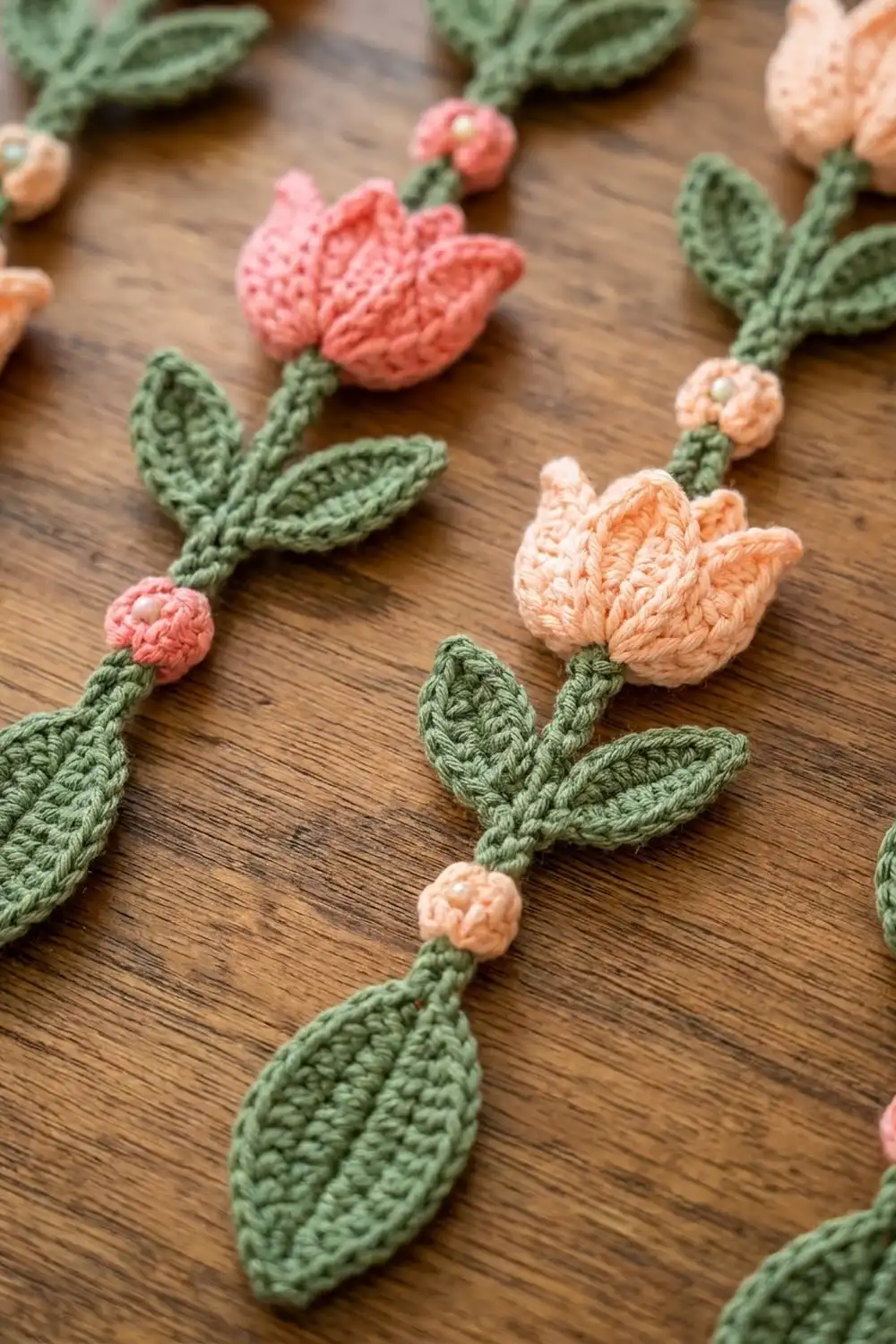
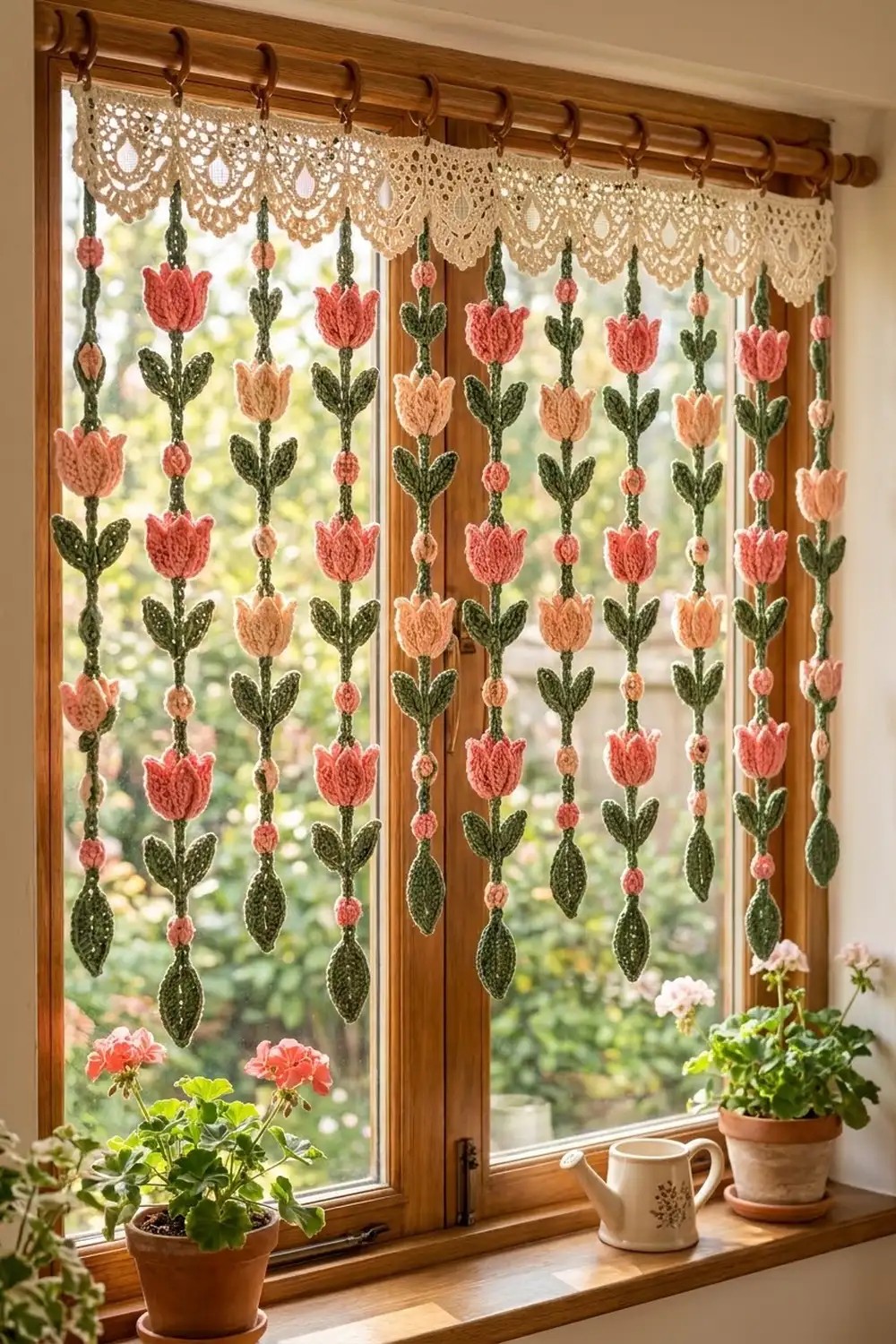
This curtain brings a spring garden to your window. A cream lace valance with deep fan scallops holds eleven slim stems. Each stem carries alternating coral and peach tulips, small round beads, and pairs of pointed sage leaves. Light shines through between the strands, so the curtain stays airy and bright.
The palette is soft: cream, coral pink, peach, and sage green. The style is cottage-romantic, with sculpted 3D tulips set against a flat lace header.
The pattern uses US crochet terms. The finished valance is 31.8 in (80.8 cm) wide. Including the hanging strands, the curtain drops about 30.9 in (78.5 cm).
Construction is modular. First you work the valance flat in rows and add an edging along the top and sides. Next you make the tulips, beads, and leaves separately. Then you crochet each stem directly onto a scallop and sew the motifs onto it at measured points.
Finished Size and Construction
- Finished size: 31.8 in (80.8 cm) wide × about 30.9 in (78.5 cm) total drop
- Skill level: Intermediate
- Terminology: US
- Yarn weight: DK (3), cotton
- Hook: US G-6 (4 mm)
- Number of pieces: 1 valance, 11 stems, 44 tulips, 44 beads, 88 small leaves, 11 large leaves
- Layout: 11 strands in one row, one per scallop, 2.8 in (7.1 cm) apart
- Valance size before edging: 31 in (78.7 cm) wide × 3.4 in (8.6 cm) deep at the sides, 4.2 in (10.7 cm) at the scallop centres
- Strand length: 26.25 in (66.7 cm), which is a 24 in (61.0 cm) stem plus the bottom leaf
- Edging depth: 0.4 in (1.0 cm)
Materials
Use a smooth mercerized or combed cotton. It shows the lace clearly, keeps the tulips crisp, and doesn’t stretch much when hanging. The amounts below assume about 115 m per 50 g.
- Cream: 60 g / 138 m (valance)
- Coral pink: 70 g / 161 m (22 tulips, 22 beads)
- Peach: 70 g / 161 m (22 tulips, 22 beads)
- Sage green: 110 g / 253 m (stems and leaves)
All quantities include a margin of about 20–25%.
Tools: 4 mm hook, tapestry needle, a small amount of polyester fiberfill, about 20 stitch markers, a measuring tape, blocking mats and pins, a spray bottle, and 12 curtain clip rings with a rod.
Abbreviations (US Terms)
- ch: chain
- sl st: slip stitch
- sc: single crochet
- hdc: half double crochet
- dc: double crochet
- tr: treble crochet
- sc2tog: single crochet 2 together
- sp: space
- st(s): stitch(es)
- RS: right side
- rep: repeat
Special stitch: reverse sc (crab stitch). Without turning, work from left to right. Insert the hook into the next stitch to the right, yarn over, pull up a loop, then yarn over and pull through both loops.
Picot: Ch 2, sl st in the 2nd ch from the hook.
Gauge and Checkpoints
Gauge: 20 sts and 10 rows of dc = 4 in (10.2 cm). For the stems, 6 ch = 1 in (2.5 cm), measured after slip-stitching back along the chain.
Before starting the full project, make one tulip, one bead, and one small leaf. Check them against these sizes:
- Tulip: 1.6 in (4.1 cm) tall × 1.3 in (3.3 cm) wide when flattened
- Bead: 0.6 in (1.5 cm) across
- Small leaf: 1.5 in (3.8 cm) long × 0.7 in (1.8 cm) wide
- Large leaf: 2.25 in (5.7 cm) long
Valance checkpoints:
- Row 1 (155 sc): 31 in (78.7 cm) wide
- After Row 7: 2.6 in (6.6 cm) deep
- After Row 9: 3.4 in (8.6 cm) deep at the sides and 4.2 in (10.7 cm) at the scallop centres
If your pieces come out too big, go down one hook size. If they’re too small, go up one size. Width matters most on the valance, because the strand spacing depends on it.
Valance
The valance is worked flat in cream. Each row is turned.
Foundation: Ch 156.
Row 1: Sc in the 2nd ch from the hook and in each ch across. Turn. (155 sc)
Row 2: Ch 3 (counts as dc). Dc in each st across. Turn. (155 dc)
Row 3 (mesh): Ch 4 (counts as dc + ch 1). Skip the next st and dc in the next st. Ch 1, skip 1 st, dc in the next st; rep from * across. Turn. (78 dc and 77 ch-1 sps = 155 sts)
Rows 4–6: Ch 4 (counts as dc + ch 1). Dc in the next dc. Ch 1, dc in the next dc; rep across, working the last dc in the 3rd ch of the turning ch. Turn. (78 dc and 77 ch-1 sps per row)
Row 7: Ch 3 (counts as dc). Dc in each ch-1 sp and in each dc across. Turn. (78 + 77 = 155 dc)
Checkpoint: The piece should be 2.6 in (6.6 cm) deep.
Row 8 (fans): Ch 1, sc in the first st.
Skip 6 sts. In the next st, work (tr, ch 1) 6 times, then tr once more in the same st. Skip 6 sts, sc in the next st.
Rep from * 10 more times. Turn.
This gives 11 fans, each with 7 tr and 6 ch-1 sps, plus 12 sc.
Here is the math for Row 8:
– Each repeat uses 14 sts.
– 11 repeats × 14 = 154 sts, plus the first sc = 155.
Row 9 (picot scallop rim): Ch 1, sc in the first sc.
Ch 2, skip the first tr of the fan. (Sc in the next ch-1 sp, ch 3) 5 times. Sc in the 6th ch-1 sp, ch 2, sc in the next sc.
Rep from * across. Do not fasten off.
Row 9 stitch counts:
– 78 sc in total (12 between-fan sc + 6 sc × 11 scallops)
– 55 ch-3 loops (5 per scallop)
– 22 ch-2 sps
The 3rd ch-3 loop of each scallop is the centre loop. That’s where you’ll attach a strand.
Checkpoint: The valance should measure 31 in (78.7 cm) wide, 3.4 in (8.6 cm) deep at the sides, and 4.2 in (10.7 cm) deep at the scallop centres.
Tulip (Make 44: 22 Coral, 22 Peach)
Work in continuous rounds. Mark the first stitch of each round.
Rnd 1: Make a magic ring and work 6 sc into it. (6)
Rnd 2: 2 sc in each st. (12)
Rnd 3: Sc in the next st, 2 sc in the next st; rep around. (18)
Rnds 4–5: Sc in each st. (18)
Rnd 6 (petals): Work each petal over 6 sts:
Sc in the next st, hdc in the next st, (dc, tr) in the next st, picot, (tr, dc) in the next st, hdc in the next st, sc in the next st.
Rep from * 2 more times, then sl st in the first sc.
This gives 3 petals, each with 8 sts plus a picot (24 sts in total).
Fasten off, leaving a 10 in (25.4 cm) tail. Add a pinch of fiberfill to the cup. Flatten the tulip so that one petal faces front, with the other two on either side.
Checkpoint: 1.6 in (4.1 cm) tall × 1.3 in (3.3 cm) wide.
Bead (Make 44: 22 Coral, 22 Peach)
Rnd 1: Make a magic ring and work 6 sc into it. (6)
Rnd 2: 2 sc in each st. (12)
Rnd 3: Sc in each st. (12)
Rnd 4: Sc2tog 6 times. (6)
Stuff the bead firmly. Close the hole and leave an 8 in (20.3 cm) tail.
Checkpoint: 0.6 in (1.5 cm) across.
Small Leaf (Make 88, Sage)
Ch 9. In this chain, c1 is the first chain made (the base of the leaf) and c9 is the last (the tip).
- First side: Sl st in c8. Then work sc in c7, hdc in c6, dc in c5, dc in c4, hdc in c3, sc in c2. (7 sts)
- Base: 3 sc in c1.
- Second side: Working along the free loops, sc in c2, hdc in c3, dc in c4, dc in c5, hdc in c6, sc in c7, sl st in c8. (7 sts)
- Tip: (Sl st, ch 2, sl st) in c9. Join with a sl st to the first sl st.
That’s 19 sts plus the tip ch-2. Fasten off, leaving a 6 in (15.2 cm) tail at the base.
Checkpoint: 1.5 in (3.8 cm) long.
Large Leaf (Make 11, Sage)
Ch 13. In this chain, c1 is the base and c13 is the tip.
- First side: Sl st in c12, sc in c11, hdc in c10, dc in c9 through c5 (5 dc), hdc in c4, sc in c3, sc in c2. (11 sts)
- Base: 3 sc in c1.
- Second side: Work the mirror image of the first side, from c2 up to c12. (11 sts)
- Tip: (Sl st, ch 2, sl st) in c13. Join with a sl st.
That’s 27 sts plus the tip ch-2. Leave a tail.
Checkpoint: 2.25 in (5.7 cm) long.
Make All Pieces
| Piece | Coral | Peach | Sage | Cream |
|---|---|---|---|---|
| Valance | – | – | – | 1 |
| Tulips | 22 | 22 | – | – |
| Beads | 22 | 22 | – | – |
| Small leaves | – | – | 88 | – |
| Large leaves | – | – | 11 | – |
| Stems | – | – | 11 | – |
There are two strand types. Each bead matches the tulip directly below it.
- Strand A: coral, peach, coral, peach (top to bottom)
- Strand B: peach, coral, peach, coral (top to bottom)
Layout, left to right (one strand per scallop):
Scallop:  1  2  3  4  5  6  7  8  9  10 11
Strand:   A  B  A  B  A  B  A  B  A  B  A
That’s 6 A strands and 5 B strands. Check that against the tulip counts:
– Coral tulips: (6 × 2) + (5 × 2) = 22
– Peach tulips: (6 × 2) + (5 × 2) = 22
Joining
Stems. With the valance’s RS facing, join sage with a sl st into the centre (3rd) ch-3 loop of scallop 1. Ch 144, then sl st in the back bump of each ch back up to the loop. (143 sl st) Sl st into the same loop and fasten off.
Checkpoint: The stem should be 24 in (61.0 cm) long.
Repeat for all 11 scallops. Each scallop repeat is 14 sts at 5 sts per inch, so the strands land exactly 2.8 in (7.1 cm) apart.
Placing motifs. Each strand has 4 units of 36 ch, or 6 in (15.2 cm) each. Before sewing, mark these positions on the stem, counting from the top. For unit k (k = 0 to 3), add 36 × k chains:
- Bead centre: ch 3, which is 0.5 in (1.3 cm) down. Sew the bead over the stem.
- Tulip: from ch 6 at the petal tips to ch 15 at the base. That’s 1.0–2.5 in (2.5–6.4 cm) down. Sew the base and the back of the cup to the stem, so the stem runs behind the tulip.
- Leaf pair: at ch 21, which is 3.5 in (8.9 cm) down. Sew one leaf base on each side, with the tips angled upward at about 45°.
The last leaf pair sits at 21.5 in (54.6 cm). Sew the base of the large leaf to the end of the stem so that its tip hangs down.
Tension. Keep the slip stitches loose enough to sink into the back bumps without tightening the chain. If you pull them tight, the stem shortens. Sew motifs with small, hidden stitches through the stem’s centre.
Checkpoint: Each strand should be 26.25 in (66.7 cm) long. Lay the strands side by side; all bead and tulip positions should line up across the curtain.
Edging
The edging is worked along the top and both sides of the valance. The scallop rim stays as it is.
Edging gauge:
– Sides: 2 sc per dc row-end, 3 sc per tr row-end, 1 sc per sc row-end
– Top: 1 sc per foundation ch
Edging Row 1: With the RS facing, join cream at the end of Row 9 on one side. Work up that side:
| Row-end | Sc |
|---|---|
| Row 9 | 1 |
| Row 8 | 3 |
| Row 7 | 2 |
| Rows 6–3 | 8 |
| Row 2 | 2 |
| Side total | 16 |
Next, work 3 sc in the first foundation ch. Then sc in each of the next 153 ch, and 3 sc in the last ch. Work 16 sc down the second side, mirroring the first.
Edging Row 1 counts:
– Top: 155 (1 per foundation ch) + 4 extra (2 extra at each corner) = 159 sc
– Total: 16 + 159 + 16 = 191 sc
Edging Row 2: Do not turn. Ch 1, then work reverse sc in each of the 191 sts. Fasten off.
Why the math works: The top edge matches the foundation chain one-for-one, so the edging adds no width and doesn’t cause rippling. The 4 extra corner stitches let the edging turn the corners flat. Each side uses 16 sc over 3.4 in (8.6 cm), which is close to the 5 sts per inch gauge.
After edging: 31.8 in (80.8 cm) wide, 3.8 in (9.7 cm) deep at the sides, and 4.6 in (11.7 cm) deep at the scallop centres. Adding the 26.25 in (66.7 cm) strands gives a total drop of about 30.9 in (78.5 cm).
Final Blocking
- Lay the valance RS up on blocking mats.
- Pin the top edge straight to 31.8 in (80.8 cm).
- Pin each fan open, with one pin in each ch-3 loop so the picot rim forms rounded scallops.
- Mist the valance thoroughly. Let it dry completely.
- Lay each strand flat. Mist the leaves and pin their tips open, keeping the angle at 45°.
- Shape the tulip petals with your fingers while they’re damp.
- Hang the finished curtain with 12 clip rings. Clip one ring at the top edge directly above each Row 8 sc, so the rings are 2.8 in (7.1 cm) apart.
Final Quality-Control Checklist
- [ ] The valance is 31.8 in (80.8 cm) wide, with an even top edge
- [ ] All 11 fans each have 7 tr and 5 picot loops
- [ ] Each strand is attached to the centre loop of its scallop
- [ ] All stems measure 24 in (61.0 cm)
- [ ] Tulip colors alternate correctly in the A/B pattern
- [ ] Beads, tulips, and leaves line up across all strands
- [ ] All tails are woven in securely, with none visible from either side
Troubleshooting
- The valance is narrower than 31 in (78.7 cm): Your foundation chain is too tight. Chain with a hook one size larger.
- The fans curl: Block them more firmly, or loosen your tr stitches.
- Stems are short: Your slip stitches are too tight. Work them more loosely, or add chains so that 6 ch = 1 in (2.5 cm).
- Tulips lean or twist: Sew both the base and the back of the cup to the stem.
- The strands twist when hanging: Steam each strand and let it hang free until it’s dry.
Care
Hand wash in cool water and roll in a towel to remove excess water. Re-pin the scallops and dry the curtain flat.
Final Notes
Every measurement in this design follows from your gauge:
– 155 sts at 5 sts per inch gives the 31 in (78.7 cm) valance.
– 11 repeats of 14 sts gives the 2.8 in (7.1 cm) strand spacing.
– 144 chains at 6 ch per inch gives the 24 in (61.0 cm) stems.
– Each 36-chain unit sets the 6 in (15.2 cm) tulip rhythm.
Check each of these as you go, and the curtain will hang straight and even.
Happy crocheting!