

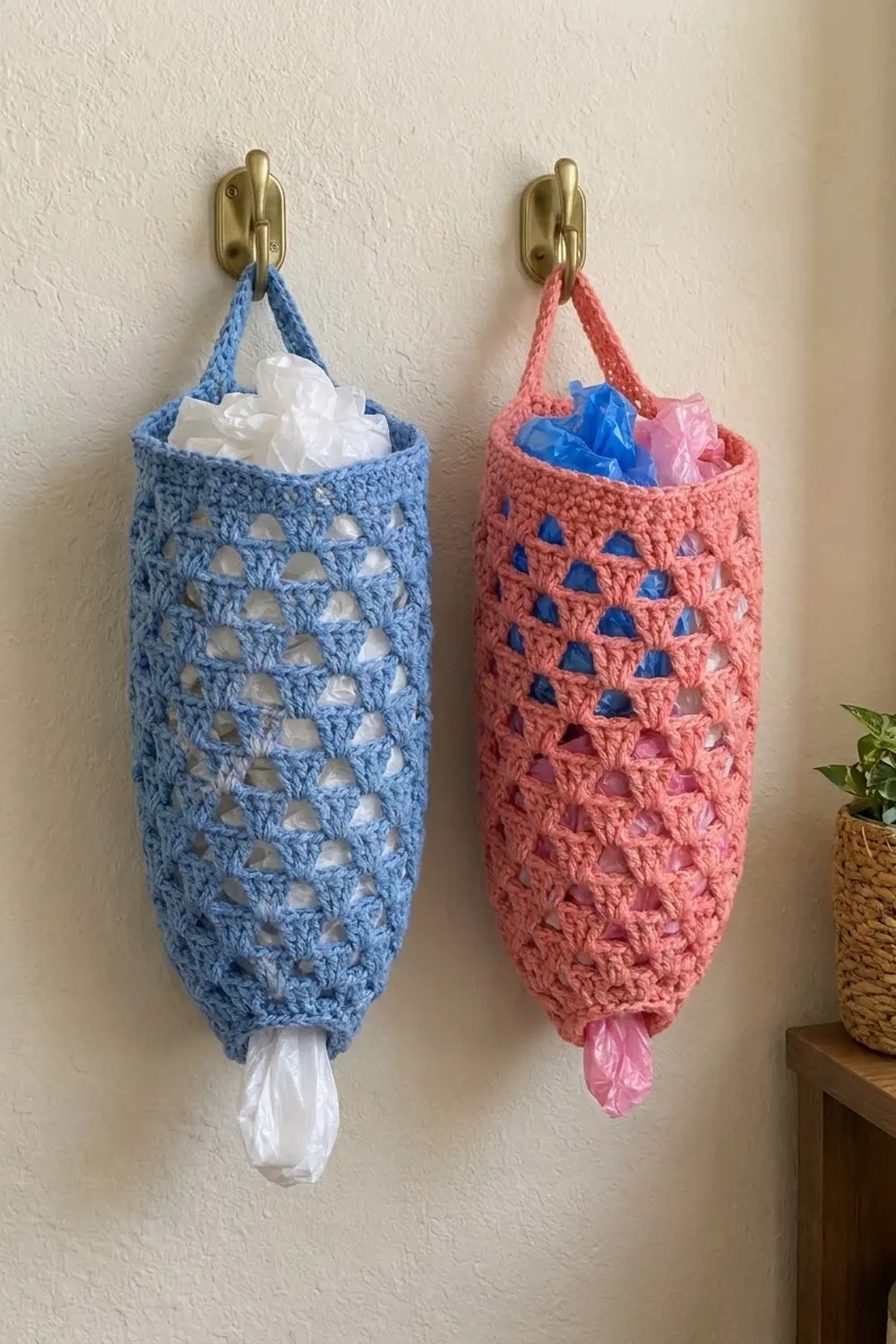
The Bluebell Mesh Plastic Bag Holder is a simple fix for that drawer full of loose grocery bags. It’s a long, slim tube in an open granny mesh. You stuff bags in at the top and pull them out one at a time through the narrow bottom. A soft strap hangs it from a hook, a door knob or the inside of a cabinet door.
The sample is made in cornflower blue cotton, and a coral pink version looks just as good. The mesh shows the bags through the holes, so white or colored bags become part of the look. The style is clean and practical, with solid single crochet bands at the top and bottom that give the open lattice a firm frame.
This pattern uses US crochet terms. The holder measures 8 in (20.3 cm) wide laid flat at the top and 20 in (50.8 cm) long, not counting the strap. The strap rises about 4.8 in (12.2 cm) above the rim.
The holder is one piece, worked from the top down in joined rounds. You start with a single crochet band, work a straight section of granny mesh, taper the mesh by shrinking the groups and chain spaces, and close with a narrow single crochet band. A one-round border tidies the starting edge, and then you work the strap directly onto it.
Finished Size and Construction
- Finished size: 8 in (20.3 cm) wide flat × 20 in (50.8 cm) long
- Skill level: Easy
- Terminology: US crochet terms
- Yarn weight: Worsted (#4), cotton or cotton blend
- Hook: 5.0 mm (H-8)
- Number of pieces: 1 (the strap is worked directly onto the body)
- Layout: Single tube, worked top-down in joined rounds
- Piece size before border: 8 in (20.3 cm) wide × 19.75 in (50.2 cm) long
- Border depth: 0.25 in (0.6 cm), one round of single crochet on the top edge
- Bottom opening: about 3.2 in (8.1 cm) wide flat, 6.4 in (16.3 cm) around
Materials
Yarn: Use a smooth worsted-weight cotton or cotton blend. Cotton holds its shape when the holder is full, doesn’t stretch out under weight the way acrylic can, and survives washing. Avoid very splitty yarns, because the 3-dc groups go into chain spaces and a splitty yarn makes them harder to place.
- Main color (Cornflower Blue or Coral Pink): 150 g, about 280 m (306 yd)
You only need one color per holder. If you’re making a matching pair like the photo, buy 150 g of each color.
Tools:
- 5.0 mm (H-8) crochet hook
- Locking stitch markers (at least 3)
- Tapestry needle
- Scissors
- Measuring tape
- Blocking pins and a towel or blocking mat
- Spray bottle
The yarn amounts include a margin of about 15% for your gauge swatch and weaving in ends.
Abbreviations (US Terms)
- ch – chain
- sl st – slip stitch
- sc – single crochet
- dc – double crochet
- sc2tog – single crochet 2 together
- sk – skip
- sp – space
- st(s) – stitch(es)
- rnd(s) – round(s)
- rep – repeat
Special stitch: Granny group (GG). Work 3 dc into the same chain space. In the taper section the group gets smaller: a 2-dc group means 2 dc in the same space.
Note: At the start of each mesh round, the ch 3 counts as the first dc.
Gauge and Checkpoints
Single crochet gauge: 15 sts and 16 rnds = 4 in (10.2 cm)
Mesh gauge: 3 repeats of (3 dc, ch 2) = 15 sts = 4 in (10.2 cm) wide; 4 mesh rnds = 3 in (7.6 cm) tall
Both gauges run at 15 stitches per 4 in, so the sc band and the mesh are the same width and the tube sits straight.
Test before committing. Work Rnds 1–3 and the first 4 mesh rounds, then flatten the tube and measure it. That small section is your gauge swatch, and you keep it if it measures correctly.
Checkpoints:
- After Rnd 3: tube is 8 in (20.3 cm) wide flat; band is 0.75 in (1.9 cm) tall.
- After Rnd 11 (8 mesh rnds): total length is 6.75 in (17.1 cm).
- After Rnd 23 (20 mesh rnds): total length is 15.75 in (40.0 cm).
- After Rnd 27 (taper complete): total length is 18.75 in (47.6 cm); bottom of taper is about 4.8 in (12.2 cm) wide flat.
- After Rnd 31: total length is 19.75 in (50.2 cm).
- After the border: total length is 20 in (50.8 cm).
If your tube is too wide, go down half a hook size (4.5 mm). If it’s too narrow, go up to 5.5 mm. If the width is right but the mesh rounds are too tall or too short, keep the hook and add or remove mesh rounds in the straight section to reach the checkpoint length.
Pattern
Top Band
Foundation: Ch 60 and join with a sl st to the first ch to form a ring. Don’t twist the chain.
Rnd 1: Ch 1, sc in each ch around, join with a sl st to the first sc. (60 sc)
Rnds 2–3: Ch 1, sc in each st around, join. (60 sc)
Place a marker in the first stitch of the round and move it up as you go.
Mesh Body (Straight Section)
Rnd 4 (setup): Ch 3 (counts as dc), dc in next 2 sts, ch 2, sk 2 sts, dc in next 3 sts, ch 2, sk 2 sts; rep from * 10 more times, join with a sl st to the top of the beginning ch-3. (12 groups: 36 dc + 12 ch-2 sps = 60 sts)*
Each repeat covers exactly 5 base stitches (3 worked plus 2 skipped), and 12 × 5 = 60. This uses every stitch of the band with nothing left over.
Rnd 5: Sl st in next 2 dc and into the next ch-2 sp, ch 3, 2 dc in same sp, ch 2, GG in next ch-2 sp, ch 2; rep from * around, join to the top of the beginning ch-3. (12 GG + 12 ch-2 sps = 60 sts)*
Rnds 6–23: Rep Rnd 5. (60 sts in each rnd)
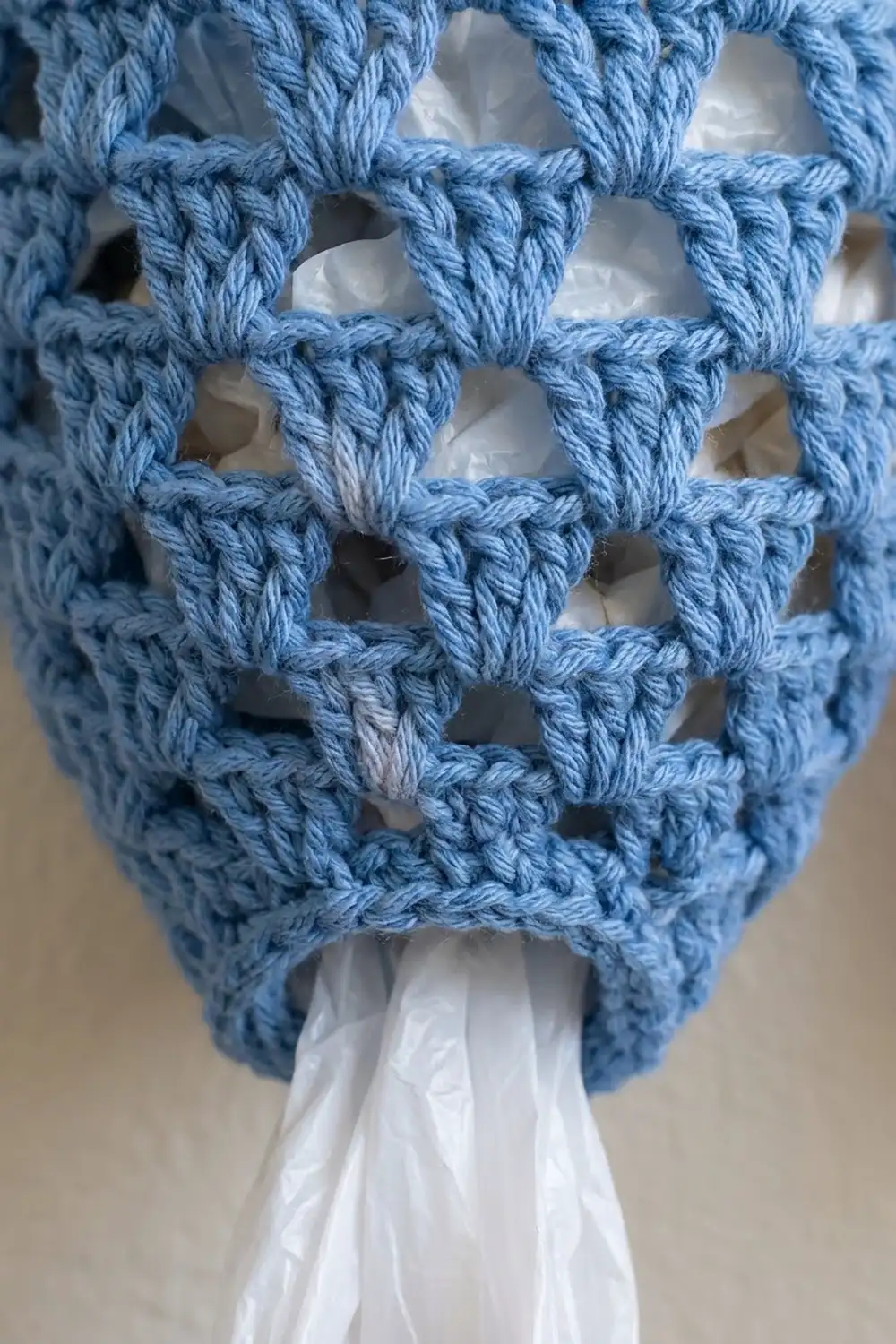
You now have 20 mesh rounds (Rnds 4–23), which measure 15 in (38.1 cm). Each granny group sits in the space between two groups below it, so the rounds offset and leave triangular holes that stack into a diamond lattice.
Checkpoint: Total length is 15.75 in (40.0 cm) and width is still 8 in (20.3 cm) flat.
Taper
The taper keeps all 12 groups so the lattice stays continuous. Only the size of the groups and spaces gets smaller.
Rnd 24: Sl st in next 2 dc and into the next ch-2 sp, ch 3, 2 dc in same sp, ch 1, GG in next ch-2 sp, ch 1; rep from * around, join. (12 GG + 12 ch-1 sps = 36 dc + 12 ch = 48 sts)*
Rnd 25: Sl st in next 2 dc and into the next ch-1 sp, ch 3, 2 dc in same sp, ch 1, GG in next ch-1 sp, ch 1; rep from * around, join. (48 sts)*
Rnd 26: Sl st in next 2 dc and into the next ch-1 sp, ch 3, dc in same sp, ch 1, 2 dc in next ch-1 sp, ch 1; rep from * around, join. (12 two-dc groups + 12 ch-1 sps = 24 dc + 12 ch = 36 sts)*
Rnd 27: Sl st in next dc and into the next ch-1 sp, ch 3, dc in same sp, ch 1, 2 dc in next ch-1 sp, ch 1; rep from * around, join. (36 sts)*
Checkpoint: Total length is 18.75 in (47.6 cm). At 36 sts the tube is about 9.6 in (24.4 cm) around, or 4.8 in (12.2 cm) flat.
Bottom Band
Rnd 28 (conversion): Ch 1, sc in each dc and sc in each ch-1 sp around, join. (24 sc in dc + 12 sc in ch-1 sps = 36 sc)
Rnd 29: Ch 1, sc in next st, sc2tog; rep from * 11 more times, join. (12 sc + 12 sc2tog = 24 sts)*
Rnds 30–31: Ch 1, sc in each st around, join. (24 sc)
Fasten off and weave in the end on the inside. The bottom band is 1 in (2.5 cm) tall. The opening is about 6.4 in (16.3 cm) around: firm enough to hold bags in but loose enough to pull one out.
Checkpoint: Total length is 19.75 in (50.2 cm).
Border and Hanging Strap
Top Border
Border gauge: Same as the sc gauge, 15 sc = 4 in (10.2 cm).
Turn the tube upside down so the foundation chain is on top. Join the yarn with a sl st in any foundation ch, at the base of the first stitch of Rnd 1.
Border Rnd: Ch 1, sc in each foundation ch around, join. (60 sc: 30 on the front and 30 on the back when flattened)
Why the math works: You work one sc into each of the 60 foundation chains, which matches Rnd 1 exactly. The border lies flat without ruffling or cinching, and the rim stays 8 in (20.3 cm) wide. It adds 0.25 in (0.6 cm), bringing the length to 20 in (50.8 cm). It also covers the loose foundation chain, so both sides of the top band look the same.
Don’t fasten off yet if you want to go straight into the strap. Otherwise, fasten off and rejoin as described below.
Hanging Strap
Flatten the tube with the border join at one side fold. Count 15 sts from the join and mark this stitch as the center front (st 15). Count 30 sts further around and mark the center back (st 45). There are 29 stitches between the markers on each side.
Row 1: Join yarn with a sl st in st 15, ch 36, then sl st in st 45, making sure the chain isn’t twisted. Sl st in the next border st (st 46).
Row 2: Turn. Sc in each of the 36 ch, then sl st in the border st beside st 15 on the same edge (st 14). (36 sc)
Row 3: Sl st in the next border st (st 13), turn. Sc in each sc across, then sl st in the next free border st beside the strap at the back end (st 47). (36 sc)
Fasten off and weave the ends into the strap and border.
The strap is 3 rows wide, about 0.75 in (1.9 cm), and 36 sts long, about 9.6 in (24.4 cm). Each end is anchored across 3 border stitches, which spreads the weight of a full holder. The strap forms an arch about 4.8 in (12.2 cm) above the rim.
Final Blocking
- Weave in all ends before blocking.
- Hand-wash in cool water or simply soak the holder for 10 minutes, then gently squeeze out the water. Don’t wring it.
- Roll it in a towel to remove the extra water.
- Lay it flat on a mat and pat it to 8 in (20.3 cm) wide at the top and 20 in (50.8 cm) long.
- Open each triangular hole with your fingers so the lattice looks even.
- Pin the top rim straight and shape the taper so it narrows smoothly toward the bottom band.
- Pin the strap flat, then let everything dry completely before hanging.
Final Quality-Control Checklist
- Top band and border: 60 sc each, flat and even
- Every mesh round has 12 granny groups
- Taper rounds: 48 sts in Rnds 24–25, then 36 sts in Rnds 26–27
- Bottom band: 36 sc, then 24 sc
- Width is 8 in (20.3 cm) flat at the top
- Length is 20 in (50.8 cm) without the strap
- Strap is centered front and back, 36 sc long, and not twisted
- All ends are woven in securely on the inside
Troubleshooting
The tube spirals or leans. Check that you join every round to the top of the beginning ch-3 and that you sl st into the correct chain space at the start. If the start drifts, the lattice twists.
There are 11 or 13 groups in a round. You missed or doubled a chain space. Count the groups after each round until the rhythm feels automatic.
The top band ruffles. The band has more stitches than the mesh can carry, or your sc is looser than your dc. Go down one hook size for the band only.
The bottom opening is too tight to pull bags through. Skip Rnd 29 and work Rnds 30–31 at 36 sc. This adds 1.6 in (4.1 cm) to the flat width of the opening.
Bags fall out on their own. Add one more round of sc2tog decreases, (sc 1, sc2tog) × 8 for 16 sts, then sc 1 round.
The strap stretches too much. Add a fourth row of sc, or work the strap with a hook one size smaller.
Care
Hand-wash or machine-wash cool on a gentle cycle in a mesh laundry bag. Reshape while damp and lay flat to dry.
Final Notes
Everything in this holder follows from one number: 60 stitches. The 60-sc band becomes 12 mesh repeats of 5 stitches each, and the mesh keeps those 60 stitches all the way down the straight section. The taper then shrinks the round to 48 and then 36 stitches without breaking the lattice. The bottom band converts those 36 stitches to sc and decreases to 24 for the opening.
The length chain is 0.75 in (1.9 cm) for the band, 15 in (38.1 cm) for the mesh, 3 in (7.6 cm) for the taper, 1 in (2.5 cm) for the bottom band and 0.25 in (0.6 cm) for the border. That makes a total of 20 in (50.8 cm). Check your gauge at the first checkpoint and the rest of the measurements should follow.
Happy crocheting!