

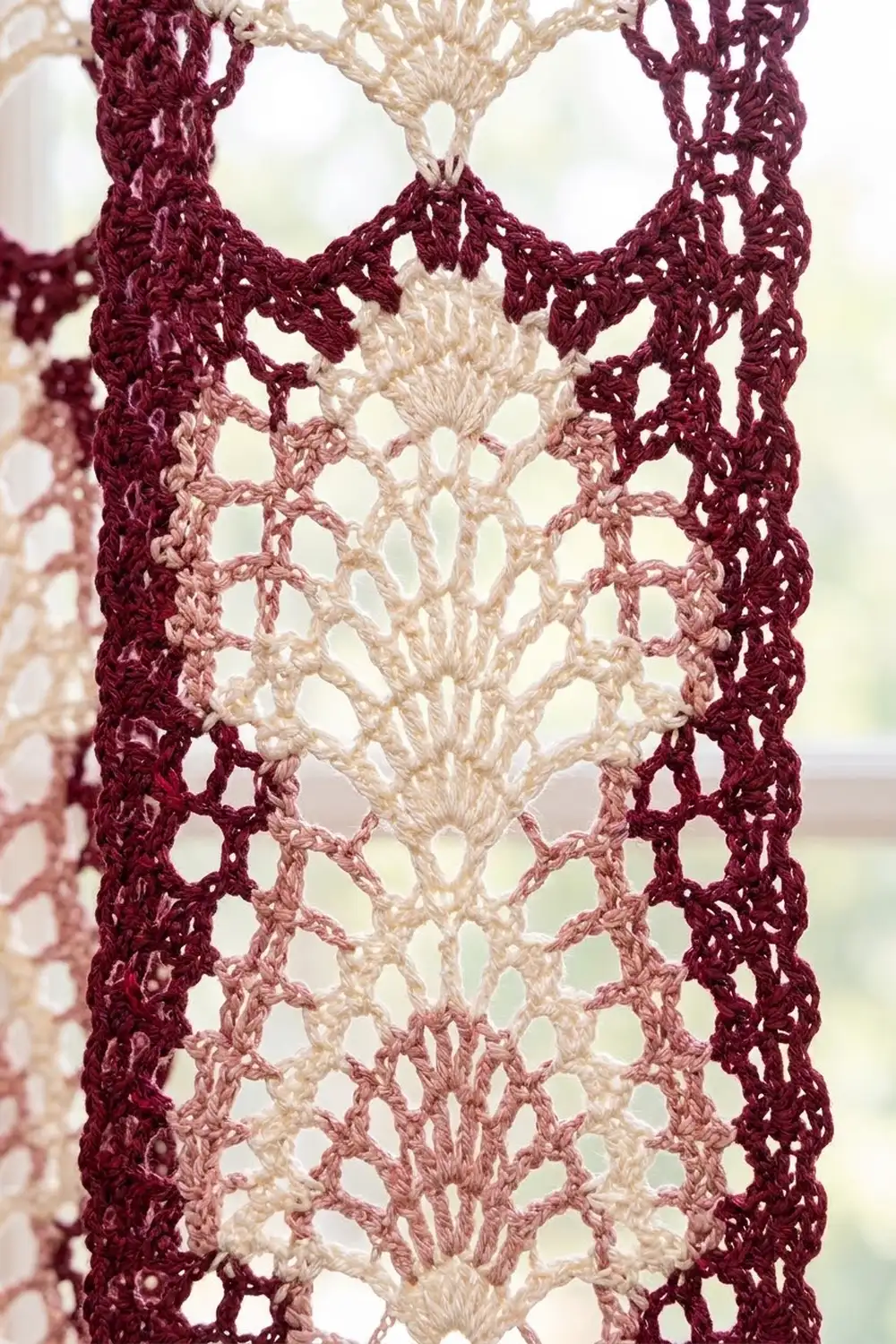
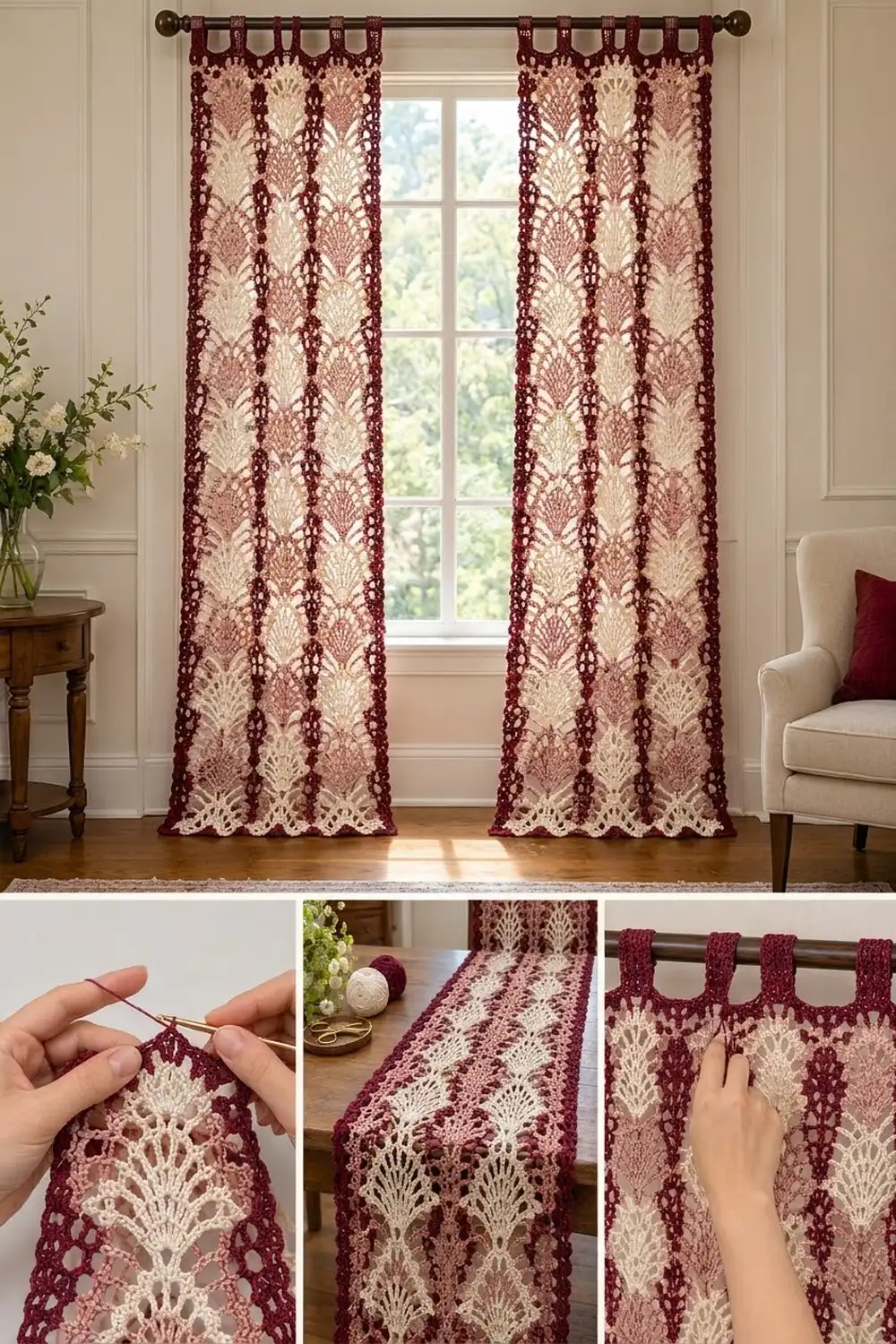
These tall, airy curtain panels are made of columns of lace fans. Each column holds a stack of fan motifs that start narrow and open out to a scalloped top. The fans alternate between creamy ivory and dusty rose, and every column is framed in deep burgundy mesh. When light comes through the window, the fans look almost like they are glowing.
The palette is warm and romantic: burgundy for structure, rose and cream for the lace. The style is vintage parlor lace, but the cotton yarn is worsted weight, so the panels work up much faster than thread curtains. The pattern uses US crochet terms throughout.
Each finished panel measures 39 in (99.1 cm) wide and 79 in (200.7 cm) long, not counting the tabs. The tabs add a 3.5 in (8.9 cm) hanging loop. The photo shows a matching pair, so the quantities below are for two panels.
Here is how it’s built. You crochet five long lace strips in rows, edge each strip in burgundy mesh, and join the strips side by side. Then you add a four-round burgundy border, finishing with a chain-loop scallop edge, and sew six tabs to the top.
Finished Size and Construction
- Finished panel size: 39 in x 79 in (99.1 cm x 200.7 cm), excluding tabs
- Skill level: Intermediate
- Terminology: US crochet terms
- Yarn weight: Worsted (#4) cotton
- Hook: 5.0 mm (H-8)
- Pieces per panel: 5 lace strips + 6 tabs (pair: 10 strips + 12 tabs)
- Layout: 5 strips side by side, 1 strip tall
- Strip size (after edging): 7.4 in x 77.0 in (18.8 cm x 195.6 cm)
- Panel size before border: 37 in x 77 in (94.0 cm x 195.6 cm)
- Border depth: 1 in (2.5 cm) per side
Materials
Use a smooth, mercerized or combed worsted cotton, about 200 yd per 100 g. Cotton hangs straight, holds the lace open, and won’t stretch out of shape the way acrylic can. Pick a burgundy dark enough to contrast clearly with the rose.
Yarn (for a pair of panels):
- Cream: 850 g, about 1,700 yd (1,554 m)
- Dusty Rose: 825 g, about 1,650 yd (1,509 m)
- Burgundy: 775 g, about 1,550 yd (1,417 m)
These quantities already include roughly a 10% margin for the gauge test and differences in tension.
Tools:
- 5.0 mm (H-8) crochet hook
- Tapestry needle
- Locking stitch markers
- Tape measure
- Rust-proof pins and blocking space at least 40 in x 80 in (101.6 cm x 203.2 cm), such as a bed covered with towels
- Spray bottle
Abbreviations (US Terms)
- ch – chain
- sl st – slip stitch
- sc – single crochet
- dc – double crochet
- dc2tog – double crochet 2 together
- sk – skip
- sp – space
- st(s) – stitch(es)
- RS / WS – right side / wrong side
Special stitch – mesh 5: This is the 5-st mesh at each edge of every fan row. Left mesh: ch 4 (counts as dc + ch 1), sk next ch-1 sp, dc in next dc, ch 1, sk next ch-1 sp, dc in next dc. Right mesh: dc in next dc, ch 1, sk next ch-1 sp, dc in next dc, ch 1, dc in 3rd ch of turning ch. Each mesh 5 counts as 5 sts (3 dc + 2 ch).
Stitch counts: Every chain counts as a stitch, so lace rows grow and shrink. The closing row always brings the strip back to 25.
Gauge and Checkpoints
Gauge: 25 dc = 6 in (15.2 cm) wide. One 5-row fan repeat = 3 in (7.6 cm) tall, measured lightly stretched lengthwise the way the curtain will hang.
Test one piece first. Start Strip A and work Rows 1–11 (the base row plus two fans), then measure:
- Checkpoint 1: Row 1 is 6 in (15.2 cm) wide.
- Checkpoint 2: Rows 1–11 are 6.6 in (16.8 cm) tall.
- Checkpoint 3: Each finished strip with edging is 7.4 in (18.8 cm) wide.
- Checkpoint 4: Five joined strips are 37 in (94.0 cm) wide.
- Checkpoint 5: The bordered panel is 39 in x 79 in (99.1 cm x 200.7 cm).
If too big: go down to a 4.5 mm hook. If too small: go up to a 5.5 mm hook. Over a 79 in (200.7 cm) drop, being off by 0.25 in (0.6 cm) per fan adds up to more than 6 in (15.2 cm), so check gauge before you go on.
Strip Pattern
Make two kinds of strip:
- Strip A starts with a Cream fan: 13 Cream fans and 12 Rose fans.
- Strip B starts with a Rose fan: 13 Rose fans and 12 Cream fans.
Colors alternate with every fan. To change color, work the last yarn over of the final dc of Row 6 with the new color. Turn at the end of every row.
Foundation: With the first fan color, ch 27.
Row 1 (base row): Dc in 4th ch from hook (skipped ch count as dc) and in each ch across. (25 sts)
Fan Repeat (Rows 2–6)
Row 2: Left mesh worked over the base row: ch 4 (counts as dc + ch 1), sk 1 st, dc in next st, ch 1, sk 1 st, dc in next st. Ch 3, sk next 7 sts, 7 dc in next st (the 13th st, the center), ch 3, sk next 7 sts. Right mesh: dc in next st, ch 1, sk 1 st, dc in next st, ch 1, sk 1 st, dc in last st. (23 sts: 5 + 3 + 7 + 3 + 5)
Row 3: Mesh 5, ch 3, sk ch-3 sp, dc in first fan dc, [ch 1, dc in next dc] 6 times, ch 3, sk ch-3 sp, mesh 5. (29 sts: 5 + 3 + 13 + 3 + 5)
Row 4: Mesh 5, ch 3, sk ch-3 sp, dc in first fan dc, [ch 2, dc in next dc] 6 times, ch 3, sk ch-3 sp, mesh 5. (35 sts: 5 + 3 + 19 + 3 + 5)
Row 5 (scallop top): Mesh 5, ch 1, sk ch-3 sp, 3 dc in each of the 6 ch-2 sps (skip the dc between them), ch 1, sk ch-3 sp, mesh 5. (30 sts: 5 + 1 + 18 + 1 + 5)
Row 6 (closing row): Ch 3 (counts as dc), dc in next ch-1 sp, dc in next dc, dc in next ch-1 sp, dc in next dc (5 dc). Sk ch-1 sp, [dc in next 4 dc, dc2tog] 3 times (15 dc). Sk ch-1 sp, dc in next dc, dc in next ch-1 sp, dc in next dc, dc in turning-ch sp, dc in 3rd ch of turning ch (5 dc). (25 sts: 5 + 15 + 5)
Rows 2–6 make one fan. The 7-dc base opens into chain-spaced ribs, then into six 3-dc scallops, and Row 6 closes it off so the next fan has a flat base.
Change color and repeat Rows 2–6 until you have 25 fans (126 rows total). Fasten off.
Checkpoint: Before edging, the strip measures 6 in x 75.6 in (15.2 cm x 192.0 cm).
Strip Edging (Burgundy)
Rnd 1: With RS facing, join Burgundy in the first st of Row 126. (Sc, ch 2, sc) in first st, sc in next 23 sts, (sc, ch 2, sc) in last st. Down the long side, work 5 sc over every 2 row ends (2 sc in one, 3 sc in the next) for 315 sc. Along the foundation ch, (sc, ch 2, sc) in first ch, sc in next 23 ch, (sc, ch 2, sc) in last ch. Work 315 sc up the second long side. Join with sl st to first sc. (25 sc per short side, 315 sc per long side, 680 sc + 4 corner ch-2 sps)
Rnd 2: Sl st into corner sp, ch 5 (counts as dc + ch 2), dc in same sp. *[Ch 1, sk 1 sc, dc in next sc] across to 1 sc before the next corner, ch 1, sk last sc, (dc, ch 2, dc) in corner sp; repeat from * around, ending with a sl st to 3rd ch of beginning ch-5.
- Short side: 12 dc + 13 ch-1 + 2 corner dc = 27 sts
- Long side: 157 dc + 158 ch-1 + 2 corner dc = 317 sts
Rnd 3: Ch 1, sc in each dc and each ch-1 sp around, (sc, ch 2, sc) in each corner sp. Join. (29 sts per short side, 319 sts per long side; 1 sc on each side of a corner sp counts toward that side)
Fasten off. Checkpoint: 7.4 in x 77.0 in (18.8 cm x 195.6 cm).
Tabs (Burgundy, make 6 per panel)
Ch 9. Row 1: Dc in 4th ch from hook and each ch across. (7 sts) Rows 2–14: Ch 3 (counts as dc), dc in each st across. (7 sts) Fasten off, leaving a 12 in (30.5 cm) tail.
Checkpoint: 1.7 in x 7 in (4.3 cm x 17.8 cm). Folded in half, it gives a 3.5 in (8.9 cm) loop.
Make All Pieces
For one panel: 3 Strip A, 2 Strip B, 6 tabs.
For the pair: 6 Strip A, 4 Strip B, 12 tabs.
Fan count per panel: 63 Cream fans and 62 Rose fans (125 fans total).
Layout (bottom of panel shown at bottom, fan color at the bottom of each strip):
| A | B | A | B | A |
| C | R | C | R | C |   <- first (bottom) fan
Starting colors alternate across the panel, so the fans form a soft checkerboard both across and up the panel.
Joining
Lay the five strips RS up in A-B-A-B-A order. Make sure every strip’s foundation edge is at the bottom.
Method: Flat slip-stitch join in Burgundy. Join yarn in the bottom corner ch-2 sp of the first strip. Sl st into the matching corner sp of the second strip, then sl st alternately into the inside loop of each Rnd 3 sc on the left strip and the matching sc on the right strip.
Stitch-to-stitch logic: Each long side has 319 sts, so the sts match 1 to 1 from corner sp to corner sp. No stitches are added or skipped. Place a marker every 50 sts on both strips to keep them aligned.
Tension: Keep the slip stitches as loose as the lace. A tight seam will pucker the panel and stop it hanging straight. If the seam measures shorter than the strips, pull it out and go up one hook size for joining only.
Join all 4 seams. Size checkpoint: 37 in x 77 in (94.0 cm x 195.6 cm).
Border
Border gauge: 4 rounds = 1 in (2.5 cm) deep. Across the short ends there are about 4 sc per 1 in (2.5 cm), the same as the strip edges.
Rnd 1: With RS facing, join Burgundy in the first sc after a top outer corner sp. Sc in each sc across the top. At each seam, step over the two joined corner sps without working into them. At each outer corner: sc in last sc, ch 2, sk the corner sp, sc in first sc of the next side. Join.
- Top/bottom: 5 strips x 29 = 145 sc
- Long sides: 1 strip x 319 = 319 sc
- Total: 928 sc + 4 corner ch-2 sps
Rnd 2: Sl st into corner sp, ch 5 (counts as dc + ch 2), dc in same sp. Repeat the mesh from strip edging Rnd 2 around.
- Top/bottom: 72 dc + 73 ch-1 + 2 corner dc = 147 sts
- Long sides: 159 dc + 160 ch-1 + 2 corner dc = 321 sts
Rnd 3: Ch 1, sc in each dc and ch-1 sp, (sc, ch 2, sc) in each corner sp. Join. (149 sts top/bottom, 323 sts long sides)
Rnd 4 (scallop loops): Sl st into corner sp, (sc, ch 3, sc) in corner sp. *[Ch 3, sk 1 sc, sc in next sc] to last sc of side, ch 3, sk last sc, (sc, ch 3, sc) in corner sp; repeat from * around. Join and fasten off.
- Top/bottom: 74 sc + 75 ch-3 loops
- Long sides: 161 sc + 162 ch-3 loops
Why the math works: Every side count is odd, so the mesh in Rnd 2 starts and ends with a ch-1 sp and both corners mirror each other. Rnds 2 and 3 each add exactly 2 sts per side (one per corner). Rnd 4 swaps every other st for a loop. You never add stitches at the seams, so the 145 top sts are exactly five strips of 29.
Attach tabs: Fold each tab in half. Sew both ends to the WS of the top border over Rnds 1–3. Put one tab at each outer edge and center one over each seam, so the tabs are spaced 7.4 in (18.8 cm) apart.
Final Blocking
- Weave in all ends along burgundy edges, where they hide best.
- Soak the panel in cool water for 15 minutes, then press out the water (don’t wring).
- Roll it in towels to remove the excess moisture.
- Lay it flat and pin to 39 in x 79 in (99.1 cm x 200.7 cm).
- Pin each strip seam straight, then pin the tip of every border loop.
- Open each fan with your fingers so the ribs fan out evenly.
- Mist again and let dry completely, usually 24–48 hours.
- Repeat for the second panel. Measure both so they match.
Final Quality-Control Checklist
- Each strip has 25 fans, and colors alternate without a missed change.
- Every closing row has 25 sts.
- The strip edging counts are 29 / 319 sts.
- All 4 seams lie flat and are the same length as the strips.
- Border Rnd 1 has 145 / 319 sc.
- The scallop loops are even and all corners are square.
- The tabs are evenly spaced and securely sewn.
- Both panels measure 39 in x 79 in (99.1 cm x 200.7 cm).
Troubleshooting
- The strip gets wider as you go: Check that the Row 6 count is 25 and that each dc2tog was worked.
- The fans look crowded: Make sure you skip the dc between ch-2 sps in Row 5.
- The edges wave: You have too many sc on the long sides in Rnd 1. Count to 315.
- The seams pucker: Loosen your tension or go up a hook size for joining.
- The panel hangs crooked: Re-block and pin the seams to a straight line.
- The panels are different lengths: Block the shorter one with more vertical stretch, up to 0.5 in (1.3 cm).
Care
Hand wash in cool water with mild detergent and dry flat. Never hang the panels to dry while wet, because the weight will stretch the lace.
Final Notes
The measurement chain is simple. A 6 in (15.2 cm) base row and 3 in (7.6 cm) fans make a 6 in x 75.6 in (15.2 cm x 192.0 cm) strip core. The edging brings each strip to 7.4 in x 77.0 in (18.8 cm x 195.6 cm). Five joined strips measure 37 in x 77 in (94.0 cm x 195.6 cm), and the 1 in (2.5 cm) border finishes each panel at 39 in x 79 in (99.1 cm x 200.7 cm). Check gauge at each step and both panels will hang straight and match.
Happy crocheting!