

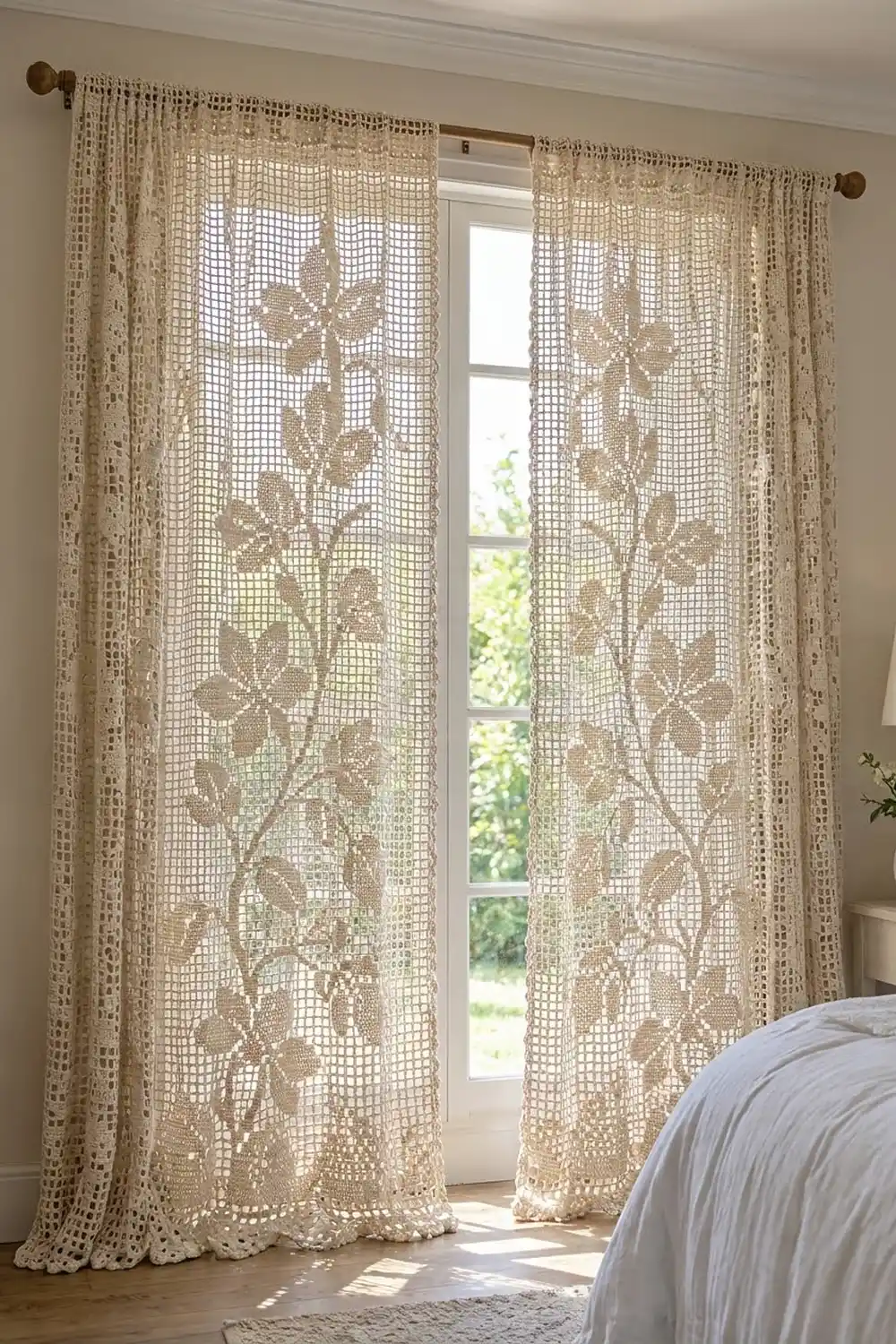
These curtains are made from open filet mesh with a solid-block vine climbing up the center of each panel. Light comes through the mesh, and the leaves show as soft cream shapes against the window.
The pattern makes two identical panels in one natural cream cotton. The style is cottage-classic: a grid background, one central stem, leaves that alternate left and right, a four-petal flower near the top and a scalloped hem. The pattern uses US crochet terms.
Each finished panel measures 36.9 in (93.7 cm) wide and 81.25 in (206.4 cm) long after blocking, including the border.
Each panel is worked flat in rows from the hem up to the top edge. You crochet the mesh and the motif together, one row at a time. Then you add two rounds of single crochet around the whole panel and a scallop row along the bottom edge. You make two panels. They hang separately, so there is no joining.
Finished Size and Construction
- Finished size (each panel): 36.9 in x 81.25 in (93.7 cm x 206.4 cm)
- Skill level: Intermediate
- Terminology: US
- Yarn weight: Fingering (#1) cotton
- Hook: 3.0 mm (C/2–D/3)
- Number of pieces: 2 separate panels, not joined
- Layout: Hung side by side, one panel on each side of the window
- Panel body: 91 meshes x 200 rows
- Size before border: 36.4 in x 80 in (92.5 cm x 203.2 cm)
- Border depth: 0.25 in (0.6 cm) on the top and sides; 1 in (2.5 cm) at the hem with the scallops
Materials
Use a mercerized 100% cotton thread in fingering weight. It should have about 340 m per 100 g. Mercerized cotton gives the blocks a crisp look, and the fabric hangs without stretching much. Choose a smooth, tightly plied thread so the mesh corners stay square.
- Cream (natural/ecru): 900 g, about 3,060 m (450 g, about 1,530 m per panel)
- 3.0 mm crochet hook
- Tapestry needle
- Locking stitch markers
- Rust-proof pins and a large blocking surface
- Measuring tape
- 16–20 curtain clip rings for hanging
These quantities include a margin of about 10%. Buy all the thread from one dye lot.
Abbreviations (US Terms)
- ch – chain
- sl st – slip stitch
- sc – single crochet
- dc – double crochet
- sk – skip
- st(s) – stitch(es)
- sp – space (open mesh)
- bl – block (filled mesh)
- RS / WS – right side / wrong side
Special stitches
- Space (sp): ch 2, sk the next 2 sts (or the ch-2 sp), dc in the next dc.
- Block (bl): 2 dc in the next 2 sts (or 2 dc in the ch-2 sp), dc in the next dc.
- Starting a row with a sp: ch 5 (counts as dc + ch 2), sk 2, dc in the next dc.
- Starting a row with a bl: ch 3 (counts as dc), dc in each of the next 3 sts.
Each mesh has 3 stitches plus one shared edge dc, so every row of 91 meshes has 3 x 91 + 1 = 274 sts. That count stays the same whether the meshes are spaces or blocks.
Gauge and Checkpoints
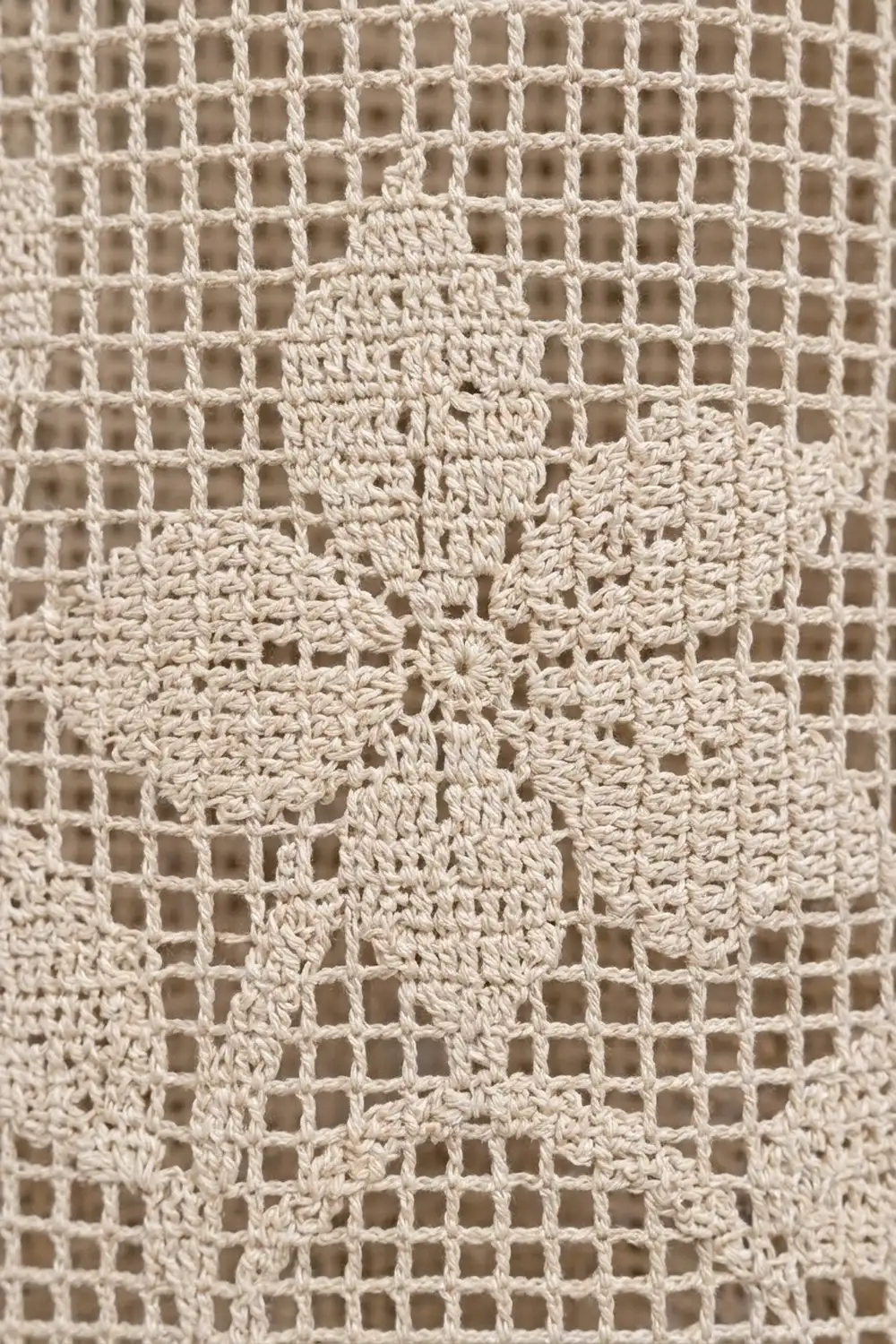
Gauge: 10 meshes x 10 rows = 4 in (10.2 cm). One mesh is 0.4 in (1.0 cm) square.
Make a test swatch before starting a panel. Ch 50 and work 15 meshes for 15 rows, with a block in the center. Wet the swatch, pin it and let it dry. Then measure the center 10 meshes.
- Swatch too big: If 10 meshes measure more than 4 in (10.2 cm), go down 0.25 mm in hook size. Being only slightly too big still adds up: at 10 meshes = 4.25 in (10.8 cm), the panel body would be 38.7 in (98.3 cm) wide.
- Swatch too small: If 10 meshes measure less than 4 in (10.2 cm), go up 0.25 mm in hook size.
- Squares not square: If the meshes come out taller than wide, pull each dc’s first loop up a little less. If they come out wider than tall, chain a little more loosely.
Checkpoints while you work (each panel):
- After Row 8: 36.4 in wide x 3.2 in tall (92.5 cm x 8.1 cm)
- After the first vine repeat (Row 32): 12.8 in (32.5 cm) tall
- After Row 176: 70.4 in (178.8 cm) tall
- After Row 200: 36.4 in x 80 in (92.5 cm x 203.2 cm)
Panel Pattern
How to read the rows: Each sequence lists meshes in the order you work them on a RS row. Odd rows are RS rows: work the sequence as written. Even rows are WS rows: work the same sequence from its end back to its start. Every row adds up to 91 meshes and 274 sts.
Foundation and Hem Margin
Foundation: Ch 278.
Row 1 (RS): Dc in the 8th ch from the hook. Ch 2, sk 2 ch, dc in the next ch. Repeat from * across. Turn. (91 sp; 274 sts)
Where the count of 278 comes from: the first 7 chains make the first mesh, 1 chain holds the first dc, and the other 90 meshes use 3 chains each (7 + 1 + 270 = 278).
Rows 2–8: Sp 91. Turn. (274 sts per row)
Vine Repeat (24 rows)
Work Repeat Rows 1–24 a total of 7 times. That covers panel Rows 9–176. Repeat Row 1 always falls on a RS row.
The stem is mesh 46, the exact center of the panel. The right-hand leaf grows over meshes 47–56 and the left-hand leaf mirrors it over meshes 36–45. Together they make a vine 21 meshes wide, or 8.4 in (21.3 cm). One repeat is 9.6 in (24.4 cm) tall.
Right leaf:
- R1: sp 45, bl 1, sp 45
- R2: sp 45, bl 2, sp 44
- R3: sp 45, bl 1, sp 1, bl 2, sp 42
- R4: sp 45, bl 1, sp 1, bl 4, sp 40
- R5: sp 45, bl 1, sp 2, bl 5, sp 38
- R6: sp 45, bl 1, sp 3, bl 5, sp 37
- R7: sp 45, bl 1, sp 5, bl 4, sp 36
- R8: sp 45, bl 1, sp 7, bl 3, sp 35
- R9: sp 45, bl 1, sp 9, bl 1, sp 35
Stem only:
- R10–R13: sp 45, bl 1, sp 45
Left leaf (mirror image):
- R14: sp 44, bl 2, sp 45
- R15: sp 42, bl 2, sp 1, bl 1, sp 45
- R16: sp 40, bl 4, sp 1, bl 1, sp 45
- R17: sp 38, bl 5, sp 2, bl 1, sp 45
- R18: sp 37, bl 5, sp 3, bl 1, sp 45
- R19: sp 36, bl 4, sp 5, bl 1, sp 45
- R20: sp 35, bl 3, sp 7, bl 1, sp 45
- R21: sp 35, bl 1, sp 9, bl 1, sp 45
Stem only:
- R22–R24: sp 45, bl 1, sp 45
Each leaf starts at the stem, widens to 5 blocks, then narrows to a single-block tip 10 meshes from the stem. This gives the pointed, upward-angled leaf shape.
Checkpoint: Lay the work flat after the first repeat. The leaf tips should sit 4 in (10.2 cm) out from the center of the stem.
Flower Crown (Rows 177–185)
The flower is 11 meshes wide (meshes 41–51), or 4.4 in (11.2 cm). The open cross in its center splits it into four petals.
- Row 177: sp 44, bl 3, sp 44
- Row 178: sp 43, bl 5, sp 43
- Row 179: sp 41, bl 4, sp 1, bl 4, sp 41
- Row 180: sp 40, bl 5, sp 1, bl 5, sp 40
- Row 181: sp 91 (the horizontal arm of the cross)
- Row 182: as Row 180
- Row 183: as Row 179
- Row 184: as Row 178
- Row 185: as Row 177
Top Margin
Rows 186–200: Sp 91. (274 sts per row) Do not fasten off. Continue straight into the border.
Make Both Panels
Make 2 panels in Cream, using about 450 g (about 1,530 m) each. Both panels are identical, so the vines match when the curtains hang.
Layout as they hang:
[ Panel 1 ]  [ window ]  [ Panel 2 ]
 vine centered            vine centered
The panels are not joined. Each one hangs from its own clip rings.
Border
Border gauge: 15 sc = 2 in (5.1 cm), which is 3 sc per mesh in both directions. This matches the mesh exactly: each mesh is 3 sts wide and one row tall, and you work 3 sc into each row end. Because of that, the edges don’t flare or pull in.
Rnd 1 (RS): Ch 1. Work 1 sc in each of the 274 sts across the top, then ch 2 for the corner. Down the side, work 3 sc around the post at each row end: 3 x 200 = 600 sc. Ch 2 for the corner. Across the bottom, work 1 sc in each of the 274 foundation-chain sts (the base of each dc plus 2 per ch-2 sp), then ch 2. Up the other side, work 600 sc, then ch 2. Join with a sl st to the first sc.
- Counts per side: top 274, bottom 274, each side 600; 1,748 sc in total, plus 4 corner ch-2 sps.
Rnd 2: Ch 1. Sc in each sc around, working (sc, ch 2, sc) in each corner sp. Join.
- Counts per side: top 276, bottom 276, each side 602 (each side gains its 2 corner sc); 1,756 sc in total, plus 4 corner ch-2 sps.
Fasten off.
Scallop row (hem only): With the RS facing, join the thread with a sc in the bottom-right corner sp. Sk 2 sts, 7 dc in the next st, sk 2 sts, sc in the next st. Repeat from * 45 more times. Sl st in the next corner sp. Fasten off.
- Count: 46 scallops. Each scallop uses 6 sts, and 46 x 6 = 276, which is exactly the bottom count from Rnd 2. Each scallop spans 0.8 in (2.0 cm).
The scallops add 0.75 in (1.9 cm) to the hem. The two sc rounds add 0.25 in (0.6 cm) to each edge. The finished size is therefore 36.4 + 0.5 = 36.9 in (93.7 cm) wide and 80 + 0.25 + 0.25 + 0.75 = 81.25 in (206.4 cm) long.
Final Blocking
- Weave in all ends along solid blocks or border stitches, never across open mesh.
- Soak the panel in cool water with a little wool wash for 20 minutes.
- Press out the water gently. Don’t wring the panel. Roll it in towels to remove more water.
- Lay the panel flat on blocking mats or a clean sheet over carpet.
- Pin the top and side edges straight first, to 36.9 in x 80.5 in (93.7 cm x 204.5 cm) measured to the bottom of the sc band.
- Pin each scallop at its center so the hem reaches 81.25 in (206.4 cm).
- Run a long straightedge up the stem to check that the vine is vertical.
- Let it dry completely, then repeat steps 2–7 for the second panel.
Final Quality-Control Checklist
- Each row has 274 sts (91 meshes).
- The stem stays on mesh 46 in every row from 9 to 185.
- 14 leaves in total, alternating right and left, with 7 on each side.
- The flower is centered and shows a clear open cross.
- The border counts are 274/600 for Rnd 1 and 276/602 for Rnd 2.
- 46 even scallops along the hem.
- Both panels are 36.9 in x 81.25 in (93.7 cm x 206.4 cm).
Troubleshooting
- The vine drifts sideways: You probably reversed a sequence on a RS row. Count meshes from the right edge on RS rows to find mesh 46.
- The panel narrows over its length: Your chains are getting tighter as you go. Check the width every 25 rows and loosen the ch-2s.
- Blocks bulge: Your tension is tighter on the dc in the spaces. Work the 2 dc into the ch-2 sp, not into the separate chains, and keep them even.
- The side edges ruffle: Work 2 sc per row end on Rnd 1 for a few rows, then go back to 3 sc per row end.
- Scallops come out uneven: Recount Rnd 2 along the bottom. It must be exactly 276 sts.
- The second panel doesn’t match the first: Measure them side by side before blocking and pin both to the same dimensions.
Care
Hand wash in cool water, or machine wash in a mesh laundry bag on the delicate cycle. Dry flat and re-pin the scallops if needed. Don’t tumble dry, because heat can shrink the mesh.
Final Notes
The size of the panels depends on a chain of measurements. One mesh is 0.4 in (1.0 cm). 91 meshes make 36.4 in (92.5 cm), and 200 rows make 80 in (203.2 cm). The 3-stitch-per-mesh border keeps those edges true and adds 0.25 in (0.6 cm) on every side. The scallops add 0.75 in (1.9 cm) at the hem. Check your swatch, the Row 8 measurement and the size after Row 200, and both panels will finish at 36.9 in x 81.25 in (93.7 cm x 206.4 cm).
Happy crocheting!