

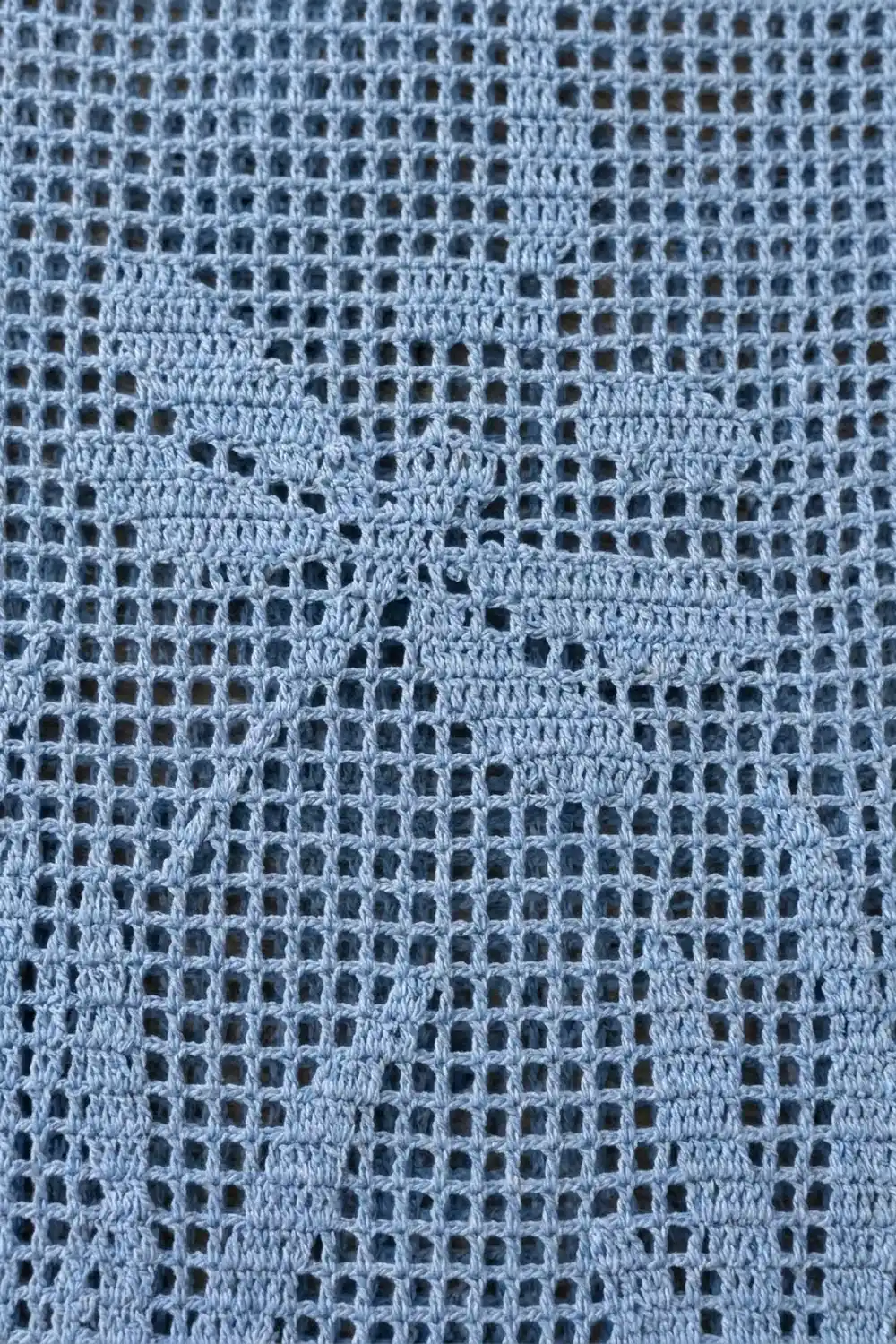
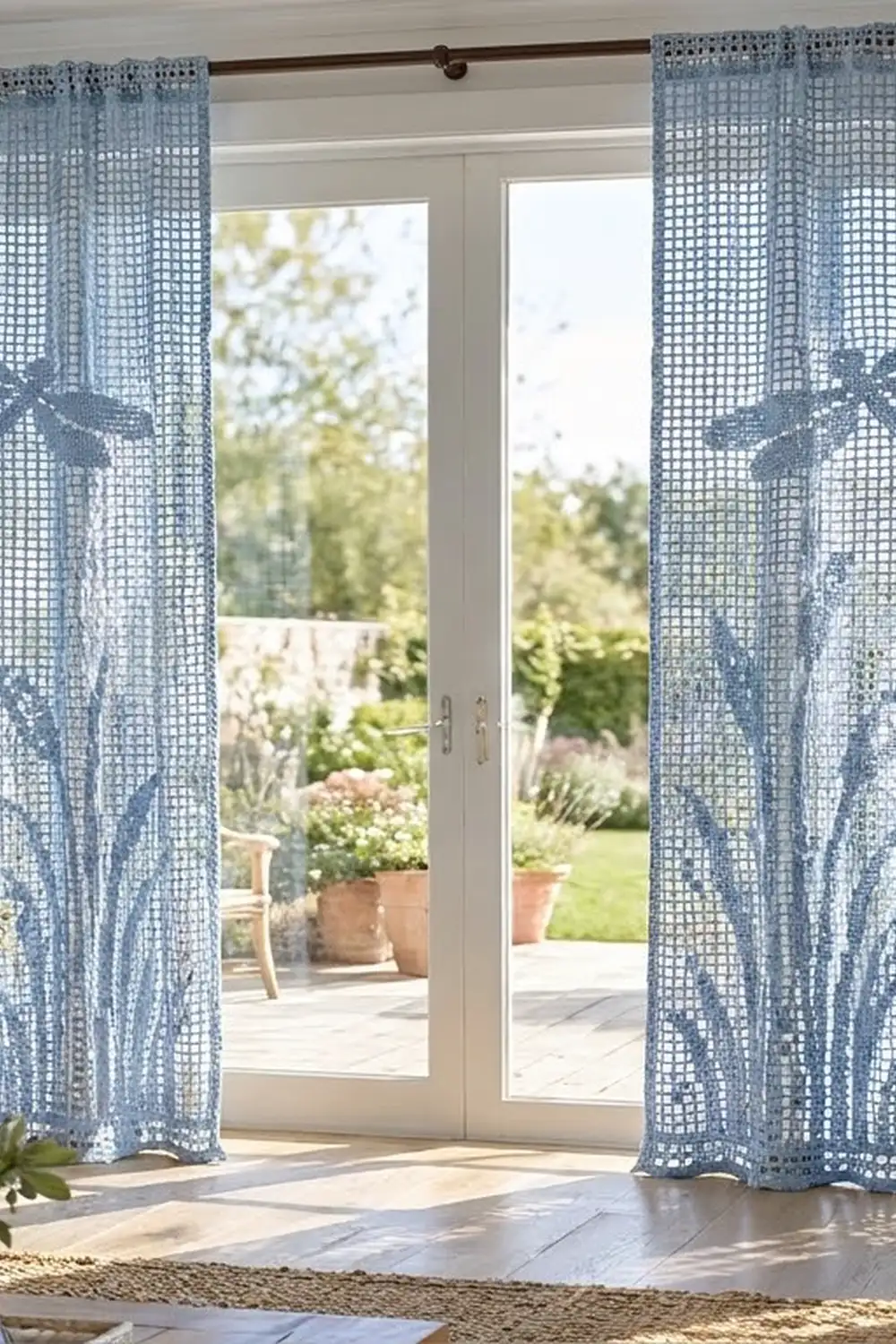
This filet crochet curtain panel shows a single dragonfly flying above a stand of cattails and arching reed leaves. Everything is worked in one soft powder blue. Solid blocks form the picture and open mesh lets the light through. When it hangs in a sunny window, the motif looks like a shadow drawn on the glass.
The style is coastal and calm. A solid frame column runs up each side, a banded hem sits at the bottom, and a small scalloped edge finishes the lower edge. The top is a simple rod pocket, so the panel slides straight onto a curtain rod. The open mesh also keeps the panel light, so it moves gently in a breeze.
The pattern uses US crochet terms. The finished panel measures 28.8 in (73.2 cm) wide and 79 in (200.7 cm) long as it hangs, including the border and the folded rod pocket.
You work the panel as one piece in rows of filet mesh, reading the design from a written block map. Next you add a two-row border along the sides and bottom. Last, you fold the top rows into a rod pocket and block the panel. To make a pair like the one shown, crochet a second panel with the map mirrored.
Finished Size and Construction
- Finished size: 28.8 in x 79 in (73.2 cm x 200.7 cm), hanging
- Skill level: Intermediate
- Terminology: US crochet terms
- Yarn weight: Sport (#2), mercerized cotton
- Hook: 3.25 mm (US D/3)
- Number of pieces: 1 panel (repeat for a pair)
- Layout: 70 meshes wide x 200 rows tall
- Piece size (before border, pocket not yet folded): 28 in x 80 in (71.1 cm x 203.2 cm)
- Size before border, after folding the pocket: 28 in x 78.4 in (71.1 cm x 199.1 cm)
- Border depth: 0.4 in (1.0 cm) on the sides, 0.6 in (1.5 cm) on the bottom
- Rod pocket: 1.6 in (4.1 cm) deep, fits a rod up to 1 in (2.5 cm) across
Materials
Choose a smooth mercerized cotton or a cotton blend in sport weight. Mercerized cotton gives crisp, square meshes and hangs straight without stretching too much. Avoid fuzzy or very stretchy yarns, because the picture depends on sharp block edges.
- Powder Blue: 550 g, about 1,650 m (1,804 yd), for one panel
These quantities include a margin of about 15 percent. Double them if you want a pair. Buy all the yarn from one dye lot, because a small color shift shows clearly against the light.
Tools:
- 3.25 mm (US D/3) crochet hook
- Tapestry needle
- Stitch markers (at least 10)
- Graph paper and a pencil for plotting the map
- Measuring tape
- Blocking mats or a clean carpet, plus rustproof pins
- Spray bottle
Abbreviations (US Terms)
- ch – chain
- dc – double crochet
- sc – single crochet
- sk – skip
- st(s) – stitch(es)
- sp – space
- RS / WS – right side / wrong side
- OM – open mesh
- BL – block
Special stitches:
- Open mesh (OM): ch 2, sk next 2 sts (or the ch-2 sp), dc in next dc.
- Block (BL): dc in each of next 2 sts (or 2 dc in next ch-2 sp), dc in next dc.
At the start of every row, ch 3. This counts as the first dc. Each of the 70 meshes after it uses 3 sts, so a full row is 1 + (70 x 3) = 211 sts.
Gauge and Checkpoints
Gauge: 10 meshes and 10 rows = 4 in (10.2 cm) in filet mesh, so one mesh is 0.4 in (1.0 cm) square.
Test first: Ch 39. Row 1: dc in 4th ch from hook and in each ch across (37 sts). Rows 2–12: ch 3, turn, work 12 OM across (37 sts). After a light steam, the swatch should measure 4.8 in (12.2 cm) in both directions.
Checkpoints:
- After Row 2: width is 28 in (71.1 cm).
- After Row 25: length is 10 in (25.4 cm). Check gauge again here, because tension often changes once you settle into a rhythm.
- After Row 100: length is 40 in (101.6 cm).
- After Row 200: length is 80 in (203.2 cm).
If your meshes are too big, go down half a hook size. If they are too small, go up half a size. If the meshes come out tall and narrow, keep the same hook and pull each dc up a little less, or loosen your chains slightly. The meshes need to be square, or the dragonfly will look stretched.
Panel Pattern
Reading the Map
Columns are numbered 1 to 70. Column 1 is at the right edge when the RS faces you. Work RS (odd) rows from column 1 to 70 and WS (even) rows from 70 to 1.
Rules:
- Rows 1, 2, 4 and 191–200 are all blocks.
- In Rows 3–190, columns 1 and 70 are always blocks (the side frame).
- In Rows 3–190, any column not listed below is open mesh.
Plot the map on graph paper before you begin, and tick off each row as you finish it. Place a marker every 10 meshes along Row 2 so you can find column numbers quickly.
Hem Band
Foundation: Ch 213.
Row 1 (RS): Dc in 4th ch from hook (the skipped ch count as the first dc) and in each ch across. (211 sts = 70 BL)
Row 2: Ch 3, turn, dc in each st across. (211 sts)
Row 3: Ch 3, turn, BL, 68 OM, BL. (211 sts)
Row 4: Ch 3, turn, BL 70 times. (211 sts)
Cattails (Rows 5–134)
Each cattail has a stem 1 block wide, a head 3 blocks wide, and a tip 1 block wide.
| Cattail | Stem: column, rows | Head: columns, rows | Tip: column, rows |
|---|---|---|---|
| A | col 9, Rows 5–64 | cols 8–10, Rows 65–76 | col 9, Rows 77–80 |
| B | col 20, Rows 5–92 | cols 19–21, Rows 93–104 | col 20, Rows 105–108 |
| C | col 33, Rows 5–118 | cols 32–34, Rows 119–130 | col 33, Rows 131–134 |
| D | col 46, Rows 5–104 | cols 45–47, Rows 105–116 | col 46, Rows 117–120 |
| E | col 60, Rows 5–78 | cols 59–61, Rows 79–90 | col 60, Rows 91–94 |
Reed Leaves (Rows 5–58)
Each leaf is 1 block wide and moves over 1 column every 6 rows, so it climbs in a smooth diagonal.
| Leaf | Rows | Start column (Rows 5–10) | Direction | End column |
|---|---|---|---|---|
| L1 | 5–40 | 8 | toward col 1 | 3 |
| L2 | 5–28 | 22 | toward col 70 | 25 |
| L3 | 5–58 | 31 | toward col 1 | 23 |
| L4 | 5–52 | 37 | toward col 70 | 44 |
| L5 | 5–46 | 55 | toward col 1 | 49 |
| L6 | 5–40 | 63 | toward col 70 | 68 |
Example: L1 is in col 8 for Rows 5–10, col 7 for Rows 11–16, and so on, ending in col 3 for Rows 35–40. L1 starts right next to stem A, so their blocks join and the leaf looks as if it grows from the stem.
Open Sky (Rows 135–149)
No motif blocks are listed in these rows, so each row is BL, 68 OM, BL. (211 sts)
Dragonfly (Rows 150–177)
- Abdomen: col 35, Rows 150–168
- Lower wings: Row 165: cols 27–33 and 37–43. Row 166: cols 24–34 and 36–46. Row 167: cols 23–34 and 36–47. Row 168: cols 25–34 and 36–45.
- Thorax: cols 34–36, Rows 169–173
- Upper wings: Row 170: cols 23–33 and 37–47. Row 171: cols 21–33 and 37–49. Row 172: cols 20–33 and 37–50. Row 173: cols 22–32 and 38–48.
- Neck: col 35, Row 174
- Head: cols 34–36, Rows 175–177
Row 169 has only the thorax and the frame. That open row separates the lower wings from the upper wings. Every row still has 211 sts.
Upper Field and Rod Pocket Rows
Rows 178–190: Ch 3, turn, BL, 68 OM, BL. (211 sts)
Rows 191–200: Ch 3, turn, dc in each st across. (211 sts) Fasten off after Row 200.
The panel now measures 28 in x 80 in (71.1 cm x 203.2 cm).
Border
The border runs along the two sides and the bottom only, because the top edge becomes the rod pocket. Work the border before you fold the pocket, and only along Rows 1–196, so the ends of the pocket stay open.
Border gauge: 5 sc = 1 in (2.5 cm) along the row ends, and 7.5 sc = 1 in (2.5 cm) along the foundation edge.
Round 1 (worked as a row, RS): Join yarn at the end of Row 196 on the left side.
- Left side: Ch 1, 2 sc in each row end down to Row 1. (196 x 2 = 392 sc)
- Corner: Ch 2.
- Bottom: Sc in each foundation ch. (211 x 1 = 211 sc)
- Corner: Ch 2.
- Right side: 2 sc in each row end up to Row 196. (392 sc)
Total: 995 sc + 2 corner ch-2 sps. Turn.
Round 2 (worked as a row, WS):
- Right side: Ch 1, sc in each sc. (392 sc)
- Corner: 3 sc in ch-2 sp.
- Bottom: Sc in first sc, sk 2, 5 dc in next sc, sk 2, sc in next sc; repeat from * 34 more times (35 scallops in all). (36 sc + 175 dc = 211 sts*)
- Corner: 3 sc in ch-2 sp.
- Left side: Sc in each sc. (392 sc)
Total: 392 + 3 + 211 + 3 + 392 = 1,001 sts. Fasten off.
Why the math works: Each dc row is 0.4 in (1.0 cm) tall. Two sc at 5 sc per inch also cover 0.4 in (1.0 cm), so the sides lie flat. Along the bottom, 1 sc goes into each of the 211 foundation sts, so the hem keeps its 28 in (71.1 cm) width. Since 211 = 6 x 35 + 1, the 6-st scallop repeat fits exactly, and the one extra sc closes the last scallop. The corner ch-2 sps are not counted as side stitches, so nothing is counted twice.
Rod Pocket
With the WS facing, fold Rows 197–200 down behind Rows 193–196. The fold line is the top of Row 196. Whipstitch the top of Row 200 to the WS along the line between Rows 192 and 193, one stitch at a time (211 sts). Leave both short ends open.
The panel now hangs 79 in (200.7 cm) long: 78.4 in (199.1 cm) of body plus 0.6 in (1.5 cm) of bottom border.
Final Blocking
- Weave in all ends along solid blocks, where they won’t show through the mesh.
- Soak the panel in cool water for 15 minutes, then roll it in a towel and press out the water. Do not wring it.
- Lay it flat with the RS up, on mats or on a carpet covered with a sheet.
- Pin the body to 28 in x 78.4 in (71.1 cm x 199.1 cm). Pin the four corners first, then the middle of each edge.
- Lay a long ruler across a few rows to check that the grid is square, and nudge any slanted rows into line.
- Pin each scallop out to a soft point.
- Let the panel dry completely, about 24 hours, before you unpin it.
Final Quality-Control Checklist
- Every row has 211 sts and 70 meshes.
- The frame columns (1 and 70) are solid from Row 1 to Row 200.
- The dragonfly’s abdomen, thorax, and head line up in col 35.
- No ch-2 spaces are missing beside the blocks.
- The sides have 392 sc each, and the bottom has 35 scallops.
- The pocket ends are open, and the rod slides through easily.
- The panel hangs 79 in (200.7 cm) long and 28.8 in (73.2 cm) wide.
Troubleshooting
Row stitch count is off: You most likely missed a ch-2 or added a dc. Count the meshes in groups of 10 at the end of every row.
Panel leans to one side: Make sure the ch 3 counts as a dc, and that the last dc of each row goes into the top of the turning ch.
Motif looks squashed: Your rows are too short. Pull up the dc loops a little taller.
Block edges look ragged: When you work a block over an open mesh, put 2 dc into the ch-2 sp rather than into the individual chains.
Side border ruffles: Work 3 sc for every 2 rows instead of 4, then recount. The scallop count stays the same.
Panel grew longer after hanging: Cotton relaxes a little over time. Re-block the panel, or take up the extra length at the pocket.
Care
Hand wash in cool water with a mild detergent and dry flat. Don’t use a hot dryer, and rehang the panel only once it is completely dry.
Final Notes
One mesh is 0.4 in (1.0 cm), so 70 meshes make 28 in (71.1 cm) and 200 rows make 80 in (203.2 cm). Folding the pocket brings the body to 78.4 in (199.1 cm), and the border brings the finished panel to 28.8 in x 79 in (73.2 cm x 200.7 cm). For a matching second panel, work column c of the map as column 71 − c, so the two dragonflies face each other across the window.
Happy crocheting!