

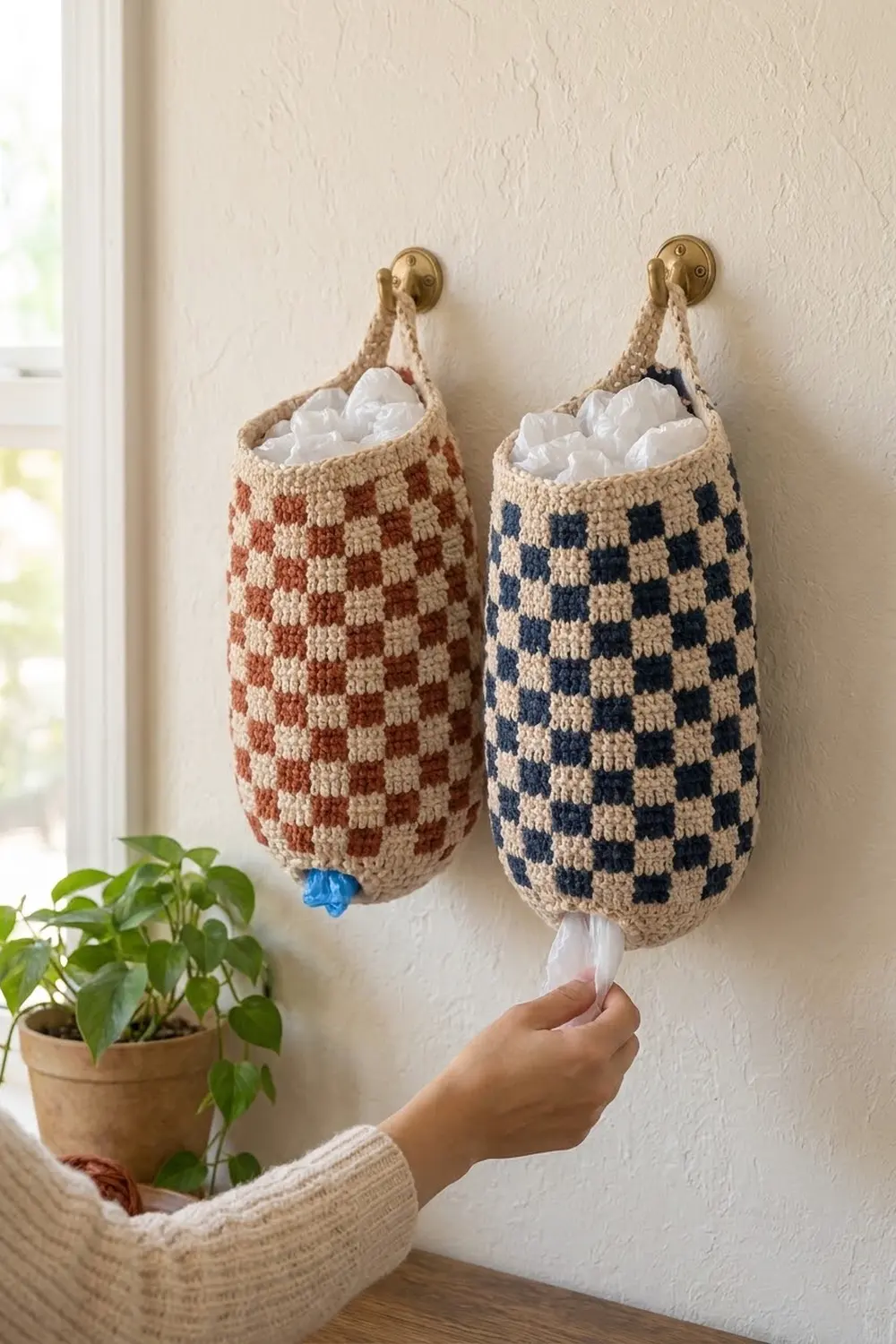
This checkerboard dispenser gets the pile of plastic bags under your sink under control. You stuff used grocery bags in through the wide top and pull them out one at a time through the small opening at the bottom. A slim crocheted handle hangs it from a simple wall hook.
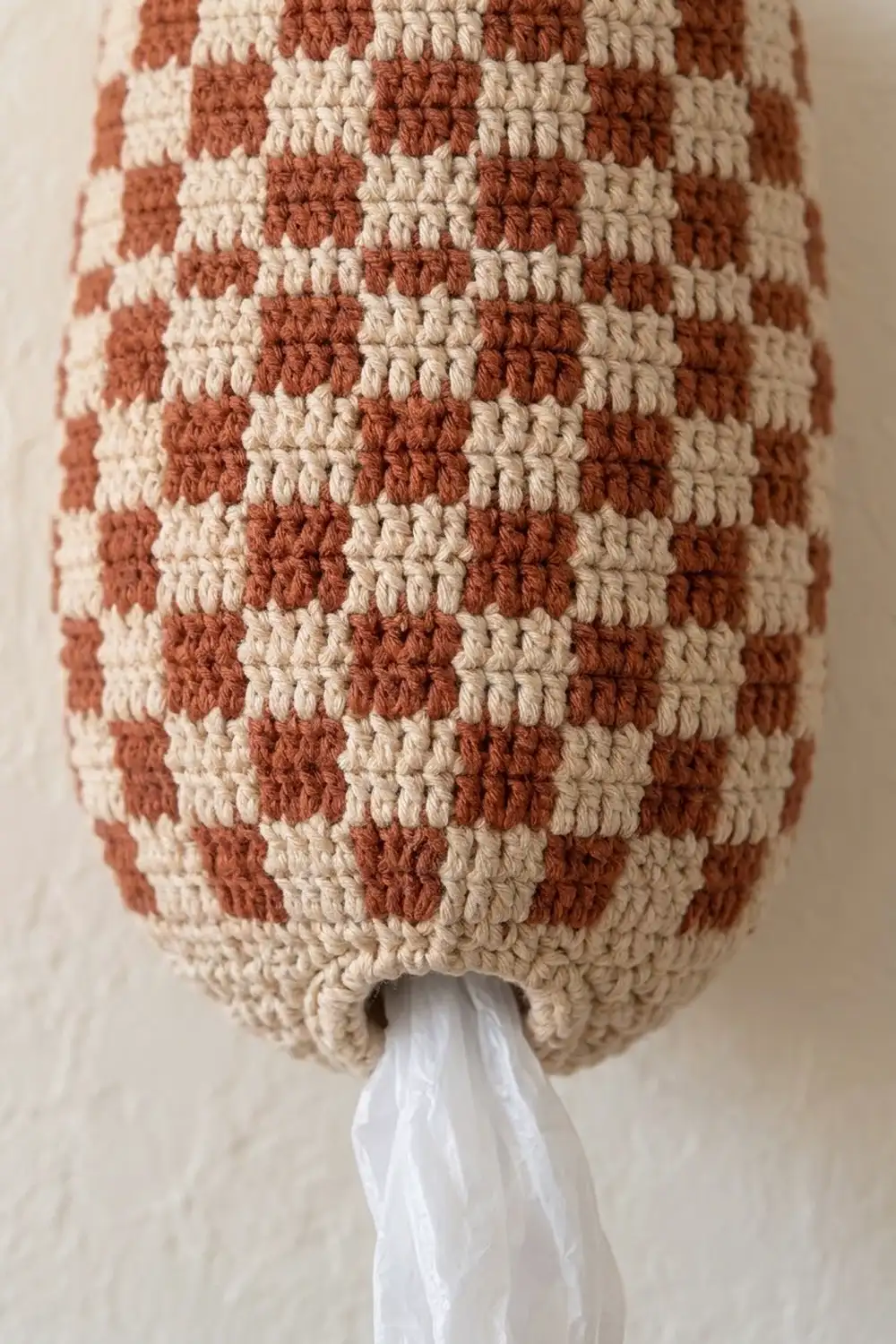
The design is a classic two-color checkerboard in warm terracotta rust and soft cream. It’s worked in tapestry crochet, so the checks stay sharp and the fabric stays dense. A cream rim, a cream bottom band and a corded edge frame the pattern. Navy and cream make a nice second version, and the two look good hanging side by side.
The pattern uses US crochet terms. The finished holder measures about 8 in (20.3 cm) wide when laid flat (16 in / 40.6 cm around) and about 16.5 in (41.9 cm) tall. The handle loop rises about 4.5 in (11.4 cm) above the rim.
The holder is one seamless piece. You start at the bottom opening and increase through a rounded taper while the checks grow wider. Then you work a straight checkerboard tube and finish with a cream rim, a built-in handle and a reverse single crochet edge.
Finished Size and Construction
- Finished size: 8 in (20.3 cm) wide flat x 16.5 in (41.9 cm) tall, plus handle
- Skill level: Intermediate (tapestry color changes in the round)
- Terminology: US
- Yarn weight: Worsted (#4), cotton or cotton blend
- Hook: 4.0 mm (G-6)
- Number of pieces: 1
- Layout: Worked bottom-up in joined rounds
- Piece size: 64 sts around at full width
- Size before border: 8 in (20.3 cm) wide flat x 15.1 in (38.4 cm) tall after Rnd 68
- Border depth: about 1.4 in (3.6 cm) of cream rim, plus the handle
Materials
Choose a smooth, firm worsted cotton or cotton blend. Cotton holds its shape when the holder is full and doesn’t stretch out under the weight of the bags. Avoid fuzzy or very soft acrylics, which blur the checks.
- Main color (MC), cream: about 100 g / 180 m
- Contrast color (CC), terracotta rust (or navy): about 75 g / 135 m
- 4.0 mm (G-6) crochet hook
- Stitch markers (at least 2)
- Tapestry needle
- Scissors
- Measuring tape
- Rustproof pins and a towel for blocking
These quantities include a margin of about 15 percent. Tapestry crochet carries the unused strand inside every stitch, so it uses more yarn than plain single crochet.
Abbreviations (US Terms)
- ch – chain
- sl st – slip stitch
- sc – single crochet
- rev sc – reverse single crochet (crab stitch)
- st(s) – stitch(es)
- Rnd – round
- MC / CC – main color / contrast color
- inc – 2 sc in the same st
Tapestry sc: Hold the unused color along the top of the round and work each sc over it, so the carried strand is hidden inside the stitches. To change color, work the last sc of the old color until 2 loops remain, then finish it with the new color. Keep the carried strand slightly relaxed.
Rev sc: Working from left to right, insert the hook into the next st to the right, pull up a loop, yo and pull through both loops.
Gauge and Checkpoints
Gauge: 16 sts and 18 rnds = 4 in (10.2 cm) in tapestry sc worked in the round.
At this gauge, one 4-st check is 1 in (2.5 cm) wide and about 0.9 in (2.3 cm) tall over 4 rnds.
Use the holder itself as your gauge test. Work through Rnd 16 and measure before you start the long straight body. If your gauge is off, you only have a short section to redo.
Checkpoints:
- After Rnd 4: 32 sts, about 4 in (10.2 cm) wide flat.
- After Rnd 12: 48 sts, about 6 in (15.2 cm) wide flat.
- After Rnd 16: 64 sts, 8 in (20.3 cm) wide flat, about 3.6 in (9.1 cm) tall.
- After Rnd 68: 8 in (20.3 cm) wide flat, about 15.1 in (38.4 cm) tall.
If it’s too big: go down 0.5 mm in hook size. If it’s too small: go up 0.5 mm. If the width is right but the height comes out short, add one full check row (4 rnds) to the straight body. Don’t change the stitch counts.
Pattern
Round method: Join every round with a sl st to the first sc, then ch 1 (does not count as a st). Work the first sc into the same st as the join. Place a marker in the first sc of each round. Joined rounds keep the check columns stacked straight instead of spiraling.
When a round starts with a CC block, make the joining sl st with CC so the new color is ready.
Before you start: Keep both balls on opposite sides of your work so the strands don’t twist together. Every few rounds, turn the work to untangle them.
Bottom Opening Band (Cream)
Rnd 1: With MC, ch 24 and sl st to the first ch to form a ring, taking care not to twist it. Ch 1, sc in each ch around, join. (24 sts)
Rnds 2–3: Ch 1, sc in each st around, join. (24 sts)
Rnd 4 (increase round): Ch 1, sc in next 2 sts, inc in next st; repeat from * 8 times total, join. (24 sts worked 1-per-st + 8 extra = 32 sts)
This cream band forms the soft edge of the dispensing opening. It’s about 2 in (5.1 cm) across when relaxed.
Rounded Taper (Checkerboard Begins)
Join CC at Rnd 5 and carry both colors from here on.
Check Row 1 – Rnds 5–8: Ch 1, 2 sc MC, 2 sc CC; repeat from * 8 times total, join. (32 sts; 16 blocks of 2 sts)
Check Row 2 – Rnd 9 (growth round): Ch 1, with CC sc in next st, inc in next st; with MC sc in next st, inc in next st; repeat from * 8 times total, join. (48 sts)
Each block grows from 2 to 3 sts and switches color, so CC sits above MC and MC sits above CC.
Rnds 10–12: Ch 1, 3 sc CC, 3 sc MC; repeat from * 8 times total, join. (48 sts)
Check Row 3 – Rnd 13 (growth round): Ch 1, with MC sc in next 2 sts, inc in next st; with CC sc in next 2 sts, inc in next st; repeat from * 8 times total, join. (64 sts)
Rnds 14–16: Ch 1, 4 sc MC, 4 sc CC; repeat from * 8 times total, join. (64 sts; 16 blocks of 4 sts)
Each block gains exactly 1 st per growth round. That makes the 16 check columns fan out evenly into a rounded bottom without any lumps.
Straight Checkerboard Body
From here on, every round has 64 sts in 16 blocks of 4 sts. Each check row is 4 rnds tall, and the colors swap at the start of every new check row.
Even check rows (CC first): Ch 1, 4 sc CC, 4 sc MC; repeat from * 8 times total, join. (64 sts)
Odd check rows (MC first): Ch 1, 4 sc MC, 4 sc CC; repeat from * 8 times total, join. (64 sts)
Work the body as follows:
- Rnds 17–20: Check Row 4 (even)
- Rnds 21–24: Check Row 5 (odd)
- Keep alternating every 4 rnds through Rnds 65–68: Check Row 16 (even)
That gives 13 straight check rows (52 rnds) above the taper and 16 check rows in total. The last check row starts with CC.
Fasten off CC after Rnd 68, leaving a 6 in (15.2 cm) tail to weave in. Continue with MC only.
Checkpoint: 64 sts, 8 in (20.3 cm) wide flat, about 15.1 in (38.4 cm) tall.
Border: Top Rim and Handle
Border gauge: The border uses the same gauge, 16 sc = 4 in (10.2 cm). The rim keeps all 64 body sts, so it stays 16 in (40.6 cm) around and doesn’t flare or pull in. The start of the round sits at the back of the holder, and the handle goes there too.
Rnds 69–71: With MC, ch 1, sc in each st around, join. (64 sts)
Rnd 72 (handle round): Ch 1, sc in each of the first 56 sts, ch 40, skip the last 8 sts, join with a sl st to the first sc. (56 sc + ch-40 loop)
The 40-ch loop is about 10 in (25.4 cm) long. Its two ends sit 8 sts, or 2 in (5.1 cm), apart.
Rnd 73 (conversion round): Ch 1, sc in each of the 56 sc, then sc in each of the 40 ch, join. (56 sts worked 1-per-st + 40 sts worked into the chain = 96 sts)
Rnd 74: Ch 1, sc in each st around, join. (96 sts: 56 rim + 40 handle)
Rnd 75: Ch 1, rev sc in each st around, join. (96 sts: 56 rim + 40 handle) Fasten off.
Handle inner edge: Join MC in the first of the 8 skipped sts of Rnd 71. Sl st in each of the 8 skipped sts, then sl st in the free loop of each of the 40 chains, join. (8 + 40 = 48 sl sts) Fasten off.
Why the math works: The rim count stays at 64 sts, so the top opening is the same width as the body. The handle simply replaces 8 rim sts with a 40-ch bridge. Rnd 73 counts 56 + 40 = 96, and Rnds 74 and 75 keep exactly 96. The inner edge covers the 8 skipped sts plus the 40 chains, so every loop is finished. The handle ends up 3 rnds wide, about 0.6 in (1.5 cm), and rises about 4.5 in (11.4 cm) above the rim when hung.
Weave in all ends on the inside, running each tail through stitches of the same color.
Final Blocking
- Turn the holder right side out and check that every check column runs straight.
- Soak the holder in cool water, then press the water out in a towel. Don’t wring it.
- Roll a towel loosely and slide it inside to fill the tube.
- Lay it flat and ease it to 8 in (20.3 cm) wide and 16.5 in (41.9 cm) tall.
- Nudge the checks square with your fingers and straighten any leaning columns.
- Shape the bottom into a smooth, round curve around the opening.
- Pin the handle straight, about 10 in (25.4 cm) along its outer edge.
- Let it dry completely before removing the towel.
Final Quality-Control Checklist
- Stitch counts are 24, 32, 48 and then 64 through the body, with 96 in the last rim rounds.
- There are 16 check rows, each 4 rnds tall, with colors alternating every row.
- There are 16 check columns around, 8 of each color in every round.
- No carried strands show on the right side.
- Width is 8 in (20.3 cm) flat and height is about 16.5 in (41.9 cm).
- The bottom opening is about 2 in (5.1 cm) across and edged in cream.
- The handle is firmly attached, with no gaps at either end.
- All ends are woven in securely.
Troubleshooting
The carried color peeks through: Hold the hook slightly lower and tug the carried strand gently every few sts. A dark CC like navy shows through more easily, so keep your tension even.
The checks slant sideways: Joined rounds reduce this, but tight work can still twist. Loosen your tension a little and block the columns straight.
The fabric puckers: The carried strand is too tight. Spread out the last few sts before each color change.
The checks look like rectangles: Your row gauge is different from the pattern’s. Matching stitch gauge matters most, so adjust the height by full check rows.
The bottom opening is too loose: Work Rnd 1 with a hook 0.5 mm smaller, or add one extra round of sc on the inside of the band.
The handle sags: Add one more rnd of sc before Rnd 75, keeping 96 sts.
Bags won’t come out of the bottom: Stretch the cream band gently over your fingers to relax it.
Care
Hand wash in cool water and lay flat to dry, reshaping while damp. If needed, cotton can also be machine washed on a gentle cycle in a laundry bag.
Final Notes
Each measurement builds on the one before. The gauge gives you 4 sts per 1 in (2.5 cm). The 24-st band makes a 2 in (5.1 cm) opening. Growth rounds take you from 32 to 48 to 64 sts, and those 64 sts give you 8 in (20.3 cm) flat. Sixteen check rows bring the holder to 15.1 in (38.4 cm), and the cream rim and handle finish it at about 16.5 in (41.9 cm). Hang it up, fill it with bags and enjoy a tidier kitchen drawer.
Happy crocheting!