

Peppermint Lane is a hanging holder for your kitchen or powder room. A cream crocheted cord loops over a wooden ring and drops in two legs to hold a paper towel roll on one dowel and a hand towel on a second dowel below. Little striped candy canes with green leaves sit along both legs.
The colors are classic holiday ones: cream for the cord, red and cream for the spiral-striped canes, and soft green for the leaves. It looks cozy and a bit rustic, and it is easy to take down after the season.
This pattern uses US crochet terms. The finished holder measures about 14 in (35.6 cm) wide and 21 in (53.3 cm) tall. Each candy cane is about 3.5 in (8.9 cm) tall and 1.5 in (3.8 cm) wide.
Construction is simple. You crochet one long I-cord, nine candy canes worked as small tubes in the round with a bendable chenille stem inside, and eighteen leaves. Then you wrap the cord around the ring and dowels and tack on the canes and leaves.
Finished Size and Construction
- Finished size: 14 in (35.6 cm) wide × about 21 in (53.3 cm) tall
- Skill level: Intermediate
- Terminology: US
- Yarn weight: Worsted (#4)
- Hooks: 3.75 mm (F) for the canes and leaves; 5.5 mm (I) for the cord
- Number of pieces: 1 cord, 9 candy canes, 18 leaves
- Layout: Triangle hanger, with 4 canes on each leg and 1 cane on the towel
- Piece size: Cane 3.5 in × 1.5 in (8.9 cm × 3.8 cm); leaf 1.25 in × 0.6 in (3.2 cm × 1.5 cm)
- Size before “border”: The canes and leaves are complete before you attach them
- Border depth: None. The cord frame does the job of a border; see the cord section below.
Materials
Use a smooth worsted acrylic or cotton blend. Smooth yarn shows the stripes clearly and keeps the cord neat.
- Cream: 50 g / 100 m (cord held double, plus the cream cane stripes)
- Red: 15 g / 30 m (cane stripes, leaf ties, tacking)
- Green: 15 g / 30 m (leaves)
These quantities include a margin of about 15–20%.
Tools and hardware:
– 3.75 mm (F) and 5.5 mm (I) hooks
– Wooden ring, 2 in (5.1 cm) across
– 2 wooden dowels, 1 in (2.5 cm) thick × 14 in (35.6 cm) long
– 9 chenille stems (pipe cleaners), cut to 4.5 in (11.4 cm)
– Locking stitch markers, tapestry needle, scissors, measuring tape
– Optional: a hand towel for the appliqué cane
Abbreviations (US Terms)
- ch: chain
- sl st: slip stitch
- sc: single crochet
- hdc: half double crochet
- dc: double crochet
- sc2tog: single crochet 2 together
- MR: magic ring
- st(s): stitch(es)
- rnd(s): round(s)
Special stitch: crochet I-cord row. Start with 3 loops on the hook.
1. Slip the last 2 loops off the hook and hold them so they don’t unravel.
2. Yarn over and pull through the 1 loop left on the hook.
3. Put the hook back into the next dropped loop, yarn over, and pull through.
4. Repeat step 3 for the last dropped loop.
You now have 3 loops on the hook again. That is 1 row.
Gauge and Checkpoints
Make one candy cane and a short piece of cord before you start the full project.
- Cane gauge (3.75 mm hook, single strand): 6 rnds of sc = 1 in (2.5 cm). The flattened tube should be 0.6 in (1.5 cm) wide.
- Cord gauge (5.5 mm hook, cream held double): 4 I-cord rows = 1 in (2.5 cm). A 16-row test piece should measure 4 in (10.2 cm), and the cord should be about 0.5 in (1.3 cm) thick.
Checkpoints:
– Cane after Rnd 12: about 2 in (5.1 cm)
– Cane after Rnd 30: about 5 in (12.7 cm)
– Each finished cord leg: 30.5 in (77.5 cm)
If your pieces are too big or too small: If the cane tube is longer than 5 in (12.7 cm) or wider than 0.6 in (1.5 cm), go down 0.25 mm in hook size. If it’s shorter or narrower, go up 0.25 mm. For the cord, it is the total length that matters. If your rows are shorter or longer than 1/4 in, keep working until each section reaches its target in inches, not just its row count.
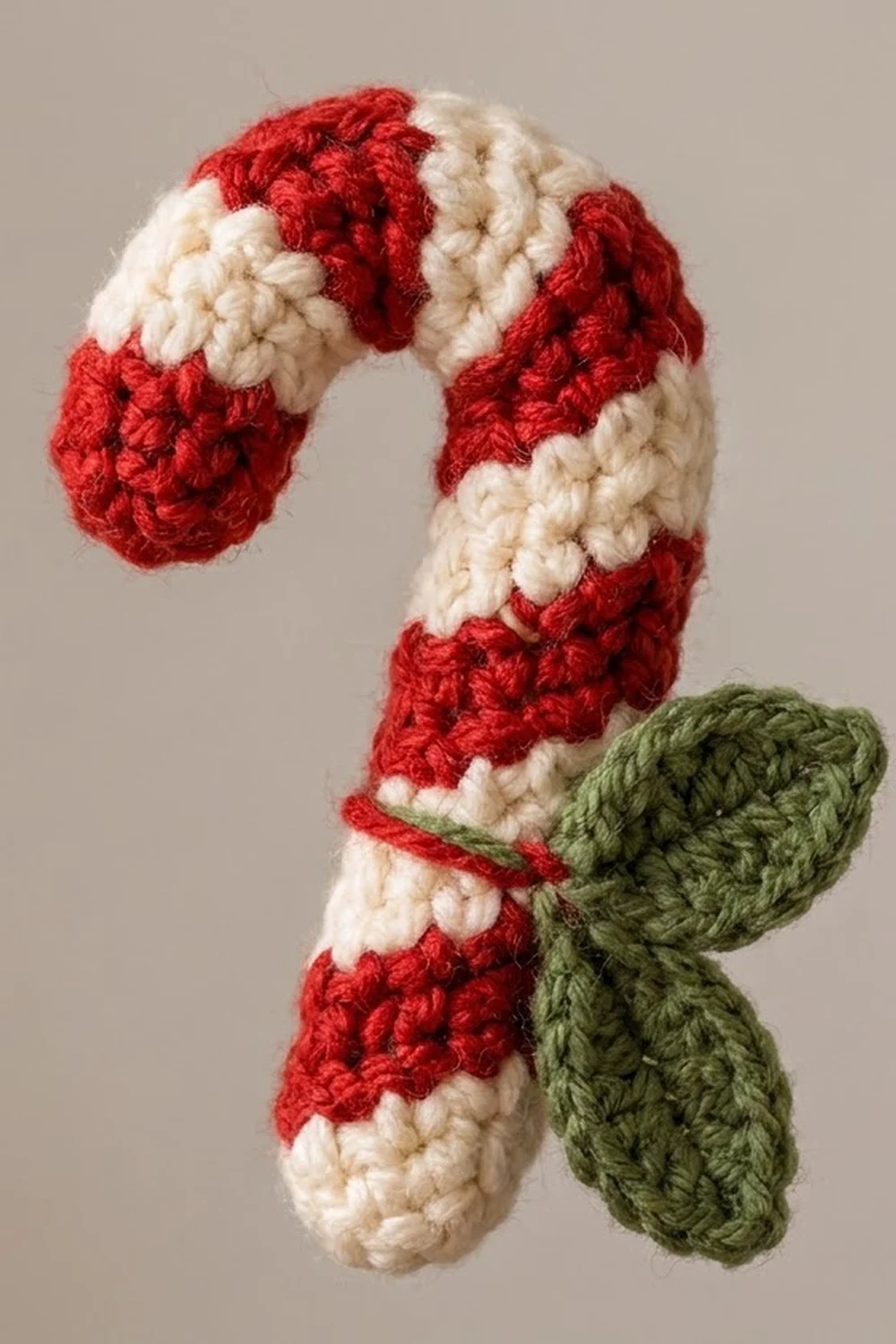
Candy Cane (make 9)
With the 3.75 mm hook. Work in a continuous spiral. Carry the color you are not using inside the tube; the floats stay hidden.
Rnd 1: With red, 6 sc in MR. (6)
Rnds 2–29: Sc in each st around. Keep 6 sts in every rnd. Follow one continuous color sequence across the rounds: 4 sc cream, 3 sc red. Repeat this sequence without restarting it at the start of each rnd. (6 per rnd)
The 7-stitch color sequence runs over a 6-stitch round, so each stripe starts 1 stitch earlier in every round. That shift is what makes the stripes slant diagonally. Rnds 2–29 are 28 rounds × 6 = 168 sts, which is exactly 24 repeats of the sequence, so Rnd 29 ends on a red stitch.
Checkpoint: The tube measures about 4.8 in (12.2 cm).
Insert the stem: Fold back 0.25 in (0.6 cm) at each end of a 4.5 in (11.4 cm) chenille stem so the wire can’t poke through. Slide it into the tube until it touches Rnd 1.
Rnd 30: With red, [sc2tog] 3 times. (3)
Fasten off. Weave the tail through the 3 front loops, pull tight, and hide the end inside.
Shape the cane: Bend the top 1.75 in (4.4 cm) of the tube around a 1 in (2.5 cm) dowel to make the hook, then slide it off. The finished cane is about 3.5 in (8.9 cm) tall and 1.5 in (3.8 cm) wide.
Leaf (make 18)
With the 3.75 mm hook and green.
Ch 8.
Side 1: Sl st in 2nd ch from hook (this is the tip), sc in next ch, hdc in next ch, dc in each of the next 2 ch, hdc in next ch, 3 sc in last ch (this is the base). (9)
Side 2: Rotate the leaf and work into the opposite loops of the foundation chain: hdc in next ch, dc in each of the next 2 ch, hdc in next ch, sc in next ch, sl st in the same ch as the first sl st. (6)
Total: 15 sts.
Point: Ch 2, sl st in 2nd ch from hook. This makes a small pointed tip.
Fasten off and leave a 6 in (15.2 cm) tail. Each leaf is 1.25 in × 0.6 in (3.2 cm × 1.5 cm).
Dress the canes: Put the bases of 2 leaves against the cane shaft, 0.75 in (1.9 cm) below the start of the hook. Wrap 12 in (30.5 cm) of red yarn around the shaft and the leaf bases 4 times. Tie a square knot at the back and keep the tails for tacking.
Hanger Cord (make 1)
With the 5.5 mm hook and cream held double.
Ch 3. Insert the hook in the 2nd ch from the hook, yarn over, and pull up a loop. Insert the hook in the next ch, yarn over, and pull up a loop. (3 loops on hook)
Rows 1–256: Work 1 I-cord row each time. Every row is 3 loops.
Place markers as you go so the cane positions are already marked when you finish (see the layout grid). Fasten off by pulling the yarn through all 3 loops. The cord is 64 in (162.6 cm) long.
Make All Pieces
Totals:
– 9 canes: red and cream
– 18 leaves: green
– 1 cord: cream, held double
Cord map, with cane markers (rows):
LEFT LEG (rows 1–122)          RING (rows 123–134)          RIGHT LEG (rows 135–256)
tail          1–8                                            diagonal     135–188
lower wrap    9–26   [cane 26]                [cane 144]  [cane 162]
between      27–50                                          upper wrap   189–206  [cane 188]
upper wrap   51–68   [cane 68]                              between      207–230  [cane 230]
diagonal     69–122  [cane 94] [cane 112]                   lower wrap   231–248
                                                             tail         249–256
On each leg, the canes sit 2.5 in (6.4 cm), 7 in (17.8 cm), 13.5 in (34.3 cm), and 24 in (61.0 cm) from the ring section. The ninth cane goes on the towel.
Joining
- Ring: Fold the cord in half and slide rows 123–134, which are 3 in (7.6 cm) long, over the ring.
- Upper dowel: On each leg, wrap the upper-wrap rows once around the dowel from front to back, 0.75 in (1.9 cm) in from the dowel’s end. Sew the start and end of the wrap together through both thicknesses with cream yarn.
- Lower dowel: Wrap the lower-wrap rows around the second dowel the same way. Tuck the 8-row tail, 2 in (5.1 cm) long, up behind the leg and whipstitch it in place.
- Canes: Using the red tails, tack each cane’s shaft to the cord at its marker. Stitch through 1 cane stitch, then 1 cord column, at 2 points 0.5 in (1.3 cm) apart: one at the leaf tie and one 2 rows lower.
Stitch logic: Each tacking point joins 1 cane stitch to 1 cord row, so the cord does not lose or gain length.
Tension: Snug each tack but don’t pull it tight. If you pull too hard, the cord puckers and that leg ends up shorter.
Size checkpoint: The legs should be 12.5 in (31.8 cm) apart, center to center, at both dowels. That leaves 12 in (30.5 cm) of clear space for an 11 in (27.9 cm) roll. Hang the holder: it should be 14 in (35.6 cm) wide and about 21 in (53.3 cm) tall.
Towel cane: Sew the ninth cane to the front of the towel with red yarn. Go around the shaft every 0.5 in (1.3 cm) and add 3 stitches across the hook.
Border: Hanger Cord Frame
This design has no stitched border. The cord frame frames the piece instead, so its math is given here.
Border gauge: 4 rows = 1 in (2.5 cm).
Each leg, 122 rows = 30.5 in (77.5 cm):
– Diagonal: 54 rows = 13.5 in (34.3 cm)
– Upper wrap: 18 rows = 4.5 in (11.4 cm)
– Between the dowels: 24 rows = 6 in (15.2 cm)
– Lower wrap: 18 rows = 4.5 in (11.4 cm)
– Tail: 8 rows = 2 in (5.1 cm)
Ring section: 12 rows = 3 in (7.6 cm).
Why the math works:
– 54 + 18 + 24 + 18 + 8 = 122 rows per leg.
– 122 × 2 + 12 = 256 rows, and 256 ÷ 4 = 64 in (162.6 cm).
– Each diagonal is 13.5 in long and spans 6.25 in sideways (half of 12.5 in), so it drops 12 in (30.5 cm) vertically.
– A 1 in dowel plus a cord about 0.5 in thick takes about 4.5 in of cord to wrap once, which is 18 rows.
Final Blocking
- Lightly mist the cord with water. Don’t soak it.
- Hang the holder with both dowels in place, and hang a damp hand towel from the lower dowel so the legs dry straight.
- Bend each cane hook again around the 1 in (2.5 cm) dowel if it has lost its shape.
- Pinch each leaf tip to a point and flatten the leaf with your fingers.
- Let everything dry hanging for 24 hours.
- Check again that the legs are 12.5 in (31.8 cm) apart.
Final Quality-Control Checklist
- Every cane has 30 rnds, the stripes slant the same way, and no wire shows.
- Every leaf has 15 sts plus the pointed tip.
- The cord has 256 rows and measures 64 in (162.6 cm).
- Both legs measure 30.5 in (77.5 cm) and both diagonals measure 13.5 in (34.3 cm).
- The canes match on both legs: at 2.5 in, 7 in, 13.5 in, and 24 in from the ring section.
- The dowels hang level.
- All ends are woven in.
Troubleshooting
- The stripes stack straight instead of slanting: The color sequence is restarting at the start of each round. Keep the 7-stitch count running continuously across rounds.
- The cane bends unevenly: The stem is too short. Use the full 4.5 in (11.4 cm) length.
- The legs are different lengths: Measure each leg before wrapping it, and add or remove rows in the tail section.
- The cord twists: Loosen your tension on the 3 loops, and block it while hanging.
- The paper roll rubs on the cords: Move the wraps 0.25 in (0.6 cm) toward the ends of the dowel.
- Leaves flop forward: Add 2 more wraps of the red tie.
Care
Spot clean with mild soap and let it air dry. Remove the canes from the towel before washing it, or hand wash the towel.

Final Notes
The measurement chain runs like this:
1. 6 rnds = 1 in, which gives a 5 in (12.7 cm) tube.
2. Bending the top 1.75 in (4.4 cm) gives a 3.5 in (8.9 cm) cane.
3. 4 cord rows = 1 in, so each leg is 122 rows = 30.5 in (77.5 cm).
4. Each diagonal is 13.5 in (34.3 cm) and drops 12 in (30.5 cm).
5. The legs sit 12.5 in (31.8 cm) apart on 14 in (35.6 cm) dowels, so the finished holder is 14 in × 21 in (35.6 cm × 53.3 cm).
If you check each link as you go, the whole holder will hang straight and balanced.
Happy crocheting!