

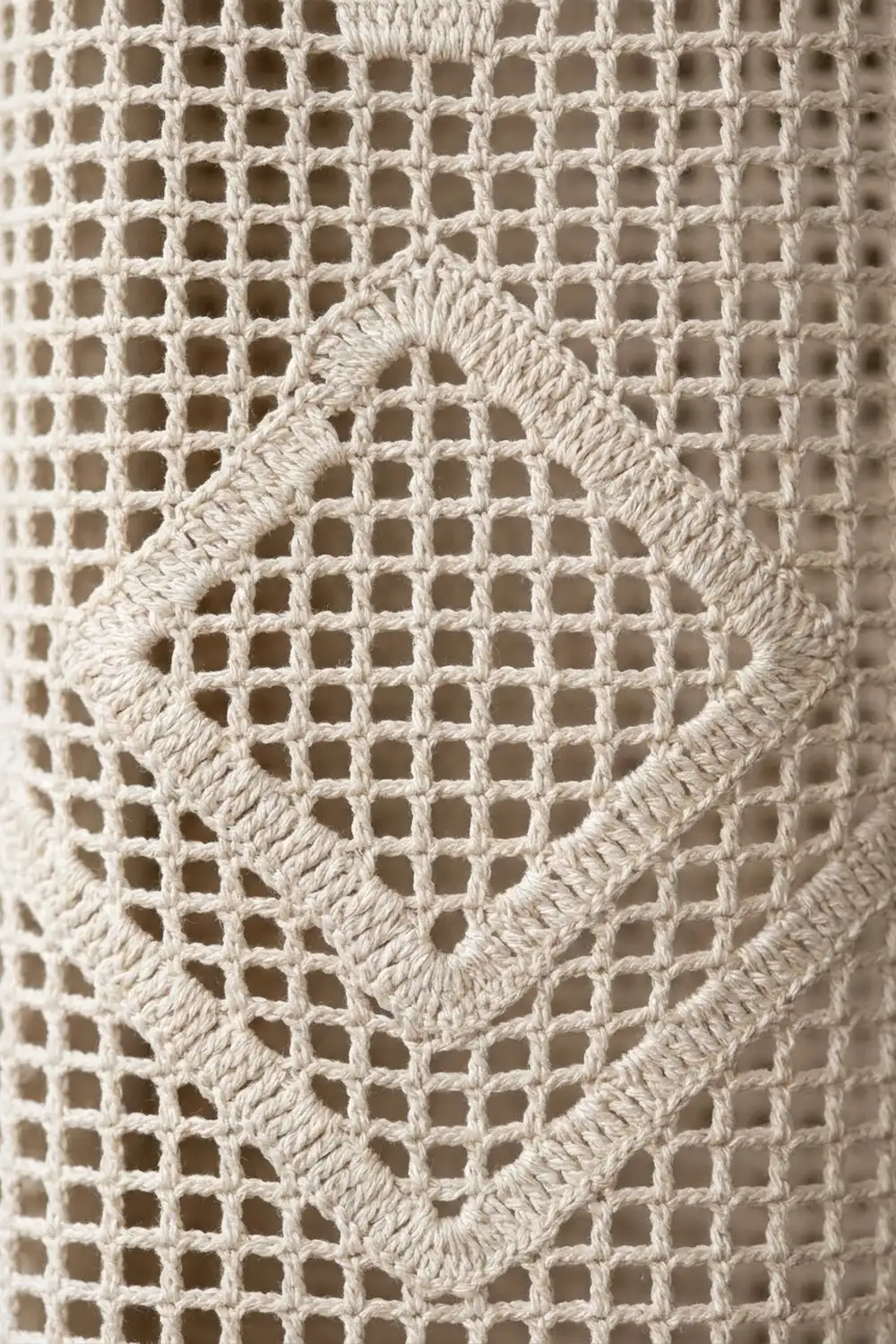
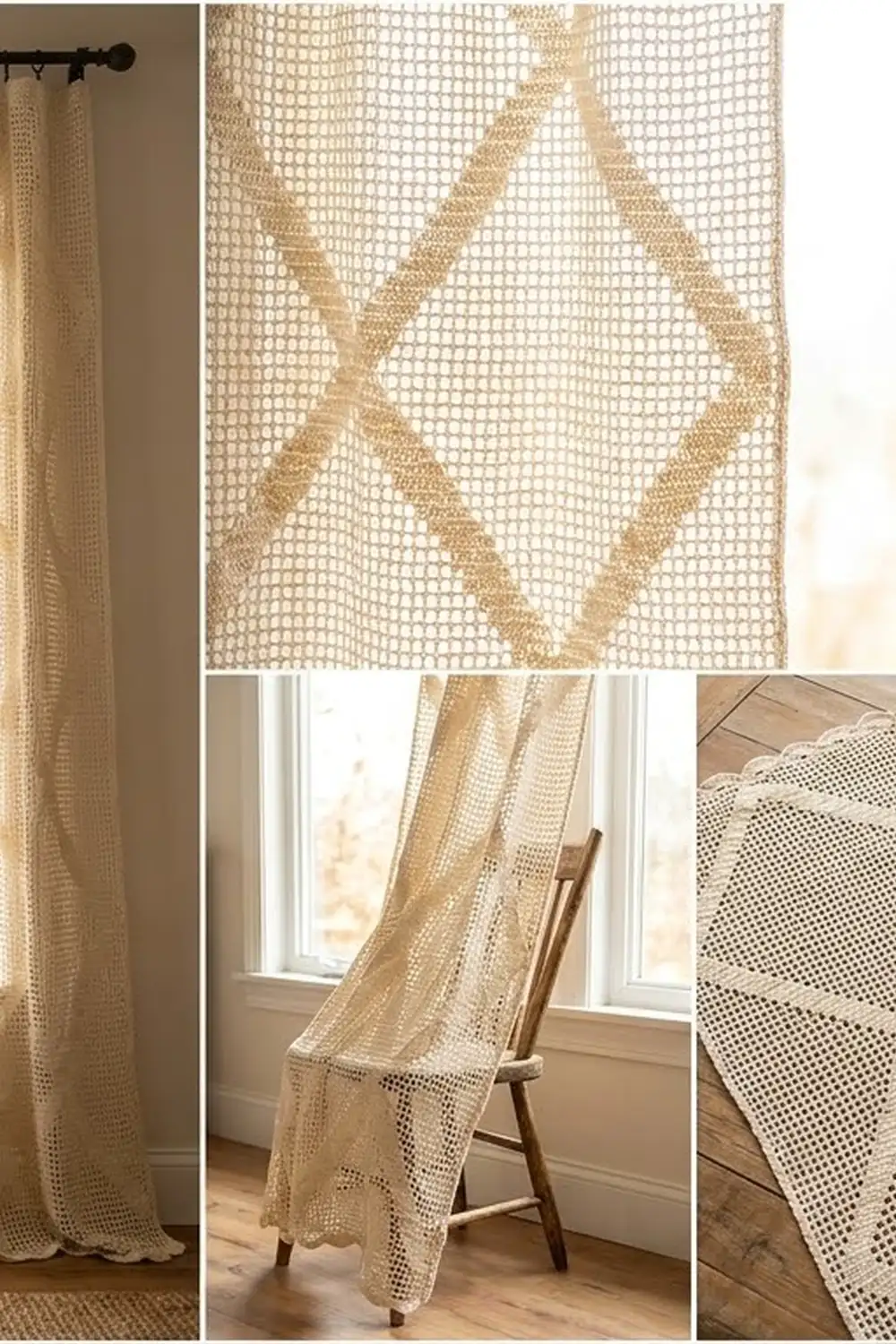
These floor-length curtain panels filter daylight through a soft grid of open mesh. Large diamonds, outlined in solid diagonal bands, stack point to point down the full length of each panel and link side to side into a continuous lattice.
The design uses a single natural ecru or cream cotton. One color keeps the look calm and lets the light do the work: the solid bands read slightly darker and the mesh glows like small windows. The style is relaxed and modern farmhouse, with a hand-knotted, macramé-like feel.
The pattern is written in US crochet terms. Each finished panel measures 38.5 in (97.8 cm) wide by 91 in (231.1 cm) long, including the rod pocket. The photo shows a pair, so you will make two identical panels.
Construction is simple. Each panel is worked flat in rows of filet crochet from the bottom edge up. A three-round border then frames all four sides, a shell row finishes the bottom hem, and a rod pocket is worked off the top edge and folded down.
Finished Size and Construction
- Finished size (each panel): 38.5 in (97.8 cm) wide x 91 in (231.1 cm) long
- Skill level: Intermediate (easy stitches, long project, careful counting)
- Terminology: US crochet terms
- Yarn weight: Aran / heavy worsted (#4) cotton
- Hook: 5.0 mm (US H-8)
- Number of pieces: 2 separate identical panels (a pair), not joined
- Layout: each panel is 3 diamond repeats wide by 7 diamond repeats tall
- Diamond repeat size: 16 squares x 16 rows = 12 in x 12 in (30.5 cm x 30.5 cm)
- Size before border: 36 in (91.4 cm) wide x 85.5 in (217.2 cm) long
- Border depth: 1.25 in (3.2 cm) on the sides and top; 2 in (5.1 cm) on the bottom including shells
- Rod pocket: 2.25 in (5.7 cm) deep when folded
Materials
Choose a smooth, firm aran-weight cotton or cotton blend, around 170 m (186 yd) per 100 g. A slightly corded or twisted cotton gives the crisp, macramé look shown. Avoid very drapey bamboo or acrylic. Curtains this long stretch under their own weight, and cotton keeps the grid squarer.
- Natural / ecru (one color): 700 g (1,190 m) per panel; 1,400 g (2,380 m) for the pair
These quantities include a margin of about 20% to allow for gauge differences and the gauge swatch.
Tools:
- 5.0 mm (US H-8) crochet hook
- Tapestry needle
- Stitch markers (at least 10)
- Measuring tape (a long one, 120 in / 304.8 cm, is ideal)
- Rust-proof pins and a large, clean blocking surface (floor with towels or foam mats)
- Spray bottle
Abbreviations (US Terms)
- ch – chain
- sl st – slip stitch
- sc – single crochet
- dc – double crochet
- sk – skip
- sp – space
- st(s) – stitch(es)
- rep – repeat
- RS / WS – right side / wrong side
Filet squares:
- Space (S): ch 2, sk 2 sts, dc in next dc.
- Block (B): dc in next 3 sts. When working a block over a space, work 2 dc in the ch-2 sp, then dc in next dc.
Each square is 3 sts wide, and the closing dc of each square sits on top of a dc in the row below. A row of 48 squares has 1 + (48 x 3) = 145 sts, counting the turning ch-3 as the first dc and each ch-2 as 2 sts.
Gauge and Checkpoints
Gauge: 4 filet squares and 4 rows = 3 in (7.6 cm) in pattern. One square is 0.75 in (1.9 cm) wide and one row is 0.75 in (1.9 cm) tall.
Test one piece first. Ch 27, dc in 4th ch from hook and in each ch across (25 sts), then work 7 rows of all spaces (8 squares per row). After a light steam, the swatch should measure 6 in (15.2 cm) wide by 6 in (15.2 cm) tall. Square holes matter more than anything else here. If the squares are taller than they are wide, the diamonds stretch into long ovals.
- Too big: go down to a 4.5 mm hook.
- Too small: go up to a 5.5 mm hook.
- Squares too tall: keep the same hook, but pull up a shorter loop on each dc.
Checkpoints (body, measured flat and unstretched):
- After Row 1: 36 in (91.4 cm) wide
- After Row 17 (1 diamond repeat): 12.75 in (32.4 cm) long
- After Row 49 (3 repeats): 36.75 in (93.3 cm) long
- After Row 113 (7 repeats): 84.75 in (215.3 cm) long
- After Row 114: 85.5 in (217.2 cm) long
Measure on a flat surface. Never measure length while the panel hangs, because it will read long.
Panel Body
The body is 48 squares wide: three 16-square diamond repeats. Every filet row begins with ch 3 (counts as dc) and ends with the last dc in the top of the turning ch of the row below. Each row has 145 sts.
Row 1 (foundation, solid): Ch 147. Dc in 4th ch from hook (the skipped ch count as the first dc) and in each ch across. Turn. (145 sts)
Rows 2–113 (filet chart): Work the 16-row diamond chart below 7 times. Row 2 is Chart Row 1, Row 17 is Chart Row 16, and Row 18 starts the second repeat with Chart Row 1. Continue this way to Row 113.
For each row: ch 3, then work the 16-square sequence 3 times across. Turn. (48 squares; 145 sts)
Diamond chart (16 squares per repeat):
- Chart Row 1: 7 S, 2 B, 7 S.
- Chart Row 2: 6 S, 4 B, 6 S.
- Chart Row 3: 5 S, 2 B, 2 S, 2 B, 5 S.
- Chart Row 4: 4 S, 2 B, 4 S, 2 B, 4 S.
- Chart Row 5: 3 S, 2 B, 6 S, 2 B, 3 S.
- Chart Row 6: 2 S, 2 B, 8 S, 2 B, 2 S.
- Chart Row 7: 1 S, 2 B, 10 S, 2 B, 1 S.
- Chart Row 8: 2 B, 12 S, 2 B.
- Chart Row 9: rep Chart Row 8.
- Chart Row 10: rep Chart Row 7.
- Chart Row 11: rep Chart Row 6.
- Chart Row 12: rep Chart Row 5.
- Chart Row 13: rep Chart Row 4.
- Chart Row 14: rep Chart Row 3.
- Chart Row 15: rep Chart Row 2.
- Chart Row 16: rep Chart Row 1.
Each chart row totals 16 squares, so three repeats give 48 squares and 145 sts in every row. Each repeat is symmetrical, so the chart reads the same on RS and WS rows.
How the lattice forms: In Chart Rows 1–8, the two-block bands move out by one square per row. In Rows 9–16 they move back in. Together they draw a diamond outline two squares thick. On Chart Rows 8 and 9, the 2 B at the end of one repeat sit next to the 2 B at the start of the next, so neighboring diamonds touch side to side in a 4-block bar. Chart Row 16 (2 B in the center) sits directly under Chart Row 1 of the next repeat, so the diamonds meet point to point vertically.
On Row 2, place a marker after every 16th square, and move the markers up every few rows. A miscounted square shows up right away against a marker.
Row 114 (top, solid): Ch 3, dc in each dc and 2 dc in each ch-2 sp across. (145 sts)
Do not fasten off or turn. Check your size: 36 in (91.4 cm) by 85.5 in (217.2 cm).
Make Both Panels
Make 2 panels in natural/ecru, using about 700 g (1,190 m) for each. Count rows carefully on both so the diamonds line up when the panels hang side by side.
Layout on the rod (the panels are separate and not joined):
[ Panel A ]   [ Panel B ]
  3 x 7         3 x 7
  diamonds      diamonds
There is no joining step. Each panel hangs on its own from its own rod pocket.
Border
Border gauge: sc rounds are 0.25 in (0.6 cm) tall, and the dc round is 0.75 in (1.9 cm) tall. Together, the three rounds add 1.25 in (3.2 cm) to each edge. Each dc row-end along the sides is 0.75 in (1.9 cm) tall, and 2 sc per row-end lies flat at this gauge.
Round 1 (sc): Ch 1, then work 3 sc in the last st of Row 114 (the st just worked; corner). Down the side, work 2 sc in each of the next 112 row-ends (Rows 113–2). Work 3 sc in the first base st of the foundation (corner), sc in each of the next 143 base sts, and 3 sc in the last base st (corner). Up the second side, work 2 sc in each of the 112 row-ends. Work 3 sc in the first st of Row 114 (corner), then sc in each of the next 143 sts across the top. Sl st to the first sc.
Count: each corner has 3 sc, and the center sc is the corner st. Between corner sts, the top and bottom each have 143 + 1 + 1 = 145 sc, and each side has 224 + 1 + 1 = 226 sc. Total: (2 x 145) + (2 x 226) + 4 corner sts = 746 sc.
Round 2 (dc): Sl st into the next corner st. Ch 5 (counts as dc and ch 2), dc in the same st. Dc in each sc to the next corner st, then (dc, ch 2, dc) in the corner st. Rep from * 2 more times, then dc in each sc to the beginning. Sl st to the 3rd ch of the beginning ch-5.
Count: each side gains its 2 corner dc. Between ch-2 corner sps, the top and bottom have 145 + 2 = 147 dc, and each side has 226 + 2 = 228 dc. Total: (2 x 147) + (2 x 228) = 750 dc, plus 4 ch-2 sps.
Round 3 (sc): Ch 1, sc in each dc around, and work 3 sc in each ch-2 corner sp. Sl st to the first sc.
Count: the middle sc of each corner group is the corner st. Between corner sts, the top and bottom each have 147 + 1 + 1 = 149 sc, and each side has 228 + 1 + 1 = 230 sc. Total: (2 x 149) + (2 x 230) + 4 = 762 sc. Fasten off.
Bottom Shell Row (bottom edge only): With RS facing, join yarn in the bottom right corner st. This row covers 149 sc plus 2 corner sts = 151 sts.
Sc in the corner st, sk 2 sts, 5 dc in next st, sk 2 sts, sc in next st. Rep from * across, ending with the last sc in the opposite corner st. Fasten off. (25 shells)
Why the math works: The bottom edge starts with the 145 sts of the body. Rounds 1, 2, and 3 each add 2 sts to the side (145, 147, 149), and the 2 corner sts bring the edge to 151. The shell repeat is a multiple of 6 sts plus 1, and 6 x 25 + 1 = 151. The shells therefore end with an sc in each corner, and both hem corners match.
Rod Pocket (top edge): With RS facing, join yarn in the top right corner st of Round 3. The top edge also has 149 sc plus 2 corner sts = 151 sts.
- Row 1: Ch 3 (counts as dc), dc in each st across. Turn. (151 dc)
- Rows 2–6: Ch 3, dc in each dc across. Turn. (151 dc)
The pocket strip measures 4.5 in (11.4 cm). Fold it to the WS and whipstitch the last row to the base of pocket Row 1, leaving both short ends open. The folded pocket is 2.25 in (5.7 cm) deep and fits a rod up to 1.5 in (3.8 cm) across.
Final Blocking
- Weave in all ends along the solid bands, never across the open mesh.
- Soak the panel in cool water for 15 minutes. Press the water out; do not wring.
- Roll the panel in towels to remove extra moisture.
- Lay it flat on mats or towels on the floor. Shape it to 38.5 in (97.8 cm) wide by 88.75 in (225.4 cm) long, measured from the bottom of the shells to the top of Round 3.
- Pin the side edges straight every 6 in (15.2 cm), then pin each shell point.
- Check one diamond. It should measure 12 in (30.5 cm) both wide and tall. Ease the grid with your fingers until the holes look square.
- Let the panel dry completely, then repeat for the second panel.
Final Quality-Control Checklist
- Every body row has 48 squares and 145 sts.
- Each panel has 7 complete diamond repeats, with points meeting vertically.
- Side-by-side diamonds meet in 4-block bars on Chart Rows 8 and 9.
- Border Round 3 counts 762 sc.
- The bottom has 25 shells, with an sc in each corner.
- The rod pocket has 151 dc in all 6 rows and is sewn closed along its edge.
- Each blocked panel is 38.5 in (97.8 cm) wide and 91 in (231.1 cm) long with the pocket folded.
- Both panels match within 1 in (2.5 cm) in length.
Troubleshooting
- Diamonds look lopsided: a band probably moved two squares on one row. Count against your repeat markers and rip back to the mistake.
- Panel narrows as you go: you are missing the last dc in the turning ch. Recount to 145 sts.
- Holes are tall rectangles: your dc is too tall. Pull up a shorter loop on each dc.
- Side border ruffles: work exactly 2 sc per row-end, and check that your dc rows are no taller than 0.75 in (1.9 cm).
- Side border pulls in: your sc is tight. Go up half a hook size for Round 1 only.
- Panel grows longer after hanging: this is normal for cotton. Re-block it and let it rest flat before you hang it again.
Care
Hand wash in cool water, or machine wash on a gentle cycle inside a mesh laundry bag, then lay flat to dry. Never hang a wet panel, because the weight of the water will stretch it out of shape.
Final Notes
The measurement chain is easy to follow. A 4-square, 4-row section measures 3 in (7.6 cm) square. One diamond repeat is 12 in (30.5 cm). Three repeats wide and seven tall, plus 2 solid rows, give a body of 36 in (91.4 cm) by 85.5 in (217.2 cm). The border brings the panel to 38.5 in (97.8 cm) wide and 88.75 in (225.4 cm) long, and the rod pocket finishes it at 91 in (231.1 cm). If your swatch is right, every later number follows.
Happy crocheting!