
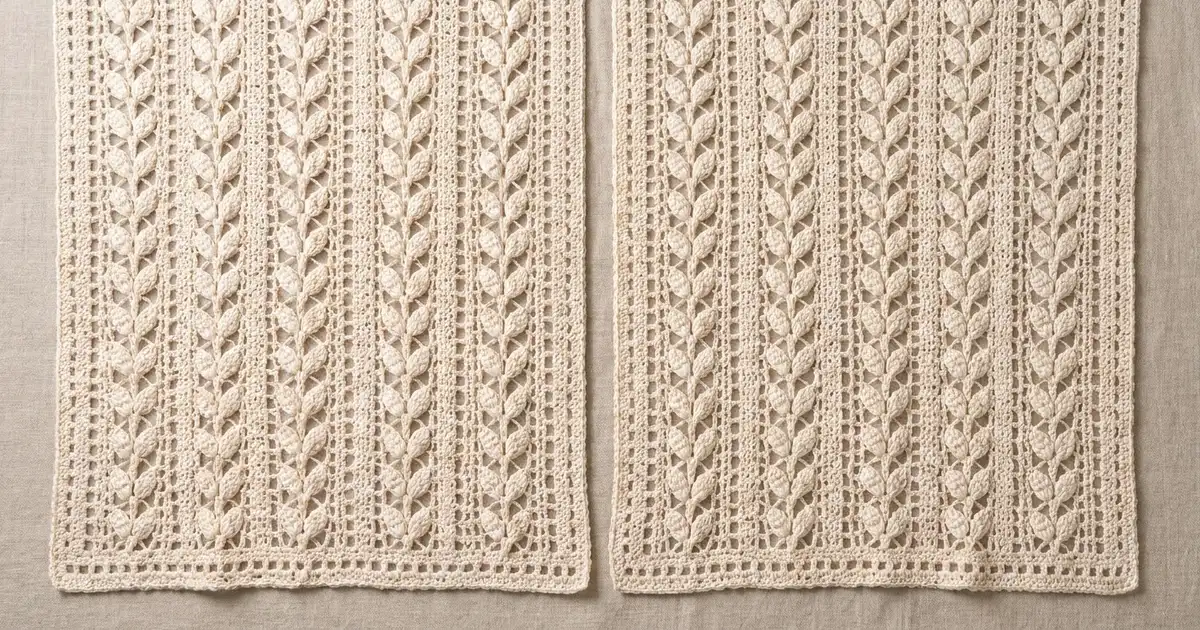
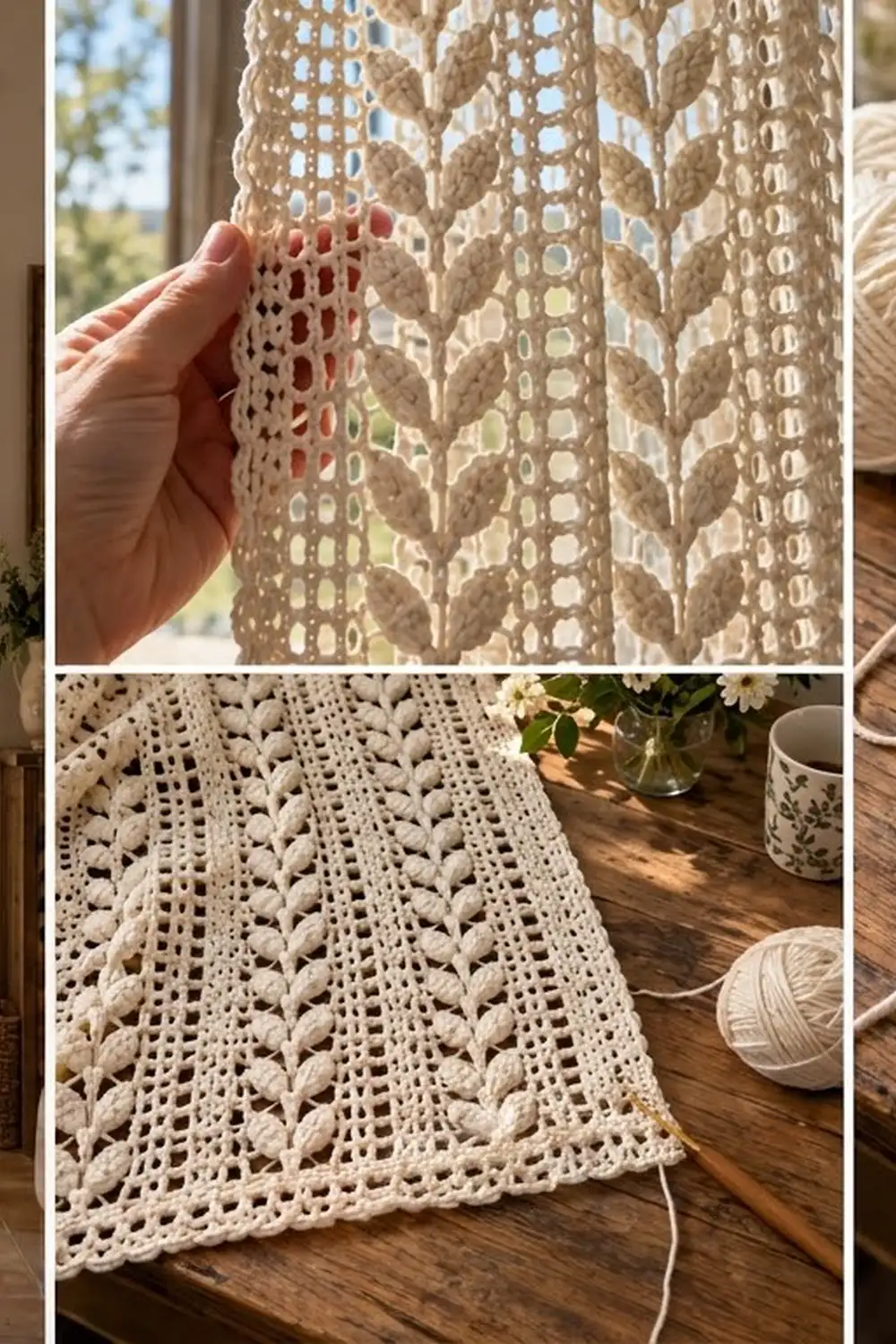
This curtain panel combines open filet mesh with tall rows of raised leaves. The leaf vines run the full length of the panel, so it looks tall and calm. Light comes through the mesh ladders between the vines and makes soft stripes across the room.
The sample uses one cream cotton yarn throughout. A single color keeps the texture in focus: the plump leaves, the solid stems, and the small eyelet holes that frame each vine. The look is farmhouse-meets-cottage and works with linen, wood, and greenery.
This pattern uses US crochet terms. One finished panel measures 33 in (83.8 cm) wide by 82.5 in (209.6 cm) long. The photographed window uses two identical panels hung side by side. They are not joined; make the pattern twice.
You work the panel flat in rows from the bottom up. Every right-side row has puff-stitch leaves, and every wrong-side row is a plain return row. When the body is done, three rounds of single crochet finish all four edges, and the panel is blocked to size.
Finished Size and Construction
- Finished size: 33 in x 82.5 in (83.8 cm x 209.6 cm) per panel
- Skill level: Intermediate
- Terminology: US crochet terms
- Yarn weight: Worsted (#4), cotton
- Hook: 5.0 mm (US H-8)
- Number of pieces: 1 per panel (make 2 separate panels for a pair, as shown)
- Layout: Single rectangle; 10 leaf vines alternating with 11 mesh ladders
- Piece size before border: 31.5 in x 81 in (80.0 cm x 205.7 cm)
- Border depth: 0.75 in (1.9 cm) on every edge
- Hanging: Clip-on curtain rings (no rod pocket)
Materials
Yarn: Choose a smooth worsted-weight cotton or cotton-linen blend. Cotton shows off the puff leaves clearly, holds its shape when blocked, and does not fuzz in sunlight. Avoid very splitty yarn, because the puffs need you to pull up 4 clean loops at a time.
- Cream / ivory: 1,100 g (about 1,980 m) per panel, based on a 100 g / 180 m skein. Buy 2,200 g (about 3,960 m) for a pair.
These quantities include a margin of about 10% for the gauge swatch, tension differences, and weaving in.
Tools:
- 5.0 mm (US H-8) crochet hook
- Tapestry needle
- Stitch markers (at least 12)
- Rust-proof blocking pins and a large blocking surface (foam mats or a bed with a clean sheet)
- Measuring tape
- Spray bottle
- 12 clip-on curtain rings per panel
Abbreviations (US Terms)
- ch – chain
- sk – skip
- sc – single crochet
- dc – double crochet
- st(s) – stitch(es)
- sp – space
- RS / WS – right side / wrong side
- L – leaf (special stitch below)
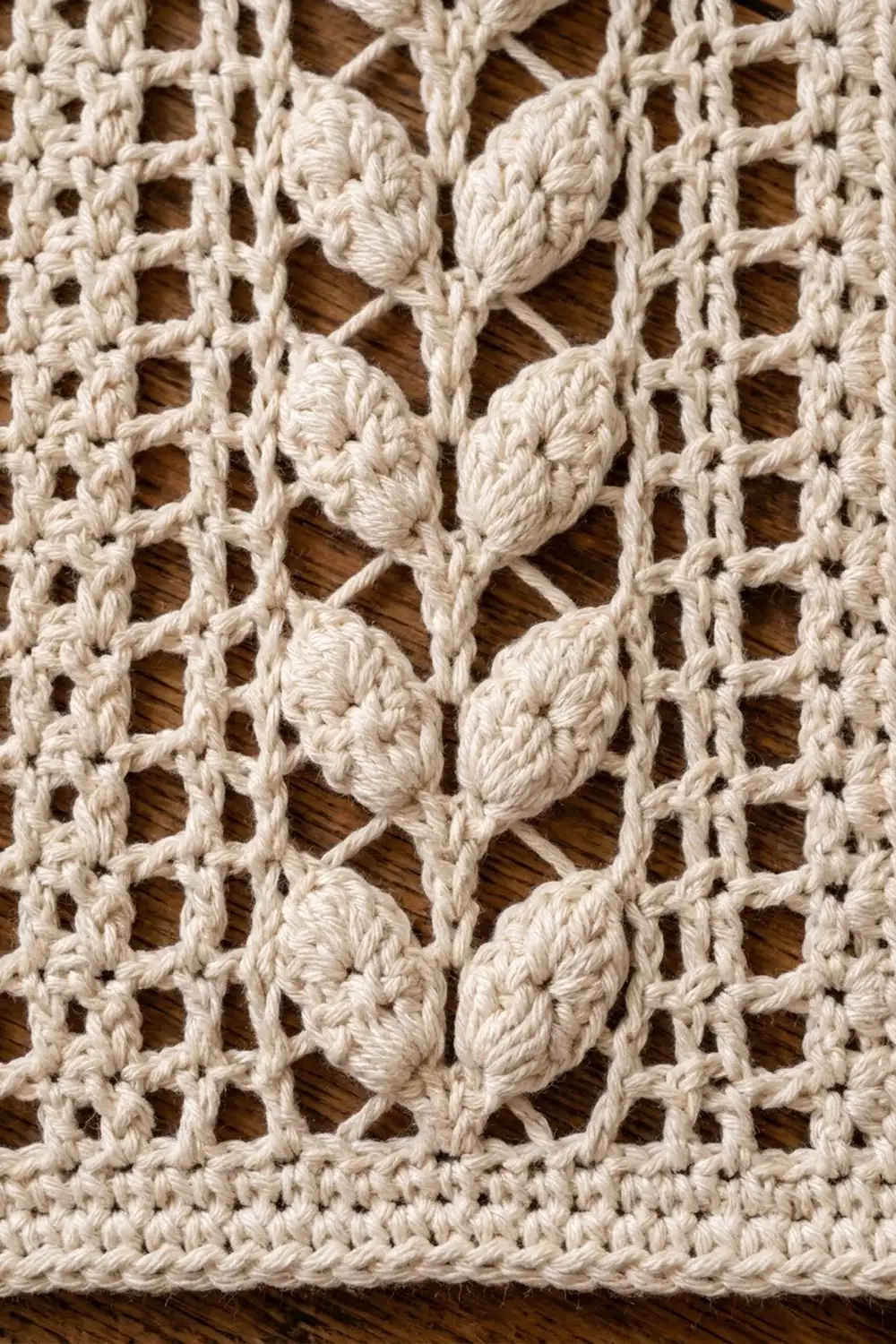
Leaf (L): (Yo, insert hook in the stitch indicated, yo, pull up a loop to the height of a dc) 4 times (9 loops on hook). Yo and draw through all 9 loops, then ch 1 to close. The closing ch 1 is not counted. Each L counts as 1 stitch.
How the leaves angle: Each leaf sits right next to the stem dc, with a ch-1 space on its outer side. While you pull up the 4 loops, keep them leaning slightly away from the stem. The open space on the outside lets the puff spread outward, so each pair of leaves forms a V that points up.
Gauge and Checkpoints
Gauge: In pattern, 1 repeat (10 sts) = 3 in (7.6 cm) wide, and 2 rows = 1 in (2.5 cm) tall. Measure gauge after a light wet block.
Test swatch first. Ch 27. Work Row 1, then repeat Rows 2–3 five times (11 rows total). This gives 25 sts with 2 leaf vines. Block it, then measure across the 2 full repeats from the first leaf column to the end of the second one. That should be 20 sts = 6 in (15.2 cm). Measure 10 rows: they should be 5 in (12.7 cm) tall.
- Too big: Use a hook one size smaller.
- Too small: Use a hook one size larger.
- Width is right but rows are too short: Pull up your dc loops a little taller. Leave the hook alone.
Checkpoints for the full panel (lightly stretched flat):
- After Row 1: 31.5 in (80.0 cm) wide.
- After Row 40: 20 in (50.8 cm) tall.
- After Row 81: 40.5 in (102.9 cm) tall, which is halfway.
- After Row 162: 81 in (205.7 cm) tall.
- After the border: 33 in x 82.5 in (83.8 cm x 209.6 cm).
If the panel is more than 0.5 in (1.3 cm) off at the Row 40 check, compare it with your swatch before you go on.
Panel Pattern
Stitch-count logic: Every row has 105 stitches:
- 1 turning ch-3 at the start
- 1 mesh section of 4 sts
- 10 repeats of (leaf section of 6 sts + mesh section of 4 sts) = 100 sts
1 + 4 + 100 = 105. Each ch-1 counts as 1 stitch, each dc counts as 1 stitch, and each L counts as 1 stitch.
Mesh section (M): (Ch 1, sk 1, dc in next st) twice. This makes 4 sts.
Leaf section (F) on RS rows: Ch 1, sk 1, L in next st, dc in next st (stem), L in next st, ch 1, sk 1, dc in next st. This makes 6 sts.
Foundation: Ch 107.
Row 1 (WS): Dc in 4th ch from hook (the skipped 3 ch count as the first dc), dc in each ch across. Turn. (105 sts)
This solid row stabilizes the bottom edge.
Row 2 (RS, leaf row): Ch 3 (counts as dc throughout), work M, F, M; repeat from * 9 more times. The last dc of the final M goes in the top of the turning ch. Turn. (105 sts: 20 leaves, 10 stems)*
Row 3 (WS, return row): Ch 3, (ch 1, sk ch-sp, dc in next dc) twice, ch 1, sk ch-sp, dc in next L, dc in stem dc, dc in next L, ch 1, sk ch-sp, dc in next dc, (ch 1, sk ch-sp, dc in next dc) twice; repeat from * 9 more times. The last dc goes in the top of the turning ch. Turn. (105 sts)*
The panel is symmetrical, so the return row lines up exactly over the leaf row. Every ch-1 sits over a ch-1, and every dc sits over a dc or L. The stacked ch-1 spaces form the eyelet columns on each side of each vine and the 2-square ladders in the mesh.
Row 4 (RS): Work as for Row 2. In each leaf section, work each L into the dc that sits above the previous leaf. (105 sts)
Rows 5–161: Repeat Rows 3–4, ending with a Row 3 (WS return row) on Row 161. (105 sts on every row)
That gives 80 leaf rows, so each vine has 80 pairs of leaves.
Row 162: Ch 3, dc in each st and ch-sp across. Turn. (105 sts)
This solid row matches Row 1 and gives the top edge firm support for the curtain rings. Do not fasten off; continue with the border.
Counting tip: Place a marker in every 20th row. If you lose your place, a leaf row always has puffs facing you on the RS, and a return row never has them.
Border
Border gauge: Along the side edges, work 2 sc in each dc row-end, which is 4 sc per 1 in (2.5 cm). Along the top and bottom edges, work 1 sc in each stitch, which matches the body gauge of 10 sts per 3 in (7.6 cm). Each sc round adds about 0.25 in (0.6 cm).
Work all border rounds with the RS facing. Each 3-sc corner group has a center stitch, called the corner center.
Round 1: Ch 1. Work along the top edge: 3 sc in the first st, sc in the next 103 sts, 3 sc in the last st. Work down the side: 2 sc in each of the 162 row-ends (324 sc). Work along the bottom, into the free loops of the foundation chain: 3 sc in the first ch, sc in the next 103 ch, 3 sc in the last ch. Work up the other side: 2 sc in each of the 162 row-ends (324 sc). Sl st to the first sc.
Count by side, between the corner centers:
- Top: 105 sc
- Bottom: 105 sc
- Each side: 326 sc
- Corner centers: 4
Total: 4 + 105 + 105 + 326 + 326 = 866 sts
Round 2: Ch 1, sc in each st around, working 3 sc in each corner center. Sl st to the first sc.
Each corner adds 2 stitches:
- Top: 107 sc
- Bottom: 107 sc
- Each side: 328 sc
- Corner centers: 4
Total: 874 sts
Round 3: Repeat Round 2.
- Top: 109 sc
- Bottom: 109 sc
- Each side: 330 sc
- Corner centers: 4
Total: 882 sts. Fasten off.
Why the math works: Each dc row is 0.5 in (1.3 cm) tall. Two sc per row-end puts 4 sc in each 1 in (2.5 cm), which is the natural sc gauge, so the sides lie flat. They won’t ruffle or pull in. On the top and bottom, you work one sc per body stitch, so the width stays the same.
The 3-sc corners add exactly 2 stitches per corner on each round. That turns the corners without cupping. Three rounds at about 0.25 in (0.6 cm) each add 0.75 in (1.9 cm) per edge. That brings 31.5 in x 81 in (80.0 cm x 205.7 cm) up to 33 in x 82.5 in (83.8 cm x 209.6 cm).
Final Blocking
- Weave in all ends along the solid stem columns or inside the sc border, where they won’t show through the mesh.
- Soak the panel in cool water with a little wool wash or mild soap for 15 minutes.
- Press the water out gently. Do not wring. Roll the panel in towels to remove more water.
- Lay it flat on the blocking surface, RS up.
- Pin the 4 corners first to 33 in x 82.5 in (83.8 cm x 209.6 cm).
- Pin along each edge every 4 in (10.2 cm). Keep the vines straight by sighting down the stem columns.
- Use your fingertips to nudge each leaf pair into a neat V and open each mesh square.
- Let it dry completely, usually 24–48 hours.
- Unpin it, then attach 12 clip rings evenly along the top border, about every 2.75 in (7.0 cm).
Final Quality-Control Checklist
- Every row has 105 sts, with 20 leaves on each leaf row.
- All 10 vines run straight and vertical, with no drift left or right.
- The mesh ladders are 2 squares wide all the way up.
- The eyelet columns line up beside every vine.
- Border Round 3 has 882 sts, with 109 sc on the top and bottom and 330 sc on each side, plus 4 corner centers.
- The side edges hang straight and don’t ripple or pull in.
- The blocked panel measures 33 in x 82.5 in (83.8 cm x 209.6 cm).
- If you made two panels, they match in length within 0.5 in (1.3 cm).
Troubleshooting
Leaves look flat or thin: Pull the 4 puff loops to full dc height before you close the stitch. Make sure the closing ch 1 is snug.
Leaves point straight up instead of into a V: Lean the loops toward the outer ch-1 space as you work, then reshape them during blocking.
Vines drift sideways: You probably missed a ch-1 or added a dc. Count each section: 4 sts for mesh and 6 sts for leaves.
Side edges ruffle: Use fewer sc. Try 3 sc over every 2 row-ends, then check the length again.
Side edges pull in: Your sc are too tight. Go up one hook size for the border only.
Panel is too short: Add leaf and return row pairs before Row 162. Each pair adds 1 in (2.5 cm).
Panels don’t match: Block both panels at the same time to the same pinned dimensions.
Care
Hand wash in cool water, or machine wash on a delicate cycle inside a mesh laundry bag. Reshape the panel and dry it flat; hanging it wet stretches the length.
Final Notes
The measurement chain is simple:
- 10 sts = 3 in (7.6 cm) and 2 rows = 1 in (2.5 cm)
- 105 sts = 31.5 in (80.0 cm) wide
- 162 rows = 81 in (205.7 cm) long
- Three sc rounds add 0.75 in (1.9 cm) on every edge, for a finished panel of 33 in x 82.5 in (83.8 cm x 209.6 cm)
Check your swatch, count your sections on the first few rows, and the vines will stay straight all the way up. Make a second panel the same way for a matched pair.
Happy crocheting!