

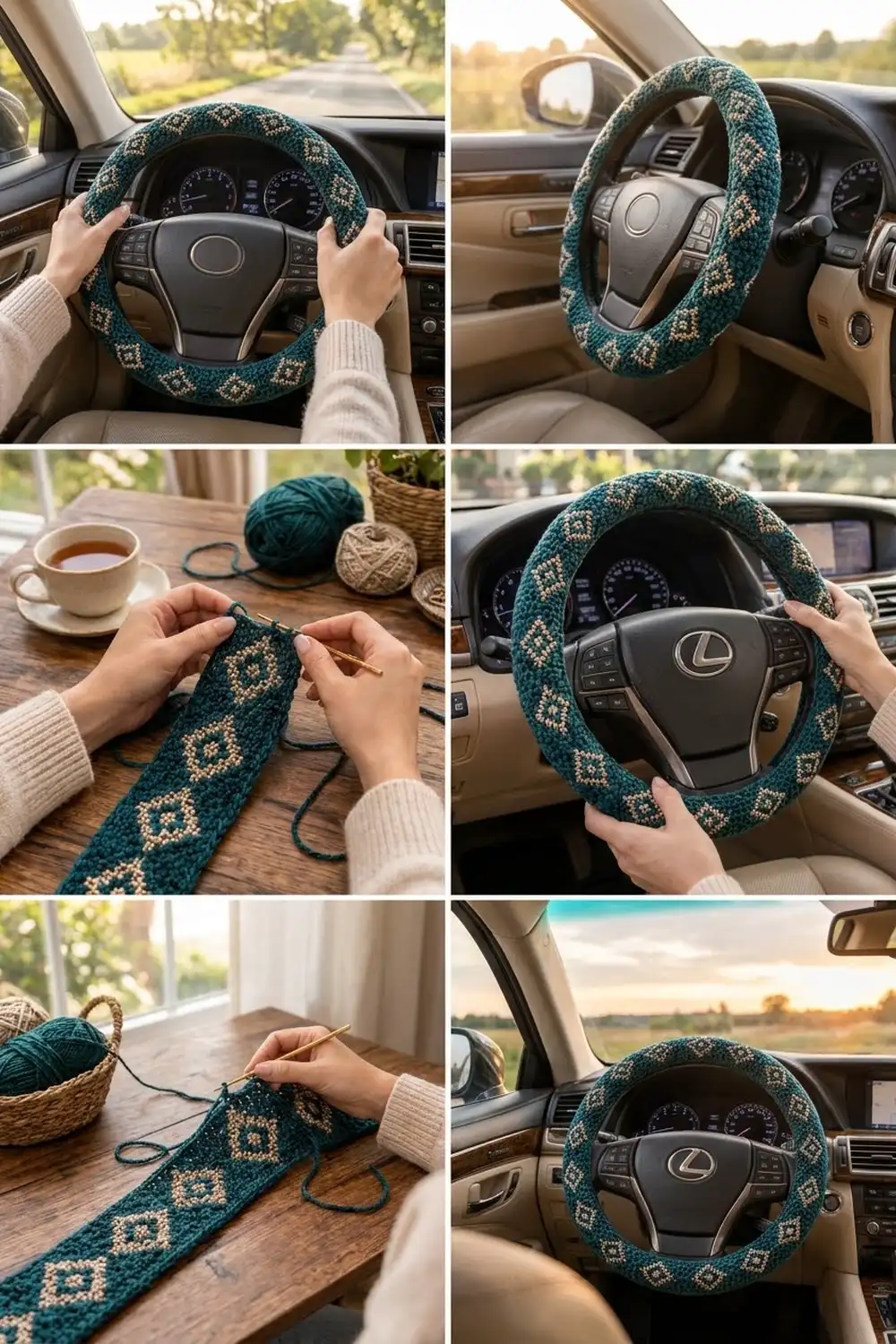
The Teal Diamond Drive cover is one long strip of tapestry single crochet. You wrap it around the rim of a car steering wheel and seam it closed on the inner edge. A single line of beige diamonds runs around the whole wheel. Each diamond is a one-stitch outline with a small four-petal flower in the middle and a teal center.
The main color is a deep teal and the accent is a soft beige-gold. Tapestry crochet makes a dense, cushioned fabric that grips well and holds its shape. The design is understated and slightly vintage, so it works in almost any car interior.
This pattern uses US crochet terms. Before installation, the bordered strip measures 4.6 in (11.7 cm) wide and 42.4 in (107.7 cm) long. It fits a standard wheel with a grip circumference of about 4.75 in (12.1 cm) and a rim centerline circumference of 43–43.5 in (109.2–110.5 cm).
You work the strip flat in short rows of 21 stitches. Every 14-row repeat has 3 plain teal rows and an 11-row diamond. One round of teal single crochet borders the strip. Then you block it, wrap it around the rim, and whipstitch it closed.
Finished Size and Construction
- Finished size (blocked, before installation): 4.6 in x 42.4 in (11.7 cm x 107.7 cm)
- Skill level: Intermediate (tapestry colorwork)
- Terminology: US crochet terms
- Yarn weight: DK (#3, light)
- Hook: 3.5 mm (E-4)
- Number of pieces: 1 (a single strip, no motifs to join)
- Layout: 15 diamond repeats in one line along the length of the strip
- Strip size before border: 4.2 in x 42 in (10.7 cm x 106.7 cm)
- Border depth: 0.2 in (0.5 cm) on every edge, 1 round
- Fit: about 0.15 in (0.4 cm) negative ease around the grip and 0.6–1.1 in (1.5–2.8 cm) negative ease around the wheel
Materials
Use a smooth DK yarn that has some body. A cotton-acrylic blend is a good choice because it grips well, wears well, and can be washed. Avoid slippery bamboo or silky yarns, which can make the wheel feel loose under your hands. The yardages below assume about 230 m per 100 g.
- Color A (deep teal): 60 g, about 138 m (151 yd)
- Color B (beige-gold): 30 g, about 69 m (75 yd)
Color B is carried inside the stitches on every row, so you need more of it than the visible diamonds suggest. Both quantities include a margin of about 25% for swatching and small fit adjustments.
Tools:
- 3.5 mm (E-4) crochet hook
- Tapestry needle
- Scissors
- Measuring tape
- Rust-proof pins and a blocking mat
- Spray bottle
- 4 locking stitch markers
Abbreviations (US Terms)
- ch – chain
- sc – single crochet
- st(s) – stitch(es)
- A – Color A, teal
- B – Color B, beige-gold
- RS / WS – right side / wrong side
Special technique – tapestry single crochet (tsc): Hold the color you are not using along the top of the row. Work each sc over it so the strand is hidden inside the stitch. To change color, work the last sc before the change until 2 loops remain on the hook, yarn over with the new color, and pull through. Carry B through every row, plain teal rows included. This keeps the fabric the same thickness all the way along.
Gauge and Checkpoints
Gauge: 20 sts and 20 rows = 4 in (10.2 cm) in tapestry sc with both colors carried.
The gauge is square on purpose (5 sts and 5 rows per inch). The border math depends on it.
Test first: The first 14 rows are your swatch. Work them, steam them lightly, and measure before you go on.
- After Row 14 (1 repeat): 4.2 in (10.7 cm) wide, 2.8 in (7.1 cm) long
- After Row 70 (5 repeats): 14 in (35.6 cm) long
- After Row 140 (10 repeats): 28 in (71.1 cm) long
- After Row 210 (15 repeats): 42 in (106.7 cm) long
If it measures too big: Go down to a 3.25 mm (D-3) hook. Also check that you are not loosening the stitch when you pull the new color through.
If it measures too small: Go up to a 3.75 mm (F-5) hook. Hold the carried strand loosely so it lies flat along the row instead of pulling it.
Measure your wheel: Wrap a tape around the grip to get the grip circumference. Then measure around the whole wheel along the middle of the grip to get the centerline circumference. The finished strip, including the border, should be 0.6–1.1 in (1.5–2.8 cm) shorter than the centerline. Each 0.2 in (0.5 cm) of length is one row. To change the length, add or remove plain teal rows, spreading them evenly between diamonds. One full repeat is 2.8 in (7.1 cm).

Diamond Motif (11 Rows)
The motif is symmetrical side to side, so it reads the same on RS and WS rows. Stitch counts read from the start of each row.
- Motif Row 1: 10 A, 1 B, 10 A. (21 sts)
- Motif Row 2: 9 A, 1 B, 1 A, 1 B, 9 A. (21 sts)
- Motif Row 3: 8 A, 1 B, 3 A, 1 B, 8 A. (21 sts)
- Motif Row 4: 7 A, 1 B, 5 A, 1 B, 7 A. (21 sts)
- Motif Row 5: 6 A, 1 B, 3 A, 1 B, 3 A, 1 B, 6 A. (21 sts) Top petal of the flower.
- Motif Row 6: 5 A, 1 B, 3 A, 1 B, 1 A, 1 B, 3 A, 1 B, 5 A. (21 sts) Widest row of the diamond, with the side petals and the teal center.
- Motif Row 7: Work as Motif Row 5. Bottom petal.
- Motif Row 8: Work as Motif Row 4.
- Motif Row 9: Work as Motif Row 3.
- Motif Row 10: Work as Motif Row 2.
- Motif Row 11: Work as Motif Row 1.
The outline is 11 sts wide at Motif Row 6, from stitch 6 to stitch 16, and 11 rows tall. Each side has 5 teal stitches between the diamond and the edge. The flower is made of 4 B petals around 1 A stitch at stitch 11.
Strip Pattern
With A, ch 22. Lay B along the top of the chain and start carrying it in Row 1.
Row 1 (RS): Sc in 2nd ch from hook and in each ch across, working over B. Turn. (21 sts)
Rows 2–3: Ch 1 (does not count as a st), sc in each st across with A, carrying B. Turn. (21 sts)
Rows 1–3 are the first 3 plain rows.
Rows 4–14: Work Motif Rows 1–11. Ch 1 and turn at the end of each row. (21 sts per row)
First repeat done. This is your gauge checkpoint: 4.2 in x 2.8 in (10.7 cm x 7.1 cm).
Rows 15–17: Ch 1, sc in each st across with A, carrying B. Turn. (21 sts)
Rows 18–28: Work Motif Rows 1–11. (21 sts per row)
Rows 29–210: Repeat Rows 15–28 thirteen more times, for 15 diamonds in total. (21 sts per row)
Row 210 is Motif Row 11 of the last diamond. After the cover is installed, the 3 plain rows at the start of the strip become the gap between the last diamond and the first. That keeps the spacing even all the way around the wheel.
Cut B, leaving a 4 in (10.2 cm) tail. Keep A attached for the border.
Stitch count check: 210 rows x 21 sts = 4,410 sts in the body. Each diamond has 24 B stitches (1+2+2+2+3+4+3+2+2+2+1), so the strip has 360 B stitches.
Border
Border gauge: 1 sc per stitch across the short ends and 1 sc per row end along the long sides. That is 5 sc per inch everywhere.
Border Round (A): Do not turn. Ch 1. Work around the strip:
- Short end (top of Row 210): 3 sc in the first st (corner), 1 sc in each of the next 19 sts, 3 sc in the last st (corner).
- Long side 1: 1 sc in each of the 210 row ends.
- Short end (foundation chain): 3 sc in the first ch (corner), 1 sc in each of the next 19 ch, 3 sc in the last ch (corner).
- Long side 2: 1 sc in each of the 210 row ends.
Join with a slip stitch to the first sc.
Count per section: Each corner group has 3 sc. Each short end has 19 sc between its corner groups, and each long side has 210 sc between corner groups. The total is (4 x 3) + (2 x 19) + (2 x 210) = 470 sc.
Conversion check: 462 sts worked 1 per existing stitch or row end (21 + 21 + 210 + 210) + 8 extra sts (2 per corner) = 470 sc.
Why the math works: The gauge is 5 sts and 5 rows per inch. One sc per row end therefore lays exactly as many stitches along a long side as the row gauge needs, so the edge stays flat with no ruffling or puckering. The 3-sc corners turn the corner without cupping. The round adds one sc on every edge, about 0.2 in (0.5 cm). The width goes from 4.2 in to 4.6 in (10.7 cm to 11.7 cm), and the length from 42 in to 42.4 in (106.7 cm to 107.7 cm).
Place a locking marker in the center sc of each corner group. Fasten off, leaving a 60 in (152.4 cm) tail of A for seaming. Weave in all other ends inside the tapestry fabric, along the carried strands.
If you widened the strip: Adding 1 A stitch at each edge (ch 24, 23 sts per row) makes the strip 0.4 in (1.0 cm) wider. The short ends then have 21 sc between corner groups, and the border total is 474 sc.
Final Blocking and Installation
- Pin flat. Lay the strip WS up on the blocking mat. Pin it to 4.6 in x 42.4 in (11.7 cm x 107.7 cm), with a pin every 2 in (5.1 cm) along each long side.
- Mist. Spray until the fabric is damp but not soaked. Pat it lightly so the stitches settle.
- Dry completely. Leave it pinned for at least 12 hours.
- Position. With RS facing out, center the strip on the bottom of the rim. Bring the long edges together on the inner edge of the grip, the side facing the center of the wheel. The two ends meet at the top of the wheel.
- Seam the long edges. With the A tail on a tapestry needle, whipstitch the outer loops of matching border stitches together, 1 stitch to 1 stitch. All 210 long-side stitches pair up exactly. Pull each stitch snug but not tight, so the seam looks like one line of teal and doesn’t pucker.
- Work around the spokes. When you reach a spoke, knot the seam yarn, pass the needle inside the cover past the spoke, and start seaming again on the other side. Most spokes leave an opening of 1.5–2.5 in (3.8–6.4 cm), which is 8–12 stitches. Always skip the same number of stitches on both edges so the pairs stay matched.
- Close the ring. At the top of the wheel, ease the short ends together. Whipstitch their 25 border stitches each side (3 + 19 + 3), 1 to 1, with the corner markers matched.
- Set it. Mist the cover lightly where it sits on the wheel and leave it to dry. Then slide it a little at a time until every diamond is centered on the front of the grip.
Final Quality-Control Checklist
- Every row has 21 sts and the strip has 210 rows.
- There are 15 diamonds, each with 24 B stitches and a teal center in the flower.
- B never shows through the teal rows. If it peeks out, tug the carried strand gently.
- The border round has 470 sc: 210 on each long side, 19 between corners on each short end, and 3 in each corner.
- Before installation the strip measures 4.6 in x 42.4 in (11.7 cm x 107.7 cm).
- The seam lies along the inner edge of the grip and is hidden from the driver’s view.
- The cover doesn’t twist or slide when you turn the wheel.
Troubleshooting
The diamonds lean to one side. In tapestry sc the stitches naturally slant a little. Working through both loops and keeping the same hook angle on RS and WS rows keeps the lean to a minimum. Steam blocking corrects what is left.
B shows through the teal stitches. You are pulling the carried strand too tight, or the hook is too large. Hold B flat along the row tops and keep the tension firm and even.
The strip is getting narrower. You may be missing the last stitch of a row. Count all 21 sts at the end of every row, or put a marker in the first stitch.
The cover feels loose on the wheel. The strip is too long. Undo the border at one short end and remove 1–2 plain teal rows from each of several gaps. Then work the border again.
The seam won’t close around the grip. The grip is thicker than 4.75 in (12.1 cm). Rework the strip with 23 sts per row.
The cover gaps at the spokes. Knot the seam firmly at both sides of each spoke, and work 2 extra whipstitches over the last pair of stitches before each opening.
Care
To clean the cover in place, spot clean it with a damp cloth and a little mild soap, then let it air-dry. If you remove it, hand wash it in cool water and dry it flat at the blocked dimensions.
Final Notes
Every measurement follows from the square gauge of 5 sts and 5 rows per inch:
- 21 sts make a strip 4.2 in (10.7 cm) wide.
- 15 repeats of 14 rows make 210 rows, or 42 in (106.7 cm).
- One border round brings the strip to 4.6 in x 42.4 in (11.7 cm x 107.7 cm). It is slightly smaller than a 4.75 in (12.1 cm) grip and a 43–43.5 in (109.2–110.5 cm) wheel, so it stays put.
Check your gauge at Row 14. Measure again at Rows 70 and 140. Adjust the length with plain teal rows before you add the border.
Happy crocheting!