

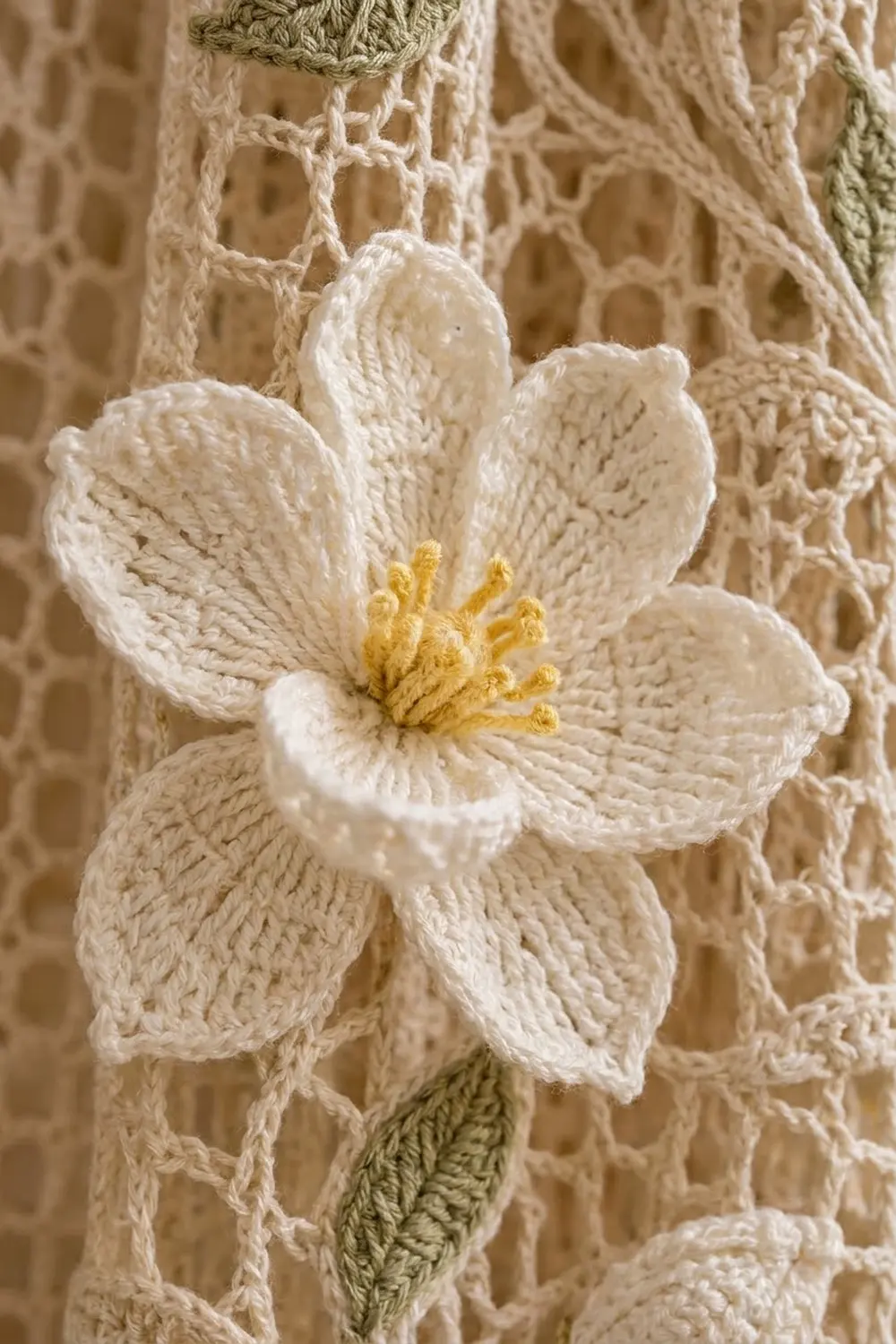
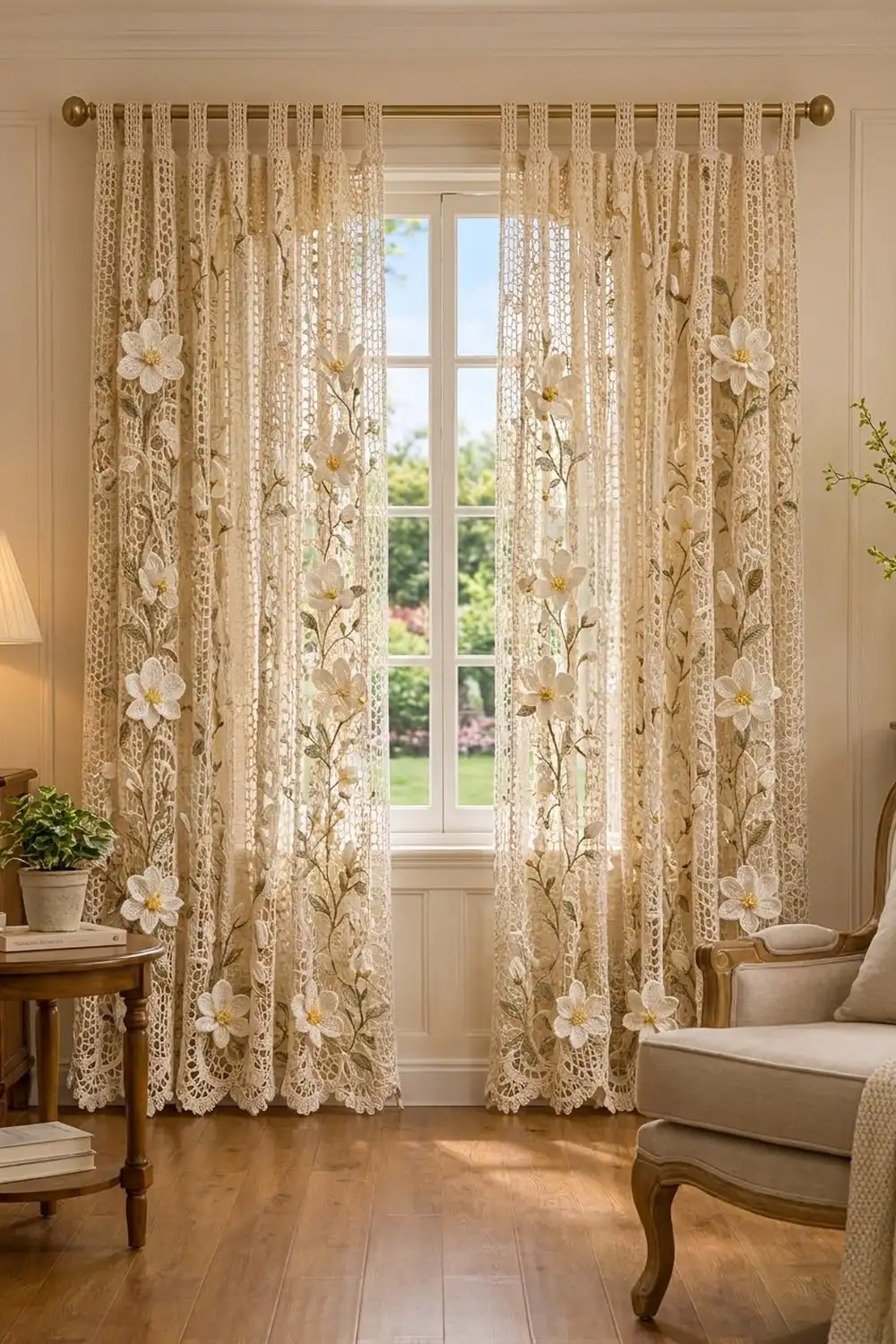
These curtains combine airy cream lace with soft, garden-style details. Each panel is an open chain-loop net that lets light through and hangs in gentle folds from simple tab tops. Sage slip-stitch vines climb each panel and carry white five-petal flowers with yellow centers, pointed leaves and small teardrop buds.
The palette is quiet and warm: cream net, white petals, a yellow center and muted sage green. The look is vintage cottage with a modern finish, and the deep scalloped hem gives the bottom edge a lace-trimmed feel.
This pattern uses US crochet terms. Each finished panel measures 29 in (73.7 cm) wide by 76 in (193.0 cm) from the top edge to the scallop points. The tabs add 3 in (7.6 cm), for 79 in (200.7 cm) overall.
Construction is straightforward. You work the net body in rows, add two rounds of single crochet all around, then work the scallops across the bottom and the tabs across the top. Next you crochet the appliqués, surface-crochet the vines and sew everything in place. Make two panels for a pair.
Finished Size and Construction
- Finished size (one panel): 29 in x 76 in (73.7 cm x 193.0 cm), plus 3 in (7.6 cm) tabs
- Skill level: Intermediate
- Terminology: US
- Yarn weight: Sport (#2) mercerized cotton
- Hook: 3.5 mm (E-4)
- Number of pieces: 2 panels; each panel is one net piece with 9 flowers, 24 leaves and 8 buds sewn on, plus 2 surface-crocheted vines
- Layout: each panel is worked as one piece, so there is no grid of motifs
- Net body size: 28 in x 72 in (71.1 cm x 182.9 cm)
- Size before border: 28 in x 72 in (71.1 cm x 182.9 cm)
- Border depth: 0.5 in (1.3 cm) on the sides and top; 3.5 in (8.9 cm) at the hem, measured to the scallop points
Materials
Use a smooth mercerized cotton or cotton blend. It drapes well, shows the lace clearly and stands up to sunlight and washing. Quantities below are for the pair of panels.
- Cream (net, border, tabs): 1,400 g / about 4,340 m
- White (petals, buds): 150 g / about 465 m
- Yellow (flower centers): 30 g / about 93 m
- Sage green (leaves, calyxes, vines): 150 g / about 465 m
Tools: 3.5 mm (E-4) hook, tapestry needle, stitch markers, measuring tape, rust-proof pins, a large blocking surface and a spray bottle.
All quantities include a margin of about 10% for swatching and differences in tension.
Abbreviations (US Terms)
- ch: chain
- sl st: slip stitch
- sc: single crochet
- hdc: half double crochet
- dc: double crochet
- tr: treble crochet
- sk: skip
- sp: space
- sc2tog: single crochet 2 together
- FLO / BLO: front loop only / back loop only
- RS / WS: right side / wrong side
Special stitch: picot. Ch 3, then sl st in the 3rd ch from the hook.
Gauge and Checkpoints
Net gauge: 6 loops and 12 rows = 4 in (10.2 cm) after blocking.
Border gauge: 6 sc = 1 in (2.5 cm).
Before you start a full panel, make one test piece: ch 50, then work the net for 24 rows. That gives 12 loops. Block it, then measure. It should be 8 in (20.3 cm) wide by 8 in (20.3 cm) tall.
Checkpoints:
– After Row 1 of the net: 28 in (71.1 cm) wide, lightly stretched.
– After Row 30: 10 in (25.4 cm) tall.
– After Row 216: 28 in x 72 in (71.1 cm x 182.9 cm), blocked.
– After border Round 2: 29 in x 73 in (73.7 cm x 185.4 cm).
– Flower: 3.5 in (8.9 cm) across. Leaf: 2.75 in (7.0 cm) long. Bud: 1.25 in (3.2 cm) long.
If your swatch is too big, go down 0.25 mm in hook size. If it is too small, go up 0.25 mm. Do not change the number of loops, because every border count depends on the 42 loops across.
Net Body (Make 2)
Use Cream throughout.
Foundation: Ch 170.
Row 1 (RS): Sc in the 6th ch from the hook. The 5 skipped chains form the first loop. *Ch 5, sk 3 ch, sc in next ch; repeat from * 41 more times. (42 loops)
Row 2: Ch 5 (this forms the first loop), turn, sc in the first loop. *Ch 5, sc in next loop; repeat from * 40 more times. (42 loops)
Rows 3–216: Repeat Row 2. (42 loops in every row)
Fasten off. The net body should measure 28 in x 72 in (71.1 cm x 182.9 cm) when blocked. The loops shift into a honeycomb pattern as you go, which is the look you want.
Border: Single Crochet Rounds
The single crochet rounds are worked with the border gauge of 6 sc = 1 in (2.5 cm). Corner ch-2 spaces are not counted in the per-side counts below. Each side count is single crochet only.
Round 1 (RS): Join Cream in the top right corner.
– Top edge: 4 sc in each of the 42 loops of Row 216. (168 sc)
– Ch 2 for the corner.
– Side: 2 sc around each row end, working into either the turning loop or the sc post. Over 216 rows that gives 432 sc.
– Ch 2 for the corner.
– Bottom edge: 4 sc in each of the 42 foundation loops. (168 sc)
– Ch 2 for the corner.
– Other side: 432 sc, worked the same way.
– Ch 2 and join with a sl st to the first sc.
Total: 1,200 sc and 4 corner spaces.
Round 2 (growth round): Ch 1, then sc in each sc. Work (sc, ch 2, sc) in each corner space. Each side count is 1 sc per existing sc plus 1 corner sc at each end:
– Top and bottom: 168 + 2 = 170 sc each
– Each side: 432 + 2 = 434 sc each
Total: 1,208 sc. Join and fasten off.
Why the math works:
– Sides: 72 in x 6 sc/in = 432 sc, which is exactly 2 sc per row end.
– Top and bottom: 42 loops x 4 sc = 168 sc, which matches 28 in x 6 sc/in.
– The 170 sc after Round 2 equals 1 + (13 x 13), so the bottom divides evenly into 13 scallops.
– The same 170 sc equals (8 x 9) + (7 x 14), so the top divides evenly into 8 tabs and 7 gaps.
Border: Scalloped Hem (Bottom Edge Only)
Work this section in rows across the 170 bottom sc.
Row 3 (RS): Join Cream in the first bottom sc after the corner. Sc in the same st. Then:
*Ch 5, sk 3 sc, sc in next sc, ch 5, sk 4 sc, sc in next sc, ch 5, sk 3 sc, sc in next sc; repeat from * 12 more times.
(40 sc, 39 ch-5 loops, 13 repeats)
The last sc of each repeat is the boundary sc that separates one scallop from the next. Mark the boundary sc’s if that helps.
Row 4 (WS): Ch 1, turn, sc in the first sc. Then:
*Ch 3, sc in next loop, ch 5, sc in next loop, ch 5, sc in next loop, ch 3, sc in boundary sc; repeat from * 12 more times.
(53 sc, 26 ch-5 loops, 26 ch-3 spaces)
Row 5 (RS): Ch 1, turn, sc in the first sc. Then:
*Ch 3, sk ch-3 sp, sc in next ch-5 loop, ch 5, sc in next ch-5 loop, ch 3, sk ch-3 sp, sc in boundary sc; repeat from * 12 more times.
(40 sc, 13 ch-5 loops)
Row 6 (WS): Ch 1, turn, sc in the first sc. Then:
*Ch 1, sk ch-3 sp, 9 tr in the ch-5 loop, ch 1, sk ch-3 sp, sc in boundary sc; repeat from * 12 more times.
(13 fans of 9 tr = 117 tr, plus 14 sc)
Row 7 (RS): Ch 1, turn, sl st in the first sc. Then:
*Sc in ch-1 sp, [sc in next tr, picot] 9 times, sc in ch-1 sp, sl st in boundary sc; repeat from * 12 more times.
(13 scallops, 117 picots)
Fasten off. The hem measures 3.5 in (8.9 cm) deep at the points, counting the two sc rounds.
Border: Tabs (Top Edge)
Work 8 tabs into the top edge’s 170 sc. Each tab uses 9 sts, and 14 sts are skipped between tabs. Tabs start on top-edge sts 1, 24, 47, 70, 93, 116, 139 and 162.
Row 1 (RS): Join Cream in the starting st. Ch 3 (counts as dc), dc in next st, [ch 1, sk 1, dc in next st] 3 times, dc in next st. (9 sts: 6 dc and 3 ch-1 spaces)
Rows 2–12: Ch 3, turn. Dc in next dc, [ch 1, dc in next dc] 3 times, dc in top of the turning ch. (9 sts)
Fasten off, leaving a 10 in (25.4 cm) tail. Each tab strip is 6 in (15.2 cm) long and 1.5 in (3.8 cm) wide. Fold it to the WS and whipstitch Row 12 to the base of Row 1. That makes a 3 in (7.6 cm) loop.
Appliqués
Flower (make 9 per panel)
Rnd 1: With Yellow, make a magic ring and work 10 sc in it. Join. (10 sc)
Rnd 2: Working in FLO, [(sl st, ch 5, sl st) in next st] 10 times. (10 stamen loops) Fasten off.
Rnd 3: Join White in BLO of any Rnd 1 st. Work 2 sc in each st, in BLO. Join. (20 sc)
Rnd 4: Sc in the first st. *Ch 5, sk 3 sts, sc in next st; repeat from * 3 more times. Ch 5, sk 3 sts, join to the first sc. (5 ch-5 loops)
Rnd 5 (petals): In each loop, work (sc, hdc, 3 dc, 2 tr, ch 3, 2 tr, 3 dc, hdc, sc). Join. (5 petals, each 14 sts plus a ch-3 tip)
Rnd 6 (petal edge): For each petal: sk the first sc, sc in the next 6 sts, (2 sc, ch 2, 2 sc) in the ch-3 tip, sc in the next 6 sts, sk the last sc. Then sl st around the Rnd 4 sc between petals.
(16 sc per petal, 80 sc total)
The flower measures 3.5 in (8.9 cm) across. The petal edge forms a pointed tip on each rounded petal, and the yellow stamen loops stand up in the center.
Leaf (make 24 per panel)
With Sage, ch 13.
Rnd 1:
– Along the first side: sc in the 2nd ch from the hook, hdc in next ch, dc in next 2 ch, tr in next 4 ch, dc in next 2 ch, hdc in next ch. Work 3 sc in the last ch.
– Working along the other side of the chain: hdc in next ch, dc in next 2 ch, tr in next 4 ch, dc in next 2 ch, hdc in next ch, sc in next ch.
– Ch 3 for the stem and sl st in the same ch.
(11 sts per side + 3 tip sc = 25 sts)
Vein: Surface sl st down the center of the leaf from the tip to the stem. The leaf measures 2.75 in (7.0 cm) long.
Bud (make 8 per panel)
With White:
– Rnd 1: Make a magic ring and work 6 sc in it. (6)
– Rnd 2: 2 sc in each st. (12)
– Rnds 3–4: Sc in each st. (12)
– Rnd 5: Sc2tog around. (6)
Stuff the bud lightly with a scrap of white yarn, then fasten off.
Calyx: Join Sage at the base. Work ch 5, then in the chains back toward the bud: sl st in 2nd ch from the hook, sc in next ch, hdc in next ch, dc in last ch. Sl st in the next base st. Repeat from * 2 more times. (3 sepals)
The bud measures 1.25 in (3.2 cm) long.
Make All Pieces
For the pair: 2 net panels, 18 flowers, 48 leaves, 16 buds and 4 vines.
Placement for one panel (mirror it on the second panel): Positions are measured from the top of the hem border.
Height   | Vine A (7 in / 17.8 cm from left) | Vine B (21 in / 53.3 cm from left)
68 in    | Flower                            | Bud
62 in    | Bud                               | Flower
54 in    | Flower                            | Bud
46 in    | Bud                               | Flower
38 in    | Flower                            | Bud
30 in    | Bud                               | Flower
22 in    | Flower                            | --
14 in    | --                                | Flower
6 in     | Flower                            | --
That places 5 flowers and 3 buds on Vine A, and 4 flowers and 5 buds on Vine B.
Leaves: Add 12 leaves per vine, in pairs, between the flowers and buds.
Joining: Vines and Appliqués
Vines: Hold Sage behind the panel. Starting just above the hem border at the 7 in (17.8 cm) mark, surface sl st upward through the net. Pass through the sc’s at the tops of the loops and sway gently left and right. Stop at 70 in (177.8 cm), giving a vine of about 65 in (165.1 cm). Repeat for Vine B at the 21 in (53.3 cm) mark.
Appliqués: Pin every piece in place following the layout before sewing anything.
– Sew each flower down at the 5 Rnd 4 sc’s and at each petal tip. Leave the petal sides free so they lift slightly.
– Tuck leaf stems under the edges of the flowers and sew along each leaf’s center vein.
– Sew each bud through its calyx only.
– On every stitch, catch the sc’s of the net, not the open chain loops.
Tension: Keep the surface slip stitches loose enough that the net lies flat. Lay the panel flat after each vine. If it pulls in, loosen the vine.
Size checkpoint: The panel should still measure 29 in (73.7 cm) wide.
Final Blocking
- Soak the panel in cool water, then gently press the water out. Do not wring.
- Lay the panel flat on towels or blocking mats.
- Pin it to 29 in x 73 in (73.7 cm x 185.4 cm), measured to the end of Round 2.
- Pin each scallop point so the hem reaches 76 in (193.0 cm).
- Shape the flower petals by hand and open the picots.
- Let it dry completely, then fluff the stamen loops.
Final Quality-Control Checklist
- [ ] Every net row has 42 loops.
- [ ] Round 2 counts: top 170, bottom 170, each side 434.
- [ ] 13 scallops, each with 9 tr in its fan.
- [ ] 8 tabs, evenly spaced.
- [ ] Each panel has 9 flowers, 24 leaves and 8 buds.
- [ ] Both panels match in size.
- [ ] All ends are woven in securely.
Troubleshooting
- Net slants: You are skipping the first loop. Work into it on every row.
- Side edges ruffle: Reduce to 2 sc at each row end and check your border gauge.
- Scallops don’t fit: Recount the bottom; it must be exactly 170 sc.
- Panel puckers behind appliqués: Re-sew them more loosely.
- Tabs twist: Fold every tab to the same side before sewing.
Care
Hand wash in cool water with a mild detergent and dry flat. Re-block lightly after each wash.
Final Notes
Here is the full measurement chain for one panel:
– 42 loops give a 28 in (71.1 cm) width, and 216 rows give 72 in (182.9 cm).
– Two sc rounds bring the panel to 29 in x 73 in (73.7 cm x 185.4 cm).
– The 13 scallops bring the length to 76 in (193.0 cm).
– The 8 tabs add 3 in (7.6 cm) at the top.
Happy crocheting!