

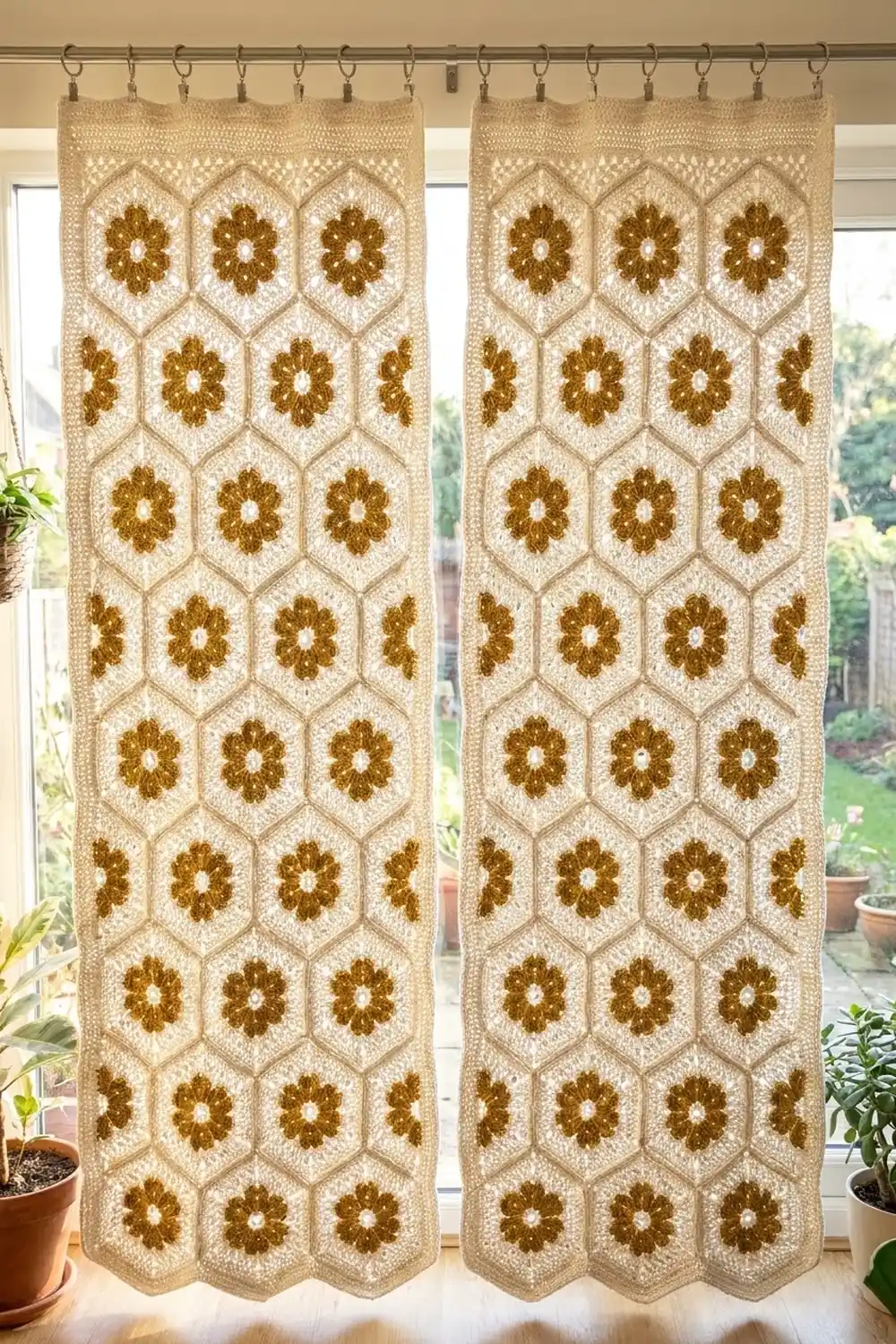
The Marigold Lattice Curtain is a light, airy panel made of hexagon flower motifs. Each hexagon has a mustard six-petal flower in a lacy cream frame. When the motifs are joined, the gaps between them form an open lattice that lets sunlight through and casts soft patterned shadows.
The palette has just two colors: warm cream and golden mustard. The style is relaxed and timeless, and the panel works well in a farmhouse, boho or cottage room. This pattern uses US crochet terms.
One finished panel measures about 43 in (109.2 cm) wide by 72 in (182.9 cm) long. Most windows need two panels.
The construction is simple. You crochet full hexagons in rounds and half-hexagons in rows, then slip-stitch them into offset rows. Leveling rows fill the zigzag at the top and bottom edges, and a three-round border frames the panel. A firm heading across the top holds the curtain clips.
Finished Size and Construction
- Finished panel size: about 43 in × 72 in (109.2 cm × 182.9 cm)
- Skill level: Intermediate
- Terminology: US
- Yarn weight: Worsted (#4) cotton or cotton blend
- Hook: 4.5 mm (US 7)
- Pieces per panel: 113 full hexagons and 14 half-hexagons
- Layout: 15 offset rows. Odd rows have 8 full hexagons. Even rows have 7 full hexagons plus 1 half-hexagon at each end.
- Hexagon size: 6 in (15.2 cm) point to point, 5.2 in (13.2 cm) flat to flat, 3 in (7.6 cm) per side
- Size before border: 41.6 in × 69.5 in (105.7 cm × 176.5 cm), including the leveling rows
- Border depth: 0.75 in (1.9 cm) on all sides, plus a 1.25 in (3.2 cm) heading at the top
Materials
Use a smooth mercerized or combed cotton in worsted weight, about 170 yd (155 m) per 100 g. Cotton keeps the stitches crisp and blocks flat. Avoid fuzzy yarns, which fill the lacy gaps.
Per panel:
– Cream: 1,300 g (about 2,015 m)
– Mustard: 275 g (about 426 m)
For a pair: 2,600 g (about 4,030 m) cream and 550 g (about 852 m) mustard.
Tools:
– 4.5 mm (US 7) hook
– Tapestry needle
– Stitch markers
– Scissors
– Blocking mats, rust-proof pins and a spray bottle
– Measuring tape
– Curtain rod with 10–12 ring clips per panel
All quantities include a margin of about 10% for gauge differences and swatching.
Abbreviations (US Terms)
- ch – chain
- sl st – slip stitch
- sc – single crochet
- hdc – half double crochet
- dc – double crochet
- tr – treble crochet
- dtr – double treble crochet
- sc2tog – single crochet 2 together
- BLO – back loop only
- sp – space
- st(s) – stitch(es)
- RS – right side
Special stitch – Petal: work (hdc, dc, tr, dc, hdc) all in the same stitch.
Gauge and Checkpoints
Make one full hexagon before anything else and block it lightly.
- After Round 2: the flower measures 2.25 in (5.7 cm) across.
- After Round 5: 5.5 in (14.0 cm) point to point.
- After Round 6: 6 in (15.2 cm) point to point, 5.2 in (13.2 cm) flat to flat, 3 in (7.6 cm) per side.
- Border gauge: 14 sc = 3 in (7.6 cm). This matches the edge of Round 6, where each side has about 14 sc over 3 in.
If your hexagon is more than 0.25 in (0.6 cm) too big, go down half a hook size. If it is too small, go up half a size. Even a small error multiplies across 8 hexagons of width and 15 rows of length.
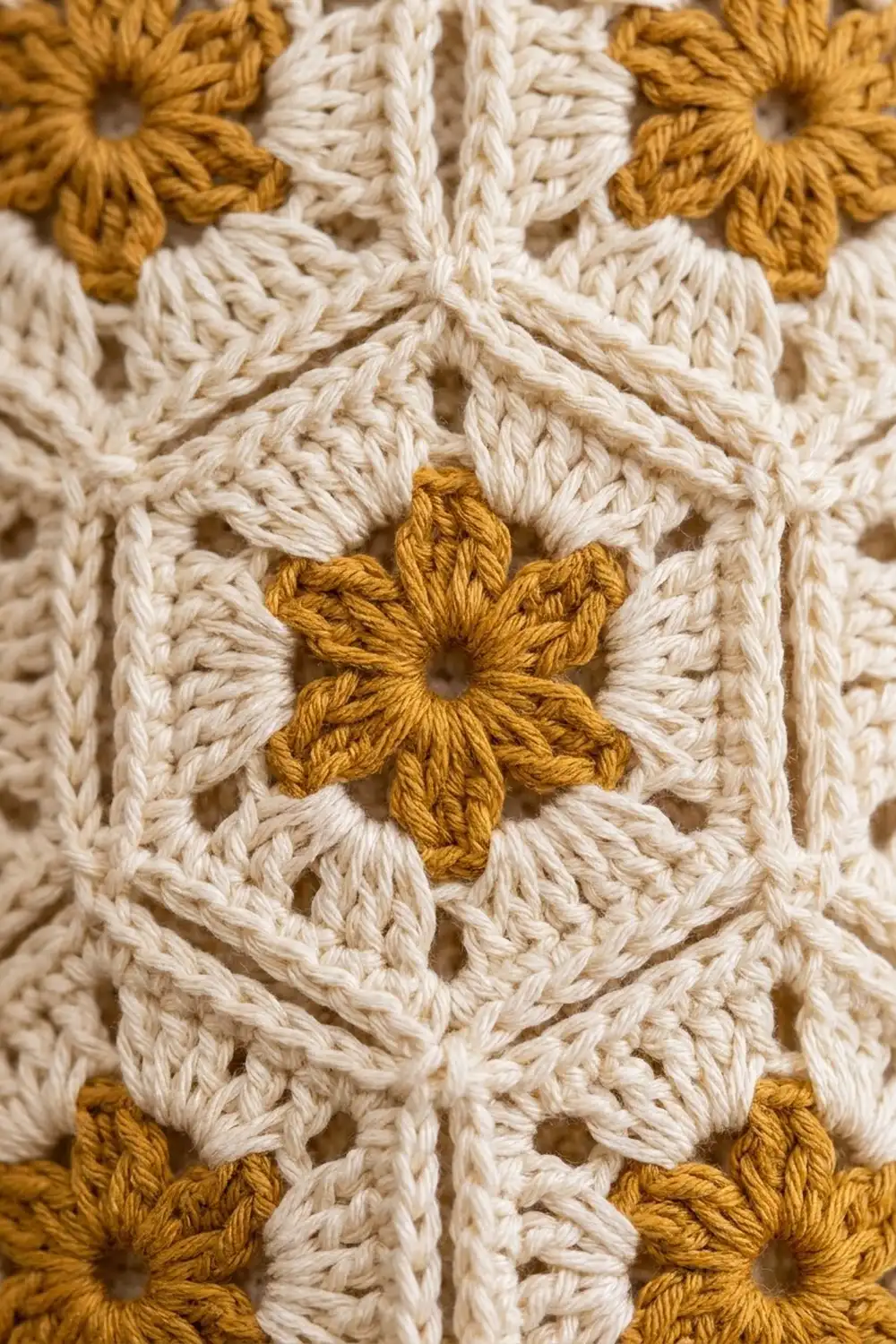
Full Hexagon (make 113)
Round 1 (mustard): Make a magic ring. Ch 3 (counts as dc), then work 11 dc in the ring. Join with a sl st to the top of the ch-3. (12 dc) Pull the ring snug but leave a small center hole.
Round 2 (mustard): Sl st in the next st, then work a Petal in the next st. Repeat from * 6 times. Fasten off. (6 petals, 6 sl st; 36 sts)
Round 3 (cream): Join cream with a sc in the tr at the tip of any petal. Ch 5. Sc in the tip of the next petal, ch 5. Repeat from * 5 more times. Join to the first sc. (6 sc, 6 ch-5 sps) The chains sit behind the petal valleys and form the first open frame.
Round 4: Sl st into the first ch-5 sp. Ch 3 (counts as dc), then work (2 dc, ch 2, 3 dc) in the same sp, ch 1. (3 dc, ch 2, 3 dc) in the next ch-5 sp, ch 1. Repeat from * 5 more times. Join. (36 dc, 6 ch-2 corners, 6 ch-1 sps)
The corners now sit between the petals, and each petal tip points to the middle of a side.
Round 5: Sl st in the next 2 dc and into the ch-2 sp. Ch 3, then work (2 dc, ch 2, 3 dc) in the same sp. Ch 1, 3 dc in the next ch-1 sp, ch 1, (3 dc, ch 2, 3 dc) in the next ch-2 sp. Repeat from * 4 more times. Ch 1, 3 dc in the last ch-1 sp, ch 1, and join. (54 dc, 6 ch-2 corners, 12 ch-1 sps)
Round 6: Ch 1. Sc in each dc and each ch-1 sp around, working 3 sc in each ch-2 corner. Join and fasten off. (84 sc)
Each side has 15 sts from corner center to corner center, both corners included. The math: 6 sides × 13 sts between corners, plus 6 corner sts, = 84.
Half-Hexagon (make 14)
The half-hexagon is the right half of a full hexagon, cut through its top and bottom points. It has three normal 15-st sides and one straight 6 in (15.2 cm) cut edge. Turn at the end of every row.
Row 1 (mustard): Make a magic ring. Ch 3 (counts as dc), then work 6 dc in the ring. Do not join. (7 dc)
Row 2: Ch 1 and turn. Sc in the first st. Petal in the next st, sl st in the next st. Repeat from * once more. Petal in the next st, then sc in the top of the ch-3. Fasten off. (3 petals; 19 sts)
Row 3 (cream): With the RS facing, join with a sc in the first sc. Ch 3, then sc in the first petal tip. Ch 5, sc in the next tip, ch 5, sc in the last tip. Ch 3, then sc in the last sc. (5 sc, 2 ch-5 sps, 2 ch-3 sps)
Row 4: Ch 3 (counts as dc) and turn. Work 2 dc in the ch-3 sp, then ch 1. Work (3 dc, ch 2, 3 dc) in the next ch-5 sp, ch 1, and repeat in the following ch-5 sp, ch 1. Work 2 dc in the last ch-3 sp, then dc in the last sc. (18 dc, 2 ch-2 corners, 3 ch-1 sps)
Row 5: Ch 3 (counts as dc) and turn. Work 2 dc in the first st, ch 1, and skip 2 dc. 3 dc in the next ch-1 sp, ch 1, (3 dc, ch 2, 3 dc) in the next ch-2 sp, ch 1. Repeat from * once. Work 3 dc in the last ch-1 sp, ch 1, skip 2 dc, then work 3 dc in the top of the turning ch. (27 dc, 2 ch-2 corners, 6 ch-1 sps)
Row 6: Ch 1 and turn. Work 3 sc in the first st. Sc in each dc and each ch-1 sp across, working 3 sc in each ch-2 corner. Work 3 sc in the top of the turning ch. (43 sc)
That count breaks down as 4 corner sts + 3 sides × 13 sts. Each side has 15 sts with its corners included, the same as a full hexagon.
Edge round: Ch 1 and rotate the piece to work along the straight edge. Work 13 sc evenly along each half: 3 sc in the end of Row 5, 3 in Row 4, 2 in Row 3, 3 in Row 2 and 2 in Row 1. Then sl st to the first sc of Row 6 and fasten off. (26 new sc)
The cut edge now has 28 sts, counting the two Row 6 corner sts.
Checkpoint: the cut edge is 6 in (15.2 cm) long, and the piece is 2.6 in (6.6 cm) deep.
Make All Pieces
Per panel:
– 113 full hexagons (226 g mustard, about 904 g cream)
– 14 half-hexagons (14 g mustard, about 63 g cream)
Weave in all ends as you go. Store the pieces in batches of 10 so you can count them easily.
Layout grid (F = full hexagon, H = half-hexagon; the flat edge of each H faces outward):
Row 1:   F F F F F F F F
Row 2:  H F F F F F F F H
Row 3:   F F F F F F F F
Row 4:  H F F F F F F F H
... alternate down to ...
Row 15:  F F F F F F F F
Odd rows (1, 3, … 15) total 8 rows × 8 = 64 full hexagons. Even rows (2, 4, … 14) total 7 rows × 7 = 49 full hexagons plus 14 halves.
Joining
Method: slip-stitch join through the back loops, with the RS facing up. This raises a neat cream ridge on the front, matching the lattice look.
Step 1 – Strips: Join the hexagons of each row side by side along their vertical sides. Place two pieces RS up and edge to edge. Sl st through the back loop of the matching sts, one from each piece, along the 15 sts of the side, corner to corner.
In even rows, join each half-hexagon’s vertical side to the first or last full hexagon in the same 15-to-15 way.
Step 2 – Rows together: Join each row to the one above along the zigzag. Every slanted side has 15 sts, so each seam is 15-to-15. Work through both corner sts where the pieces meet.
At the side edges, each half-hexagon’s two slanted sides join to the full hexagons above and below it.
Tension: keep the slip stitches as loose as your normal sc. If seams pull, the panel cups and shortens. If that happens, go up a hook size for joining only.
Size checkpoints:
– One joined row of 8 measures 41.6 in (105.7 cm).
– Three joined rows measure 15 in (38.1 cm) from top point to bottom point. Each extra row adds 4.5 in (11.4 cm).
– The full body measures 69 in (175.3 cm) from top peaks to bottom peaks.
Border
Border gauge: 14 sc = 3 in (7.6 cm). That works out to about 24 sc per hexagon width of 5.2 in (13.2 cm).
Leveling Row A (top): With the RS facing, join cream in the upper-left corner st of the first hexagon in Row 1. Work through the outer loops of the edge sts and ignore the seam sl sts. Ch 5 (counts as dtr). The ch-5 stands in for the first dtr in the valley corner.
Then work this sequence across each hexagon’s two upper sides (29 sts per hexagon):
– dtr in the valley corner, dtr in the next st
– 3 tr, 3 dc, 3 hdc, 3 sc
– sc in the peak corner
– 3 sc, 3 hdc, 3 dc, 3 tr
– dtr in the next st, dtr in the valley corner
The row totals 8 × 29 = 232 sts. The tall stitches fill the 1.5 in (3.8 cm) valleys.
Leveling Row B: Ch 1 and turn. For each 29-st repeat, work sc in the next 2 sts, then (sc2tog, sc in the next 4 sts) 4 times, then sc2tog and sc in the next st. That reduces each repeat to 24 sts, for 8 × 24 = 192 sts.
Bottom: Repeat Rows A and B along the lower sides of Row 15. (192 sts)
Round 1: Work sc around the whole panel as follows:
– Top: 3 sc in the first st of Row B, sc in the next 190 sts, 3 sc in the last st.
– Each side: 328 sc. Work 1 sc in the end of Row B and 5 sc in the end of Row A. Then work 316 sc along the pieces: 8 full-hexagon sides × 15 = 120, plus 7 half-hexagon cut edges × 28 = 196. Finish with 5 sc in the end of the bottom Row A and 1 sc in the end of the bottom Row B.
– Bottom: the same as the top.
Join. (1,048 sts. Top and bottom have 194 sts each and the sides 330 sts each, corner centers included.)
Round 2: Ch 2. Hdc in each st, working 3 hdc in each corner center. (1,056 sts. Top and bottom 196, sides 332.)
Round 3: Ch 1. Sc in each st, working 3 sc in each corner center. (1,064 sts. Top and bottom 198, sides 334.)
Heading: Work 4 rows of hdc across the top 198 sts only, turning with ch 2 (it does not count as a st). Work Row 1 through both loops and Rows 2–4 in the BLO. Fasten off.
Why the math works:
– The 192 top sts at border gauge measure 41.1 in (104.4 cm), against a body width of 41.6 in (105.7 cm). That’s just enough to stay flat without flaring.
– The 328 side sts measure 70.3 in (178.6 cm), against a 69.5 in (176.5 cm) edge. That is about 1% ease, so the sides hang straight without puckering.
– Nothing extra is added at the seams. Every seam count comes from the 15-st and 28-st edges of the pieces themselves.
Final Blocking
- Lay the panel on mats, RS up. Work in sections if your space is small.
- Pin the side borders straight, measuring 43 in (109.2 cm) across.
- Pin the heading in a straight line, then pin the bottom border so the length is 72 in (182.9 cm).
- Push the open diamonds into shape with your fingers, and open each petal flat.
- Spray until damp, not soaked.
- Let it dry fully, about 24 hours, before unpinning. Then block the second section.
Final Quality-Control Checklist
- Every hexagon measures 6 in (15.2 cm) point to point.
- All seams are 15-to-15 or 28-to-edge, with no skipped corners.
- The side edges are straight, with the half-hexagons flush.
- The top and bottom edges are level after Rows A and B.
- The border corners lie flat and square.
- The heading is firm enough to hold the clips without stretching.
- All ends are woven in at least 1 in (2.5 cm) and trimmed.
Troubleshooting
- Petals cup: loosen your tension on the tr, or pull the magic ring less tight.
- The hexagon is curling: Round 3’s ch-5 is too tight. Chain more loosely.
- The half-hexagon cut edge bows: redo the edge round, using 12 sc per half instead of 13.
- The top border waves: check that Row B has 192 sts, then block firmly.
- The panel is too short: add 2 rows of hexagons, an odd row and an even row, for +9 in (22.9 cm). Add 4 full hexagons + 2 halves to Round 1’s side counts, which adds 2 × 15 + 28 = 58 sts per side.
Care
Hand wash or machine wash cold on a gentle cycle in a mesh bag. Lay flat to dry and reshape while damp, and don’t hang the panel wet, because the weight will stretch it.
Final Notes
Everything follows one measurement chain:
– One 6 in (15.2 cm) hexagon with 15-st sides.
– Rows of 8 hexagons at 41.6 in (105.7 cm), stacked in 15 rows for 69 in (175.3 cm).
– Leveling rows that bring each hexagon to 24 sts.
– A 0.75 in (1.9 cm) border and a 1.25 in (3.2 cm) heading, for a panel of about 43 in × 72 in (109.2 cm × 182.9 cm).
Check your first hexagon carefully, and the rest of the panel will follow.
Happy crocheting!