

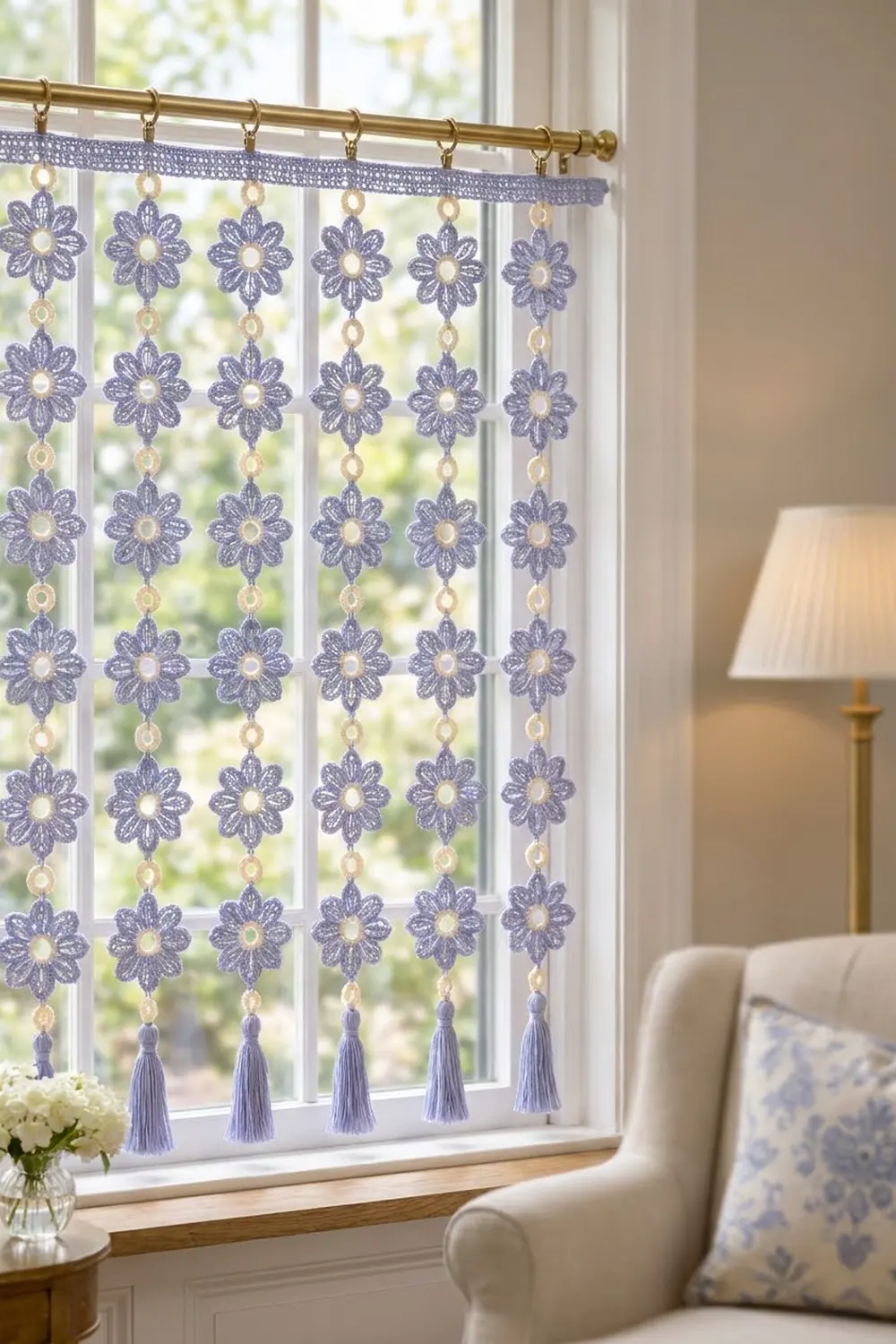
This curtain is a row of flower chains that hang from a narrow crocheted band. Each strand alternates periwinkle lavender daisies with small cream rings and ends in a soft lavender tassel. Light comes through the open petals, so the window stays bright while the glass gets a gentle screen.
The palette is just two colors. Lavender is used for the petals, the header band, and the tassels. Cream is used for the flower centers and the connector rings. The overall look is airy and slightly vintage, and it suits a kitchen window, a cottage-style bedroom, or a doorway.
The pattern uses US crochet terms. The finished panel measures 36 in (91.4 cm) wide and 33.5 in (85.1 cm) long from the top of the header to the tips of the tassels. Each daisy is 3.75 in (9.5 cm) across and each ring is 0.75 in (1.9 cm) across.
The construction is modular. First you crochet 54 flowers and one header band. Then you build each of the 9 strands downward from the header, joining as you go: every cream ring is joined to the piece above it and the piece below it while you work it. The tassels go on last.
Finished Size and Construction
- Finished size: 36 in (91.4 cm) wide x 33.5 in (85.1 cm) long
- Skill level: Intermediate
- Terminology: US crochet terms
- Yarn weight: DK / light (3) cotton
- Hook: 3.5 mm (E-4)
- Number of pieces: 54 flowers, 63 rings, 1 header band, 9 tassels
- Layout: 9 strands, each with 6 flowers and 7 rings
- Piece size: flower 3.75 in (9.5 cm), ring 0.75 in (1.9 cm)
- Size before border (strands only): each strand 27.75 in (70.5 cm) long. With the tassel it is 31.75 in (80.6 cm).
- Border (header band) depth: 1.75 in (4.4 cm)
Materials
Choose a smooth mercerized or combed DK cotton, roughly 120 m per 50 g. Cotton gives crisp petal outlines and hangs straight without stretching. Avoid fuzzy yarns, because they fill in the open petal eyes.
- Lavender (periwinkle): 300 g (approx. 720 m), for petals, header, and tassels
- Cream: 100 g (approx. 240 m), for flower centers and rings
Tools:
- 3.5 mm (E-4) crochet hook
- Tapestry needle
- Scissors
- 10 stitch markers
- Stiff card, 4 in (10.2 cm) tall, for tassels
- Blocking mat and rust-proof pins
- Spray bottle
- Curtain rod with 10 clip rings
The quantities include a margin of about 15% for gauge swatching and weaving in ends.
Abbreviations (US Terms)
- ch chain
- sl st slip stitch
- sc single crochet
- hdc half double crochet
- dc double crochet
- sk skip
- sp space
- st(s) stitch(es)
- rep repeat
Special stitch: join slip stitch (join sl st). Insert the hook into the given spot on another piece, yarn over, and pull the loop through that spot and through the loop on your hook. This links two pieces without adding a stitch to the count.
Gauge and Checkpoints
- Header gauge: 20 sc and 22 rows = 4 in (10.2 cm)
- Flower: 3.75 in (9.5 cm) from petal tip to opposite petal tip
Before you start, make one flower and one ring as a test and measure them.
- After Round 2 (cream center): 1.25 in (3.2 cm) across, with a hole about 0.5 in (1.3 cm) wide
- After Round 3 (petal arches): about 3 in (7.6 cm) across
- After Round 4 (finished flower): 3.75 in (9.5 cm) across
- Ring: 0.75 in (1.9 cm) across
If your flower is more than 0.25 in (0.6 cm) too big, go down half a hook size. If it is too small by the same amount, go up half a size. Check the header gauge the same way on a 4 in (10.2 cm) sc swatch. The flower size sets the strand length, and the header gauge sets the spacing between strands.

Flower (make 54)
Round 1 (cream): Ch 10 and sl st in the first ch to form a ring. Ch 1, then work 24 sc into the ring. Sl st in the first sc to join. (24 sc)
Round 2 (cream): Ch 1, sc in each sc around, and sl st in the first sc to join. (24 sc) Fasten off. This gives a firm cream ring around an open center.
Round 3 (lavender): Join lavender with a sl st in any sc. Ch 1, then sc in the same st, ch 12, and sk the next 2 sc. Sc in the next sc, ch 12, sk the next 2 sc. Rep from * 6 more times, then sl st in the first sc. (8 sc and 8 ch-12 arches)
Each arch starts at one sc and ends at the next sc, three sts along the center. These arches make the open eyes of the petals.
Round 4 (lavender, petal outline): Sl st into the first ch-12 arch. In each arch, work (sc, 2 hdc, 4 dc, ch 2, 4 dc, 2 hdc, sc). Sl st in the first sc to join. (112 sts and 8 ch-2 tip sps, which is 14 sts per petal) Fasten off.
The stitches crowd around the outside of each arch. The chain itself stays visible inside as an open, lacy teardrop. The ch-2 sp sits at the point of each petal.
Weave in the ends. Pin each flower to 3.75 in (9.5 cm) on the blocking mat, mist it, and let it dry. Mark two petal tips that are directly opposite each other (petals 1 and 5). These are the top and bottom join points.
Make All Pieces
- Flowers: 54 in total. Each one uses about 2.5 m of cream and 9 m of lavender.
- Rings: 63 in cream, made during assembly
- Tassels: 9 in lavender
- Header band: 1 in lavender
Layout grid (H = header, R = ring, F = flower, T = tassel; one column per strand):
H H H H H H H H H
R R R R R R R R R
F F F F F F F F F
R R R R R R R R R
F F F F F F F F F
R R R R R R R R R
F F F F F F F F F
R R R R R R R R R
F F F F F F F F F
R R R R R R R R R
F F F F F F F F F
R R R R R R R R R
F F F F F F F F F
R R R R R R R R R
T T T T T T T T T
Border: Header Band
The header is the only border on this curtain. It runs along the top edge.
Border gauge: 20 sc = 4 in (10.2 cm), which is 5 sts per inch.
The math: There are 9 strands, and each strand gets 20 sts, so 9 x 20 = 180 sts. Each 20-st segment is 4 in (10.2 cm) wide: 3.75 in (9.5 cm) for the flower plus 0.25 in (0.6 cm) of air between neighboring flowers. 180 sts at 5 sts per inch gives exactly 36 in (91.4 cm).
Foundation: With lavender, ch 181.
Row 1: Sc in the 2nd ch from the hook and in each ch across. Turn. (180 sc)
Place a marker after every 20th st to mark the 9 segments.
Row 2: Ch 1, sc in each sc across. Turn. (180 sc)
Row 3 (mesh): Ch 3 (counts as dc). Ch 1, sk next sc, dc in next sc. Rep from * 88 more times, then dc in the last sc. Turn. (91 dc and 89 ch-1 sps = 180 sts)
Row 4: Ch 1, sc in each dc and in each ch-1 sp across. Turn. (180 sc)
Row 5 (mesh): Repeat Row 3. (91 dc and 89 ch-1 sps = 180 sts)
Row 6: Repeat Row 4. (180 sc)
Row 7: Ch 1, sc in each sc across. (180 sc) Fasten off.
Checkpoint: The band should be 36 in (91.4 cm) long and 1.75 in (4.4 cm) deep. Row 7 is the top edge. The foundation edge (Row 1) is the bottom, where the strands hang.
The count never changes because every row works exactly 1 st into each st or ch-1 sp. Each mesh row uses 91 dc and 89 spaces, which adds up to the same 180 sts. Any extra stitch would push a strand off center.
Joining
Work each strand from the top down. Rings are worked in cream and joined as you go.
Ring with two joins (top and middle rings):
- Ch 6 and sl st in the first ch to form a ring.
- Ch 1, then work 6 sc into the ring.
- Join sl st into the upper target.
- Work 6 more sc into the ring.
- Join sl st into the lower target.
- Sl st in the first sc to close. Fasten off. (12 sc plus 2 join sl sts, at opposite points of the ring)
Strand assembly (rep for each of the 9 segments):
- Top ring: The upper target is the bottom loops of sc 10 and sc 11 of the segment, taken together. This is the center of the segment. The lower target is the marked top petal tip (ch-2 sp) of Flower 1.
- Middle rings (5): The upper target is the bottom petal tip of the flower above. The lower target is the top petal tip of the next flower. Continue until Flower 6 is attached.
- Bottom ring: Work 12 sc with only one join sl st, into the bottom petal tip of Flower 6.
Stitch-to-stitch logic: Each join uses one ch-2 tip sp on the flower and one sl st on the ring. Nothing is added to the flower or header counts, so the header stays at 180 sts.
Tension: Keep the join sl sts snug but not tight. A tight join twists the flower sideways. A loose one lets it droop forward. Hold the strand up as you go and make sure each flower faces front.
Size checkpoint: Measured from the header to the bottom of the last ring, each strand should be 27.75 in (70.5 cm) long. That is 6 flowers x 3.75 in (9.5 cm) = 22.5 in (57.2 cm), plus 7 rings x 0.75 in (1.9 cm) = 5.25 in (13.3 cm). All 9 strands should match within 0.5 in (1.3 cm).
Tassels (make 9)
- Wrap lavender 30 times around the 4 in (10.2 cm) card.
- Slide a 10 in (25.4 cm) tie strand under the wraps at the top and knot it tightly.
- Cut the wraps at the bottom.
- Wrap another strand 0.5 in (1.3 cm) below the top, knot it, and bury the ends inside the tassel.
- Use the top tie to attach the tassel through the bottom ring.
- Trim the tassel to 4 in (10.2 cm).
Final Blocking
- Lay the curtain face down on a clean surface or a large blocking area.
- Pin the header straight to 36 in (91.4 cm) and 1.75 in (4.4 cm) deep.
- Pin each strand straight down from its segment center, so the strands are spaced 4 in (10.2 cm) apart.
- Open each petal eye with a pin if it has closed up.
- Mist everything evenly until damp, but not soaked.
- Let it dry completely, which takes 12 to 24 hours.
- Unpin it and steam the tassels lightly so they hang smooth.
- Clip on the 10 rings: one at each end of the header (sts 1 and 180) and one at each segment boundary (between sts 20/21, 40/41, and so on up to 160/161).
Final Quality-Control Checklist
- 54 flowers, each 3.75 in (9.5 cm) across, with 8 open petals
- 63 rings, each 0.75 in (1.9 cm) across
- Header is 180 sts, 36 in (91.4 cm) wide, and 1.75 in (4.4 cm) deep
- Each strand is joined at the center of its 20-st segment
- All strands are 27.75 in (70.5 cm) long before tassels
- All flowers face front, joined at opposite petal tips
- 9 tassels, each 4 in (10.2 cm) long
- All ends are woven in securely
Troubleshooting
Petals ruffle or curl: Your Round 4 tension is too tight against the ch-12 arch. Loosen up, or work the arch with a ch 13 instead.
Petal eyes close up: The ch-12 arch was too tight. Chain more loosely, or go up half a hook size for Round 3 only.
Strands hang at different lengths: Measure every flower. Re-block any that are off, or rework the rings with even tension.
Flowers twist sideways: The top and bottom joins are not on opposite petals. Count 4 petals between the two joins.
Header is wavy: The foundation chain was tight. Redo it with a hook one size larger, or use a foundation sc row of 180 sts.
Header is too long: Check your stitch count. If it is right at 180, your gauge is loose, so go down a hook size.
Care
Hand wash in cool water with mild soap and roll it in a towel to remove the water. Dry it flat and pinned to size, then re-hang it.
Final Notes
Everything in this curtain comes down to a short chain of measurements:
- Each flower is 3.75 in (9.5 cm) and each ring is 0.75 in (1.9 cm), so each strand is 27.75 in (70.5 cm) long.
- Each strand has its own 20-st, 4 in (10.2 cm) segment of header, so 9 segments make 180 sts and 36 in (91.4 cm).
- The 1.75 in (4.4 cm) header and the 4 in (10.2 cm) tassels bring the full length to 33.5 in (85.1 cm).
Measure as you go and every strand will hang straight and even.
Happy crocheting!