

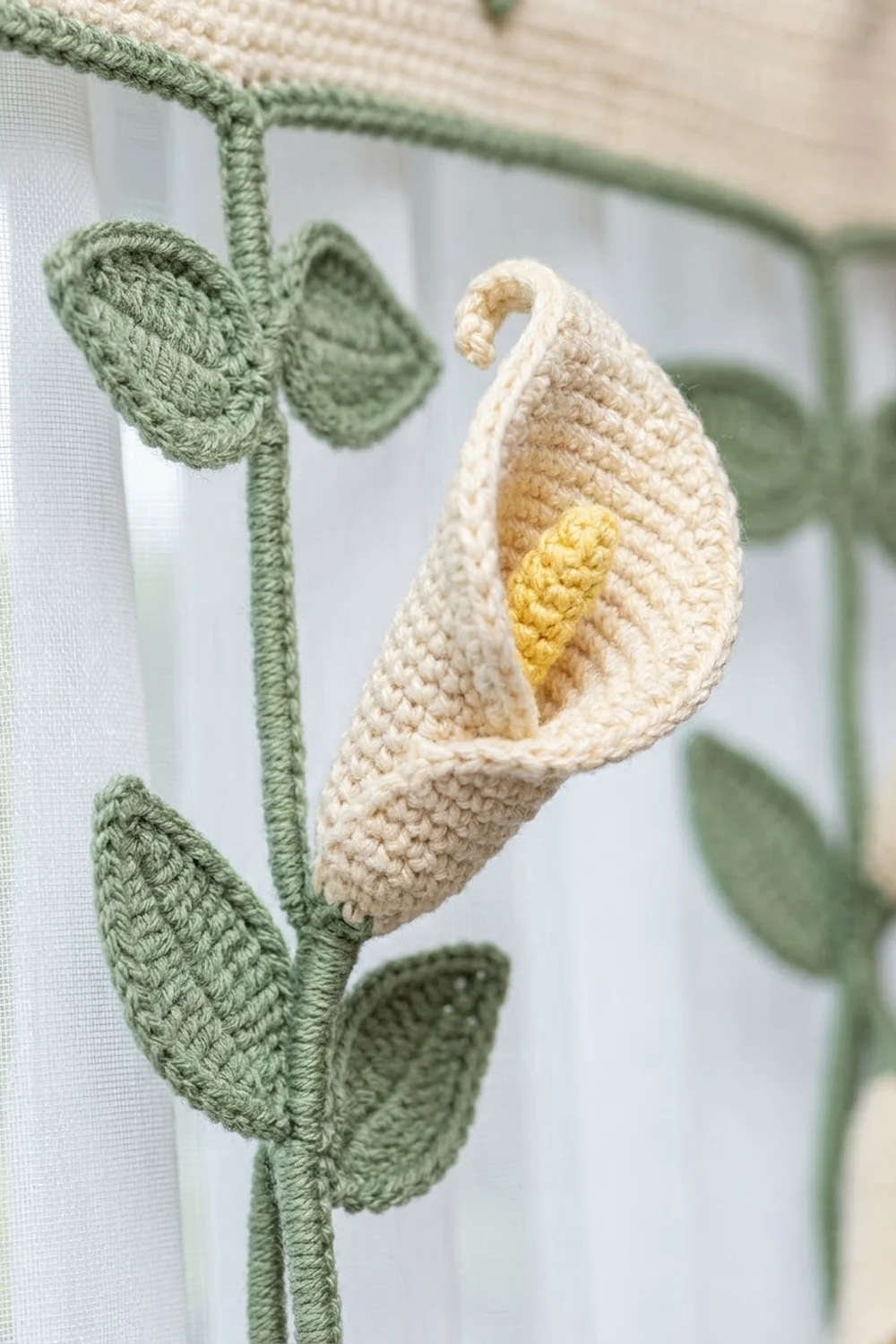
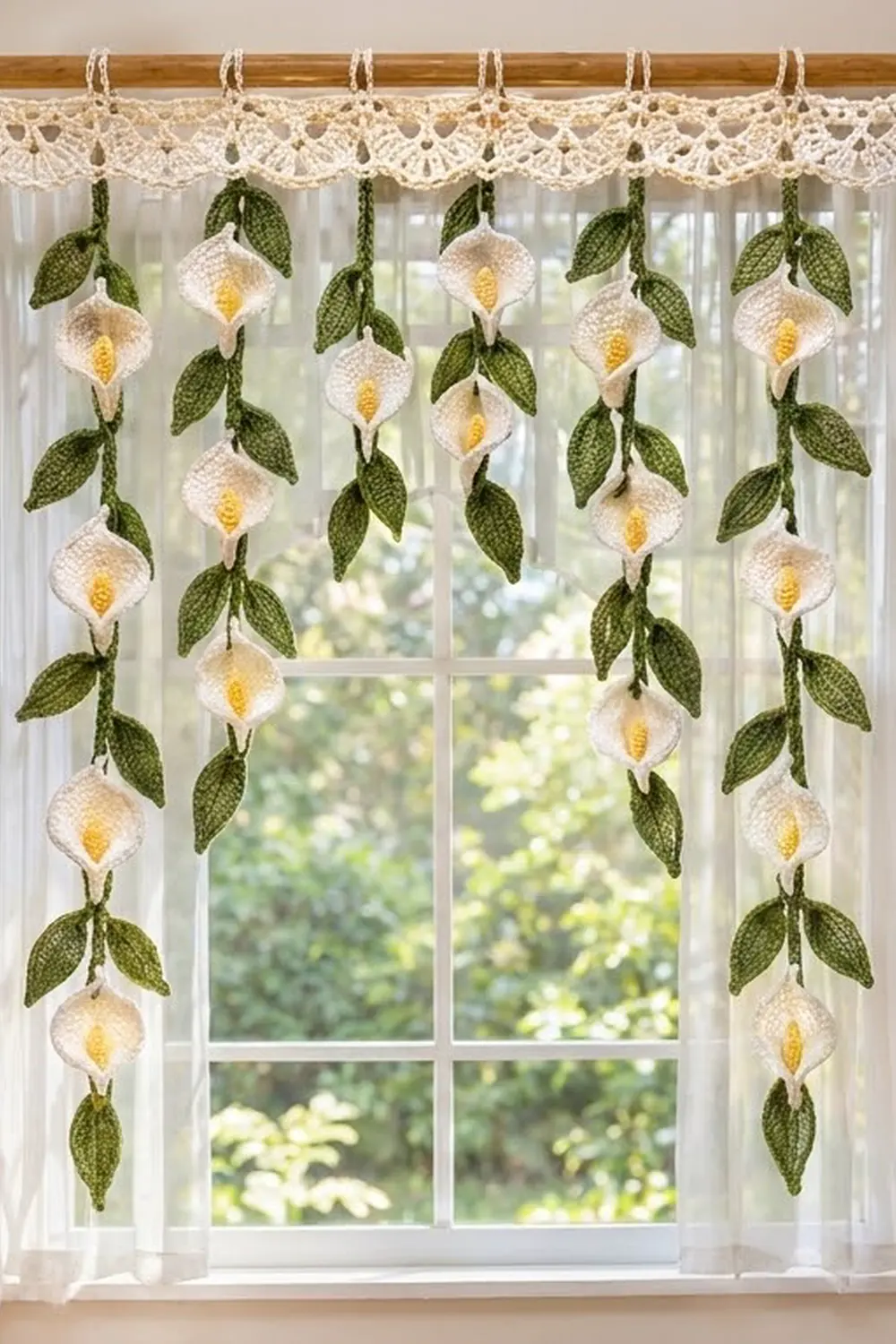
This valance brings a quiet garden into a window. A cream lace header hangs from the curtain rod on chain loops, and seven sage-green vines fall from its scalloped edge. Each vine carries pointed leaves and cream calla lilies with butter-yellow centers.
The palette is soft: cream, butter yellow and sage green. It looks best against a sheer curtain, where light comes through the lace and the lilies stand out as solid shapes.
The pattern uses US crochet terms. The finished header measures 36.2 in (91.9 cm) wide by 3.0 in (7.6 cm) deep. Long vines hang 24 in (61.0 cm) and short vines hang 20 in (50.8 cm), measured along the stem.
Construction is modular. You crochet one header in rows, then stems, leaves, lilies and spadices as separate small pieces. You assemble each vine, sew the vines to the back of the header, then work the scalloped border and rod loops last.
Finished Size and Construction
- Finished size: header 36.2 in x 3.0 in (91.9 cm x 7.6 cm); total drop to the stem end is 25.5 in (64.8 cm) for long vines and 21.5 in (54.6 cm) for short vines
- Skill level: intermediate (simple stitches, a lot of finishing)
- Terminology: US
- Yarn weight: DK (3), cotton
- Hook: 3.5 mm (E-4)
- Number of pieces: 143 (1 header, 7 stems, 32 lilies, 32 spadices, 71 leaves)
- Layout: 7 vines across the header, alternating Long-Short-Long-Short-Long-Short-Long
- Piece size: lily 2.75 in x 3.25 in (7.0 cm x 8.3 cm) flat; leaf about 2.75 in x 1.25 in (7.0 cm x 3.2 cm)
- Size before border: header body 36.2 in x 2.0 in (91.9 cm x 5.1 cm)
- Border depth: 1.0 in (2.5 cm) along the bottom edge, plus rod loops along the top
Materials
Pick a smooth, mercerized DK cotton. It gives crisp stitch definition, keeps the lilies firm and doesn’t fuzz in sunlight. Avoid acrylic blends that stretch, because the vines hang under their own weight.
- Cream (A): 250 g / 575 m (header, lilies)
- Butter yellow (B): 50 g / 115 m (spadices)
- Sage green (C): 150 g / 345 m (stems, leaves, lily bases)
Tools:
- 3.5 mm (E-4) crochet hook
- Tapestry needle
- 10-12 locking stitch markers
- Small amount of fiberfill or yarn scraps
- Tape measure, rust-proof pins and a blocking mat
- Spray starch (optional, for the header)
These quantities include a margin of about 20% for swatching and sewing tails.
Abbreviations (US Terms)
- ch chain
- sl st slip stitch
- sc single crochet
- hdc half double crochet
- dc double crochet
- tr treble crochet
- MR magic ring
- sk skip
- sp space
- st(s) stitch(es)
- RS / WS right side / wrong side
Special stitches:
- Shell: 5 dc in the same stitch.
- Picot: ch 3, sl st in the top of the sc just made.
Gauge and Checkpoints
Gauge in sc: 20 sts and 22 rows = 4 in (10.2 cm). Stem gauge: 5 sl sts = 1 in (2.5 cm) along the cord.
Make one lily first. It’s your best gauge test.
- After lily Rnd 5, the flat circle should measure 2.25 in (5.7 cm) across.
- The finished flat lily should measure 2.75 in x 3.25 in (7.0 cm x 8.3 cm).
- After header Row 1, the strip should measure 36.2 in (91.9 cm).
- After header Row 5, the depth should be 2.0 in (5.1 cm).
If your pieces are too big, go down 0.25 mm. If they’re too small, go up 0.25 mm. The lilies should feel firm. If you can see light through the single crochet, go down a hook size even if the measurements match.
Header Body
With A, ch 182.
Row 1 (RS): Sc in 2nd ch from hook and in each ch across. Turn. (181 sc)
Row 2: Ch 3 (counts as dc), dc in each st across. Turn. (181 dc)
Row 3 (mesh): Ch 4 (counts as dc + ch 1), sk next st, dc in next st, ch 1, sk next st, dc in next st across. Turn. (91 dc, 90 ch-1 sps = 181 sts)
Row 4: Ch 3 (counts as dc), dc in each ch-1 sp and each dc across, ending in 3rd ch of turning ch. Turn. (181 dc)
Row 5: Ch 1, sc in each st across. Fasten off. (181 sc)
Checkpoint: 36.2 in x 2.0 in (91.9 cm x 5.1 cm). Mark Row 5 sts 19, 43, 67, 91, 115, 139 and 163. These are the vine positions, spaced 24 sts (4.8 in / 12.2 cm) apart, with 18 sts (3.6 in / 9.1 cm) left at each end.
Lily Spathe (make 32)
With A, work in continuous rounds. Mark the first st of each round.
Rnd 1: 8 sc in MR. (8)
Rnd 2: 2 sc in each st. (16)
Rnd 3: Sc in next st, 2 sc in next st 8 times. (24)
Rnd 4: Sc in next 2 sts, 2 sc in next st 8 times. (32)
Rnd 5: Sc in next 3 sts, 2 sc in next st 8 times. (40)
Checkpoint: 2.25 in (5.7 cm) across.
Rnd 6 (shaping): Sc in next 12 sts, hdc in next 4 sts, dc in next 3 sts, (dc, tr, ch 2, tr, dc) in next st for the tip, dc in next 3 sts, hdc in next 4 sts, sc in next 13 sts. (40 sts worked 1 per existing st + 3 extra = 43 sts, plus 1 ch-2 tip sp)
The graded stitches turn the circle into a teardrop with a sharp point.
Rnd 7 (edge): Sc in each st around, working 3 sc in the ch-2 tip sp. Sl st to first sc. (43 sc worked 1 per st + 3 in tip sp = 46 sc)
Fasten off and leave a 12 in (30.5 cm) tail. Flat size: 2.75 in x 3.25 in (7.0 cm x 8.3 cm).
Spadix (make 32)
With B:
Rnd 1: 6 sc in MR. (6)
Rnds 2-9: Sc in each st around. (6)
Fasten off and leave an 8 in (20.3 cm) tail. Turn the tube inside out so the purl bumps face outward. This gives the corn-cob texture. Stuff lightly with a pinch of fiberfill. Length: 1.5 in (3.8 cm). Width: 0.4 in (1.0 cm).
Leaf (make 71)
With C, ch 13.
Rnd 1: Working into the 12 chains, sl st in 2nd ch from hook, sc in next ch, hdc in next 2 ch, dc in next 4 ch, hdc in next 2 ch, sc in next ch, (sc, ch 2, sc) in last ch for the tip. Rotate and work along the other side of the foundation: sc in next ch, hdc in next 2 ch, dc in next 4 ch, hdc in next 2 ch, sc in next ch, sl st in last ch. (11 + 2 + 11 = 24 sts, plus 1 ch-2 tip sp)
Rnd 2 (edge): Sl st in each st around, working (sl st, ch 2, sl st) in the tip sp. (24 sts worked 1 per st + 2 in tip = 26 sl sts)
Fasten off and leave a 6 in (15.2 cm) tail. The foundation chain makes the center vein.
Stem (make 4 long, 3 short)
With C:
- Long: Ch 121. Sl st in the back bump of the 2nd ch from hook and each ch across. (120 sl sts = 24 in / 61.0 cm)
- Short: Ch 101. Work as for the long stem. (100 sl sts = 20 in / 50.8 cm)
Fasten off. The end where you fasten off is the top of the stem. Starting from the top, place a marker every 10 sts. Each marker is 2 in (5.1 cm) from the last.
Make All Pieces
| Piece | Color | Long vine (x4) | Short vine (x3) | Total |
|---|---|---|---|---|
| Lily | A | 5 each = 20 | 4 each = 12 | 32 |
| Spadix | B | 5 each = 20 | 4 each = 12 | 32 |
| Leaf | C | 11 each = 44 | 9 each = 27 | 71 |
| Stem | C | 4 | 3 | 7 |
| Header | A | – | – | 1 |
Layout across the header (Row 5 stitch numbers):
Vine:   1    2    3    4    5    6    7
Type:   L    S    L    S    L    S    L
St:     19   43   67   91   115  139  163
Vine map, measured from the stem top (L = lily, P = leaf pair, T = tip leaf):
Long:   P2  L4  P6  L8  P10  L12  P14  L16  P18  L20  T24
Short:  P2  L4  P6  L8  P10  L12  P14  L16  T20
Joining
Finish the lilies: Insert a spadix into the center of the lily with its base 0.75 in (1.9 cm) above the bottom curve and sew it in place. With the tip pointing up, lap the lower left edge over the lower right by 0.75 in (1.9 cm). Let the overlap taper to nothing halfway up. Whipstitch the overlap through both layers. Wrap C around the narrow base 5 times and secure it. Roll the tip backward and steam it.
Assemble the vines: Leaf pairs sit at the 2, 6, 10, 14 and 18 in markers (5.1, 15.2, 25.4, 35.6 and 45.7 cm). Sew one leaf to each side of the stem through the base sl st and the first 2 sts, angled slightly downward. Lilies sit at 4, 8, 12, 16 and 20 in (10.2, 20.3, 30.5, 40.6 and 50.8 cm). Sew the green-wrapped base to the front of the stem with the lily mouth facing forward. Sew the tip leaf to the bottom end. Short vines stop at the 16 in (40.6 cm) lily, with the tip leaf at 20 in (50.8 cm).
Join to the header: Work stitch to stitch. Center each stem top on its marked Row 5 st and overlap the top 0.5 in (1.3 cm) on the WS across Rows 4-5. Whipstitch through the back loops only so the front loops stay free for the border.
Tension: Sew snugly but don’t pucker the work. The header must stay flat, and each stem must hang straight down from its stitch.
Checkpoint: the header stays 36.2 in (91.9 cm) wide, with the vines 4.8 in (12.2 cm) apart.
Border
The border is worked at the same 20 sts per 4 in gauge, so it keeps the 36.2 in (91.9 cm) header width.
Bottom B1 (shells): With RS facing, join A in the first st of Row 5. Ch 1, sc in first st, sk 2 sts, shell in next st, sk 2 sts, sc in next st 30 times. (30 shells + 31 sc = 181 sts)
Bottom B2 (picot trim): Ch 1, turn, sc in first sc, sc in next 2 dc, (sc, picot) in next dc, sc in next 2 dc, sc in next sc 30 times. (181 sc worked 1 per st + 30 picots) Fasten off.
Why the math works: Each repeat uses 6 sts, and 1 + (30 x 6) = 181. The valley sc land on sts 1, 7, 13 and so on (every 1 + 6n). Sts 19, 43, 67, 91, 115, 139 and 163 all fall on that sequence, so every vine hangs from a valley between two scallops. Border depth: 1.0 in (2.5 cm).
Top T1 (rod loops): With RS facing, join A in the first ch of the foundation. Ch 1, sc in each st across. At sts 1, 21, 41, 61, 81, 101, 121, 141, 161 and 181, after the sc, ch 16 and sl st in the same sc. (181 sc worked 1 per st + 10 loops) Each loop is 3.2 in (8.1 cm) of chain and fits a rod up to 1 in (2.5 cm) thick.
Both short ends are clean turning-chain edges, so they get no border. Final header: 36.2 in x 3.0 in (91.9 cm x 7.6 cm).
Final Blocking
- Lightly mist the header and pin it flat to 36.2 in x 3.0 in (91.9 cm x 7.6 cm).
- Pin each scallop into an even curve and open each picot.
- Spray starch lightly if you want a crisper lace.
- Steam the leaves flat, holding the iron above them without touching.
- Re-steam the lily tips so they curl back evenly.
- Hang the valance and let the vines straighten under their own weight for 24 hours.
Final Quality-Control Checklist
- Header is 181 sts wide and 36.2 in (91.9 cm) across.
- 30 shells and 30 picots, evenly spaced.
- 10 rod loops, the same length.
- Vines hang from sts 19, 43, 67, 91, 115, 139 and 163.
- Long stems are 24 in (61.0 cm); short stems are 20 in (50.8 cm).
- All 32 lilies face forward with the tips curled back.
- Every spadix is centered and secure.
- All tails are woven in and trimmed.
Troubleshooting
- Lily won’t hold a cone: Your stitches are too loose. Go down a hook size, or add a few stitches to the seam.
- Tip is blunt: Check that Rnd 6 has the tr pair and the ch-2 sp in a single stitch.
- Stems curl or twist: Steam them straight while weighted, and work the sl sts a little looser.
- Header ripples: You added stitches. Recount to 181 on every row.
- Header pulls in under the vines: The joining stitches are too tight. Resew them more gently.
- Leaves cup: Steam and pin each one flat.
Care
Hand wash in cool water with mild soap, roll in a towel and dry flat. Reshape the lilies while damp and re-steam the tips.
Final Notes
Here is the measurement chain. A gauge of 20 sts = 4 in gives a 181-st header that is 36.2 in (91.9 cm) wide and 2.0 in (5.1 cm) deep before the border. The 30 shell repeats add 1.0 in (2.5 cm), for a finished depth of 3.0 in (7.6 cm). Seven vines hang 4.8 in (12.2 cm) apart from the valley stitches. Long stems run 24 in (61.0 cm) and short stems 20 in (50.8 cm), with a lily every 4 in (10.2 cm). If you check gauge on that first lily, every later piece will fit.
Happy crocheting!